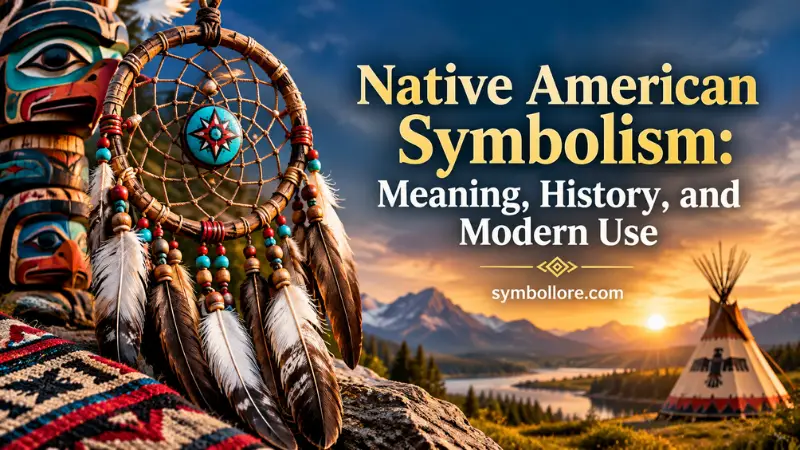
Native American symbolism includes the images, colors, animals, materials, patterns, stories, and ceremonial forms used by Indigenous nations across North America. These symbols may express identity, family relationships, history, spiritual teachings, political authority, or connections with particular homelands.
However, there is no single Native American symbol system. Cherokee, Diné, Lakota, Ojibwe, Choctaw, Pueblo, Haida, Tlingit, and hundreds of other peoples maintain distinct languages and traditions. Even similar images can carry different meanings in neighboring communities. Therefore, accurate interpretation begins by identifying the nation, artist, period, location, and purpose behind a symbol.
Quick Answer
Native American symbolism does not have one universal set of meanings. Each Indigenous nation develops symbols through its own language, homeland, history, artistic traditions, clans, ceremonies, and community teachings. Animals, colors, geometric forms, plants, and natural forces may hold important meanings, but their interpretation must remain specific to the people and context involved.
TL;DR
- There is no single symbolic language shared by all Native nations.
- Meanings come from specific communities, places, stories, and uses.
- Animals do not represent the same quality in every tribal tradition.
- Official seals, pottery, textiles, carvings, and regalia communicate different forms of identity.
- Some ceremonial symbols and teachings are not intended for public interpretation.
- Respectful use requires accurate attribution and support for Native voices and artists.
Native American Symbols at a Glance
| Symbol or Form | Documented Context | Possible Meaning | Important Limit |
|---|---|---|---|
| Cherokee seven-pointed star | Seal of the Cherokee Nation | Cherokee clans and national identity | Not a universal seven-directions symbol |
| Choctaw bow and arrows | Great Seal of the Choctaw Nation | Peace, defense, leadership, and history | Meaning belongs to the Choctaw national context |
| Ojibwe dream catcher | Protective woven hoop | Protection, care, and Spider Woman teachings | Commercial versions may alter its form and meaning |
| Lakota star quilt | Gifts, honors, and community events | Honor, care, kinship, and life milestones | Designs and uses vary among makers and communities |
| Northwest Coast crest figures | Houses, carvings, regalia, and family property | Lineage, history, rights, and relationships | A figure is not a simple animal personality chart |
| Animal imagery | Stories, clans, art, ceremony, and personal experience | Depends on species, nation, story, and setting | No animal has one meaning across all tribes |
What Is Native American Symbolism?
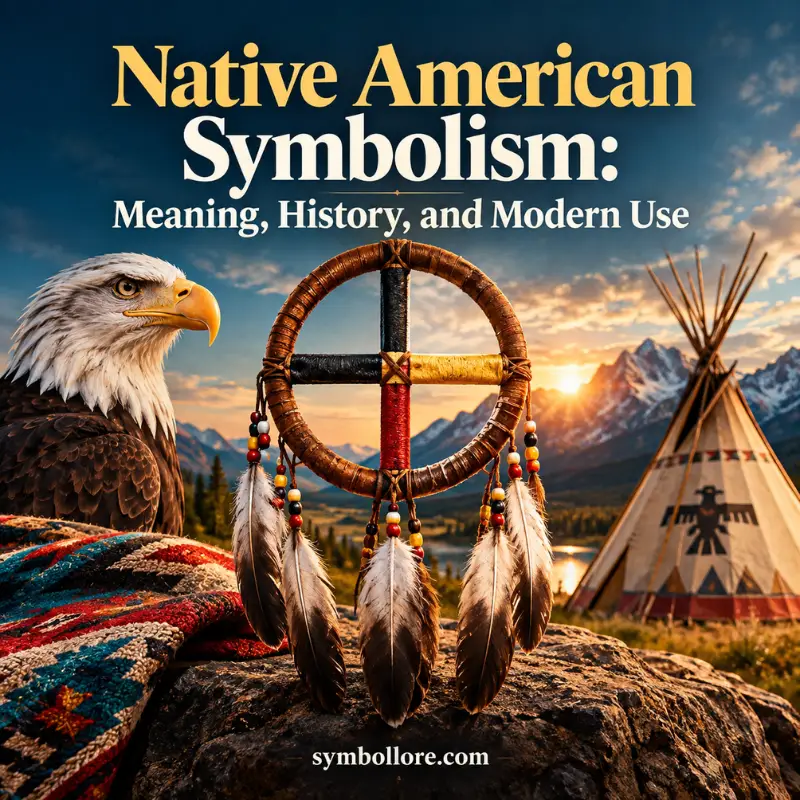
Native American symbolism is a broad modern label for many separate Indigenous systems of meaning. It can include visual marks, but symbolism is not limited to written-looking signs. A story, dance, song, landscape, animal, garment, or material may also communicate identity and knowledge.
Some symbols identify a nation, clan, family, society, or government. Others record events, teach moral responsibilities, or express relationships with the natural world. Certain forms belong to ceremonies and carry meanings that community members may not share publicly.
A symbol can also serve practical and meaningful purposes at the same time. A basket holds food, yet its materials and design may connect the maker with a place, family tradition, and generations of knowledge. A blanket provides warmth while also marking honor, kinship, or an important life event.
Therefore, the word “symbol” should not reduce a living cultural object to decoration. Meaning often comes from how people create, exchange, use, and care for it.
Why There Is No Universal Symbol Dictionary
The phrase “Native American” includes hundreds of distinct political nations and cultural communities. These peoples speak different languages, live in different homelands, and maintain different histories.
The Smithsonian’s National Museum of the American Indian states clearly that there is
no single American Indian culture or language.
Its educational framework also explains that Native cultures remain dynamic. They have adapted, survived, and continued into the present rather than belonging only to the past.
Because of this diversity, a chart claiming that “the wolf always means loyalty” or “four always means balance” cannot describe every tradition. One nation may connect an animal with a clan. Another may know it through a specific story. Elsewhere, the same animal may have little ceremonial importance.
Meaning can also change within a community. An old design may enter a modern flag, public mural, military emblem, or work of contemporary art. The form remains connected with history, but the new setting adds another layer.
The safest question is not “What does this mean to Native Americans?” Instead, ask, “Which nation or artist created it, and what does it mean in that context?”
Where Indigenous Symbols Appear
Indigenous symbolism appears across many forms of life and creative expression. People may encounter it in:
- Pottery and basketry
- Beadwork and quillwork
- Woven blankets and rugs
- Clothing and dance regalia
- Jewelry and metalwork
- Carved poles, masks, and house posts
- Rock art and painted hides
- National seals and flags
- Songs, dances, and oral histories
- Contemporary painting, film, photography, and digital art
Each form has its own rules. A pattern placed on everyday pottery may differ from an image used on ceremonial clothing. Likewise, a government seal communicates public national identity, while a family crest may concern inherited history and rights.
Materials can also carry meaning. Cedar, clay, shell, turquoise, porcupine quills, wool, feathers, and hide connect art with local environments and specialized knowledge. However, a material does not have one meaning everywhere.
The act of making often matters as much as the finished image. Gathering materials, preparing them, learning from relatives, and giving the completed object can all form part of its cultural significance.
Animal Symbolism and Its Cultural Limits
Animal figures are among the most recognized parts of Indigenous art. However, popular websites often turn them into a simple personality system. That approach removes the animal from its community and story.
An animal may serve as a clan name, ancestor, teacher, food source, helper, rival, or figure in an oral history. It may also appear because it lives in the nation’s homeland. These roles cannot be reduced to one quality.
For example, a bear might communicate strength in one modern artwork. In another setting, it may identify a clan or recall a named story.
General brown bear symbolism
can help readers compare modern meanings, but it cannot replace information from the nation represented.
The wolf creates a similar problem. Modern American culture often treats wolves as symbols of loyalty, freedom, or leadership.
does not provide a universal Indigenous definition.
Even ordinary behavior can shape meaning differently. A community that depends on salmon may understand bears through fishing and shared habitat. Another community may focus on healing knowledge, kinship, hunting, or a local oral tradition.
Birds, Eagles, and Feathers
Birds can connect sky, land, water, movement, seasons, and observation. Still, their meanings remain specific to the bird and cultural tradition.
Eagles hold great importance for many Native peoples, but not for identical reasons. Eagle feathers may appear in honors, prayers, leadership traditions, dances, or ceremonies. Their use follows community protocols and, in the United States, federal wildlife laws.
Other birds also carry distinct associations. Ravens appear in many Northwest Coast stories and artworks, while cranes, herons, owls, hawks, and water birds hold different places across the continent.
may include vision and speed, yet a tribal story can give the bird a far more specific role.
Feathers should not be treated as generic “Native” decorations. The species, number, placement, wearer, and occasion may all matter. Some feather arrangements represent earned honors or responsibilities rather than personal fashion.
Therefore, using a feather image respectfully requires more than assigning it words such as freedom or spirituality. The cultural source and intended function must guide the interpretation.
Land, Water, Plants, and the Sky
Many Indigenous symbols grow from long relationships with particular homelands. Mountains, rivers, plants, weather, and animals can form part of a nation’s history and identity.
This relationship does not mean all Native peoples follow one romantic “nature religion.” Indigenous knowledge systems differ, and they include practical observation, governance, agriculture, hunting, law, spiritual life, and community responsibility.
Corn holds central importance for many agricultural nations, especially in the Southwest, Southeast, and parts of the Eastern Woodlands. It can connect with sustenance, community, ceremony, and continuity. However, Arctic and Northwest Coast peoples developed their lives around different foods and environments.
Water symbols may refer to rain, rivers, migration, fertility, travel, or specific sacred places. Likewise, a mountain can mark an origin story, a boundary, or a living homeland rather than a general symbol of ambition.
The Haida Heritage Centre explains that Haida language, art, and stories express relationships with the land and sea. Its description of
shows why a symbol cannot be separated from the place and people who sustain it.
Colors, Directions, and Numbers
Colors can identify directions, natural forces, sacred beings, seasons, ceremonial roles, or stages of life. Yet popular charts often combine teachings from different nations and label the result “Native American color symbolism.”
That method creates false certainty. Black may represent night, soil, a direction, a sacred mountain, power, danger, or another idea depending on the tradition. White may connect with snow, shell, peace, age, mourning, or a specific ceremonial role.
The four directions also do not have one standard color system. Communities may assign different colors, begin in different directions, or understand the directional pattern through separate teachings. Some groups use more than four directions by including above, below, or center.
Numbers work in a similar way. Four may carry importance because of directions, seasons, winds, stages, or community structures. Seven may matter in another nation for entirely different reasons.
Without a named source, a neat chart should not be treated as traditional knowledge. Accurate articles must identify the nation and explain where the recorded interpretation came from.
Circles, Crosses, Spirals, and Geometric Forms
Geometric forms appear in pottery, baskets, beadwork, architecture, rock art, textiles, and maps. A circle may suggest movement, gathering, continuity, a celestial body, or the structure of an object. However, “circle of life” is not an automatic explanation for every round Indigenous design.
Crosses existed in the Americas before European Christian missions. Some cross-shaped forms may represent directions or intersecting paths. Others entered Native art through Christianity, trade, or cultural exchange. Their meaning depends on the date and setting.
Spirals, stepped shapes, triangles, diamonds, and repeated lines may refer to water, movement, landscape features, plants, animals, or design rhythm. Sometimes a pattern serves mainly as a recognized artistic style. Not every shape acts as a coded word.
The same caution applies to medicine wheels. Stone structures and circular teaching diagrams belong to particular Plains and Indigenous contexts. Modern commercial charts often combine colors, animals, seasons, personality types, and non-Native ideas without explaining their source.
A visual resemblance alone cannot prove identical meaning. Researchers need the maker’s explanation, community knowledge, archaeological setting, or reliable historical documentation.
Dream Catcher Symbolism and Ojibwe Origins
Dream catchers began in Ojibwe culture rather than as a universal Native American object. Traditional forms use a hoop and woven web connected with protection and Spider Woman teachings.
The Sherman Indian Museum explains that Ojibwe people created dream catchers and that neighboring nations later adopted them through trade, marriage, and cultural exchange. During the pan-Indian movement, they became broader signs of Indigenous unity. Its history of
also notes concerns about commercialization and misuse.
This history shows how symbolism changes. An object can begin within one nation, travel among Native communities, and eventually become a widely marketed decoration. Each stage adds meaning, but the later popularity does not erase the Ojibwe origin.
Many mass-produced versions use plastic, synthetic feathers, unrelated beads, or patterns chosen only for appearance. They may carry personal meaning for buyers, but they should not be sold as authentic sacred objects without a documented Native maker and community connection.
National Seals as Nation-Specific Symbols
Official tribal seals offer strong examples of why symbols need precise attribution. Their meanings often connect with sovereignty, leadership, law, historical events, and national identity.
The Cherokee Nation seal contains a seven-pointed star surrounded by oak leaves. The seven points refer to the seven Cherokee clans and Cherokee characters meaning “Cherokee Nation.” The oak leaves recall the sacred fire once kept burning with oak wood.
The documented Cherokee seal symbolism
belongs specifically to Cherokee political and cultural history.
The Great Seal of the Choctaw Nation uses an unstrung bow, three arrows, and a pipe-hatchet. The arrows refer to three historic Choctaw leaders and districts, while the bow and pipe-hatchet communicate peace, council, and readiness to defend the nation.
The Choctaw seal’s recorded meaning
comes from Choctaw history, not a universal arrow-symbol chart.
These examples also challenge the idea that Indigenous symbols belong only to ancient religion. Tribal nations use symbols in government, law, education, public communication, and modern civic life.
Northwest Coast Crests and Carved Poles
Carved poles are strongly associated with Northwest Coast peoples, including Tlingit, Haida, Tsimshian, Kwakwaka’wakw, and other nations. However, not all Native peoples traditionally carved them.
The common term “totem pole” covers several forms. A pole may honor a person, display family crests, record history, welcome visitors, support a house, or serve another community purpose. It should not automatically be described as an object of worship.
Animal and supernatural figures on a pole may refer to lineage, inherited privileges, named stories, or important relationships. Their order and placement matter. A raven on a Haida work cannot be interpreted by copying a general paragraph about raven intelligence.
Crests may also involve ownership. A family or clan can hold the right to display certain figures and stories. Copying such a design without permission can ignore those rights.
Museum labels and Native cultural centers provide useful starting points. Still, artists and communities remain the strongest sources for understanding how a specific carving functions.
Contemporary Native Art and Changing Meanings
Native symbolism continues to grow through painting, fashion, music, film, photography, public murals, performance, and digital design. Contemporary Native artists may preserve traditional forms, challenge stereotypes, address political issues, or combine old and new materials.
A symbol can therefore refer to both history and present-day life. An artist might place a clan image beside city streets, boarding-school records, military objects, or environmental data. The older symbol gains another layer without losing its cultural roots.
First Peoples Fund reports that Native creative expression can support cultural preservation, social responsibility, spiritual practice, and community healing. Its research on
how institutions measure Native arts
also warns that Western definitions of art may overlook important community practices.
Viewers should not expect every Native artwork to explain tradition to outsiders. Some artists create humor, abstraction, science fiction, personal memory, or social criticism. Indigenous art is as varied and current as the people who make it.
Sacred, Private, and Restricted Meanings
Not every symbol is open for public explanation. Some designs, songs, names, dances, bundles, and ceremonial objects belong to particular societies, families, religious leaders, or initiated members.
A lack of published information does not mean the meaning has been forgotten. The community may choose to protect it. Researchers should not pressure people to reveal knowledge or treat restricted teachings as missing data.
Museums sometimes display objects that communities consider sensitive. Many institutions now consult with tribal nations about access, care, description, and repatriation. These discussions recognize that an object can hold living responsibilities beyond its appearance.
Online symbol guides often ignore these limits. They may copy ceremonial images and give them invented meanings. Readers should treat such pages carefully, especially when they provide no nation, artist, date, or source.
Respect sometimes means accepting that outsiders are not entitled to every explanation.
Cultural Appropriation, Stereotypes, and Commercial Use
Cultural appreciation begins with accurate learning and respect. Appropriation occurs when people take designs, identities, ceremonial objects, or community knowledge while ignoring their source, ownership, or restrictions.
Common problems include wearing imitation war bonnets, copying sacred face paint, selling false “tribal” jewelry, or combining unrelated designs into a fantasy Native style. Sports mascots and costumes can also turn living peoples into historical characters or racial stereotypes.
Not every use of Indigenous-inspired art is equally harmful. Context matters. Buying a work from a Native artist, visiting a tribal museum, or studying a public design with reliable sources supports a different relationship than copying it for profit.
Before using a design, ask:
- Is the nation and artist clearly identified?
- Is the symbol public, personal, inherited, or ceremonial?
- Has the community explained appropriate use?
- Am I copying a sacred form or earning money from it?
- Can I purchase or commission work from a Native creator instead?
- Does my description treat Native people as living communities?
Respectful engagement gives credit, avoids imitation, and allows Native people to define their own symbols.
How to Interpret Native American Symbols Responsibly
First, identify the nation or community. A broad label such as “tribal” or “Indian symbol” does not provide enough information.
Next, examine the object’s purpose. A seal, basket, tattoo, blanket, carving, and ceremonial item follow different rules. Note its maker, date, material, location, and use.
Then consult community-created sources. Tribal government websites, cultural centers, Native museums, artist statements, and language programs usually offer better context than anonymous symbol dictionaries.
Compare evidence without forcing agreement. Two members of the same nation may describe a symbol differently because of family background, region, or personal experience. Tradition can include variation.
Finally, state limits honestly. Use wording such as “in this Cherokee national seal” or “within this Ojibwe teaching.” Avoid phrases like “all Native Americans believe.” Accurate language preserves the meaning that generalization removes.
Common Misconceptions
One major misconception says every Indigenous symbol has a short English definition. In reality, meaning may come from a long story, ceremony, family right, or relationship that cannot fit into one word.
Another claim treats the medicine wheel as a universal Native zodiac. Different circular traditions exist, but many commercial charts combine unrelated teachings and modern inventions.
Animal personality lists create a similar problem. Bears, wolves, eagles, turtles, and ravens do not hold identical meanings across the continent.
People also call every Northwest Coast carved pole a religious idol. Many poles record family history, crests, rights, honors, memorials, or community stories.
Finally, Native symbolism is not frozen in the distant past. Tribal governments, artists, veterans, activists, designers, and young people continue to create and reshape meaningful symbols today.
FAQs
There is no single most important Native American symbol. Importance depends on the nation, family, ceremony, and purpose. A Cherokee national star, an Ojibwe dream catcher, and a Haida crest each belong to different historical and cultural systems.
Animals can represent clans, relatives, teachers, food sources, spiritual beings, or characters in specific stories. Their meanings vary greatly among nations. Therefore, an animal should not receive a universal Native definition without a named cultural source.
A circle may represent continuity, gathering, movement, celestial bodies, directions, or the shape of a ceremonial or practical object. However, no single meaning applies to every round design. The nation, object, and teaching determine the correct interpretation.
No. The dream catcher originated with the Ojibwe and later spread to neighboring peoples and the wider pan-Indian movement. Although many communities now use it, its popularity should not erase its specific Ojibwe roots.
No universal color chart applies to all Native nations. Colors may relate to directions, materials, sacred places, ceremonies, or national identity. Their order and meaning can change from one community to another.
The answer depends on the symbol and context. Public artwork purchased from a Native artist differs from copied ceremonial regalia or an inherited clan design. When uncertain, identify the nation, research community guidance, and avoid sacred or restricted forms.
Start with the tribal nation, Native artist, or cultural institution connected with the object. Look for an official explanation, maker’s statement, museum record, or community teaching. Avoid sources that provide universal meanings without attribution.
Conclusion
Native American symbolism reflects hundreds of living nations rather than one shared dictionary. Symbols gain meaning through language, homeland, history, family, art, government, ceremony, and community use. Animals, colors, circles, feathers, and natural forces may look similar across traditions, yet their meanings can differ greatly. The best interpretation identifies the nation and listens to the people connected with the symbol. It also respects restricted knowledge and avoids turning sacred or inherited forms into decoration. Careful attribution does more than prevent mistakes—it preserves the cultural relationships that give Indigenous symbols their depth and value.
Five Related Articles from symbollore.com
- Deer Antler Symbolism: Renewal, Strength, and Meaning — https://symbollore.com/deer-antler-symbolism/
- Brown Bear Symbolism: Strength, Protection, and Renewal — https://symbollore.com/brown-bear-symbolism/
- Falcon Symbolism: Vision, Power, and Cultural Meaning — https://symbollore.com/falcon-symbolism/
- Blue Heron Symbolism: Powerful Meanings Explained — https://symbollore.com/blue-heron-symbolism/
- Mountain Goat Symbolism: Meaning, History, and Culture — https://symbollore.com/mountain-goat-symbolism/


