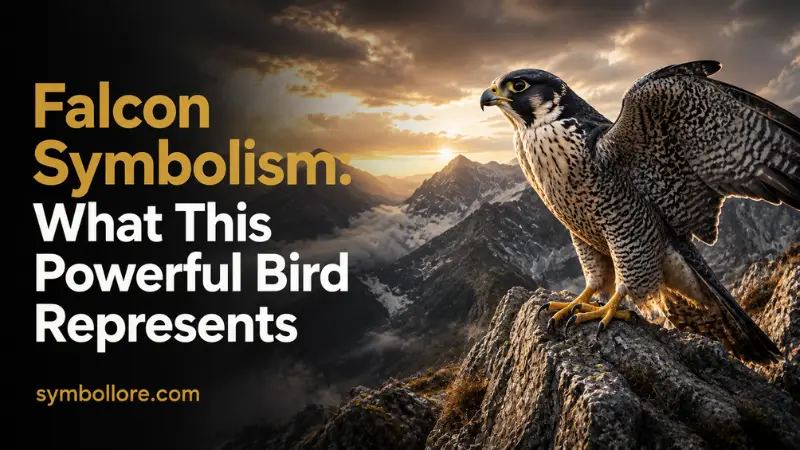
Falcon symbolism most often centers on vision, focus, speed, freedom, authority, and decisive action. These associations grew from the falcon’s ability to survey a wide area, pursue prey with precision, and move rapidly through open skies.
However, the bird does not have one universal meaning. Ancient Egyptian art connected it with divine kingship, while falconry helped make it an emblem of discipline and social rank. Modern spiritual readings often treat a sighting as encouragement to gain perspective, but that interpretation remains personal rather than predictive.
Quick Answer
Falcon symbolism represents clear vision, disciplined focus, freedom, speed, protection, and power. Its exact meaning depends on context: Egyptian imagery links the bird with Horus and kingship, falconry adds nobility and trained skill, and modern personal interpretations emphasize perspective and timely action. A falcon sighting is not proof of a supernatural message.
Key Takeaways
- Falcons commonly represent vision, precision, freedom, authority, and swift action.
- Egyptian falcon imagery is closely tied to Horus and legitimate rule.
- Indigenous meanings must be identified by culture, place, and historical period.
- Falconry added associations with discipline, partnership, skill, and social rank.
- Dreams and encounters offer personal reflection, not reliable predictions.
- Falcon imagery can also warn against aggression or excessive ambition.
Falcon Meanings at a Glance
| Context | Common Meaning | Why the Association Developed | Important Distinction |
|---|---|---|---|
| Natural behavior | Vision and precision | Falcons locate and pursue prey efficiently | This is an observation-based metaphor |
| Ancient Egypt | Kingship and divine protection | Horus appeared as a falcon or falcon-headed god | Meanings varied by period and deity |
| Mississippian imagery | Sky power and warrior status | Raptor features appeared in ceremonial art | It does not represent every Native nation |
| Falconry | Discipline, rank, and partnership | Hunting required training and cooperation | The practice also had practical purposes |
| Modern spirituality | Perspective and decisive action | High flight suggests a wider view | Interpretations are personal, not proven omens |
| Dreams | Ambition, scrutiny, or readiness | The dreamer assigns meaning through emotion | No fixed dream dictionary is universal |
| Tattoos and logos | Speed, independence, and strength | A striking silhouette communicates motion | Pose and design alter the message |
Why Falcons Symbolize Vision, Focus, and Speed
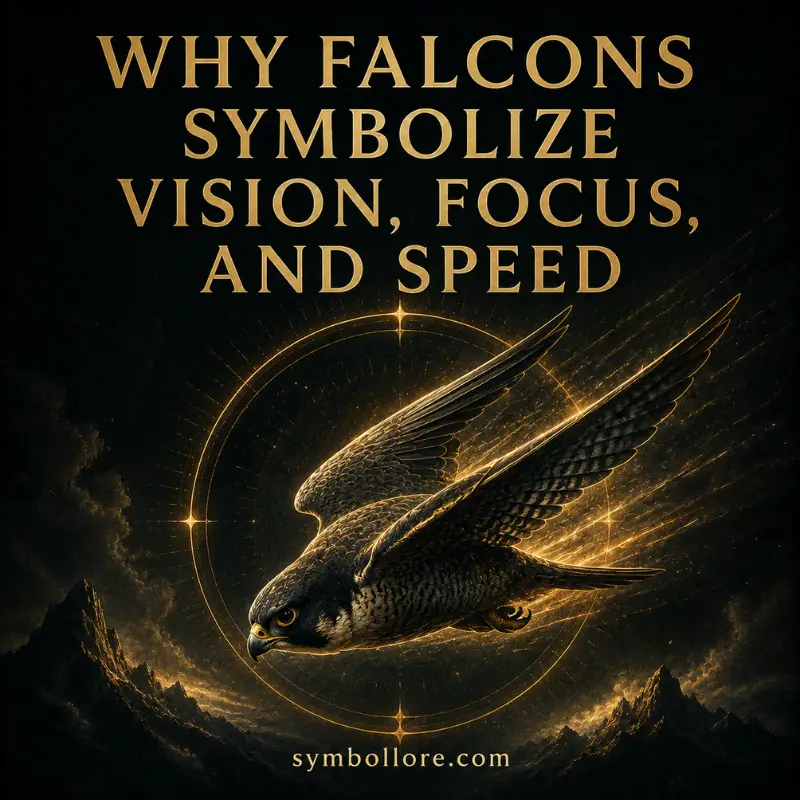
The strongest falcon meanings come from observable behavior. Falcons are birds of prey with tapered wings, fast flight, and highly controlled hunting movements. People watching them naturally connected these traits with alertness, strategy, and decisive action.
The peregrine falcon makes that connection especially powerful. Its steep hunting dive, called a stoop, has made it an enduring symbol of speed and commitment. Yet speed alone does not define the bird. A hunt also requires observation, positioning, timing, and adjustment.
For that reason, a useful interpretation is not simply “move faster.” Falcon imagery can suggest seeing the whole situation first and acting only when the moment is right. Vision without action becomes hesitation, while speed without awareness becomes recklessness. The bird symbolically joins perspective with execution.
Falcon Symbolism in Ancient Egypt
Ancient Egyptian falcon imagery represented the sky, royal authority, protection, and legitimate rule. Horus could appear as a full falcon or as a human figure with a falcon’s head. Egyptian rulers closely associated themselves with this deity.
A statue in The Metropolitan Museum of Art’s collection
shows Horus as a falcon protecting King Nectanebo II. The museum explains that Horus was both a sky god and a god of kingship. This context matters because the bird did not merely stand for generic courage; it helped express a ruler’s sacred authority.
The Eye of Horus developed related meanings. According to
The Met’s account of ancient Egyptian amulets,
the restored eye combined human and falcon features and represented healing and regeneration. Although Horus was sometimes joined with solar deities, it is safer to examine each artifact and period than to treat Horus, Ra, and every falcon figure as identical.
Falcons in Indigenous North American Traditions
There is no single “Native American falcon meaning.” Indigenous nations have distinct languages, ceremonies, histories, and relationships with birds. A culturally responsible explanation must identify the community or archaeological tradition connected with a particular image.
One documented example comes from Mississippian ceremonial art in the southeastern and midwestern United States.
depicts a winged human figure whose forked-eye pattern and wings represent a peregrine falcon. The Smithsonian describes the bird as connected with the sky world of spirits and ancestors.
Such imagery may also relate to warfare, high status, celestial power, or ceremonial identity. However, those meanings belong to particular historical settings. They should not be projected onto all Indigenous peoples or used to support claims about a universal “falcon clan personality.” When discussing a living tradition, community-based sources deserve priority over generalized symbolism websites.
Falconry, Nobility, and Cultural Heritage
Falconry strengthened the bird’s association with discipline, prestige, patience, and partnership. A trained falcon is powerful, but successful falconry depends on care, knowledge, trust, and close attention to the animal’s behavior. That relationship produced a richer symbol than domination alone.
In medieval Europe, access to certain hunting birds became associated with social rank. In other regions, falconry developed as a practical way to obtain food and as a tradition passed through families. Therefore, its meaning cannot be reduced to European nobility.
as the traditional practice of training and flying falcons and other raptors. Its multinational heritage listing emphasizes transmission, community, nature, and cultural continuity. In a modern symbolic reading, falconry can represent skilled freedom: the bird retains its abilities, while human and animal work through a carefully maintained relationship.
Spiritual Meaning of Seeing a Falcon
Seeing a falcon can inspire a person to pause, widen their perspective, and act with greater focus. That is a modern spiritual interpretation, not a guaranteed message about the future. Falcons also appear because they are hunting, migrating, defending territory, or using favorable air currents.
A grounded interpretation starts with three questions:
- What was the bird doing? Circling may suggest observation, while a dive emphasizes commitment or urgency.
- What were you thinking about? The sighting may feel meaningful because it intersects with an existing concern.
- What practical response helps? A useful meaning should lead to reflection or responsible action, not fear.
A close encounter may represent freedom, protection, ambition, or a need for clearer priorities. Still, context matters more than a fixed dictionary. If the bird repeatedly visits a building, ordinary explanations such as nearby prey or a nesting site should come first.
Falcon Dream Meaning
A falcon dream often reflects ambition, concentration, independence, scrutiny, or readiness to act. The dream’s emotional tone offers more useful information than the bird alone.
A falcon flying calmly may represent confidence or a wider perspective. A diving bird could suggest decisive movement, although fear during the dream may turn that same scene into a warning about pressure or aggression. A caged falcon can express restricted independence or unused ability. An injured bird may reflect shaken confidence, exhaustion, or a goal that needs a new approach.
Dream interpretation is subjective. No falcon dream reliably predicts victory, danger, wealth, or death. Instead, consider the setting, the bird’s condition, your role in the scene, and the feeling that remained after waking. These details create a more personal and honest interpretation.
Falcon Tattoo Symbolism and Design
A falcon tattoo commonly represents focus, independence, courage, power, and the determination to pursue a goal. However, the pose changes the message.
A soaring design emphasizes freedom, perspective, and transcendence. A diving falcon suggests speed, precision, and full commitment. A perched bird appears watchful and controlled, while an image with open talons can communicate aggression or readiness to defend.
Egyptian-inspired artwork may evoke Horus, royal authority, healing, or protection. Such a design should use researched visual references rather than mixing unrelated Egyptian symbols for decoration. Likewise, Indigenous-inspired patterns require care because ceremonial designs may carry community-specific meaning.
Before choosing a tattoo, define the quality you want the bird to represent. This step creates a clearer design and reduces the risk of using sacred or historical imagery inaccurately.
Biblical and Christian Associations
The Bible does not establish one clear symbolic doctrine for falcons. Some English translations use “falcon,” “hawk,” or broader terms for raptors in passages involving birds and dietary laws. Translation choices vary because ancient bird names do not always match modern species categories neatly.
Later Christian art and moral writing sometimes treated a wild hunting bird as an uncontrolled soul, while a trained one could represent discipline or conversion. Other modern readers connect its high flight with spiritual perspective. These are later interpretations rather than a direct biblical definition.
Therefore, claims that a falcon always means divine protection, prophecy, or a specific warning should be treated cautiously. A Christian may use the bird as a personal metaphor for watchfulness or purpose, but that application should not be presented as an explicit scriptural promise.
Modern American Meaning
In the United States, falcons often symbolize speed, competitiveness, strength, and high performance. Sports teams, military imagery, vehicle names, and corporate logos use the bird because its shape communicates motion and command quickly.
The bird also carries a major conservation meaning. Peregrine populations suffered severe declines during the twentieth century, largely because DDT interfered with reproduction. Following pesticide restrictions, captive breeding, and nest protection, the species made a striking recovery in the United States. It was removed from the federal endangered species list in 1999.
Urban peregrines now nest on bridges, towers, and tall buildings that resemble natural cliffs. Consequently, the bird can represent adaptation and recovery as well as wilderness. This modern story gives falcon symbolism a grounded American layer: power is not only the ability to strike, but also the capacity to survive environmental damage and return.
The Falcon’s Shadow Meanings
Falcon imagery is not always positive. The same qualities that suggest confidence and achievement can become domination, impatience, tunnel vision, or aggression when taken too far.
A hunter’s concentration can symbolize healthy purpose, but it can also warn against treating people as obstacles. Height can represent perspective or superiority. Fast action may show courage, yet it can become impulsiveness when evidence is incomplete.
This shadow reading makes the symbol more useful. If a falcon represents ambition to you, ask whether that ambition includes patience and ethical judgment. If it represents freedom, consider whether your independence respects important commitments. The strongest interpretation balances power with restraint and clear sight with humility.
FAQs
Seeing a falcon is commonly interpreted as a positive sign of clarity, confidence, or timely action. However, the sighting does not objectively predict good fortune. Its value comes from the reflection it inspires and the practical choices you make afterward.
Spiritually, a falcon often represents higher perspective, focused intention, freedom, and the ability to act decisively. These are modern interpretive associations rather than universal religious facts. Different faiths and cultures may assign the bird different meanings or none at all.
Both birds can represent vision, hunting skill, and power. Falcon imagery more often emphasizes speed, precision, and open-sky movement, while hawk imagery commonly stresses observation and guardianship. Popular symbolism frequently overlaps because historical sources did not always classify raptors using modern scientific categories.
A falcon can represent protection, especially in imagery connected with Horus or a watchful bird guarding its territory. Still, protection is only one contextual meaning. The bird may also signify royal authority, warfare, discipline, or strategic awareness.
A peregrine commonly represents exceptional speed, commitment, adaptability, and recovery. Its dramatic hunting dive supports the first two meanings, while its successful conservation story adds resilience. Urban nesting also makes it a modern emblem of adapting to human-altered environments.
A found falcon feather may personally suggest freedom, alertness, or precision. In the United States, possessing feathers from native migratory birds is generally restricted under federal law unless an exemption or permit applies. Appreciate and photograph the feather without automatically taking it home.
Conclusion
Falcon symbolism joins wide vision with focused action. The bird can represent freedom, precision, authority, protection, ambition, or disciplined power, but no interpretation applies everywhere. Ancient Egyptian religion, Mississippian art, falconry, modern spirituality, and American popular culture each provide a different context.
The most grounded reading begins with documented history and observable behavior. Personal meanings can still be valuable, especially in dreams, tattoos, or memorable encounters, as long as they are treated as reflection rather than universal fact or prediction.


