
Hippopotamus symbolism in the Bible comes mainly from one mysterious creature: Behemoth in Job 40:15–24. Many translators and commentators identify Behemoth with the hippopotamus because it eats plants, has enormous strength, rests among reeds, and remains calm in surging water. Yet the Hebrew text does not call it a hippo, and several details resist an exact zoological match.
The passage therefore carries more weight than a species label. Behemoth represents overwhelming created power, the limits of human control, and God’s authority over a world larger than human understanding. It also invites humility. Those meanings arise from Job’s setting and the animal’s role in God’s speech, not from a universal biblical code attached to every hippopotamus.
Quick Answer
Hippopotamus symbolism in the Bible centers on immense strength, untamed creation, human limitation, and God’s sovereignty. These meanings come from Behemoth in Job 40:15–24, a powerful, water-loving beast often identified as a hippo. However, the identification remains debated, so the passage should not be treated as proof that every hippopotamus carries a fixed spiritual message.
TL;DR
- Job 40:15–24 describes Behemoth, not an animal explicitly named “hippopotamus” in Hebrew.
- Many readers identify the beast as a hippo because of its strength, plant diet, and watery habitat.
- Behemoth shows that some parts of creation exceed human control.
- Its greater theological purpose is to emphasize God’s wisdom and authority.
- The cedar-like tail and other poetic details make an exact species match uncertain.
- Seeing or dreaming of a hippo is not defined as a biblical omen.
Biblical Hippopotamus Meanings at a Glance
| Feature or Context | Possible Meaning | Why the Association Exists | Important Limit |
|---|---|---|---|
| Behemoth’s muscular body | Extraordinary strength | Job describes powerful loins, belly, bones, and limbs | Strength belongs to Behemoth; “hippo” is an interpretation |
| Life among reeds and rivers | Untamed nature | The creature rests in marsh growth and does not fear rushing water | Water does not automatically mean baptism or spiritual cleansing |
| Beyond human capture | Human limitation | Job cannot master what God created and governs | The image teaches humility, not human worthlessness |
| “First” among God’s works | Grandeur of creation | Behemoth stands out as a supreme example of created power | The wording does not identify a modern species with certainty |
| God as Maker and master | Divine sovereignty | The animal’s power remains under its Creator’s authority | This does not make the animal evil |
| Modern hippo image | Strength under restraint | Readers connect real hippo size and force with Job’s description | This is an application, not a separate biblical doctrine |
What Does Hippopotamus Symbolism in the Bible Mean?
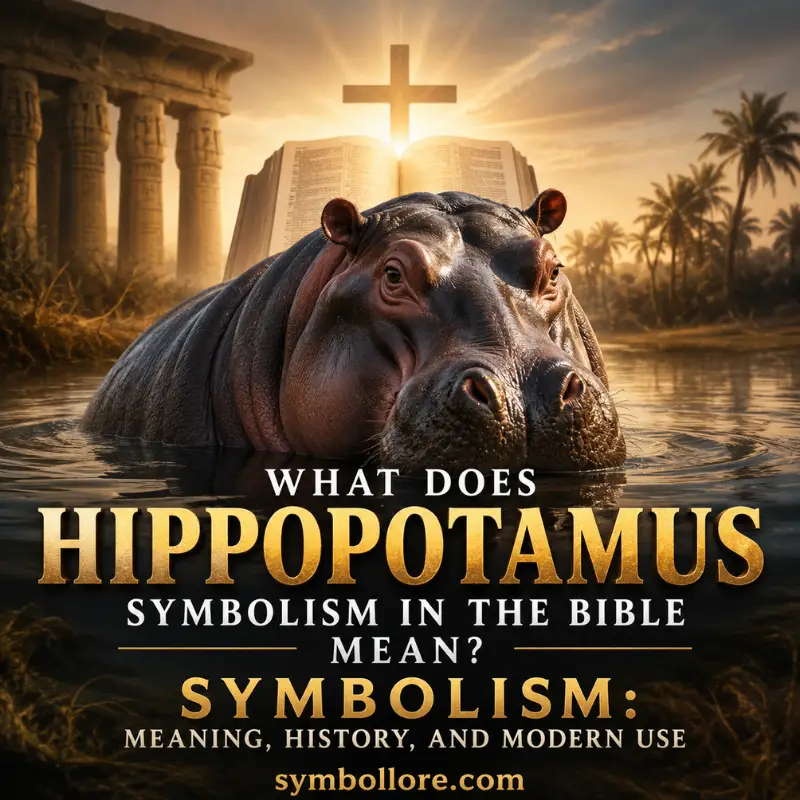
The clearest meaning is power that humans did not create and cannot fully command. In Job 40, Behemoth has massive muscles, bones like bronze, and limbs compared with iron. A rushing river does not frighten it. Human attempts to trap it seem almost absurd. Every detail builds a picture of calm, embodied force.
Yet strength is not the final point. God made Behemoth, feeds it through the landscape, and remains able to approach it. The creature that overwhelms Job does not overwhelm its Maker. Therefore, Behemoth’s power points beyond itself to divine sovereignty.
The image also challenges a human-centered view of creation. Behemoth does not exist because Job can tame, eat, trade, or use it. Luther Seminary’s
notes that the creature lies outside Job’s control yet still has value as God’s creation. In that sense, the passage presents wildness as meaningful, not defective.
Where the Hippopotamus Appears in Job 40
The relevant scene comes near the end of the Book of Job. Job has suffered deeply and argued that his treatment does not fit a simple system in which good people always prosper and wicked people always suffer. God answers from a whirlwind, but the speech does not give Job a short explanation for every loss. Instead, it reveals a vast, complex world that Job cannot govern.
Behemoth enters this second divine speech in Job 40:15. It eats vegetation like an ox. Its strength rests in its body, while its bones and limbs seem as durable as metal. It feeds from the hills, lies beneath lotus plants, shelters among reeds, and faces river force without panic. Finally, God asks whether anyone can capture it.
Some English versions preserve the Hebrew name “Behemoth.” The Living Bible instead tells the reader to look at the
then explains in a footnote that the literal term is Behemoth. That translation choice shows how influential the hippo interpretation became, but it does not remove the underlying uncertainty.
Strength That Exposes Human Limits
Behemoth first symbolizes strength because the poem concentrates on its physical power. The comparison with bronze and iron lifts the description beyond an ordinary nature report. The reader should feel the creature’s weight, stability, and resistance to force.
That power exposes Job’s limits. If a person cannot dominate one created beast, how could that person manage the whole moral and natural order? God’s question is not merely, “Are you physically strong?” It asks whether Job possesses the knowledge, reach, and authority required to rule every part of existence.
Humility here does not mean that Job’s pain is unimportant. Nor does it prove that every authority figure is right. Instead, the image places human judgment inside a reality wider than any one person can see. The same context-based method matters elsewhere in biblical animal imagery. For example,
crow and raven symbolism in Scripture
changes from provision to ritual impurity or desolation according to the passage.
God’s Sovereignty Over Untamable Creation
Behemoth is wild to Job but not independent of God. Job 40:15 introduces the creature as something God made. Verse 19 then places its exceptional status beside the authority of its Maker. Whatever the difficult line about God’s sword means, the contrast remains: divine rule reaches where human control ends.
This creates an important biblical distinction. Untamed does not mean uncreated, and dangerous does not automatically mean evil. Behemoth belongs within God’s world even though people cannot safely reduce it to a tool.
Consequently, the hippopotamus interpretation can represent power under a greater power. A modern Christian might use the image to remember that strength, institutions, natural forces, and frightening circumstances are not ultimate. However, that is a theological reflection on Job. It is not a promise that a hippo image will grant protection or control.
Humility in the Middle of Unanswered Suffering
The Behemoth speech appears within a book about undeserved suffering, protest, wisdom, and the limits of easy answers. For that reason, “hippo means strength” is too thin. The creature helps reshape Job’s position before a world he cannot fully explain.
Behemoth does not tell Job why each disaster happened. Rather, it shows that reality includes lives, powers, and purposes beyond human management. Job’s knowledge is real but incomplete. God’s questions lead him toward humility without turning his earlier honesty into a simple moral failure.
This theme can speak to readers who face uncertainty. The grounded application is not “stop asking questions.” Job spends much of the book asking hard questions. A better takeaway is to hold honest protest together with awareness of limited perspective. Behemoth makes room for awe when explanation remains unfinished.
Is Behemoth Really a Hippopotamus?
Possibly, but the identification is not certain. Several details fit a hippo well: the creature eats plants, possesses tremendous body strength, rests near reeds and water, and remains secure when a river surges. Hippos were also known in Egypt, a cultural world familiar to biblical writers and audiences.
Other details are harder to match. Behemoth receives food from the hills, and its tail is compared with a cedar. The description may use bold poetic language rather than field-guide precision. Alternatively, the creature may combine traits from a real hippo with a larger literary image of primeval or chaotic power.
The NET Bible notes on Job 40:15
summarize the main possibilities: a real animal, often the hippopotamus; a mythic creature; or a real creature described with mythic associations. The responsible conclusion is therefore modest. A hippo is a strong candidate and a useful visual reference, but Job does not require readers to settle the zoological question before understanding the speech.
What the Name Behemoth Means
“Behemoth” comes from the Hebrew bĕhēmôt, a plural form related to a word for beast, animal, or cattle. In Job 40, however, the grammar and description treat Behemoth as one creature. The unusual form gives the name a sense of magnitude or collectiveness rather than supplying a species label.
Translation specialists explain that the ending may function like an intensified plural.
Their translation note on bĕhēmôt
describes a singular creature whose name has the form of a majestic or intensified plural. Put simply, readers might hear something like “great beast” or “beast of beasts.”
That linguistic point supports the symbolic reading. Job’s poem is presenting more than a casual animal sighting. Behemoth gathers the idea of land-based animal power into one unforgettable figure. Still, etymology alone cannot prove that the creature is a hippo, composite monster, elephant, or any other proposed animal.
The Cedar-Like Tail Debate
The line about Behemoth moving or stiffening its tail “like a cedar” causes much of the disagreement. A hippopotamus has a short tail, while a cedar suggests something large, strong, or impressive. Readers who expect exact anatomy often see the comparison as evidence against the hippo theory.
Poetry, however, can compare motion, firmness, or symbolic grandeur rather than size alone. Some interpreters also argue that the Hebrew term translated “tail” may carry a euphemistic meaning. No proposal has ended the debate.
The safest reading keeps the line inside the poem’s larger effect. Every body part reinforces vigor and formidable presence. The cedar image intensifies that impression. It should make readers cautious about claiming certainty, yet it does not erase the many water-and-marsh details that led others to see a hippopotamus.
Does Behemoth Represent Chaos or Evil?
Some scholars read Behemoth as more than a natural animal. Paired with Leviathan in the next chapter, it can evoke forces of chaos, danger, oppression, or disorder that no human ruler can defeat. Under this view, the animal-like figure represents powers larger than one creature.
Even so, Job 40 does not simply call Behemoth Satan or label the hippopotamus evil. God says that he made the creature, and much of the description expresses admiration for its body and habitat. The moral meaning remains less direct than in later visions where beasts clearly represent empires or persecuting powers.
Therefore, writers should distinguish three levels: a possible real-animal basis, poetic enlargement, and theological interpretation. Blending them creates false certainty. A hippo may help readers picture Behemoth, while the literary figure may also communicate dangerous power within creation. Neither point makes living hippopotamuses demonic.
Ancient Egyptian Hippo Symbolism Is Different
Ancient Egyptian art gives the hippopotamus a rich symbolic history, but those meanings should not be imported into Job without evidence. Egyptian images could connect hippos with danger, royal victory, fertile Nile life, regeneration, and fierce maternal protection. Taweret, a deity with hippopotamus features, guarded women and children.
The Metropolitan Museum of Art’s study of
explains this double character. The animal’s force could appear threatening, while the female hippo’s defense of her young supported protective imagery. Decorated faience hippos also carried links with river plants, life, and rebirth.
Job uses a different religious framework. Behemoth is not a goddess, amulet, or fertility charm. It is a creature under Israel’s God. Egyptian material helps show why a hippo could communicate tremendous and ambivalent power to an ancient audience. However, it does not prove that Job borrowed every Egyptian meaning.
Does the Bible Make the Hippo a Symbol of Protection?
Not directly. Protection belongs to ancient Egyptian hippo-goddess imagery and to some modern personal interpretations. Job focuses on Behemoth’s security, strength, habitat, and relationship to its Creator. It never tells Israelites or Christians to wear, display, or pray through a hippo image for protection.
A person may still choose a hippopotamus as a private symbol of strong boundaries, parental defense, or calm confidence. Those meanings make sense when openly labeled as modern applications. They should not be introduced with “the Bible says.”
This distinction also prevents cultural mixing. Taweret’s protective role belongs to ancient Egyptian religion. Behemoth’s role belongs to Hebrew wisdom literature. Respectful symbolism allows the two traditions to illuminate the animal’s visual power without turning them into one universal spiritual system.
Modern Christian Meaning and Personal Reflection
Modern readers can use the Behemoth image in several grounded ways. First, it may represent strength that does not need constant display. The animal lies calmly among plants and remains unshaken by a surging river. Second, it can suggest respect for realities that cannot be controlled. Finally, it can remind believers that created power remains below divine authority.
The passage also supports a care-centered view of nature. Behemoth has food, shade, water, and a place within creation apart from its usefulness to humans. That idea can encourage humility and responsible stewardship rather than conquest.
Yet personal reflection should remain personal. A hippo tattoo, painting, journal image, or church illustration can express strength, humility, or trust if the creator explains the connection. Similar care is needed with modern nature comparisons such as
dragonfly symbolism in Christian reflection:
an animal may illustrate a biblical theme without becoming a source of doctrine.
What Hippopotamus Symbolism Does Not Mean
The Bible does not establish a secret hippopotamus code. It does not say that seeing one in a dream predicts conflict, pregnancy, financial success, spiritual attack, or protection. It also gives no special meaning to a hippo’s color, number, direction, or repeated appearance.
Likewise, Behemoth is not clearly presented as a model believers must imitate. Its strength can support reflection, but Job’s main concern is the contrast between human and divine rule. The creature points to a theological question, not a personality quiz.
Finally, Scripture never identifies Behemoth as a dinosaur. That proposal appears in some modern interpretations, often because of the cedar-like tail. The text supplies no species name, fossil claim, or timeline argument. Readers can discuss the theory, but they should not present it as the passage’s plain or settled meaning.
How to Interpret Hippopotamus Symbolism in the Bible Today
Start with Job 40 rather than with an online symbol list. Ask what Behemoth does, who speaks, and why the creature enters the argument. Its strength, habitat, and resistance to capture establish the contrast between human limits and divine rule.
Next, separate the levels of meaning. “Behemoth may be based on a hippopotamus” is a historical interpretation. “Behemoth represents untamable created power” is a literary and theological reading. “A hippo reminds me to stay calm under pressure” is a personal application. Each can be meaningful, but they do not carry equal authority.
Finally, test any claim against the text. Context matters across biblical symbolism;
for instance, can indicate presence, guidance, purification, or judgment depending on the passage. In the same way, a modern hippo encounter does not inherit every possible meaning associated with Behemoth, ancient Egypt, dreams, or popular spirituality.
FAQs
A hippopotamus most reasonably symbolizes immense created strength, human limitation, and God’s sovereignty when it is identified with Behemoth in Job 40. However, the Hebrew text names Behemoth rather than a hippo. The spiritual meaning belongs to the passage’s argument, not to every encounter with the animal.
No. The hippopotamus is a long-standing and plausible identification because Behemoth eats vegetation, has great strength, and lives near water and reeds. Still, the cedar-like tail and enlarged poetic language leave room for other views, including a composite or mythically heightened creature.
In the Behemoth reading, the hippopotamus illustrates that God creates and governs powers people cannot master. The animal’s size and security make divine authority appear even greater. The passage also shows that wild creation has a place and value beyond immediate human use.
No. The Bible never declares the hippopotamus evil. Some interpreters connect Behemoth with chaos or oppressive power, but Job also presents it as God’s impressive creation. Dangerous strength should not be confused with moral wickedness or demonic identity.
The Bible gives no fixed interpretation for a hippopotamus dream. A dream might prompt personal reflection on power, fear, boundaries, or lack of control, but those ideas come from the dreamer’s context. Scripture does not promise that such a dream predicts an event or delivers a divine command.
Not specifically. Protection and motherhood come mainly from ancient Egyptian imagery involving female hippos and Taweret. Job’s Behemoth emphasizes strength, wildness, and divine mastery. A modern person may adopt maternal protection as a private hippo meaning, but it is not a stated biblical symbol.
Conclusion
Hippopotamus symbolism in the Bible is best understood through Behemoth, the mighty creature of Job 40. Its massive body, marsh habitat, and fearlessness before rushing water explain why many readers picture a hippo. More importantly, Behemoth embodies created strength beyond human control and places that strength beneath God’s authority.
The species question remains open because the poem uses heightened and sometimes puzzling language. Culture also changes the animal’s meaning: ancient Egyptian protection and rebirth imagery is not the same as Job’s theology. A grounded reading therefore treats the hippo as a plausible image of Behemoth while keeping the main lesson on humility, wild creation, and the limits of human power.
Five Related Articles from symbollore.com
- Crow Symbolism in the Bible: What the Key Passages Mean — https://symbollore.com/crow-symbolism-bible/
- Dragonfly Symbolism in the Bible: A Careful Christian View — https://symbollore.com/dragonfly-symbolism-bible/
- Fire Symbolism in the Bible: Meaning and Key Passages — https://symbollore.com/fire-symbolism-bible/
- Fog Symbolism in the Bible: Meanings, Verses, and Context — https://symbollore.com/fog-symbolism-bible/
- Dirt Symbolism: Growth, Mortality, and Hidden Meaning — https://symbollore.com/dirt-symbolism-meaning/