
Black wolf symbolism commonly represents mystery, inner strength, protection, independence, and the hidden parts of the self. However, it can also express fear, isolation, grief, or a challenge that must be faced. Its meaning changes with the setting, the wolf’s behavior, and the observer’s cultural or personal associations.
A real black wolf is not a separate supernatural species. It is generally a dark-coated gray wolf. Therefore, its symbolic meaning comes from combining familiar wolf qualities with human associations surrounding darkness and the unknown.
Quick Answer
Black wolf symbolism represents mystery, personal power, protection, transformation, and confrontation with the shadow self. A calm or protective wolf may suggest confidence and guidance, while an attacking or threatening wolf may reflect fear or unresolved conflict. These are interpretive possibilities—not universal messages, predictions, or established meanings shared by every culture.
Key Takeaways
- Black wolves often symbolize mystery, courage, protection, and concealed strength.
- Threatening imagery may represent fear, conflict, danger, or suppressed emotions.
- Dream meaning depends more on context than on color alone.
- Black wolves are melanistic gray wolves, not a separate species.
- Cultural wolf traditions should not be reduced to one universal interpretation.
- Tattoo meaning depends on design, pose, setting, and personal intention.
Black Wolf Meanings at a Glance
| Symbolic Meaning | What It May Represent | Common Context |
|---|---|---|
| Mystery | The unknown, secrecy, or unexplored knowledge | Forest scenes, darkness, dreams |
| Inner strength | Quiet confidence and endurance | Calm or watchful wolf |
| Protection | Strong boundaries and loyal guardianship | Wolf beside a person or family |
| Transformation | Entering a new identity or life stage | Moving wolf, moon, changing landscape |
| Shadow self | Hidden fear, anger, instinct, or desire | Dreams and psychological artwork |
| Independence | Self-reliance and freedom from control | Lone wolf imagery |
| Warning | A threat, neglected problem, or need for caution | Growling, chasing, or watching wolf |
What Does Black Wolf Symbolism Mean?
Black wolf symbolism combines the wolf’s familiar qualities—instinct, loyalty, endurance, freedom, and social intelligence—with the meanings people attach to darkness. Black often suggests mystery, concealment, mourning, authority, rebellion, or the unknown. Together, these ideas create a symbol that can feel protective and intimidating at the same time.
A black wolf may consequently represent power that remains controlled rather than displayed. It can describe someone who observes quietly, protects firm boundaries, and acts only when necessary. In a more difficult context, however, it may represent fear, loneliness, aggression, or a truth that someone has avoided.
The symbol has no single meaning that applies to everyone. A person’s experience, cultural background, and emotional response all shape the interpretation.
Why Black Wolves Carry Distinct Symbolism
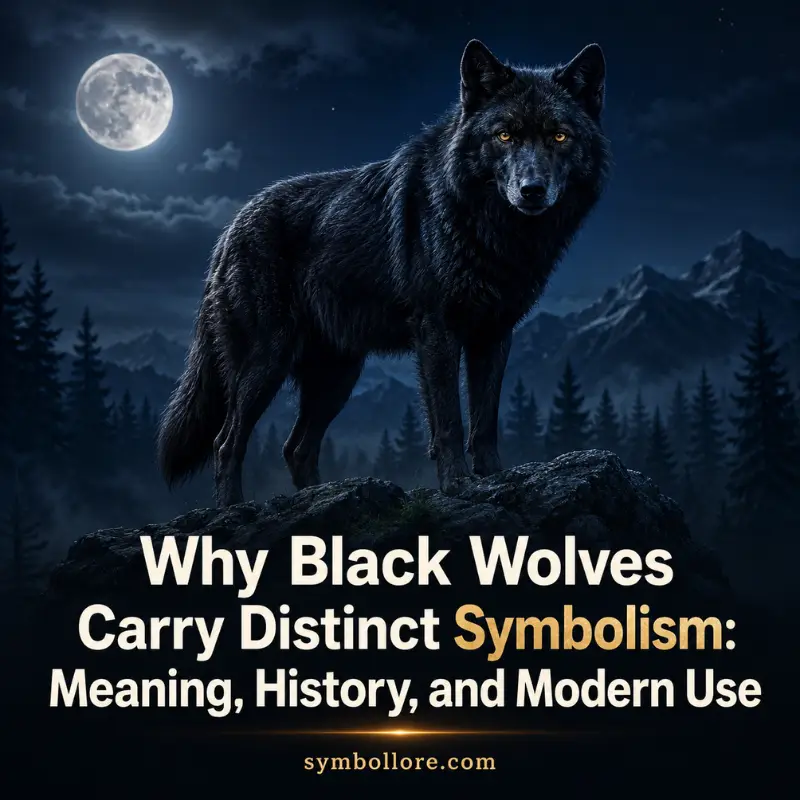
A black wolf is usually a gray wolf, or Canis lupus, with a genetic form of dark pigmentation called melanism.
The U.S. Fish and Wildlife Service
notes that gray-wolf coats can range from white and mottled gray to brown and coal black.
Research published in Science connected the black coat found in North American wolves to a genetic variant that entered wolf populations through ancient breeding with domestic dogs. Moreover, the
National Park Service’s Yellowstone wolf research
reports that about half of Yellowstone’s wolves have dark coats.
These animals are not supernatural or automatically more aggressive than lighter wolves. Nevertheless, their dark appearance can make them seem secretive, powerful, or difficult to read. Human reactions to darkness—not a special black-wolf personality—create much of the color’s modern symbolism.
Seven Core Black Wolf Meanings
Mystery and the unknown
A black wolf can symbolize something that has not yet been understood. The darkness of its coat hides visual detail, while the wolf’s quiet movement adds a sense of secrecy. As a result, the image often appears in stories about entering unfamiliar emotional or spiritual territory.
This meaning does not automatically imply danger. The unknown may contain a new opportunity, an unrecognized talent, or knowledge that requires patience.
Inner strength
A calm black wolf frequently represents controlled power. It does not need to attack or dominate to appear strong. Instead, its stillness can suggest discipline, confidence, and the ability to endure pressure without surrendering personal values.
This interpretation suits people who identify with private resilience. It may also represent strength developed through hardship rather than strength granted without effort.
Protection and boundaries
The black wolf may serve as a guardian in dreams, art, stories, or tattoos. Wolves defend territories and maintain close family relationships, so people often connect them with loyalty and protection.
Real wolf groups are usually family units rather than collections of unrelated animals fighting for dominance.
explains that howling helps wolves locate pack members and warn neighboring wolves away. Symbolically, that behavior supports themes of communication, belonging, and firm boundaries.
Transformation
Black wolf symbolism can mark a transition into a new identity. This interpretation is especially common when the wolf travels through darkness, crosses a threshold, or appears beside a moon.
Transformation here does not have to mean becoming completely different. Instead, it may involve accepting a quality that was previously denied, leaving an outdated role, or finding courage during uncertainty.
The shadow self
In modern psychological and spiritual language, a black wolf may represent the shadow self: emotions, instincts, desires, or traits a person hides or rejects. The wolf can therefore invite honest self-examination.
However, “shadow” should not be confused with evil. Anger, ambition, grief, and self-protection can become destructive when uncontrolled, but they can also provide useful information. The symbolic task is to understand these feelings and direct them responsibly.
Independence and instinct
A lone black wolf often symbolizes independence, intuition, and the willingness to follow an unconventional path. It may appeal to someone who values freedom or has learned to make decisions without constant approval.
Still, wolves are deeply social animals. Therefore, lone-wolf imagery should not be read as proof that isolation is always admirable. In nature, a lone wolf may be dispersing to find a mate, territory, or new family group.
Fear or warning
A snarling, chasing, or watching black wolf may symbolize a perceived threat. It can represent an unsafe situation, a distrusted person, an internal conflict, or anxiety that has become difficult to ignore.
Yet symbolic warnings do not predict future harm. Instead, the image can encourage practical reflection: What currently feels threatening? Is the danger real, exaggerated, or misunderstood? What boundary or action would create greater safety?
Black Wolf Spiritual Meaning and the Shadow Self
The modern spiritual meaning of a black wolf centers on intuition, hidden knowledge, personal transformation, and reconciliation with rejected emotions. Some people view it as a guide through uncertainty. Others see it as a reminder to protect their energy or examine a concealed fear.
These interpretations belong largely to contemporary personal spirituality. They should not be presented as scientific facts or beliefs shared by every religion. Terms such as “spirit animal” and “totem” also have specific cultural connections that casual online content often overlooks.
A respectful personal interpretation might be: “The black wolf reminds me to trust my judgment while examining my fears.” That statement describes individual meaning without falsely claiming a message from a culture, deity, or supernatural authority.
Black Wolf Dream Meaning
Black wolf dream meaning depends on what the wolf does, how the dreamer feels, and what is happening in waking life. Dreams do not come with a universal dictionary, so the same image can mean security to one person and danger to another.
Use three questions to interpret the dream:
- What was the wolf doing? A guiding wolf differs from one that attacks, hides, or runs away.
- How did you feel? Fear may suggest vulnerability, while calmness may point toward confidence or protection.
- What resembles your present life? Consider current boundaries, relationships, decisions, and unresolved emotions.
A friendly black wolf may represent accepted instinct or unexpected support. A pursuing wolf can reflect a problem the dreamer wants to avoid. Meanwhile, an injured wolf may express neglected strength, grief, or concern for someone who appears powerful but is suffering.
Black Wolf Tattoo Meaning
Black wolf tattoo meaning commonly includes strength, mystery, loyalty, survival, independence, and personal change. However, the design’s details determine the final message more clearly than the animal’s color alone.
A howling wolf may express communication, remembrance, or a desire to be heard. In contrast, a calm forward-facing wolf suggests alertness and self-control. A snarling wolf communicates defense, anger, or readiness to fight. Adding a forest emphasizes the unknown, while a moon can suggest cycles, intuition, or transformation.
Before choosing culturally specific feathers, headdresses, ceremonial patterns, or clan imagery, research their origins. A personal wolf design can express resilience without copying sacred or community-owned symbols.
Black Wolves in Mythology and Religion
Wolves carry sharply different meanings across mythology. Norse tradition includes Fenrir, the powerful wolf bound by the gods and destined to break free during Ragnarök. This story connects the wolf with chaos, fear, restraint, and forces that cannot be controlled forever.
Roman tradition offers a different image. A she-wolf nourishes Romulus and Remus, the legendary founders of Rome. Here, the wolf signifies protection, survival, ancestry, and the wild forces supporting civilization.
Biblical passages generally use wolves as metaphors for danger, destruction, or deceptive leaders. However, these texts discuss wolves broadly; they do not establish a separate biblical meaning for black wolves. Therefore, claims about a specific “biblical black wolf message” are modern extensions rather than direct scriptural teachings.
Indigenous Traditions and Cultural Respect
There is no single Native American meaning of the wolf. Indigenous nations have distinct languages, histories, ceremonies, clan systems, and relationships with animals. In some communities, wolves appear in creation accounts, family histories, or teachings about hunting and kinship. Meanings elsewhere may be different or even cautionary.
The Smithsonian’s National Museum of the American Indian explains that animals can communicate community values and appear in creation, clan, family, and personal stories.
Its guidance on honoring animal relatives
also advises people not to copy protected or culturally specific imagery.
Consequently, phrases such as “the Native American black wolf meaning” are too broad. Name a particular nation and use a source connected to that community whenever discussing an Indigenous tradition.
Seeing a Black Wolf in Real Life
Seeing a black wolf in nature means you encountered a wild animal with dark fur—not necessarily an omen. In places such as Yellowstone, black-coated wolves are well documented. Their color results from genetics, not a supernatural condition.
If the sighting feels personally meaningful, you may reflect on the emotions it created without ignoring the real animal. Awe might suggest renewed respect for nature. Fear could reveal vulnerability, while the wolf’s calm movement might inspire endurance or alertness.
Maintain a safe distance and follow local wildlife guidance. Never approach, follow, or feed a wolf. Wolves generally avoid people, but they remain powerful wild predators that deserve space and respect.
Is a Black Wolf a Good or Bad Sign?
A black wolf is neither automatically a good sign nor a bad one. A peaceful wolf may symbolize guidance, courage, protection, or quiet power. Conversely, a threatening wolf can represent fear, conflict, unsafe behavior, or the need for stronger boundaries.
Context supplies the most useful answer. Consider the wolf’s behavior, your immediate emotional response, the setting, and your existing associations with wolves and the color black.
Most importantly, do not use symbolic interpretation to replace evidence. If a real person or situation feels dangerous, assess observable behavior and seek practical support rather than relying on an omen.
FAQs
Spiritually, a black wolf may symbolize mystery, intuition, protection, transformation, or hidden parts of the personality. These are modern interpretive themes rather than universal spiritual facts. Its most relevant meaning depends on the person’s beliefs, emotional response, and the context in which the image appeared.
No, a black wolf does not inherently symbolize evil. Darkness has negative associations in some traditions, but it can also represent privacy, authority, fertility, mystery, or the unknown. A threatening black wolf may express danger, while a calm one can symbolize protection and disciplined strength.
A friendly black wolf may represent growing trust in your instincts, an accepted part of your personality, or support from an unexpected source. Consider whether the wolf guided, followed, or protected you. Your feelings during the dream provide more useful evidence than its color alone.
Being chased by a black wolf can reflect fear, pressure, unresolved conflict, or an issue you would rather avoid. It does not predict an attack or future misfortune. Consider what currently feels persistent, threatening, or emotionally difficult in your waking life.
Their frequency depends on location. Black wolves are uncommon in many Eurasian populations, but they are relatively visible in parts of North America. Yellowstone National Park reports an approximately even division between black and gray coats, showing that “rare” is not accurate everywhere.
Black-and-white wolf imagery commonly represents contrast: fear and courage, instinct and reason, secrecy and truth, or independence and belonging. It can also express balance between qualities that appear opposed. However, its meaning should not automatically be attributed to Indigenous traditions without reliable, nation-specific evidence.
Conclusion
Black wolf symbolism brings together mystery, inner strength, protection, transformation, independence, and confrontation with hidden emotions. Its darker meanings—fear, danger, grief, or isolation—become relevant mainly when the surrounding scene supports them.
The symbol is most useful when treated as a prompt for reflection rather than a fixed prophecy. Consider the wolf’s behavior, the setting, your emotional response, and your cultural framework. That approach respects both the complexity of symbolism and the real gray wolf behind the powerful black image.