
Rhodolite symbolism centers on love, warmth, emotional strength, confidence, and expressive beauty. These meanings mostly come from two sources: rhodolite’s identity as a garnet and its distinctive rose-to-purplish-red color. Modern crystal traditions add ideas such as emotional healing, self-worth, and heart-centered courage.
However, rhodolite does not have the same long, independently documented symbolic history as garnet itself. The name rhodolite was introduced for rose-colored material from North Carolina in the late 1890s. Older stories about garnet therefore provide historical context, but they should not automatically be described as ancient rhodolite traditions.
That distinction makes rhodolite especially interesting. Its symbolism is layered: ancient garnet lore forms the foundation, its rose-purple appearance adds a softer emotional tone, and modern spiritual practices add newer interpretations.
Quick Answer
Rhodolite symbolism commonly represents love, warmth, inner strength, confidence, compassion, and emotional expression. Its connection with garnet supplies older associations with love, vitality, and protection, while its rose-purple color creates a softer modern meaning. Chakra and healing interpretations exist in contemporary crystal traditions, but they are beliefs rather than scientifically proven properties.
TL;DR
- Rhodolite commonly symbolizes love, warmth, compassion, and emotional strength.
- Its symbolism is largely inherited from the older garnet tradition.
- The rose-purple color adds associations with affection, individuality, and expressive beauty.
- Rhodolite itself was named in North Carolina in the late 1890s.
- Garnet is January’s birthstone, so rhodolite can carry that birthstone meaning as a garnet variety.
- Chakra, zodiac, and healing claims belong to modern metaphysical traditions, not established mineral science.
Rhodolite Meanings at a Glance
| Context | Possible Meaning | Why the Association Exists | Important Limit |
|---|---|---|---|
| Garnet heritage | Love, vitality, protection | Rhodolite belongs to the garnet family | Older garnet lore is not automatically rhodolite-specific |
| Rose-pink color | Affection, warmth, tenderness | Pink often softens the emotional force of red | Color symbolism varies by culture and setting |
| Purple-red color | Individuality, creativity, refinement | Purple adds a less traditional tone to garnet’s red | These are interpretive color associations |
| January birthstone | Identity, celebration, personal connection | Garnet is the traditional January birthstone | Birthstone meaning is a cultural tradition |
| Modern crystal practice | Emotional balance, self-worth, heart-centered courage | Contemporary metaphysical traditions assign these qualities | Not scientifically proven |
| Jewelry and gifts | Love, commitment, sentiment | Garnet has long been used in meaningful adornment | The giver’s intention matters most |
What Does Rhodolite Symbolism Mean?
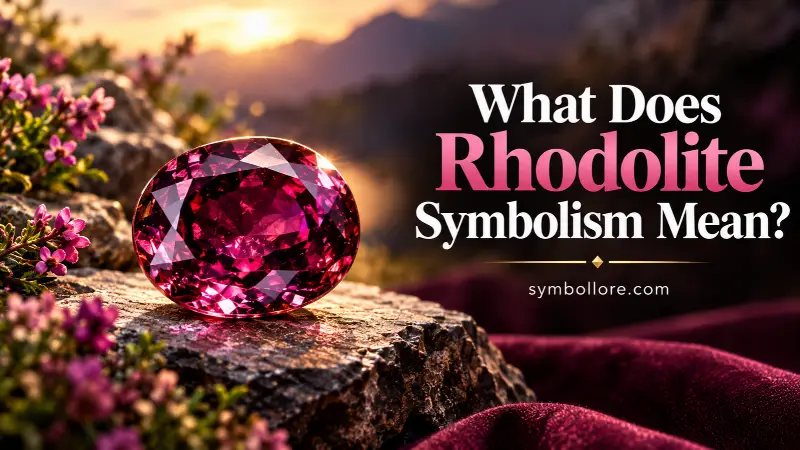
The strongest modern meaning of rhodolite is warm, emotionally grounded love.
That wording is more precise than simply calling rhodolite a “love stone.” Traditional garnet symbolism includes love, passion, courage, and protection. Rhodolite’s lighter rose and purple tones can make those ideas appear gentler and more personal. GIA’s discussion of garnet symbolism similarly connects garnet with love, passion, courage, and protection.
Modern rhodolite pages add compassion, emotional sincerity, creativity, confidence, and self-worth. These associations are common in contemporary gemstone writing, but they should be treated as symbolic or spiritual interpretations, not proven effects.
This gives rhodolite a useful symbolic range:
love + garnet heritage + rose-purple color = warmth, affection, strength, and individuality.
The formula is interpretive, not an ancient rule. That distinction is important when discussing gemstone symbolism responsibly.
Why Rhodolite Became Associated With Love and Warmth
Rhodolite’s connection with love makes sense partly because it belongs to the garnet family.
Garnets have a long history as jewelry stones. GIA records red garnet jewelry in ancient Egypt and signet-ring use in ancient Rome. The American Gem Society also records ancient Egyptian and Roman uses and describes garnet’s later protective lore.
Garnet’s deep red colors helped create associations with life, warmth, passion, and emotional intensity. Modern rhodolite has a different visual effect. Its rose, raspberry, and purplish-red tones can look softer and more romantic than darker red garnets.
That difference matters.
A traditional deep-red garnet may suggest strong passion. Rhodolite can suggest affection that feels warmer and less forceful.
Modern jewelry writers often describe this as a gentler form of garnet’s romantic symbolism.
The symbolism is therefore better understood as an evolution of the garnet tradition rather than a completely separate ancient system.
The Rose Color Gives Rhodolite a Softer Emotional Tone
Rhodolite’s color is one of its strongest symbolic features.
GIA describes rhodolite as a pink or purplish-red garnet variety. Its distinctive color separates it visually from the darker red garnets most people associate with the word “garnet.”
The rose side of rhodolite can suggest:
- affection;
- tenderness;
- appreciation;
- emotional warmth;
- romantic feeling;
- graceful self-expression.
This resembles the softer emotional language often attached to pink flowers. For comparison, SymbolLore’s discussion of
shows how pink can modify an established symbol rather than replacing it.
The same principle applies to rhodolite. Its color does not erase garnet symbolism. Instead, it changes the emotional tone.
A rose-pink rhodolite may feel more tender. A saturated raspberry-red stone may feel more passionate. A violet-leaning specimen may seem more unusual or artistic.
These are useful interpretive distinctions, not fixed definitions.
What the Purple Tone Adds to Rhodolite Symbolism
Purple adds another layer.
Purple is commonly associated in modern Western symbolism with ideas such as individuality, imagination, dignity, mystery, and creativity. Rhodolite does not usually appear as a pure purple gemstone, but its violet or purplish-red tones can create some of these impressions.
This helps explain why rhodolite can feel different from traditional red garnet.
A strongly red stone may emphasize:
passion → vitality → courage
A more purple rhodolite may suggest:
individuality → creativity → emotional depth
The effect is partly visual. Rhodolite’s color can appear to change in character under different lighting and depending on the balance between red and purple. GIA’s gem research documents the range of purple-red rhodolite and pyrope-almandine material.
For a useful comparison, SymbolLore’s
explains how a rose’s established symbolism can combine with purple-toned color associations to create a different emotional message.
Rhodolite works in a similar way.
Rhodolite Has a Modern History, Not an Ancient Rhodolite Tradition
One of the most important facts about rhodolite symbolism is chronological.
Garnet is ancient. Rhodolite as a named gem variety is comparatively modern.
JCK reports that William Earl Hidden and J. H. Pratt identified alluvial rhodolite deposits in Macon County, North Carolina, in the late 1890s. The German Gemmological Society likewise dates the naming to 1898 and connects it with the Greek rhodon, meaning “rose.”
That means claims such as “ancient Egyptians used rhodolite as a symbol of love” need caution.
Ancient Egyptians certainly used garnet. GIA records garnet jewelry among Egyptian finds dating thousands of years. But the historical record does not justify turning every ancient garnet reference into a specific rhodolite tradition.
This distinction improves the symbolism:
Ancient garnet lore → historical foundation
Late-19th-century rhodolite → distinct gem identity
Modern color and crystal traditions → contemporary rhodolite symbolism
That is a much stronger historical explanation than treating rhodolite as an unchanged ancient symbol.
Rhodolite and the Symbolism of Garnet
Because rhodolite is part of the garnet family, garnet symbolism remains important.
GIA identifies rhodolite as a purplish-red garnet variety associated with the pyrope-almandine series.
Garnet’s documented history includes jewelry, decorative objects, signet rings, and protective traditions. The American Gem Society records stories of garnet being used as a protective talisman by warriors and travelers. It also records the ancient Egyptian association with life.
Those historical traditions can influence how modern people interpret rhodolite.
For example:
- Garnet protection → rhodolite may be interpreted as emotional protection.
- Garnet love → rhodolite may represent affectionate commitment.
- Garnet vitality → rhodolite may suggest energy and inner strength.
- Garnet adornment → rhodolite can represent meaningful personal identity.
The first three are interpretations of older garnet lore. They are not proof that ancient people gave rhodolite those exact meanings.
Rhodolite as a Symbol of Inner Strength
Strength may seem less obvious than love, but it is a recurring part of modern rhodolite symbolism.
Garnet’s older associations with courage and protection provide part of the reason. Modern rhodolite traditions then soften that strength by connecting it with compassion and emotional awareness.
This creates a useful symbolic contrast:
strength without hardness.
In this interpretation, rhodolite represents the ability to remain emotionally open while still maintaining confidence and boundaries.
That can make it meaningful as a personal symbol during periods of change. Someone may choose rhodolite jewelry as a reminder of resilience, self-respect, or emotional courage.
There is no scientific evidence that wearing rhodolite creates these qualities. The meaning comes from the person’s chosen symbolism.
Rhodolite as a January Birthstone Symbol
Garnet is the traditional birthstone for January, and rhodolite is a garnet variety. This gives rhodolite an additional layer of personal meaning for people born in January. The American Gem Society lists garnet as January’s birthstone, while GIA also identifies garnet as the January birthstone.
Birthstone symbolism is especially useful because it does not require a mystical explanation.
A January-born person may choose rhodolite because:
- it connects them with their birth month;
- they prefer its rose-purple color;
- they want something less traditional than dark-red garnet;
- the gemstone marks a birthday or milestone;
- the stone has personal sentimental value.
The symbolism comes from the cultural tradition of birthstones and the person’s relationship with the gem.
Rhodolite in Modern Spiritual and Crystal Traditions
Modern crystal traditions give rhodolite a much larger symbolic vocabulary.
Common claims include connections with:
- the heart chakra;
- the root chakra;
- emotional healing;
- self-love;
- confidence;
- compassion;
- emotional balance;
- spiritual growth;
- creativity.
Pages devoted to crystal traditions often present these ideas as part of contemporary energetic practice.
These claims should be labeled correctly.
They are metaphysical beliefs and practices, not established medical or scientific properties. There is no reliable scientific evidence that rhodolite can heal emotional trauma, balance chakras, treat illness, or change a person’s physical health.
That does not make the symbolism meaningless. A person can use rhodolite during meditation or reflection because the stone has personal meaning.
The important distinction is between:
“Rhodolite is used in some crystal traditions to represent emotional healing.”
and
“Rhodolite heals emotional problems.”
The first describes a belief. The second makes an unsupported factual claim.
Does Rhodolite Have a Specific Cultural or Religious Meaning?
There is limited evidence for a distinct ancient religious tradition centered specifically on rhodolite.
This is another reason to avoid assigning the gemstone a universal cultural meaning.
Garnet itself appears in several historical settings. Ancient Egyptians used garnet in jewelry and carvings, Romans used garnet in rings and decorative objects, and medieval European cultures used garnets in jewelry.
But those examples concern garnet, not necessarily rhodolite.
Modern crystal traditions are different again. Their chakra and spiritual associations belong to contemporary metaphysical practice rather than ancient religious doctrine.
So the most accurate statement is:
Rhodolite has a strong modern symbolic identity, but evidence for a separate ancient religious symbolism of rhodolite itself is limited.
That distinction protects the historical record while still allowing modern interpretations to be discussed.
Rhodolite Jewelry and Gift Symbolism
Rhodolite jewelry often works well as a symbolic gift because its color supports several overlapping messages.
A ring can suggest commitment or affection. A pendant can become a personal reminder of strength or self-worth. Earrings or bracelets can simply celebrate the recipient’s love of the gemstone.
The occasion changes the interpretation.
For an anniversary, rhodolite may suggest lasting affection. For a January birthday, it can combine birthstone identity with personal style. For a milestone, it may represent growth or renewed confidence.
The stone’s unusual color can also make the gift feel more individual.
This is similar to the way other symbolic gemstones work. The object is not carrying one universal message. Instead, the giver, recipient, occasion, color, and surrounding design work together.
For example, red diamond symbolism
shows how a gemstone’s inherent qualities and its color can combine to create a layered symbolic reading.
What Rhodolite Symbolism Does Not Automatically Mean
Several popular claims deserve a clear boundary.
Rhodolite does not automatically mean romantic love. Love is a common interpretation, but a person may choose it for friendship, self-expression, birthstone identity, or beauty.
Rhodolite is not an ancient gemstone name. Garnet is ancient, but rhodolite was named as a distinct variety in the late 19th century.
Rhodolite does not scientifically heal emotions. Crystal traditions may assign healing meanings to it, but these are not established medical effects.
Rhodolite does not have one universal chakra or zodiac meaning. Different modern crystal sources assign different systems and correspondences.
Rhodolite does not guarantee protection, luck, or relationship success. Those ideas belong to symbolic or spiritual belief rather than demonstrated cause and effect.
This distinction is useful because it lets readers appreciate gemstone lore without confusing tradition with scientific evidence.
How to Interpret Rhodolite Symbolism in a Specific Context
The best interpretation starts with the reason rhodolite appears.
Ask four questions:
- What is the color? A rose-pink stone may create a softer emotional impression than a deep purplish-red stone.
- What is the setting? Jewelry, artwork, meditation, a gift, and a birthstone have different symbolic contexts.
- What tradition is being used? Garnet history, modern crystal practice, and personal symbolism are separate systems.
- What does the person intend? Personal meaning can be more important than a general symbolism guide.
For example, rhodolite in an engagement ring may emphasize love and commitment. The same stone worn by a January-born person may primarily represent identity and birth month.
A crystal practitioner may associate it with the heart chakra. A gem collector may simply value its color and rarity.
None of these interpretations needs to cancel the others.
FAQs
Rhodolite commonly symbolizes love, warmth, compassion, emotional strength, confidence, and expressive beauty. These meanings mainly develop from its garnet heritage and rose-purple color. Modern crystal traditions add ideas such as self-love and emotional balance, but those are spiritual beliefs rather than scientifically established properties.
Garnet is an ancient gemstone, but rhodolite as a distinct named variety is much more recent. William Earl Hidden and J. H. Pratt identified rose-colored garnet material in North Carolina in the late 1890s and named it rhodolite.
Rhodolite can be used as a January birthstone because it is a variety of garnet, and garnet is January’s traditional birthstone. Its rose-purple color offers a different look from the darker red garnets many people associate with January.
In modern crystal traditions, rhodolite is often associated with love, emotional balance, self-worth, courage, compassion, and heart-centered growth. Some sources connect it with the heart and root chakras. These are metaphysical interpretations, not scientifically demonstrated effects.
Yes, love is one of the most common modern interpretations of rhodolite. The association is partly inherited from garnet’s older romantic symbolism and partly influenced by rhodolite’s warm rose and red coloring. The exact meaning can range from romantic love to affection, friendship, or self-love.
Protection is a reasonable modern interpretation because garnet has a documented history of protective lore. The American Gem Society records garnet’s use as a protective talisman in historical traditions. However, this does not prove that rhodolite itself provides physical or spiritual protection.
Rhodolite can symbolize affection, appreciation, emotional warmth, commitment, individuality, or a personal milestone. A January birthday adds birthstone significance. For an anniversary or romantic occasion, its rose-red color can make the symbolism more explicitly affectionate.
Sources and Further Reading
- GIA — Garnet History and Lore
- GIA — Garnet Gemstone Information
- GIA 4Cs — Garnet Engagement Ring History, Meaning & Symbolism
- American Gem Society — Garnet Folklore
- German Gemmological Society — Rhodolite and Mandarin Garnet
Conclusion
Rhodolite symbolism is best understood as a layered modern symbolism rather than a single ancient code. Its strongest associations with love, warmth, emotional strength, and individuality come from the older symbolism of garnet combined with rhodolite’s distinctive rose-purple color. Garnet has a much longer historical record, while rhodolite itself was named as a distinct variety in North Carolina in the late 1890s.
Modern crystal traditions add meanings such as self-love and emotional balance, but those belong to contemporary spiritual belief. The most grounded interpretation considers the gemstone’s history, color, cultural setting, and the intention of the person using it.


