
Earth element symbolism centers on stability, physical existence, fertility, nourishment, and the foundations that support life. Soil holds roots, stone resists pressure, and land provides food and shelter. These natural qualities explain why Earth commonly represents security, patience, endurance, and practical responsibility.
However, Earth does not have one universal meaning. Greek philosophy, Western alchemy, astrology, tarot, Indian traditions, and Chinese thought organize it differently. Its symbolism can also include limitation, stagnation, mortality, and the need to accept change.
Quick Answer
Earth element symbolism represents stability, groundedness, fertility, endurance, and connection with the material world. Earth supports life and gives objects weight and form, so it often signifies dependable foundations, practical work, physical needs, and gradual growth. In difficult contexts, it can represent rigidity, possessiveness, decay, burial, or feeling stuck.
Key Takeaways
- Earth represents stability, structure, nourishment, and physical reality.
- Fertile soil connects Earth with growth, abundance, and motherhood.
- Stone gives the element meanings of strength and endurance.
- Burial links Earth with death, return, and renewal.
- Elemental correspondences vary between cultures and spiritual systems.
- Context determines whether Earth suggests support or stagnation.
Earth Element Meanings at a Glance
| Earth feature | Common symbolic meaning | Possible shadow meaning |
|---|---|---|
| Solid ground | Security, foundation, reliability | Resistance to change |
| Fertile soil | Growth, fertility, abundance | Possessiveness |
| Roots | Belonging, ancestry, identity | Inability to move forward |
| Stone | Strength, permanence, endurance | Emotional hardness |
| Harvest | Reward, provision, completion | Material fixation |
| Caves and depths | Shelter, inward reflection | Fear, isolation, burial |
| Natural cycles | Renewal, patience, maturity | Decline and mortality |
What Earth Element Symbolism Means
Earth symbolizes whatever gives life form, weight, support, and continuity. Unlike fire, which visibly transforms, or air, which moves freely, Earth appears solid and slow. That physical character makes it a natural metaphor for reliability, patience, boundaries, and long-term effort.
The element also represents the material world. This includes the body, shelter, food, possessions, labor, and other tangible parts of life. In spiritual writing, “being grounded” usually means remaining present and practical instead of becoming lost in fear, fantasy, or abstraction.
Earth’s symbolic stability does not mean total stillness. Soil changes continually as organisms grow, die, and decompose. Therefore, the element can express slow transformation: the kind that happens through repetition, maturation, and natural cycles rather than sudden action.
Why Earth Represents Fertility and Mother Earth
Earth represents fertility because soil receives seeds, supplies nutrients, and supports new growth. Farming societies depended directly on healthy land, rain, seasons, and successful harvests. As a result, fields and gardens became visible signs of nourishment, survival, abundance, and future possibility.
The expression Mother Earth develops from this life-supporting role. Earth appears to receive, shelter, feed, and renew living things. Numerous cultures have personified the land as a maternal being, although their deities and stories are not interchangeable.
This symbolism also has a darker half. Living things return to the ground through burial and decay. Earth can therefore hold beginnings and endings at once. It becomes a place of birth, death, memory, and renewal rather than a simple emblem of cheerful growth.
Origins in the Classical Elements
In ancient Greek philosophy, Earth became one of four basic roots or elements alongside air, fire, and water. Empedocles used these four roots to explain how varied substances could arise through mixture and separation.
The Stanford Encyclopedia of Philosophy
explains that his model joined the roots with the opposing forces of Love and Strife.
Later thinkers developed other relationships between matter, qualities, and motion. Aristotle associated Earth with heaviness and a movement toward the universe’s center. These ideas influenced European philosophy, medicine, cosmology, and alchemy for centuries, but they are not modern chemistry.
The classical elements remain symbolically important because they organize experience into recognizable qualities. Earth stands for what seems dense, solid, resistant, and physically present. Modern artists and spiritual writers often retain those associations even when they reject the ancient scientific model.
The Alchemical Symbol for Earth
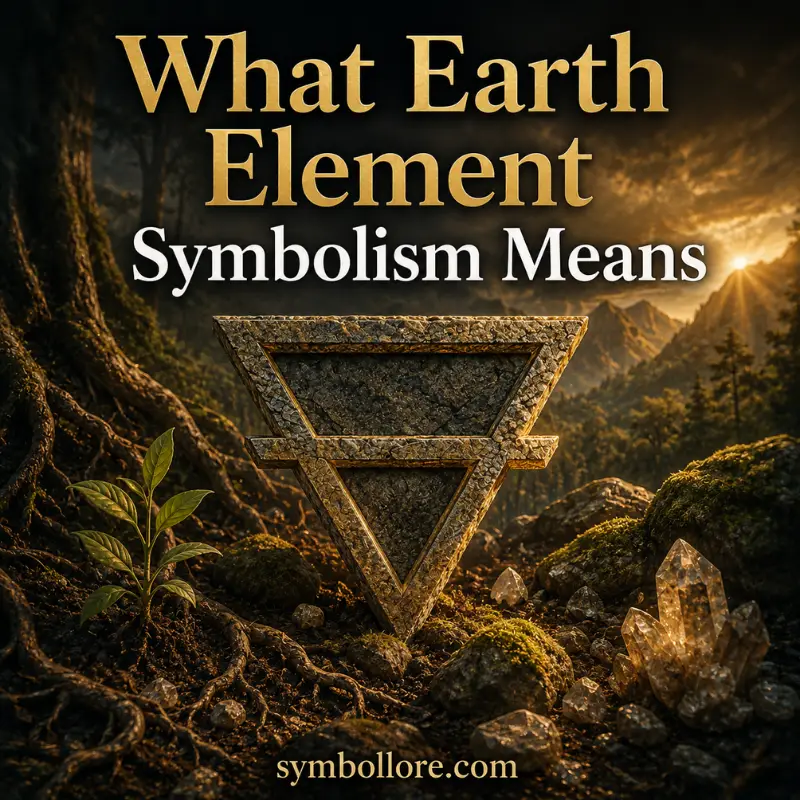
The best-known alchemical symbol for Earth is a downward-pointing triangle crossed by a horizontal line. It resembles the water emblem, another downward triangle, but the added bar distinguishes Earth. Modern designs often use this mark in jewelry, tattoos, artwork, and elemental diagrams.
The downward direction is commonly interpreted as movement toward matter, density, or physical embodiment. The horizontal bar can suggest stability or containment. However, such explanations are modern interpretive readings, not one universally documented definition from every alchemical school.
In European elemental correspondence systems, Earth was frequently classified as cold and dry. Those qualities belonged to an older philosophical model of matter. Consequently, the emblem should be understood as a historical-symbolic sign, not a scientific description of soil or the modern chemical elements.
Earth in Astrology: Taurus, Virgo, and Capricorn
Western astrology assigns Taurus, Virgo, and Capricorn to the Earth group. Astrologers traditionally connect these signs with practicality, tangible results, routine, resources, and sustained effort. Yet each expresses those themes differently.
Taurus is commonly linked with preservation, comfort, sensory experience, and value. Virgo is associated with organization, skill, analysis, and practical improvement. Capricorn is connected with structure, responsibility, ambition, and long-term achievement.
These interpretations belong to astrology, which is a divinatory tradition rather than an evidence-based method for predicting personality or events. An Earth-heavy birth chart is symbolically read as emphasizing material or practical concerns. It does not prove that a person is dependable, stubborn, wealthy, or emotionally reserved.
Earth and Pentacles in Tarot
In many modern tarot systems, the suit of pentacles corresponds to Earth. Its cards often concern work, money, home, health, resources, skills, and results that take physical form. Some decks call this suit coins or disks, making the material connection especially visible.
Earth helps readers understand why pentacle cards are not only about money. They may address care for the body, dependable relationships, craftsmanship, security, or responsible use of resources. A card’s number, imagery, position, and surrounding cards still affect the reading.
Difficult pentacle cards may point toward scarcity, overwork, greed, insecurity, or excessive attachment to possessions. Thus, Earth’s tarot meaning includes both wise stewardship and material imbalance.
Prithvi and Wuxing: Different Elemental Traditions
Indian and Chinese systems should not be treated as alternate versions of Greek philosophy. In several Indian traditions, Prithvi refers to Earth as a great element associated with solidity, physical form, and sensory experience. The specific interpretation changes among Hindu, Buddhist, Jain, yogic, and Ayurvedic sources.
For example, the Internet Encyclopedia of Philosophy’s discussion of Sāṅkhya
describes a five-element structure containing ether, air, fire, water, and Earth. Within that philosophical account, Earth carries all five sensible qualities. Other Indian schools define elemental relationships differently.
Chinese wuxing contains wood, fire, Earth, metal, and water. However, “five phases” is often a clearer translation than “five elements.”
The Internet Encyclopedia of Philosophy
explains that these are dynamic, interdependent processes, unlike supposedly unchanging Greek building blocks. Earth can signify centrality, transition, stabilization, and relationships within a cycle.
Earth’s Shadow Meanings
Earth becomes restrictive when stability hardens into immobility. A wall protects, but it also confines. Roots sustain a tree, yet being “rooted to the spot” suggests an inability to act. Therefore, Earth may represent stubbornness, fear of change, excessive caution, or attachment to familiar conditions.
Material symbolism also has two sides. Caring for food, housing, savings, and physical safety is necessary. However, an extreme focus on ownership or status may turn Earth into a sign of greed, control, or materialism.
Burial adds further meanings of secrecy, suppression, grief, and mortality. In a dream or artwork, soil covering an object could suggest protection, concealment, decomposition, or preparation for growth. The surrounding story determines which reading makes sense.
How to Interpret Earth Symbols
Interpret Earth imagery by examining its condition, action, setting, and symbolic system. The presence of soil alone does not produce one fixed meaning.
- What condition is the Earth in? Fertile soil suggests potential, while cracked ground may suggest depletion or neglect.
- What is happening to it? Planting, digging, building, falling, and burial create different meanings.
- Which tradition applies? An alchemical triangle, an astrological sign, and Chinese Earth do not follow the same rules.
- What does the observer associate with it? A family farm may symbolize belonging for one person and hardship for another.
For a tattoo, jewelry design, dream, or artwork, start with the immediate context. Then compare historical conventions. This approach respects established meanings without pretending that every symbol has a single secret translation.
Grounding Practices and Their Limits
Symbolic grounding practices direct attention toward the body, immediate surroundings, and practical needs. Gardening, walking in nature, holding a stone, or noticing physical sensations may help someone pause and refocus. Their value can come from attention, routine, movement, or a personally meaningful connection with nature.
These practices should not be confused with electrical “earthing” claims or treated as cures for anxiety, depression, pain, or other health conditions. Spiritual correspondences are interpretive rather than medical evidence.
If distress is persistent or disrupts daily life, professional support is more appropriate than relying on elemental rituals. Earth symbolism can provide a useful metaphor for stability, but it should complement responsible care rather than replace it.
FAQs
Spiritually, the Earth element commonly represents grounding, stability, nourishment, patience, and physical existence. It encourages attention to the body, home, work, resources, and the natural environment. The precise meaning depends on whether the context is Wiccan, astrological, alchemical, Indian, Chinese, or personal.
Brown and green commonly symbolize Earth because they resemble soil and vegetation. Some Western correspondence systems also use black, while Chinese five-phase traditions often associate Earth with yellow or ochre. No color list is universal, so the relevant cultural or artistic system should guide interpretation.
The divided downward-pointing triangle is the most recognizable Western alchemical emblem for Earth. Other traditions use different images, including squares, circles, mountains, stones, grain, or specific deities. A plain globe usually represents the planet rather than the classical element.
Many Western esoteric systems classify Earth as receptive or feminine because of its associations with fertility, nourishment, and motherhood. That classification is symbolic, not a statement about biological sex or women’s personalities. Other traditions may organize elemental qualities through different categories.
Earth in a dream may suggest security, physical needs, growth, ancestry, work, burial, or feeling stuck. Rich garden soil differs from a landslide or barren field. The dreamer should consider what happened, how the scene felt, and what land means in their own life.
Symbolic and astrological traditions connect Earth with dependability, patience, realism, discipline, and practical skill. Its challenging traits may include rigidity, pessimism, possessiveness, or resistance to change. These are interpretive associations and should not be used as factual personality assessments.
Earth is an element or symbol within several philosophical and spiritual traditions. Grounding is a broader practice or metaphor for becoming calm, present, and attentive to physical reality. Someone can use psychological grounding techniques without accepting any spiritual elemental system.
Conclusion
Earth element symbolism expresses the support, structure, nourishment, and limits of physical life. Fertile soil makes Earth a sign of growth and abundance, while stone suggests strength and endurance. Burial and immobility also connect it with mortality, concealment, and stagnation.
Its exact meaning changes across alchemy, astrology, tarot, Indian philosophy, Chinese thought, art, and personal experience. The most reliable interpretation begins with the symbol’s context instead of combining every elemental tradition into one universal system.