

Phoenix symbolism in Christianity centers on resurrection, eternal life, spiritual renewal, hope, and Christ’s victory over death. Early Christians adapted the ancient story of a rare bird that died and returned to life because it offered a memorable comparison with resurrection.
The phoenix is not a central biblical symbol like the cross, lamb, fish, or Good Shepherd. It came from earlier Mediterranean legend and gained Christian meaning through allegory, art, sermons, and religious poetry. Its details also changed over time. Some early accounts describe decay and regeneration, while later art favors a bird rising dramatically from flames or ashes. That distinction helps separate documented Christian history from the popular modern version.
Quick Answer
Phoenix symbolism in Christianity represents Christ’s resurrection, the promised resurrection of believers, eternal life, spiritual rebirth, and hope beyond death. Early Christians adopted the legendary bird because its supposed return to life offered a visual comparison with resurrection. However, the phoenix is mainly a Christian allegory from tradition and art, not a clearly established biblical creature or formal doctrine.
TL;DR
- Christians began using the phoenix as a resurrection symbol by the late first century.
- Clement of Rome compared the bird’s renewal with the future resurrection of the dead.
- Later Christian texts linked its return to life more directly with Christ.
- The phoenix appears in early Christian funerary art and medieval manuscripts.
- It is not as central or universal as the cross, lamb, or fish.
- Modern phoenix designs may express Christian faith, secular resilience, or both.
Christian Phoenix Meanings at a Glance
| Christian Context | Main Meaning | Why the Phoenix Fits | Important Limit |
|---|---|---|---|
| Christ’s resurrection | Victory over death | The legendary bird returns after dying | The phoenix is an allegory, not a Gospel figure |
| Resurrection of believers | Future life after death | One life appears to emerge after the old one ends | Christian teaching rests on Christ, not phoenix mythology |
| Eternal life | Life continuing beyond death | The bird’s cycle resists final destruction | Versions of the legend differ |
| Spiritual rebirth | Repentance and changed life | The former life gives way to something renewed | This is a later devotional application |
| Hope in suffering | Renewal after loss | Destruction does not have the final word | Not every phoenix image carries Christian meaning |
| Funerary art | Hope beyond the grave | Resurrection imagery suits burial settings | Context must identify the design as Christian |
| Fire imagery | Purification and transformation | Later legends place the bird in flames | Clement’s account does not describe a bird rising from ashes |
What Does the Phoenix Represent in Christianity?
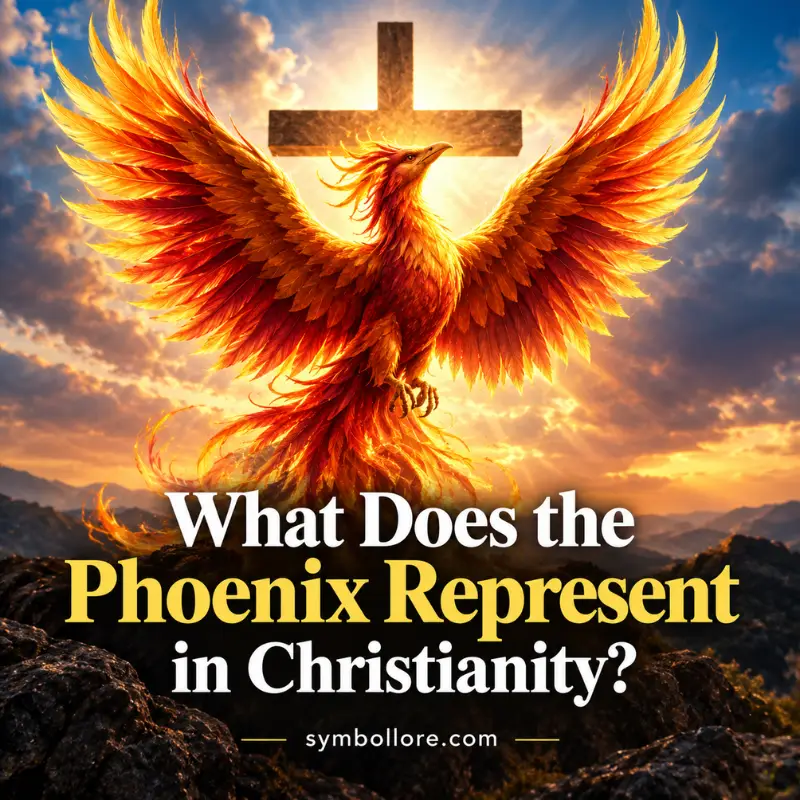
Within Christian symbolism, the phoenix most often represents resurrection and life after death. Christians saw a useful parallel between the legendary bird’s return to life and their belief that Jesus rose after the Crucifixion.
The comparison later expanded. The phoenix could represent Christ himself, the resurrection promised to believers, or a Christian life renewed through repentance. In funerary art, it could communicate hope that death was not the final end.
These meanings connect naturally with the broader visual language of
The cross expresses sacrifice and victory, while the lamb emphasizes redemption. The phoenix highlights renewed life emerging after death.
Still, the comparison has limits. Christian theology does not teach that Jesus repeatedly dies and returns in an endless natural cycle. The resurrection of Christ is understood as a unique event, not a recurring process like the phoenix’s legendary life cycle.
How a Pagan Bird Entered Christian Symbolism
The phoenix did not begin as a Christian symbol. Greek and Roman writers described an extraordinary bird associated with long life, the sun, Arabia, and Egypt. Details varied widely. Some accounts involved fragrant spices and a new bird forming from the dead bird’s remains. Fire and ashes became more prominent in later retellings.
Early Christians often adapted familiar animals, objects, and stories to explain religious ideas. A symbol did not have to originate within Christianity before Christian writers could give it a new interpretation. The fish, anchor, shepherd, vine, palm, and several legendary creatures all acquired meanings shaped by Christian teaching.
The phoenix offered a particularly useful comparison because its entire story centered on death followed by restored life. Christians did not need to accept its earlier religious associations. They could reinterpret the bird through their own belief in resurrection.
This process is better described as adaptation than direct continuation. Christian writers changed the phoenix’s meaning by placing it beside Christ, resurrection, paradise, and eternal life.
Clement of Rome and the Earliest Christian Phoenix
One of the earliest Christian uses appears in First Clement, a letter commonly dated to the late first century. Chapters 24–26 defend belief in resurrection through patterns of renewal.
The writer first points to day following night and plants growing from fallen seeds. He then describes a phoenix that lives for 500 years. As death approaches, it enters a nest made with frankincense, myrrh, and other spices. After the bird dies, new life develops from its remains. The new bird eventually carries the former bird’s bones to Heliopolis in Egypt.
The surviving text appears in the
where Chapter 25 calls the phoenix an emblem of resurrection. Clement uses the story to argue that renewed life should not appear impossible to believers.
This account differs from the most familiar modern version. Clement does not describe a mature bird flying immediately from a pile of fiery ashes. Instead, his phoenix dies, decays, and produces new life gradually.
That difference matters because it shows how legends evolve. The central symbolic pattern remained stable, but its visual details changed.
The Phoenix as a Symbol of Christ’s Resurrection
Later Christian writers made the comparison with Jesus more direct. The phoenix became a “type,” or symbolic pattern, that pointed toward Christ’s death and resurrection.
The comparison worked through a simple sequence:
- The phoenix reaches the end of its life.
- It accepts death rather than escaping it.
- New life emerges after its death.
- The renewed bird becomes a sign that death can be overcome.
Some versions added a three-day period before the bird’s return. This made the parallel with the Gospel accounts of Jesus’ burial and resurrection especially clear.
The Physiologus, an influential early Christian collection of moralized animal stories, developed this interpretation. In its phoenix account, the bird’s deliberate death and return become an answer to people who deny Christ’s resurrection. The University of Victoria’s
explains this Christ-centered reading.
The analogy remained an illustration rather than the foundation of Christian belief. Early writers used the phoenix to make resurrection imaginable. They did not replace biblical testimony with a mythical animal story.
Resurrection, Eternal Life, and Christian Hope
The phoenix eventually came to represent more than Jesus’ empty tomb. It could also express the Christian hope that believers would share in renewed life.
The New Testament gives resurrection a central place in Christian faith. First Corinthians 15 connects Christ’s resurrection with hope, bodily resurrection, and victory over death.
The BibleProject overview of 1 Corinthians
summarizes how resurrection shapes the letter’s teaching about Christian life and future hope.
The phoenix gave artists and teachers a compact image for these ideas. A living bird emerging after death could suggest:
- death giving way to life;
- corruption giving way to renewal;
- grief giving way to hope;
- mortal existence giving way to eternal life; and
- apparent defeat becoming victory.
However, Christian resurrection is not simply a return to the same earthly life. Nor is it an endless cycle of repeated death. Within Christian theology, resurrection means God’s decisive victory over death and the transformation of human life.
Therefore, the phoenix works best as a partial comparison. It captures renewal after death, but it cannot express every part of Christian teaching.
Phoenix Imagery in Early Christian Art
Christian phoenix imagery was not limited to written texts. It also appeared in burial art, church mosaics, sarcophagi, and illustrated manuscripts.
A peer-reviewed study in The Biblical Annals examines what may be the oldest Christian phoenix depiction in Rome’s Catacombs of Priscilla. The study connects the image with early Christian resurrection beliefs and traces the symbol’s movement from ancient Mediterranean tradition into Christian thought. It also discusses later examples, including fourth-century art and the sixth-century mosaic at the Basilica of Saints Cosmas and Damian.
The academic study of the Priscilla phoenix
provides images and detailed historical analysis.
A funerary setting gives the bird a clear purpose. Early Christians buried their dead while affirming hope in resurrection. A phoenix placed near a tomb could express confidence that physical death did not end the believer’s story.
The symbol’s appearance could vary. Artists might show:
- a bird surrounded by fire;
- a phoenix standing on a palm tree;
- rays or a halo around its head;
- the bird within a heavenly landscape;
- spices associated with its legendary death; or
- a phoenix near Christian figures or resurrection scenes.
A bird alone does not prove Christian meaning. The burial site, accompanying images, date, and religious setting determine whether the phoenix functions as a Christian symbol.
The Phoenix in Medieval Christian Literature
Medieval Christianity expanded phoenix symbolism through bestiaries, sermons, poetry, and manuscript art. Bestiaries described real and legendary animals, then gave each one a moral or theological lesson.
In these works, the phoenix often became a direct figure of Christ. Its death suggested the Crucifixion, while its return represented the Resurrection. Its supposed uniqueness could also recall Christ’s unique identity.
An important literary example is the anonymous Old English poem The Phoenix, preserved in the Exeter Book. Its first part adapts a Latin phoenix poem attributed to Lactantius. The later portion transforms the bird’s story into an extended Christian allegory involving Christ, resurrection, paradise, judgment, and renewed life.
The University of Notre Dame’s Medieval Studies discussion of the phoenix tradition
places the symbol within this manuscript and literary history.
Medieval writers also connected the bird with moral renewal. A Christian could “die” to an old sinful way of life and begin again through repentance. This was not physical resurrection. It was an ethical and spiritual transformation modeled through the same death-and-renewal pattern.
Is the Phoenix Mentioned in the Bible?
The phoenix is not clearly and directly described in most English Bibles. The main debate concerns Job 29:18, where Job expects to die in his nest and multiply his days.
The Hebrew word chol in this verse usually means “sand.” That reading produces the idea of days being as numerous as grains of sand. Some ancient and later interpretations instead connected the word with a palm tree or the phoenix. The Greek word phoinix can also refer to either a palm or a phoenix, which added further ambiguity.
Because translations and scholars differ, Job 29:18 should not be presented as certain proof that the Bible describes the legendary bird. At most, it shows a possible interpretive tradition.
The stronger historical claim is different: Christian writers used the phoenix outside the biblical canon to explain biblical beliefs about resurrection. The symbol belongs firmly to Christian tradition, but its presence in Scripture remains disputed.
This distinction prevents two common mistakes:
- claiming that the phoenix has no relationship with Christianity because it is mythological; and
- claiming that the Bible clearly teaches the complete phoenix legend.
Neither extreme reflects the evidence.
Fire, Ashes, and Their Christian Meaning
Modern images almost always show the phoenix rising from flames. This version supports several connected Christian interpretations.
Fire as death and suffering
Flames may represent persecution, sacrifice, judgment, or a painful trial. When the phoenix survives or returns, destruction appears unable to produce the final outcome.
Ashes as mortality
Ashes remind viewers that earthly bodies, possessions, and achievements do not last. Within a Christian setting, the renewed bird can express hope that mortality is not the end.
Fire as purification
Christian writers have sometimes used fire as an image of testing or purification. A phoenix passing through flames may therefore represent faith refined through hardship.
Rising as resurrection
The upward movement of the bird visually expresses life, victory, ascension, and restored hope. Wings strengthen the sense of movement from death toward life.
These interpretations suit later imagery, but they should not be projected backward onto every early account. Clement’s version emphasizes death, decomposition, and new formation rather than a sudden rise from ashes.
Spiritual Rebirth and Repentance
The phoenix can also represent personal spiritual renewal. In this use, the “old life” gives way to a changed way of living.
Christians may connect the image with:
- repentance after wrongdoing;
- renewed faith after doubt;
- freedom from a destructive habit;
- returning to a religious community;
- rebuilding life after grief; or
- developing humility through hardship.
This interpretation resembles other symbols of unrealized or renewed potential, such as the growth described in
However, the phoenix adds destruction and discontinuity. It suggests not only gradual growth but also a decisive break with what came before.
The image does not promise that suffering automatically improves a person. Nor does it mean that every loss was divinely arranged. It works as a voluntary symbol of hope, repentance, and renewed commitment.
Phoenix Symbolism Compared With Other Christian Symbols
The phoenix shares meanings with several better-known Christian images, but each symbol emphasizes something different.
| Symbol | Main Christian Meaning | How It Differs From the Phoenix |
|---|---|---|
| Cross | Sacrifice, salvation, and victory | Directly connected with Jesus’ Crucifixion |
| Empty tomb | Christ’s resurrection | Comes directly from the Gospel narratives |
| Lamb | Sacrifice, innocence, and redemption | Rooted in biblical titles and sacrificial imagery |
| Butterfly | Transformation and new life | Uses metamorphosis rather than death and return |
| Peacock | Immortality and incorruption | Grew from an ancient belief that its flesh did not decay |
| Phoenix | Resurrection and renewal after death | Uses a legendary bird’s self-renewal as an allegory |
The phoenix therefore belongs within Christian visual tradition, but it does not carry the same authority or recognition as the cross. The cross remains the central symbol because it comes directly from the story of Jesus’ death.
The peacock offers a useful comparison. Both birds could symbolize immortality in early Christian art, but their supposed natural qualities differed. Readers interested in this wider tradition can compare the phoenix with
How to Recognize a Christian Phoenix
A phoenix is more likely to carry a Christian meaning when surrounding details point toward Christian resurrection, worship, or funerary hope.
Look for:
- a cross, Chi-Rho, halo, or other Christian emblem;
- placement in a church, cemetery, manuscript, or memorial;
- an empty tomb or resurrection scene;
- three flames, three days, or another clearly explained Trinitarian detail;
- palm branches representing victory or eternal life;
- inscriptions about Christ, resurrection, or paradise; and
- placement near the lamb, peacock, dove, or Good Shepherd.
By contrast, a phoenix in a sports logo, fantasy story, business brand, or secular tattoo may simply represent resilience, ambition, reinvention, or survival.
Context carries more weight than the bird alone. A red phoenix surrounded by flames is not automatically Christian.
Modern Christian Use of the Phoenix
The phoenix remains less common than the cross, dove, fish, or lamb, but it still appears in Christian artwork, books, jewelry, tattoos, memorial designs, and teaching materials.
Modern Christians may use it to express:
- faith in the Resurrection;
- survival after persecution or crisis;
- recovery from addiction or personal failure;
- renewal within a congregation;
- hope after bereavement;
- baptismal or conversion imagery; or
- restoration after a church building has been damaged.
A modern example appeared during the restoration of Notre-Dame Cathedral after the 2019 fire. The new golden rooster installed on the rebuilt spire was designed with flame-like features and described by the architect as a phoenix. In that setting, the image joined physical restoration with ideas of resilience and resurrection.
Modern usage also creates ambiguity. “Rising from the ashes” has become a widespread secular expression. Therefore, a contemporary Christian artist should include clear context if the intended message is Christ’s resurrection rather than general self-reinvention.
Common Misconceptions About the Christian Phoenix
“The phoenix originated in Christianity”
It did not. Christians adapted an older Mediterranean legend and gave it a Christ-centered interpretation.
“The phoenix is a biblical animal”
The identification remains uncertain. Job 29:18 has several possible translations, and most English versions do not name a phoenix.
“Early Christians always described it rising from ashes”
Clement’s account describes death, decomposition, and gradual regeneration. The dramatic ashes-and-fire image became more dominant later.
“The phoenix and Christ have exactly the same story”
The comparison is limited. The phoenix follows a legendary recurring cycle, while Christian teaching presents Christ’s resurrection as a unique victory over death.
“Every phoenix image is Christian”
Modern phoenixes often represent recovery, rebellion, national identity, fantasy, business renewal, or personal resilience. Christian meaning depends on context.
FAQs
Yes, the phoenix has a documented place in Christian writing and art as a symbol of resurrection, eternal life, and Christ’s victory over death. However, it began in pre-Christian legend and is not as central or universal as the cross.
The Bible does not assign the phoenix a clear symbolic meaning. Job 29:18 contains a disputed Hebrew term that some interpreters have connected with the phoenix, while others translate it as sand or a palm tree. Christian phoenix symbolism developed mainly through later tradition.
Early Christians often reinterpreted familiar images to communicate Christian beliefs. The phoenix’s legendary return to life offered a memorable comparison with resurrection, so writers removed or changed earlier meanings and applied the bird to Christ and eternal life.
It can represent Jesus in Christian art and literature, especially when the bird’s death and renewal mirror the Crucifixion and Resurrection. Still, it functions as an allegory. The phoenix is not a biblical title for Jesus.
A Christian phoenix tattoo may express resurrection faith, conversion, survival through hardship, repentance, or hope beyond death. A cross, empty tomb, Scripture reference, or other Christian element can make the intended meaning clearer.
It can be appropriate when the family or community understands its historical connection with resurrection and eternal life. However, the symbol may be unfamiliar to some viewers. Pairing it with a clear inscription or recognized Christian emblem can reduce confusion.
Sources and Further Reading
- First Clement: The Phoenix as an Emblem of Resurrection
- The Symbol of the Phoenix in the Catacombs of Priscilla
- Phoenix Imagery in Early Christian Art
- The Phoenix Returns: Medieval Studies Research Blog
- This Is How the Phoenix Became a Christian Symbol
Conclusion
Phoenix symbolism in Christianity represents resurrection, eternal life, spiritual renewal, and hope beyond death. Early Christians adopted the ancient bird because its legendary return to life gave them a vivid way to explain resurrection. Clement of Rome used it as an emblem of the dead rising, while later writers and artists connected it more directly with Christ.
Yet the phoenix remains an allegory rather than a central biblical symbol. Its Christian meaning depends on its religious, artistic, and historical context. Read carefully, the phoenix does not promise that suffering disappears. It expresses the grounded Christian hope that death and destruction do not have the final word.


