Crow symbolism in the Bible is better understood as raven symbolism because biblical translations normally identify the bird as a raven. These related black birds do not carry one fixed meaning in Scripture. Instead, their significance changes with the passage.
Ravens appear as unclean animals under Israel’s dietary law, survivors after the Flood, agents of God’s provision, and creatures under divine care. They also occur in scenes of desolation. However, the Bible never establishes crows as automatic omens of death, misfortune, or supernatural messages.
Quick Answer
Crow symbolism in the Bible mainly points to divine provision, dependence on God, survival, ritual impurity, and sometimes desolation. Most relevant passages actually name ravens, which belong to the same bird family as crows. Scripture does not teach that seeing a crow predicts death, bad luck, or an approaching spiritual event.
Key Takeaways
- Most English Bibles mention ravens rather than crows.
- A raven’s ritual impurity does not make it morally evil.
- God uses ravens to provide food for Elijah.
- Job, Psalms, and Luke emphasize God’s care.
- Prophetic raven imagery can reinforce desolation.
- Biblical crow-number meanings do not exist.
Biblical Crow and Raven Passages at a Glance
| Passage | Setting | Raven’s role | Responsible takeaway |
|---|---|---|---|
| Genesis 8:7 | Noah’s ark after the Flood | Flies over the receding waters | Survival and environmental testing |
| Leviticus 11:15 | Israel’s dietary laws | Classified among prohibited birds | Ritual impurity, not moral evil |
| 1 Kings 17:4–6 | Elijah during a drought | Delivers bread and meat | Unexpected divine provision |
| Job 38:41 | God questions Job | Young ravens depend on food | God sustains creation |
| Psalm 147:9 | Praise for God’s care | Young ravens cry for food | No creature lies outside God’s concern |
| Isaiah 34:11 | Judgment against Edom | Raven inhabits devastated land | Desolation and abandoned places |
| Luke 12:24 | Jesus teaches about worry | Ravens receive food from God | Trust rather than anxious self-reliance |
Does the Bible Mention Crows or Ravens?
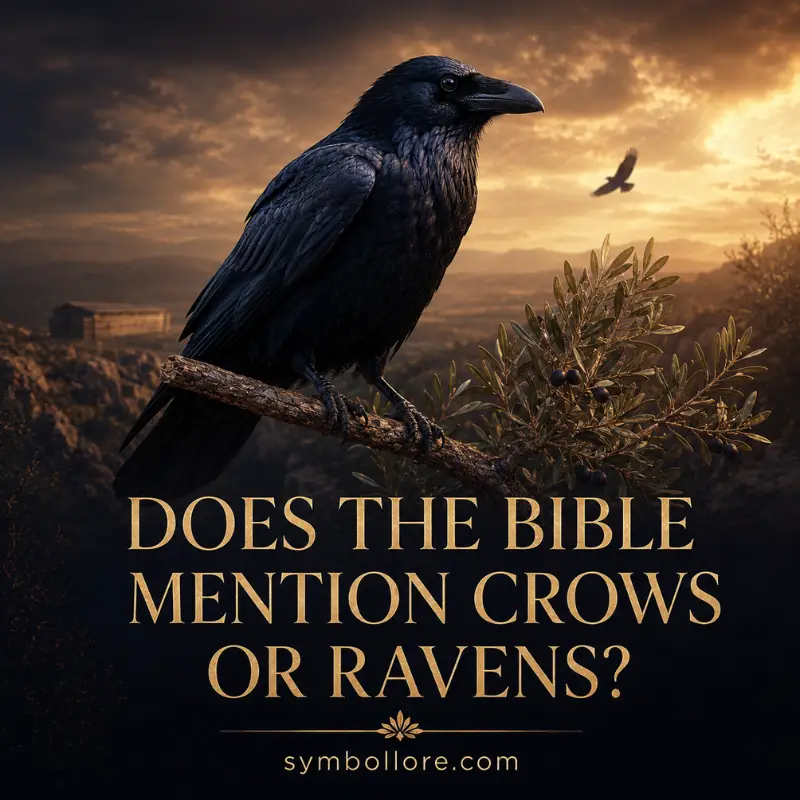
Most standard English translations use raven in the passages commonly discussed as crow symbolism. The underlying biblical terms are broader than modern English bird labels, but translators consistently identify the relevant bird as a raven.
This distinction matters because a crow and a raven are not the same species. Nevertheless, both belong to the corvid family.
The Cornell Lab of Ornithology’s crow and raven guide
explains that both are large, black corvids, although ravens generally have heavier bills, larger bodies, and differently shaped tails.
Therefore, “crow” remains a useful popular search term. Still, a careful biblical explanation should say raven when discussing the actual wording of Genesis, Leviticus, Kings, Job, Psalms, Isaiah, and Luke.
What Crow Symbolism in the Bible Really Means
Crow symbolism in the Bible does not function as a single code with one universal definition. The bird’s role depends on the genre and setting of each passage.
Five themes emerge:
- Survival: The raven remains active above the Flood waters.
- Ritual impurity: Israel could not eat ravens under Mosaic dietary law.
- Divine provision: Ravens bring food to Elijah.
- Dependence: Young ravens rely on God’s sustaining order.
- Desolation: Ravens inhabit ruined landscapes in prophetic poetry.
These meanings can appear to conflict. An unclean bird becomes God’s chosen means of feeding a prophet. Yet that contrast supports an important biblical idea: God’s authority is not restricted by human expectations about which creatures seem useful, beautiful, or respectable.
Noah’s Raven in Genesis 8:7
In Genesis 8:7, Noah releases a raven after the Flood. It flies back and forth until the waters dry from the earth. Noah then sends a dove, which returns before later bringing an olive leaf.
The Genesis account
does not say that the raven disobeyed Noah, abandoned the ark selfishly, or represented Satan. Those ideas come from later interpretation rather than the stated narrative.
The raven may have been suited to surviving above a damaged landscape because corvids can eat many kinds of food. However, Genesis emphasizes the progress of the receding water, not the bird’s moral character.
Readers may view the raven as a sign of endurance or continued life after catastrophe. They should not present that application as the only divinely assigned meaning.
Elijah and the Ravens in 1 Kings 17
Ravens become agents of provision in Elijah’s story. During a severe drought, God directs the prophet to hide near the Kerith Ravine. Ravens then bring him bread and meat in the morning and evening.
The account in 1 Kings 17:2–6
emphasizes God’s ability to sustain Elijah in an unlikely way. The birds are not omens that merely announce help. They perform the practical task of delivering food.
This scene reverses ordinary expectations. An animal later readers may associate with carrion and death becomes a source of life. Moreover, a creature prohibited as food under Israel’s law carries acceptable food to God’s prophet.
The passage therefore supports themes of providence, obedience, and unexpected help. It does not establish ravens as universal heavenly messengers for every person who sees one.
Why Ravens Were Classified as Unclean Birds
Ravens appear among the prohibited birds in Leviticus 11 and Deuteronomy 14. Israelites living under the Mosaic covenant were not permitted to eat them.
The scholarly reference
Bible Odyssey’s entry on the raven
identifies the bird as unclean and connects it with several biblical passages. In this context, unclean describes ritual or dietary classification. It does not mean that every raven was sinful, demonic, or hated by God.
That distinction is essential. Animals do not commit moral wrongdoing by following their natural feeding behavior. Scripture itself later depicts God commanding ravens, feeding their young, and using them in Jesus’ teaching.
Therefore, biblical impurity should not be converted into a claim that a crow’s presence brings evil. The dietary category concerns Israel’s religious practice, not a permanent spiritual curse attached to the animal.
God Feeds the Ravens
Several passages use ravens to show the reach of God’s care. Job 38:41 asks who provides prey when young ravens cry out for food. Psalm 147:9 similarly praises God for feeding animals and young ravens.
Jesus develops the same theme in Luke 12:24. He tells his disciples to consider ravens: they do not plant crops or maintain barns, yet God feeds them. His point concerns anxiety and trust, not bird divination.
The collection of relevant verses can be read together in this
Bible Gateway passage comparison..
Together, they establish a striking contrast. Ravens were excluded from Israel’s diet, but they were never excluded from God’s care.
For Christian readers, the primary lesson is reassurance: if God sustains creatures people often overlook, human life is not beyond his attention.
Ravens, Desolation, and Judgment
Ravens can contribute to images of desolation in prophetic writing. Isaiah 34:11, for example, describes birds inhabiting Edom after judgment turns its settled land into ruins.
The raven is effective in this picture because it can live in harsh or abandoned environments. Its presence helps readers imagine a formerly populated place becoming wild and empty. The surrounding passage, rather than the bird alone, communicates divine judgment.
This distinction prevents overinterpretation. Isaiah does not announce that every raven predicts destruction. It uses several wild creatures to build one poetic scene about Edom.
Therefore, desolation is a genuine aspect of raven symbolism, but it remains context-specific. Readers should not detach the animal from Isaiah’s prophecy and apply the image automatically to a crow outside their home.
Do Crows Represent Death or Evil in Scripture?
Crows and ravens do not serve as universal biblical symbols of death or evil. Their dark feathers, scavenging behavior, and presence around dead animals helped produce ominous meanings in later art and folklore. Those associations are understandable, but they do not control every biblical passage.
Scripture offers a more varied picture. The Flood narrative places a raven above a devastated world, and Isaiah includes one in a ruined landscape. In contrast, Kings portrays ravens preserving Elijah’s life. Job, Psalms, and Luke present them as recipients of God’s care.
Calling the raven simply “evil” ignores this evidence. A better interpretation recognizes tension: the bird can inhabit death-marked environments while still remaining part of creation and an instrument of provision.
Is Seeing a Crow a Biblical Sign?
Seeing a crow is not, by itself, a biblical sign. The Bible never provides a rule stating that an ordinary crow encounter predicts death, money, transformation, spiritual warfare, or a message from a deceased person.
A grounded response involves three questions:
- Is there an ordinary explanation? Crows commonly live near farms, parks, roads, and cities.
- Does Scripture assign this event a meaning? No biblical passage interprets random sightings through a fixed omen system.
- Does the interpretation create fear or certainty without evidence? If so, caution is appropriate.
A crow may remind a believer of God’s provision in Luke or Elijah’s experience in Kings. That is a personal reflection based on Scripture, not proof that God sent a coded prediction.
Crow Numbers and Popular Spiritual Claims
The Bible does not assign special crow meanings to sightings of one, two, three, or seven birds. Popular lists may claim that two crows promise harmony or that three predict change, but these formulas come from folklore or modern spiritual systems.
Biblical numbers sometimes carry literary or theological importance. That fact does not authorize attaching a meaning to every numbered group of animals. A valid interpretation needs textual support, not merely a number that appears elsewhere in Scripture.
Consequently, seeing several crows usually means that social birds have gathered around food, shelter, or one another. Readers can appreciate the experience without treating the group as a prophetic calculation.
FAQs
The biblical meaning of crows is drawn mainly from passages about ravens. Depending on context, the bird can represent survival, ritual impurity, desolation, God’s care, or unexpected provision. Scripture does not give it one fixed symbolic definition.
No. Ravens were classified as unclean for Israel’s diet, but ritual impurity is not the same as moral evil. God commands ravens to feed Elijah and cares for their young, showing that these birds remain under divine authority and care.
Christian Scripture provides no special meaning based solely on a crow’s black color. Later Western culture often connects black birds with death or mystery, but Christians should distinguish those traditions from biblical teaching.
Genesis says Noah released a raven, not a crow, although both birds belong to the corvid family. The raven flew back and forth until the water dried. The passage does not explicitly condemn the bird or explain its behavior as a spiritual failure.
The passage demonstrates God’s control over creation and his ability to provide through unexpected means. Ravens brought bread and meat during the drought. The narrative does not explain why that species was chosen, so stronger claims remain speculative.
No biblical teaching connects a crow outside a home with an approaching death. Crows regularly visit populated areas to find food, nesting locations, and safe resting places. Treating their presence as a guaranteed warning goes beyond Scripture.
Conclusion
Crow symbolism in the Bible should be interpreted through passages that actually speak about ravens. These texts present a varied picture: an unclean bird survives above the Flood, feeds Elijah, depends on God for food, and appears in prophetic scenes of desolation.
Therefore, the crow is neither a universal sign of evil nor a guaranteed heavenly messenger. Its strongest biblical lesson is that God can sustain creation and provide through unexpected means. Personal reflection is reasonable, but omen claims require support that Scripture does not provide.