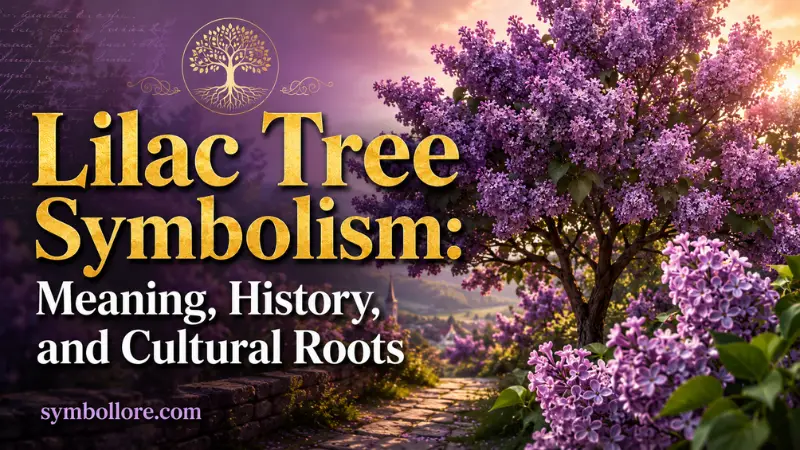
Lilac tree symbolism centers on first love, youthful beauty, renewal, memory, and spring. These meanings grew from the plant’s short but striking bloom, strong fragrance, and place in nineteenth-century flower language. Later, poetry and American garden traditions added deeper associations with remembrance and loss.
The common lilac, Syringa vulgaris, has a long history outside North America. It moved through European gardens before becoming a familiar part of American landscapes. Because old lilac bushes can remain for generations, the tree-like shrub can also become a living marker of family, home, and memory.
Still, lilac does not have one universal meaning. Purple and white flowers developed different associations in Victorian flower books, while literature created another layer around grief and remembrance. The setting, period, color, and personal history all matter.
Quick Answer
Lilac tree symbolism most strongly represents first love, youth, renewal, and remembrance. Purple lilac became associated with the first emotions of love in nineteenth-century flower language, while its spring bloom and powerful fragrance encourage ideas of returning life and treasured memories. In the United States, literature and family gardens have added strong associations with grief and nostalgia.
TL;DR
- Purple lilac traditionally represents the first emotions of love in Victorian flower language.
- White lilac was associated with youthful innocence in several nineteenth-century sources.
- Spring flowering supports modern meanings of renewal, return, and hope.
- Lilac fragrance can trigger powerful associations with memory and nostalgia.
- Walt Whitman’s poetry gave lilacs a major American literary connection with grief and remembrance.
- Lilac meanings vary by historical source, color, culture, and personal experience.
Lilac Tree Meanings at a Glance
| Context or Feature | Possible Meaning | Why the Association Exists | Important Limit |
|---|---|---|---|
| Purple lilac | First love | Victorian flower dictionaries connected it with early romantic feeling | A historical flower-language meaning, not a universal code |
| White lilac | Youthful innocence | Nineteenth-century sources associated white lilac with youth and innocence | Different books sometimes varied |
| Spring bloom | Renewal and return | Lilacs flower as winter gives way to warmer weather | A natural metaphor rather than a fixed tradition |
| Strong fragrance | Memory and nostalgia | Scent can become closely tied to places and past experiences | Personal associations differ |
| Old garden lilac | Family memory and continuity | Long-lived plantings can remain where families once lived | The meaning comes from lived history |
| Whitman’s lilac | Grief and remembrance | When Lilacs Last in the Dooryard Bloom’d uses lilacs in mourning for Lincoln | This is a specific literary symbolism |
| Lilac color | Gentleness and youthful beauty | Pale purple combines associations of purple with a softer visual tone | Modern color meanings are flexible |
What Does Lilac Tree Symbolism Mean?
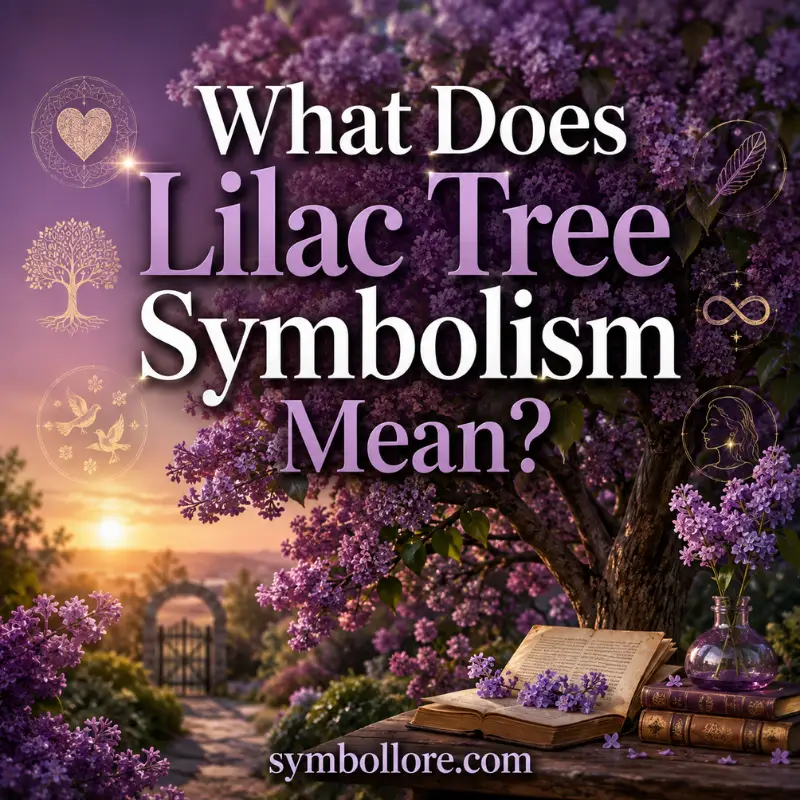
Lilac symbolism is strongest when several ideas meet: new love, youth, seasonal renewal, memory, and beauty that does not last forever.
The connection with first love has unusually clear historical support. Kate Greenaway’s Language of Flowers, published in 1884, lists purple lilac as “First emotions of love” and white lilac as “Youthful Innocence.” Other nineteenth-century flower-language sources also connect lilac with the first emotions of love.
The reason given in an older flower-language text is revealing. The lilac’s fresh leaves, abundant flowers, soft colors, fragrance, and brief spring display were compared with the freshness and intensity of youthful emotion. In other words, the symbolism was not simply an arbitrary label. Writers saw the plant’s appearance and seasonal behavior as a fitting metaphor for early love.
That distinction matters today. A purple lilac can reasonably suggest a first romance or the tenderness of a young relationship. It does not automatically communicate eternal love, marriage, or lifelong devotion.
Why Lilacs Became Symbols of Spring and Renewal
Lilacs naturally invite interpretations of renewal because their flowers arrive with the return of spring.
After a dormant winter period, the plant produces fresh foliage and dense clusters of fragrant flowers. For people living in colder regions, that seasonal return can feel especially significant. The bloom becomes a visible sign that winter has ended and another growing season has begun.
This association does not require an ancient religious doctrine. It is a symbolic reading based on the plant’s observable life cycle.
The Arnold Arboretum describes lilac flowers as arriving as temperatures warm and notes how their fragrance can evoke memories of springs past. Its collection also celebrates the seasonal arrival of lilacs each year.
As a result, a blooming lilac tree can represent:
- a fresh beginning;
- recovery after a difficult period;
- the return of something cherished;
- youth and seasonal energy;
- hope after dormancy; and
- beauty appearing at the right moment.
The idea of renewal is therefore strong, but it should remain an interpretation. The plant does not predict that a new beginning will occur. Instead, its seasonal return provides a useful image for one.
The Historical Roots of Lilac Symbolism
The common lilac is not native to North America. Syringa vulgaris originated in eastern Europe, while the wider Syringa genus includes species from Europe and Asia. Lilacs later became established in Western gardens and eventually became deeply familiar in American horticulture.
The plant also has an interesting linguistic history. Encyclopaedia Iranica notes that the word “lilac” is connected with Persian terminology associated with indigo or dark blue. The same source explains the botanical name Syringa, which connects to the Greek figure Syrinx and refers to the hollow stems of the genus.
This history needs one important correction.
The story of Syrinx is not an ancient Greek myth about the lilac flower itself. Syrinx was transformed into a reed, and the botanical name Syringa later connected the plant to that older story because of its hollow shoots. The linguistic connection is real, but saying that ancient Greeks believed the lilac shrub symbolized a particular quality would go beyond the evidence.
The plant’s symbolic history is better understood as layered. Its natural qualities came first. European garden culture and flower language added meanings later. American literature and personal memory added still more.
Purple Lilac and the Meaning of First Love
Purple lilac has the clearest traditional romantic meaning.
In Greenaway’s 1884 flower dictionary, purple lilac represents the first emotions of love. Other nineteenth-century sources preserve essentially the same association. The symbolism fits the plant’s short spring flowering period and its soft, youthful colors.
This meaning is narrower than simply saying “love.”
Roses became strongly associated with romantic love in Western flower language. Lilac instead points toward the beginning of romantic feeling. It can suggest a first crush, early courtship, youthful attraction, or the emotional awakening that accompanies a new relationship.
That distinction can make lilac particularly meaningful for:
- first-love memories;
- teenage or young-adult romance;
- anniversary designs that recall a couple’s early years;
- literary scenes about new affection; and
- personal artwork about emotional beginnings.
However, Victorian flower language was never one perfectly standardized system. Smithsonian Gardens notes that nineteenth-century flower guides could disagree with each other, meaning readers needed to know which floral dictionary they were following.
So the historical meaning is well documented, but it should not be treated as an eternal rule.
White Lilac and Youthful Innocence
White lilac carries a different historical association.
Greenaway lists white lilac as youthful innocence. Other nineteenth-century flower-language comparisons also connect white lilac with youth, purity, or innocence.
The symbolism makes visual sense. White flowers often invite ideas of freshness and simplicity, while the lilac’s spring appearance adds a sense of youth and newness.
Still, modern readers should avoid assuming that every white lilac arrangement carries a Victorian message. White flowers can mean peace, remembrance, celebration, simplicity, or personal affection depending on the setting.
A white lilac planted near a family home might therefore mean something completely different from a white lilac used in a historical illustration.
The safest interpretation is to treat “youthful innocence” as a documented historical association rather than a universal definition.
How Fragrance Gives Lilacs a Memory Symbolism
Lilac’s fragrance gives its symbolism an unusually personal quality.
A person may forget the appearance of an old garden while remembering its scent instantly. That sensory connection can make lilac a powerful symbol of childhood, family, home, or someone who has died.
The Arnold Arboretum’s account of lilacs describes fragrance as a trigger for memories of earlier springs. The same account connects lilacs with family history and memories of gardens planted by earlier generations.
This creates a useful distinction between traditional symbolism and personal symbolism.
Traditional flower language says what lilac could represent within a historical system. Personal memory explains why a particular lilac tree may mean something much more specific to one person.
For example, an old bush beside a childhood home might symbolize:
- a grandparent’s care;
- family continuity;
- a house that no longer exists;
- childhood itself;
- a lost relationship; or
- the persistence of memory.
None of these meanings needs to be an ancient tradition. Personal symbolism becomes legitimate when the connection comes from lived experience.
Lilacs, Home, and Family Continuity
Lilac trees can become symbols of home because they often remain in gardens for many years.
The University of New Hampshire describes historical lilacs as family possessions rather than agricultural commodities. Its account notes that the plant was often grown by homes, fences, barns, and other familiar domestic spaces. Lilacs therefore became part of household memory rather than simply decorative horticulture.
This history helps explain a common modern interpretation: the lilac tree as a living connection to the past.
An old lilac may survive changes that remove almost everything else from a property. Buildings can be replaced. Families can move. Gardens can disappear. Yet a mature shrub may continue flowering in the same location.
That makes lilac particularly useful in memorial landscapes and family stories. The plant does not literally preserve a person’s memory. Instead, its continued presence gives people a physical object around which memory can gather.
The idea is especially powerful when a family propagates or replants lilacs from an older garden.
Lilac and Grief in American Literature
One of the most important American meanings of the lilac comes from Walt Whitman’s poem “When Lilacs Last in the Dooryard Bloom’d.”
Whitman wrote the elegy after Abraham Lincoln’s assassination in 1865. The poem places the blooming lilac beside the fallen star and the hermit thrush, creating a symbolic structure around death, mourning, and national grief. The Library of Congress describes the work as one of Whitman’s major Lincoln laments and highlights its use of lilac, star, and thrush as enduring images.
The lilac does not simply mean death in the poem.
Instead, it becomes part of a larger process of mourning. Spring continues to return while the speaker remembers someone who has died. That tension gives the flower a deeper meaning: life continues, memory remains, and grief becomes part of the cycle of returning seasons.
The poem repeatedly returns to the lilac in the dooryard. The ordinary domestic setting matters. The flower is not a distant mythical object. It grows near a home, making national loss feel personal and immediate.
The Library of Congress also explains how Whitman connected the poem with national healing and regeneration.
Because of Whitman’s influence, American readers may encounter lilac as a symbol of remembrance even when they have never studied Victorian flower language.
Lilac, Memory, and the Passage of Time
Lilac symbolism becomes especially interesting because the flower combines return and impermanence.
The plant returns each spring. Yet the individual flowers last only for a limited period. This creates a natural contrast between continuity and change.
A person may therefore interpret a lilac tree as a reminder that some things return without ever returning in exactly the same form.
The same garden may look different each year. People grow older. Houses change. Relationships begin and end. Yet the familiar scent of lilac can suddenly connect the present with an earlier moment.
This helps explain why lilac often works well in literary symbolism. A writer can use one flowering tree to bring together present experience and remembered time.
T. S. Eliot’s The Waste Land provides an important literary example. The Library of Congress notes that Eliot’s opening reference to lilacs is widely understood as an allusion to Whitman’s Lincoln elegy.
That literary connection adds another layer. Lilac can suggest spring and renewal while also carrying memories that make renewal painful or complicated.
Lilac Tree Symbolism in American Culture Today
Modern American use tends to blend historical flower language with personal experience.
A lilac may appear in gardens, wedding arrangements, memorial settings, artwork, tattoos, stationery, and seasonal decoration. Yet the intended meaning often comes from the situation rather than from a strict symbolic code.
For example, someone might plant a lilac tree to remember a parent. Another person might choose purple lilacs to represent a first love. A gardener may simply love the fragrance and later discover that the plant has a long symbolic history.
All three uses are valid, but they should not be presented as the same tradition.
Lilacs also have a strong place in American horticultural history. Thomas Jefferson recorded planting lilacs in his Garden Book in 1767, and George Washington recorded transplanting lilacs in 1785. Harvard’s Arnold Arboretum also notes that some historic North American lilacs may date to around 1750.
That long presence helps explain why lilacs can feel deeply American even though the plant is not native to North America.
What Lilac Tree Symbolism Means in Different Contexts
The same tree can communicate different ideas depending on how someone uses it.
In a garden
A flowering lilac can represent spring, beauty, continuity, and a connection to home. If the tree has been in the garden for decades, family history may become more important than traditional flower language.
In a romantic setting
Purple lilac can recall first love and early romantic feelings. This is the strongest historically documented romantic association.
In a memorial
Lilac can represent remembrance, continuing affection, and the persistence of memory. Whitman’s poetry makes this especially recognizable within American literary culture.
In artwork
A lilac tree can mark a transition between seasons or between past and present. Its brief flowers make it useful for expressing beauty, youth, and impermanence at the same time.
In a family story
An old lilac may represent ancestry, home, childhood, or a person who planted it. In this case, the symbolism is personal and local rather than part of a formal flower-language tradition.
For readers exploring related plant meanings,
offers another useful example of how color and historical flower dictionaries can produce different meanings across periods.
Lilac Symbolism and the Meaning of Color
Color can refine lilac’s symbolism, but it should not be treated as a universal code.
Purple lilac
Purple lilac has the strongest historical association with first love. Its color also contributes to a broader impression of beauty and emotional depth.
White lilac
White lilac is associated with youthful innocence in Victorian flower language. Today, it can also suggest simplicity, peace, or remembrance.
Pink lilac
Pink lilacs may be interpreted through modern associations of tenderness, affection, and warmth. These meanings are less firmly established than the traditional purple and white associations.
Blue-toned lilac
Some lilac cultivars have cool blue-violet tones. Modern viewers may connect them with calmness or gentleness, but those interpretations should not be presented as a fixed historical flower-language rule.
The Smithsonian’s discussion of flower language is useful here because it stresses that meanings changed across time and culture.
What Lilac Symbolism Does Not Mean
Several popular claims about lilacs deserve caution.
First, lilac does not have one universal spiritual meaning. A person may personally view a blooming lilac as a sign of renewal, but that does not establish a supernatural message.
Second, lilac does not have a single ancient meaning that survived unchanged into modern America. Its symbolism developed through different sources, including horticulture, flower dictionaries, literature, and personal memory.
Third, the Syrinx story should not be described as an ancient myth specifically explaining the lilac shrub. The connection comes through the later botanical name Syringa and the plant’s hollow stems.
Finally, lilac does not simply mean “death” because Whitman used it in an elegy. His poem created a powerful association with mourning, but the same flower already had romantic and youthful meanings.
The most accurate approach is therefore layered rather than absolute.
How to Interpret Lilac Tree Symbolism Responsibly
Start with the context.
If a historical character gives someone purple lilacs, check the flower-language tradition available in that period. If the scene comes from nineteenth-century culture, the first-love meaning may be especially relevant.
If an old lilac appears beside a family home, consider memory and continuity. The location may tell you more than the color.
If the flower appears in a memorial poem, look for literary connections. Whitman’s work may make grief and remembrance more important than romantic symbolism.
Finally, consider the plant itself. Spring return, fragrance, dense blossoms, and a relatively brief flowering period all provide natural images for renewal, beauty, youth, and memory.
This approach avoids turning symbolism into a fixed dictionary. Instead, it treats symbols as relationships between objects, people, history, and meaning.
For a broader comparison,
shows how a plant’s seasonal behavior can also shape ideas of endurance and continuity.
Likewise, hawthorn symbolism
demonstrates why plant meanings should remain tied to particular folklore, historical periods, and cultural settings rather than being treated as universal.
FAQs
A lilac tree commonly symbolizes first love, youth, renewal, memory, and spring. Purple lilac has a documented nineteenth-century association with the first emotions of love, while the plant’s spring flowering encourages ideas of return and renewal. In American literature, lilacs can also represent grief and remembrance.
A purple lilac traditionally symbolizes the first emotions of love. This meaning appears in nineteenth-century flower-language sources, including Kate Greenaway’s 1884 Language of Flowers. Modern readers may use purple lilac more broadly for romance or affection, but first love is the strongest historical association.
White lilac was associated with youthful innocence in Victorian flower language. Modern arrangements can give white lilacs additional meanings, such as peace, simplicity, remembrance, or fresh beginnings. The historical meaning should therefore be separated from contemporary personal symbolism.
Lilacs have a strong fragrance that can become linked with particular people, gardens, homes, and seasons. Their recurring spring bloom can also bring back memories of earlier years. This makes memory a powerful personal association, although it is not a universal traditional meaning.
Lilac became strongly associated with grief through Walt Whitman’s 1865 elegy “When Lilacs Last in the Dooryard Bloom’d,” written after Abraham Lincoln’s assassination. Whitman used the recurring spring flower within a larger meditation on death, mourning, memory, and national healing.
Yes, lilac can symbolize renewal because it returns with fresh growth and flowers in spring. This is best understood as a natural metaphor rather than a universal religious belief. Its seasonal return can represent recovery, hope, or the beginning of a new phase.
There is no established biblical symbolism for the modern lilac shrub. Claims that lilac has a specific biblical meaning should therefore be treated cautiously. A Christian or spiritual interpretation can be personally meaningful, but it should not be presented as a meaning explicitly assigned to lilac in biblical texts.
Conclusion
Lilac tree symbolism brings together first love, youthful beauty, spring renewal, memory, and remembrance. Purple lilac gained its strongest romantic meaning through nineteenth-century flower language, while white lilac became associated with youthful innocence. In America, family gardens and Walt Whitman’s poetry added powerful associations with home, grief, and memory.
The symbol works best when its context remains visible. A purple bloom may recall a first romance, while an old flowering bush may preserve a family memory. In Whitman’s poetry, the same flower becomes part of mourning and healing. Lilac therefore does not carry one fixed message. Its meaning grows from color, season, history, literature, and the human memories attached to it.
Five Related Articles from symbollore.com
- Larkspur Flower Symbolism — https://symbollore.com/larkspur-flower-symbolism/
- Hawthorn Symbolism — https://symbollore.com/hawthorn-symbolism/
- Crepe Myrtle Symbolism — https://symbollore.com/crepe-myrtle-symbolism/
- Evergreen Symbolism — https://symbollore.com/evergreen-symbolism/
- Apricot Symbolism — https://symbollore.com/apricot-symbolism-meaning/