Fire symbolism in the Bible does not carry one fixed meaning. Depending on the passage, fire can reveal God’s holy presence, guide his people, accept a sacrifice, refine faith, or portray judgment and destruction. The surrounding story determines which meaning applies.
That contrast gives biblical fire much of its power. A flame may provide light in Exodus, test a person’s work in Paul’s letters, or express final judgment in Revelation. Readers must therefore examine who sends the fire, what it does, and what follows.
Quick Answer
Fire symbolism in the Bible most often represents God’s presence and holiness, divine judgment, purification, guidance, accepted worship, or the work of the Holy Spirit. It is not automatically positive or negative. Its meaning depends on the speaker, setting, purpose, and result of the fire within each passage.
Key Takeaways
- Biblical fire has several meanings rather than one universal definition.
- Context determines whether fire reveals, guides, refines, or destroys.
- The burning bush presents fire as a sign of holy presence.
- Refining imagery describes testing and purification, not simple destruction.
- Pentecost uses fire-like imagery to mark the Spirit’s arrival.
- Modern disasters should not automatically be labeled divine judgment.
Biblical Fire Meanings at a Glance
| Passage or Image | Context | Primary Meaning | Important Distinction |
|---|---|---|---|
| Burning bush, Exodus 3:2–6 | Moses’ call | Divine presence and holiness | The bush burns without being consumed |
| Pillar of fire, Exodus 13:21–22 | Israel’s journey | Guidance, light, and protection | Fire directs rather than destroys |
| Mount Sinai, Exodus 19:18 | Covenant revelation | Majesty, holiness, and awe | Fire marks God’s descent |
| Altar fire, Leviticus 6:12–13 | Israelite worship | Continuing sacrifice and sacred service | A real flame gains ritual significance |
| Refiner’s fire, Malachi 3:2–3 | Purification of worship | Testing and cleansing | Heat removes impurity |
| Tongues as of fire, Acts 2:1–4 | Pentecost | The Holy Spirit’s presence and empowerment | The text uses comparative language |
| Lake of fire, Revelation 20:14–15 | Final judgment | Defeat, punishment, and exclusion | Apocalyptic imagery requires genre awareness |
What Fire Symbolism in the Bible Means
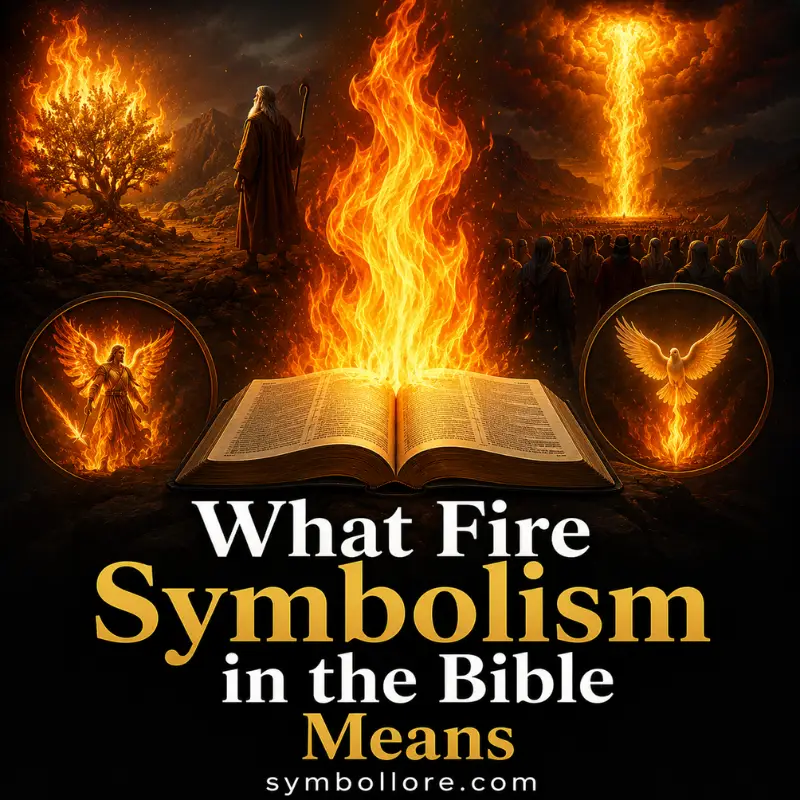
Biblical fire represents an intense encounter with power. Sometimes that power reveals God. In other passages, it guides, purifies, accepts an offering, exposes wrongdoing, or destroys what opposes God’s purposes.
This range reflects the physical behavior of fire. A flame gives warmth and light, yet it can also consume. Heat can destroy a field, but it can refine metal. Biblical writers use these familiar qualities to explain holiness, moral testing, protection, divine action, and judgment.
The American Bible Society’s overview of fire
similarly groups the image around God’s presence, Israelite worship, punishment, and purification. Those categories show why a verse should never be interpreted from the word fire alone: the action and setting supply its meaning.
Fire as God’s Presence and Holiness
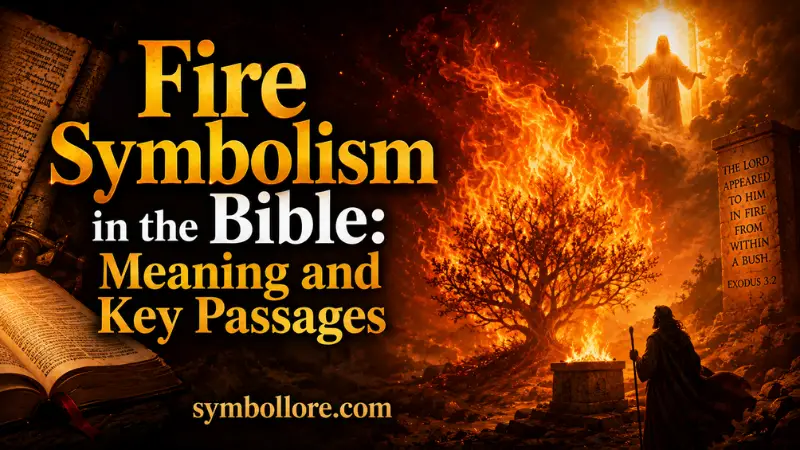
Fire often marks God’s presence without suggesting that God is merely a physical flame. The burning bush in Exodus 3 is the best-known example. Moses sees a bush burning without being consumed, then hears God call him to remove his sandals because the ground is holy.
This event is a theophany, meaning a visible manifestation through which God makes his presence known. The unusual flame attracts Moses, but God’s speech interprets the moment. The passage is about revelation, holiness, and a divine commission rather than fire as an independent magical force.
A concise scholarly entry from
notes that biblical fire can signify holiness, protection, and divine action. Mount Sinai develops the same association on a larger scale: fire, smoke, sound, and trembling communicate the seriousness of encountering the holy God.
The Pillar of Fire: Guidance and Protection
The pillar of fire represents God’s guidance, light, and continuing presence during Israel’s departure from Egypt. According to Exodus 13:21–22, the pillar allowed the people to travel at night while the cloud guided them during the day.
Here, fire does not punish or purify. It makes the path visible. Later, the cloud and fire also stand between Israel and the Egyptian forces, giving the image a protective function.
The passage demonstrates why symbolic dictionaries alone cannot settle meaning. The pillar’s position, movement, and effect reveal its purpose. It leads a community through danger and reassures the people that they have not been abandoned.
Altar Fire, Sacrifice, and Accepted Worship
In Israelite worship, altar fire had both practical and sacred functions. It consumed offerings, produced smoke, and maintained the continuing service commanded in the sanctuary. Leviticus 6:12–13 instructs priests to keep the altar flame burning.
At significant moments, fire coming from God consumes a sacrifice and signals acceptance. Leviticus 9:24 describes this at the beginning of Aaron’s priestly service. A similar pattern appears in Elijah’s confrontation with the prophets of Baal in 1 Kings 18:38.
However, the flame itself is not the object of worship. Its meaning comes from God’s action, the covenant setting, and the offering. Biblical altar fire therefore points toward sacred service, divine acceptance, and the seriousness of approaching God as instructed.
Refiner’s Fire: Purification and Testing
Refiner’s fire represents a process that exposes and removes impurity. Ancient metalworkers heated ore or metal so unwanted material could be separated from what was valuable. Biblical writers turned that visible process into a moral and spiritual comparison.
Malachi 3:2–3 portrays the coming Lord like a refiner who purifies the descendants of Levi. The goal is corrected worship, not pointless suffering. Zechariah 13:9 uses similar language for a tested people who again call upon God.
First Peter 1:6–7 compares tested faith with gold examined by fire. Trials do not automatically prove that someone has failed. Within that passage, testing can reveal faith’s genuineness. Consequently, refining should not be confused with every example of punitive fire.
Fire as Judgment and Destruction
Fire represents judgment when the passage connects it with wrongdoing, defeat, punishment, or the removal of evil. Examples include Sodom and Gomorrah, prophetic warnings against nations, Jesus’ judgment sayings, and Revelation’s lake of fire.
The physical force of fire makes it a natural image for irreversible loss. Yet biblical judgment passages differ in genre. A historical narrative, prophetic poem, parable, and apocalyptic vision should not be read in exactly the same way.
This distinction also limits modern applications. Christianity.com appropriately notes in its discussion of
that people should not assume every house fire or wildfire is God’s punishment. Unless Scripture interprets a specific event that way, claiming to know its divine cause goes beyond the text and may deepen the suffering of victims.
The Holy Spirit and Tongues of Fire
At Pentecost, fire-like tongues accompany the arrival of the Holy Spirit and the disciples’ ability to speak in other languages. Acts does not simply say that ordinary flames burned the believers. It says that divided tongues “as of fire” appeared and rested on them.
That wording identifies a visible comparison. The image recalls earlier scenes of divine presence while also fitting the event’s emphasis on speech. What looks like a tongue rests on each person, and spoken languages immediately follow.
The full account of Pentecost in Acts 2
connects the signs with the Spirit’s empowerment and a multilingual public witness. Therefore, tongues of fire primarily signify divine presence and mission in this scene, rather than uncontrolled emotion or literal burning.
What Does Baptism With Fire Mean?
“Baptism with fire” has more than one major Christian interpretation. In Matthew 3:11–12 and Luke 3:16–17, John the Baptist says that the coming Messiah will baptize with the Holy Spirit and fire. He then describes wheat gathered safely and chaff burned.
One interpretation treats Spirit and fire as a unified promise of cleansing and empowerment. Another understands the Spirit as a gift for the repentant and fire as judgment for the unrepentant. Some readers connect the phrase closely with Pentecost.
The immediate mention of burning chaff gives the judgment reading substantial contextual support. Still, Christian traditions differ. A careful explanation should acknowledge this debate instead of claiming that “fire baptism” always means intense worship, spiritual enthusiasm, or a particular modern experience.
Fire Imagery From the Old to New Testament
The New Testament inherits fire imagery already established in the Hebrew Scriptures. The Old Testament connects fire with divine presence at the burning bush and Sinai, guidance in the wilderness, sacrificial worship, prophetic judgment, and purification.
The New Testament applies related imagery to Jesus’ teaching, the Holy Spirit’s appearance at Pentecost, the testing of human work, and final judgment. Hebrews 12:29 even repeats the description of God as a consuming fire from Deuteronomy 4:24.
Continuity does not mean that every passage is interchangeable. Acts 2 is not another destruction of Sodom, and the lake of fire is not another pillar guiding Israel. Shared imagery creates a relationship between passages, while each author and setting directs the specific interpretation.
How to Interpret Fire in a Biblical Passage
A reliable interpretation begins with context rather than a preset symbolic definition. Four questions can guide the reading:
- What kind of text is this? Identify narrative, law, poetry, prophecy, parable, letter, or apocalyptic vision.
- Is the fire literal, comparative, or visionary? A real altar flame functions differently from a prophetic metaphor.
- What does the fire do? It may reveal, illuminate, guide, test, accept, consume, or punish.
- How does the passage explain the result? Look for holiness, protection, repentance, destruction, empowerment, or restored worship.
Readers should also compare nearby verses before moving to distant cross-references. Repeated imagery can illuminate a passage, but it should not erase the meaning created by its immediate story.
Common Misunderstandings About Biblical Fire
Biblical fire is not a secret code with one answer. It does not always mean the Holy Spirit, hell, anger, or personal transformation. Those associations apply only when the passage supports them.
Likewise, a dream about fire does not receive an automatic biblical interpretation. The Bible records some meaningful dreams, but it does not provide a universal dream dictionary in which every flame predicts the same event.
People should also avoid declaring that victims of wildfires, accidents, or war have experienced divine punishment. Biblical narratives sometimes identify a judgment explicitly. Modern observers usually lack that authority and knowledge. A responsible reading combines close attention to Scripture with humility, compassion, and awareness of literary genre.
FAQs
Fire can be positive, negative, or awe-inspiring depending on its function. It guides Israel, marks God’s presence, and refines faith, but it also portrays destruction and judgment. The image’s moral meaning comes from the surrounding passage rather than from fire itself.
The burning bush primarily signifies God’s holy presence and Moses’ divine calling. Its flame attracts Moses without consuming the plant, setting the event apart from an ordinary brush fire. God’s command to remove his sandals confirms that the encounter concerns holiness and revelation.
Deuteronomy 4:24 calls God a consuming fire while warning Israel against idolatry, and Hebrews 12:29 repeats the expression. It emphasizes God’s uncompromising holiness and the seriousness of covenant loyalty. It does not mean that God’s entire nature can be reduced to physical fire.
No. Fire is associated with the Holy Spirit at Pentecost and in John the Baptist’s announcement, but many other passages concern guidance, sacrifice, purification, human destruction, or judgment. Identifying the Spirit requires evidence from the passage, not merely the presence of a flame.
Not necessarily. Refining imagery emphasizes testing, purification, and the removal of what is corrupt. Although that process may be painful, passages such as Malachi 3:2–3 describe a corrective purpose. Punitive fire, by contrast, may emphasize destruction, exclusion, or final judgment.
The lake of fire represents final judgment, defeat, and the “second death” within Revelation’s apocalyptic vision. Christian traditions differ on some details of final punishment. However, the image clearly communicates the ultimate removal of evil rather than ordinary earthly fire.
Conclusion
Fire symbolism in the Bible includes holiness, divine presence, guidance, worship, purification, spiritual empowerment, and judgment. No single definition fits every appearance. The burning bush reveals, the wilderness pillar leads, the refiner’s flame tests, and judgment fire consumes.
The safest approach is to read each image within its literary and historical setting. Identify what the fire does, who controls it, and how the passage explains its result. That context preserves the force of the symbol without turning it into an oversimplified spiritual code.