
Raven symbolism in Celtic culture is closely connected with ideas of warfare, prophecy, fate, wisdom, and the mysterious boundary between life and death. These meanings developed from Celtic mythology, heroic stories, and the bird’s presence around battlefields and sacred narratives.
However, the raven did not have one single meaning across all Celtic traditions. Irish mythology, Welsh legends, and later folklore used the bird in different ways. Understanding the raven requires looking at the stories, cultures, and historical settings that shaped its symbolism.
Quick Answer
Raven symbolism in Celtic culture often represents fate, battle, prophecy, transformation, and hidden knowledge. These meanings grew from myths where ravens appeared near warriors, gods, and legendary figures. In Celtic traditions, the raven was not simply a symbol of death; it could also represent protection, wisdom, and powerful change depending on the story and context.
TL;DR
- Ravens were strongly linked with battle and fate in Irish Celtic mythology.
- The Morrígan, a powerful Irish figure connected with war and sovereignty, was associated with raven imagery.
- Welsh traditions connect the name Bran with the raven and ideas of protection and kingship.
- The raven’s dark feathers and battlefield presence helped create associations with death and transformation.
- Modern interpretations often emphasize wisdom, mystery, and personal transformation.
Raven Meanings in Celtic Culture at a Glance
| Context | Possible Meaning | Why the Association Developed | Important Limit |
|---|---|---|---|
| Battlefields | War and fate | Ravens were seen around places of conflict and death | Not every raven appearance meant a prediction |
| Morrígan traditions | Prophecy and sovereignty | The goddess was connected with battle and raven form | Surviving texts reflect mythology, not everyday Celtic belief |
| Welsh Bran traditions | Protection and kingship | Bran’s name means raven in Welsh traditions | The symbolism developed through legendary literature |
| Folklore | Mystery and omens | Ravens became connected with the unknown | Folklore varies by region and period |
| Modern symbolism | Wisdom and transformation | Popular culture emphasizes intelligence and change | Modern meanings are not ancient Celtic facts |
Why Ravens Became Powerful Symbols in Celtic Traditions
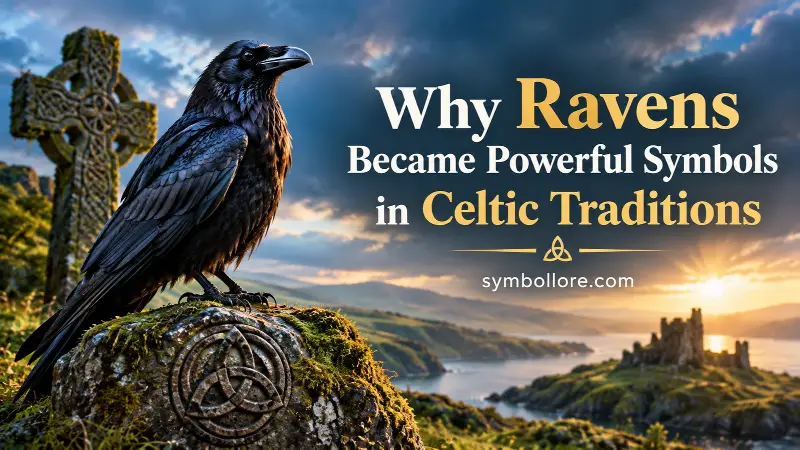
The raven’s symbolism came partly from its natural characteristics. Ravens are large, intelligent birds with dark feathers and strong survival abilities. Their presence near battlefields, where they could feed on remains, connected them with scenes of death and conflict.
For ancient societies, animals that appeared during important moments often gained symbolic meanings. The raven’s association with battle did not come from the bird being considered evil. Instead, it reflected the realities of war, mortality, and the unknown.
The raven became a symbol of the space between endings and beginnings. Death was not always viewed only as destruction in Celtic stories; it could also represent change, destiny, and transition.
The Morrígan and the Raven Connection in Irish Mythology
One of the strongest Celtic raven associations comes from the Irish figure known as the Morrígan. She is connected with battle, fate, and sovereignty. In mythology, she appears in raven form, especially around scenes of conflict.
The raven’s connection with the Morrígan reflects the uncertainty of war. The bird became an image of victory, defeat, and the forces that shaped a warrior’s destiny.
A famous example appears in the story of Cú Chulainn. After his death, the Morrígan is associated with a raven appearing on his body. This image connects the raven with battle, prophecy, and the final moments of heroic life.
Raven Symbolism in Welsh Tradition and Bran the Blessed
Welsh mythology offers another important raven connection through Bran, or Bendigeidfran, a legendary figure from the medieval Welsh collection known as the Mabinogion.
The name Bran is linked with the raven. In the story tradition, Bran’s severed head continues to have a protective and prophetic role after his death.
This does not mean every Welsh person historically viewed ravens in exactly the same way. Instead, the story shows how the raven became connected with kingship, protection, and supernatural knowledge in Welsh literature.
Ravens, War, and the Meaning of Death
The raven’s connection with death is one of its most recognized Celtic associations. Ancient warriors understood that ravens often appeared after battles because they fed on remains left behind.
This natural behavior influenced symbolic interpretation. The bird became linked with the aftermath of conflict and the unavoidable reality of human mortality.
However, Celtic raven symbolism was more complex than a simple “death symbol.” The same bird could represent knowledge, power, and transformation because death in mythology often marked a change from one state of existence to another.
The Raven as a Symbol of Wisdom and Hidden Knowledge
Although ravens are often connected with darkness, they also represent intelligence and insight.
Their reputation for cleverness contributed to later associations with secret knowledge and observation. In Celtic-inspired interpretations, the raven is sometimes viewed as a guide through uncertainty because it appears comfortable in places humans find mysterious.
These interpretations are best understood as symbolic readings rather than proven historical beliefs shared by all Celtic communities.
Did Celtic People Believe Ravens Were Omens?
Some Celtic stories connect ravens with signs, prophecy, and future events. This is especially visible in myths involving war and powerful figures such as the Morrígan.
However, there is no evidence that every raven sighting had one universal meaning across Celtic societies.
Folklore develops differently across regions and time periods. A raven near a battlefield in a myth may represent fate, while a raven in another setting may simply be part of the natural world.
Raven Symbolism Compared With Modern Uses
Today, ravens appear in tattoos, artwork, books, films, and spiritual discussions. Modern audiences often associate them with independence, intelligence, mystery, and transformation.
These modern meanings sometimes connect with older Celtic themes, but they are not identical. A contemporary raven tattoo may represent personal growth or individuality rather than an ancient Celtic belief.
Modern symbolism works through personal and cultural choices. The same image can carry different meanings for different people.
Common Misconceptions About Celtic Raven Symbolism
Ravens Were Not Simply Symbols of Evil
The connection between ravens and darkness does not mean Celtic traditions viewed them only negatively. The bird represented powerful forces that included both destruction and knowledge.
Raven Symbolism Was Not Identical Across All Celtic Groups
“Celtic” refers to many different cultures and regions. Irish, Welsh, Scottish, and continental traditions developed their own stories and interpretations.
Raven Meanings Are Not Scientific Predictions
A raven appearing near someone does not provide proof of future events. Symbolic meanings belong to cultural traditions, stories, and personal interpretations.
FAQs
A raven commonly symbolizes fate, battle, prophecy, transformation, and hidden knowledge in Celtic traditions. These meanings are especially connected with Irish mythology and figures such as the Morrígan.
The Morrígan is associated with battle and sovereignty in Irish mythology, and stories describe her connection with raven imagery. The bird helped express ideas of fate, conflict, and transformation.
A raven can represent both threatening and positive ideas. It may symbolize death and war, but it can also represent wisdom, protection, and powerful change.
A raven tattoo may represent mystery, intelligence, transformation, independence, or connection with mythology. The meaning depends on the person and design rather than one universal rule.
Sources and Further Reading
- Common Raven cultural depictions and mythology overview
- Animals in Celtic Life and Myth by Miranda Green
- Order of Bards, Ovates & Druids: The Raven Symbolism
Conclusion
Raven symbolism in Celtic culture developed from powerful stories about war, fate, prophecy, and transformation. The raven became meaningful because it appeared in myths connected with warriors, gods, and legendary figures.
Yet the raven was never limited to one interpretation. Across Celtic traditions, it could represent danger, wisdom, protection, or change. Modern readers can appreciate these meanings while remembering that symbols depend on culture, history, and personal context.


