
Balance symbolism represents harmony, fairness, stability, and the careful relationship between different forces. It appears in scales, symmetrical designs, paired opposites, religious imagery, nature, art, jewelry, and tattoos. However, these symbols do not all communicate the same idea.
Some forms show equal measurement, while others represent continuous adjustment. A balanced scale may suggest justice and impartial judgment. In contrast, yin-yang expresses the interaction of complementary forces. Understanding the symbol’s cultural setting, visual form, and intended use reveals which meaning applies.
Quick Answer
Balance symbolism represents equilibrium, harmony, fairness, moderation, or the successful coordination of opposing needs. Scales commonly express justice and measured judgment, while yin-yang depicts interconnected forces in continuous change. Therefore, the precise meaning depends on the symbol, its cultural origin, and the context in which it appears.
Key Takeaways
- Balance can represent harmony, justice, moderation, stability, or wise judgment.
- Equal-looking forms often communicate order and visual calm.
- Dynamic symbols show adjustment rather than permanent stillness.
- Scales and yin-yang carry different cultural meanings.
- Context determines whether balance is legal, spiritual, emotional, or artistic.
- Tilted or broken symbols can communicate conflict, bias, or instability.
Balance Symbols and Meanings at a Glance
| Symbol | Common Meaning | Important Context |
|---|---|---|
| Balanced scales | Justice, fairness, impartial judgment | Law, ethics, Libra |
| Yin-yang | Interdependence and dynamic harmony | Chinese philosophical traditions |
| Ma’at’s feather and scales | Truth, order, ethical conduct | Ancient Egyptian religion |
| Symmetrical circle | Unity, completeness, stability | Art, design, personal symbolism |
| Stones in equilibrium | Patience, concentration, temporary stability | Wellness imagery and photography |
| Tree with balanced branches and roots | Grounding, growth, connection | Nature-based and modern spiritual designs |
| Balanced sun and moon | Complementary cycles or energies | Modern art, tattoos, and jewelry |
| Balance scale emoji | Law, fairness, comparison, or weighing options | Digital communication |
What Does Balance Symbolism Mean?
Balance symbolism expresses a condition in which different parts work together without one part overwhelming the others. Its central meanings include harmony, stability, equality, self-control, proportion, and thoughtful decision-making.
However, balance does not always mean that two sides are identical. A person may balance work and rest without giving each the same number of hours. Likewise, an artwork can feel stable even when its two sides look different. In these cases, equilibrium comes from proportion and adjustment rather than exact equality.
This distinction makes balance a flexible symbol. It can describe an external system, such as justice, or an internal condition, such as emotional steadiness. It may also represent a goal instead of an accomplished state.
Why Scales Symbolize Justice and Fairness
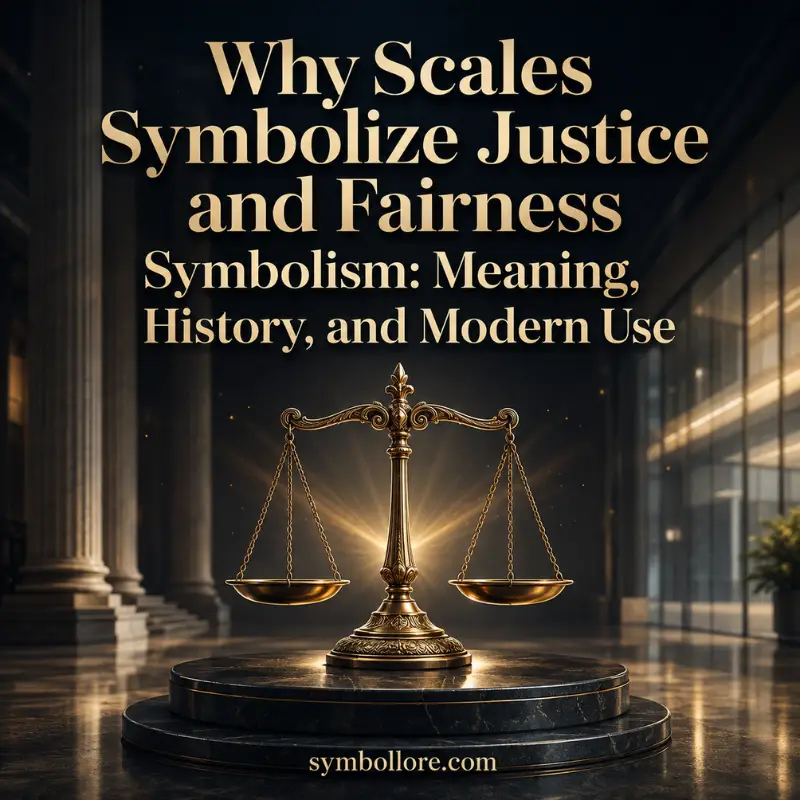
Scales symbolize justice because they compare competing weights on a shared standard. When the beam rests evenly, the image suggests that evidence, arguments, rights, or responsibilities have received fair consideration.
The scales of justice are strongly associated with Lady Justice.
The Supreme Court of the United States explains
that scales represent impartiality, while her sword represents power. A blindfold may further suggest that status and appearance should not control judgment.
Still, the scales can communicate ideas beyond law. They may represent a difficult choice, balanced priorities, accountability, commercial exchange, or the consequences of an action. If one pan sits lower, the design may show inequality, stronger evidence, excessive influence, or a decision that has not yet reached resolution.
Ma’at and the Ancient Egyptian Idea of Balance
In ancient Egypt, Ma’at represented truth, right order, justice, and the proper relationship between society, nature, and the divine world. She was both a goddess and a much broader principle of ethical and cosmic order.
A well-known funerary scene shows a deceased person’s heart weighed in a balance. The other side contains Ma’at or an emblem associated with her.
The Metropolitan Museum of Art’s description of Nauny’s Book of the Dead
explains that her heart is weighed against Ma’at as the embodiment of cosmic order and ethical conduct.
Modern summaries sometimes call Ma’at’s ostrich plume the feather of truth. That phrase is useful, but the original symbolism reaches beyond simple honesty. It connects individual behavior with justice, order, responsibility, and the desired structure of the universe.
Yin-Yang and Dynamic Balance
Yin-yang symbolizes the interdependence of complementary forces rather than a struggle in which one side must defeat the other. The familiar circular design contains contrasting sections, and each section carries a small part of its counterpart.
This pattern expresses duality, change, and relationship. Rest and activity, darkness and light, contraction and expansion, or coolness and warmth can differ while remaining connected. As conditions change, their relative influence also changes.
Therefore, yin-yang should not be reduced to a Western idea of “good versus evil.” Nor does it say that every situation needs a perfect 50–50 division. Its curved, flowing structure communicates dynamic equilibrium: harmony maintained through movement and mutual dependence.
Balance Symbolism in Religion and Spiritual Life
Spiritual balance usually represents disciplined alignment among values, actions, desires, and responsibilities. Its meaning depends on the tradition using it, so one universal definition cannot cover every religious setting.
In Christian ethics, for example, balance may be connected with temperance. Temperance does not necessarily reject pleasure. Instead, it places desires under wise moral direction. Buddhist discussions may emphasize a middle way that avoids harmful extremes, although the concept has specific doctrinal meanings and is not simply a slogan about lifestyle moderation.
Modern spiritual imagery often combines circles, trees, stones, moons, or geometric patterns. These designs may suggest inner peace or grounded living, but those meanings are frequently personal rather than established teachings from one historical religion.
Balance in Art, Design, and Nature
Visual balance occurs when the elements in a composition produce a sense of stability. Symmetry creates this effect by placing similar visual weight on either side of an axis. It often communicates formality, calm, permanence, or order.
Asymmetrical designs can also feel balanced. A large muted shape, for instance, may be offset by several smaller and brighter elements. Radial arrangements create stability by directing forms around a central point.
Nature reinforces these patterns through branching trees, flower heads, paired wings, cycles, and changing ecosystems. Yet natural balance is rarely motionless. Weather, seasons, growth, decay, and adaptation continually reshape it. Consequently, nature-based balance symbolism often represents resilience and responsive change rather than perfect stillness.
Balance Symbolism in Tattoos and Jewelry
A balance tattoo can represent fairness, emotional steadiness, recovery from extremes, or the effort to manage competing parts of life. Jewelry may serve the same purpose as a private reminder or public expression of personal values.
Before selecting a design, consider four points:
- Choose the intended meaning. Decide whether the design should express justice, harmony, moderation, equality, or resilience.
- Check its cultural origin. Learn whether the symbol belongs to a specific religious or philosophical tradition.
- Consider other associations. Scales can indicate law or the zodiac sign Libra, not only personal stability.
- Review the composition. Tilted, cracked, or uneven elements may communicate struggle instead of achieved harmony.
A simple original design can sometimes communicate a personal experience more accurately than a borrowed sacred emblem.
Modern Uses of Balance Symbols
Balance symbols appear in courthouses, wellness branding, environmental campaigns, financial services, educational materials, jewelry, and social media. Their meaning changes with the surrounding words and images.
In a courthouse, balanced scales normally indicate impartial justice. In a financial logo, they may suggest responsible comparison or risk management. Meanwhile, stacked stones in advertising often communicate calm, even though naturally occurring stacked formations can have entirely different origins.
The ⚖️ balance scale emoji commonly refers to legal matters, fairness, judgment, or comparing two choices.
Unicode identifies the character as “balance scale”
but a sender’s message supplies its practical tone. It can support a serious legal statement, a debate, or a casual “weighing the options” remark.
What an Unbalanced Symbol Can Mean
An uneven or damaged balance symbol usually communicates instability, unfairness, tension, or incomplete adjustment. For example, a lowered scale pan may show that one argument carries more weight. It can also expose prejudice or unequal power when the setting is political or legal.
In art, however, imbalance does not always have a negative meaning. Deliberate asymmetry can create energy, suspense, movement, or attention. Likewise, a tattoo showing stones about to fall may represent the difficulty of preserving stability rather than failure.
Interpret the whole composition before assigning a meaning. Direction, color, surrounding objects, text, and the creator’s stated purpose can turn imbalance into a symbol of danger, transition, resistance, or growth.
How to Interpret Balance Symbolism
The most reliable interpretation comes from examining the symbol’s form, origin, setting, and condition. Avoid assigning a spiritual meaning based only on visual resemblance.
Use these four questions:
- What is balanced? Scales, natural objects, colors, figures, or abstract shapes suggest different ideas.
- Is the arrangement static or moving? Stillness suggests stability; movement may represent adaptation.
- Where does the symbol come from? Legal, Chinese, Egyptian, religious, and modern designs need separate context.
- Where does it appear? A courtroom sculpture, tattoo, advertisement, and emoji serve different purposes.
Finally, look for imbalance or alteration. A tilted beam, divided circle, broken line, or missing half can substantially change the message.
Common Misconceptions About Balance Symbols
Balance does not always mean equal portions. Often, it means an appropriate relationship between unequal elements. It also does not promise constant calm. Many symbols portray stability as something maintained through repeated correction.
Similarly, yin-yang is not merely a decorative icon for opposites, and Ma’at should not be treated as a generic wellness figure. Both belong to complex cultural traditions. The scales used with Lady Justice also represent impartial evaluation, not a guarantee that every real legal system produces equal outcomes.
Finally, symmetry and balance are related but not identical. Symmetry is one method of creating visual balance. Asymmetrical compositions can produce an equally convincing sense of stability.
FAQs
Balanced scales are among the clearest Western symbols of balance because they represent measured comparison, fairness, and impartiality. However, there is no single universal symbol. Yin-yang, circles, paired forms, and balanced natural objects communicate different versions of the idea.
Spiritually, balance often means aligning actions, values, emotions, and responsibilities without being controlled by one extreme. The exact interpretation depends on the religious or philosophical tradition. Therefore, a general wellness meaning should not replace a symbol’s original cultural context.
Yin-yang represents dynamic harmony between interconnected forces, not a permanently fixed or mathematically equal division. Its flowing design emphasizes change, mutual dependence, and the presence of each force within the other.
Scales can represent evaluation, accountability, trade, choice, consequences, equality, or the need to compare priorities. In astrology, they also represent Libra. The surrounding setting usually indicates whether the intended meaning is legal, personal, commercial, or astrological.
A balance tattoo may express fairness, self-control, emotional stability, recovery, or harmony between different areas of life. Its meaning changes with the chosen symbol. Scales, yin-yang, stones, and geometric shapes each carry distinct associations.
The ⚖️ emoji usually refers to law, justice, fairness, judgment, or comparing alternatives. In casual conversation, it can mean that someone is considering both sides. Its tone depends on the accompanying message and the seriousness of the discussion.
Yes. An uneven composition may represent the process of seeking balance, the pressure of competing responsibilities, or the fragility of stability. In art, controlled asymmetry can also produce visual balance without making both sides look identical.
Conclusion
Balance symbolism expresses harmony, fairness, proportion, and the work required to keep different forces in a healthy relationship. Yet scales, yin-yang, Ma’at, symmetry, and natural forms do not carry identical meanings.
A thoughtful interpretation considers the symbol’s cultural origin, visual condition, and setting. Balance may appear calm, but it is often active: priorities shift, forces interact, and stability requires adjustment. The strongest reading is therefore not simply “everything is equal,” but “different parts are being held in a meaningful relationship.”