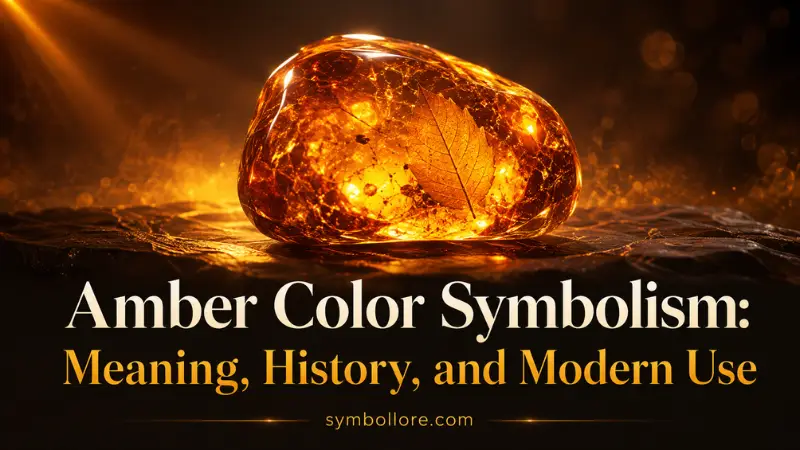
Amber color symbolism centers on warmth, vitality, preservation, caution, and the passage of time. The rich golden-yellow shade resembles sunlight, firelight, honey, autumn leaves, and fossilized resin. As a result, amber can feel energetic and comforting while also carrying a sense of age, memory, and natural history.
However, amber does not have one universal meaning. A glowing lamp may suggest hospitality, while an amber warning light asks people to slow down or prepare. In jewelry, artwork, clothing, and spiritual practice, its meaning depends on the object, setting, surrounding colors, and personal interpretation.
Quick Answer
Amber color symbolism commonly represents warmth, confidence, vitality, preservation, wisdom, and cautious awareness. Its uplifting meanings come from sunlight, fire, honey, and autumn landscapes. Because amber is also associated with fossilized tree resin and warning signals, it may represent memory, ancient knowledge, transition, delay, or the need to pay attention.
Key Takeaways
- Amber combines yellow’s brightness with orange’s warmth and brown’s maturity.
- Fossilized resin connects amber with preservation, memory, and deep time.
- Warning signals give amber practical associations with caution and preparation.
- Autumn strengthens its meanings of change, harvest, maturity, and nostalgia.
- Spiritual interpretations often emphasize protection, wisdom, and inner light.
- Context determines whether amber feels comforting, urgent, luxurious, or dated.
Amber Color Meanings at a Glance
| Context | Common Meaning | Why It Developed |
|---|---|---|
| Sunlight and fire | Warmth, energy, hope | Amber resembles a steady golden glow |
| Fossil resin | Preservation, memory, time | Natural amber can preserve ancient organic material |
| Autumn leaves | Change, maturity, harvest | Amber appears during seasonal transition |
| Warning lights | Caution, attention, preparation | The color signals a changing condition |
| Jewelry | Heritage, beauty, protection | Amber has a long history as an ornament |
| Spiritual practice | Wisdom, grounding, inner strength | Its natural origin and glow inspire symbolic beliefs |
| Branding | Confidence, craft, friendliness | Amber feels energetic without red’s aggression |
| Dark amber | Age, heaviness, stagnation | Brown undertones create a denser impression |
What Amber Color Symbolism Means
Amber is usually described as a golden yellow or yellow-orange shade. It sits between bright yellow and deeper orange, often with a subtle brown undertone. This position explains why the amber meaning combines brightness, movement, warmth, and maturity.
Yellow contributes visibility, optimism, alertness, and mental energy. Orange adds enthusiasm, sociability, and heat. Brown brings stability, earthiness, and age. Together, these qualities create a color that appears lively without seeming weightless.
The central symbolic message of amber is warm energy with depth. It can communicate enthusiasm, but it usually feels more grounded than lemon yellow. It can suggest confidence, although it is less aggressive than red. Because it resembles aged natural materials, amber may also represent experience, craftsmanship, and something valuable that has endured.
A bright amber hue often feels active and optimistic. Muted amber may seem rustic or nostalgic, while dark amber can communicate maturity, heaviness, or old-world richness.
How Fossilized Tree Resin Shaped Amber Meaning
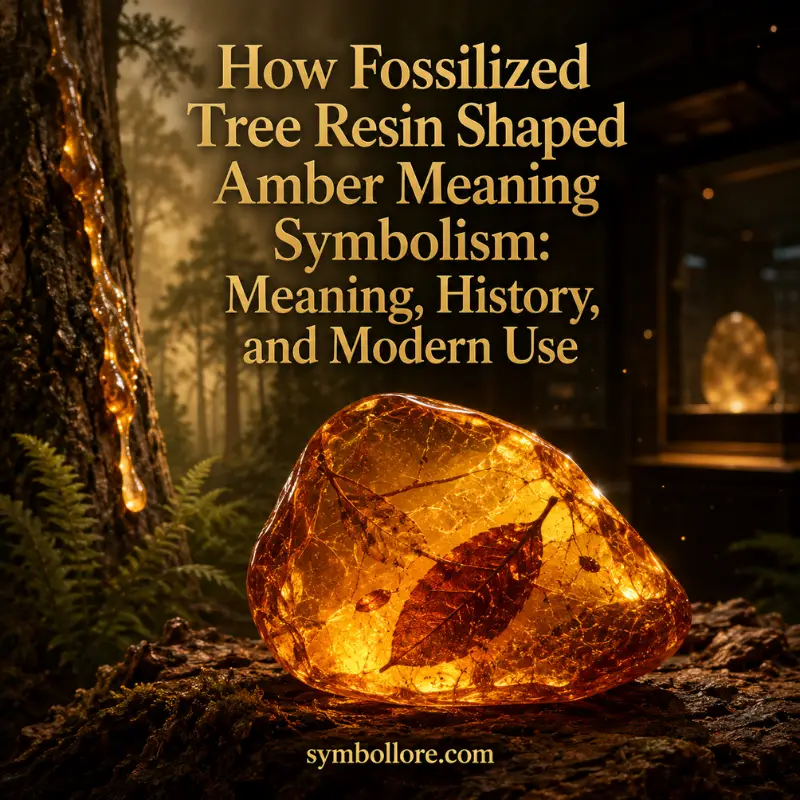
Much of amber’s symbolism comes from the natural material that gave the color its name. Amber is fossilized or petrified plant resin rather than a mineral. Trees originally produced the sticky resin, which later hardened and changed over geological time. The Smithsonian describes amber as fossilized resin produced by trees, while the Gemological Institute of America calls it a natural time capsule.
Natural amber sometimes contains trapped insects, leaves, flower parts, needles, or bubbles. These inclusions provide scientists with evidence of ancient environments and organisms.
Consequently, amber became closely associated with life preserved through time.
This material history gives amber several deeper meanings:
- Memory that survives change
- Beauty shaped by time
- Connection with ancient nature
- Protection of something fragile
- Patience and gradual transformation
- Continuity between past and present
These associations do not mean every amber-colored object carries the properties of real resin. Still, the material remains the historical foundation for preservation symbolism connected with the color.
Amber may therefore feel more reflective than ordinary orange or yellow. Its glow suggests life and energy, while its ancient origin introduces age, permanence, and mystery.
Amber Color Psychology: Warmth Without Universal Rules
In color psychology, amber is commonly associated with warmth, friendliness, vitality, optimism, and alertness. As a member of the warm colors, it attracts attention and can create an active or welcoming atmosphere.
Research supports broad patterns in how people connect colors with emotions. A systematic review published in 2025 found that yellow and orange were commonly associated with positive, high-arousal emotions. However, the researchers also warned that abstract color associations do not necessarily prove that a color will directly produce the same emotion in every real setting.
A large study involving participants from 30 countries also found both shared patterns and meaningful cultural differences.
Language, geography, experience, and local traditions influenced how people connected colors with emotions.
Therefore, amber may suggest comfort, motivation, or confidence, but it cannot guarantee those reactions. Several factors affect the result:
- Brightness: Pale amber feels lighter than dark, brownish amber.
- Saturation: Intense amber appears more energetic and demanding.
- Lighting: Soft light creates warmth, while harsh light may feel industrial.
- Surrounding colors: Navy makes amber look polished; brown makes it rustic.
- Personal memory: One person may recall autumn, while another remembers warning lights.
Color psychology works best as a guide to common associations, not as a fixed rule about human behavior.
Why an Amber Warning Light Means Caution
Amber often symbolizes caution because it occupies a visual middle position between green and red. Green generally permits movement, while red communicates stopping, closure, or immediate danger. Amber or yellow warns that conditions are changing and that action may soon become necessary.
In official U.S. traffic guidance, the color is generally called yellow, even when people informally describe the light as amber. For example, Federal Highway Administration guidance states that a steady yellow X above a lane means the lane is about to close and drivers should prepare to leave it. A red X means the lane is already closed.
This practical use shaped the amber warning light meaning:
- Slow down
- Look carefully
- Prepare for a change
- Check the situation
- Address a developing risk
- Do not ignore the signal
Amber does not usually represent the same degree of urgency as red. Instead, it marks the stage when a problem may still be manageable.
The same three-level system appears in business and project reporting. Green may mean work is proceeding normally, amber may identify a delay or risk, and red may indicate a serious failure. In this context, amber symbolizes uncertainty combined with an opportunity to respond.
The Spiritual Meaning of Amber
The spiritual meaning of amber commonly includes protection, grounding, healing light, wisdom, and connection with the earth. These interpretations draw from the color’s resemblance to sunlight and fire, along with the long use of natural amber in jewelry and ceremonial objects.
Amber’s warm glow can represent light carried through darkness. Unlike brilliant yellow, it has enough depth to suggest mature knowledge rather than sudden inspiration. For this reason, some people connect it with inner strength, accumulated wisdom, and lessons preserved from the past.
Its connection with fossilized tree resin also supports themes of transformation. Soft resin gradually becomes a durable material, so amber may symbolize personal growth that takes time. It can represent an experience that was once painful or uncertain but later became meaningful.
Other spiritual associations include:
- Protection during change
- Emotional steadiness
- Respect for ancestors
- Connection with nature
- Release of stagnant energy
- Gratitude for past experiences
- Confidence rooted in self-knowledge
These are cultural and personal interpretations, not scientifically proven effects. Amber-colored items and amber jewelry should not be treated as substitutes for medical or mental health care.
The Biblical Meaning of Amber
The biblical meaning of amber is mainly connected with radiance, fire, divine presence, and overwhelming brightness. Ezekiel 1:4 describes a storm, a great cloud, flashing fire, and a brilliant substance at its center.
However, English translations do not use identical wording. Some versions describe the substance as amber, while others use glowing metal, gleaming bronze, polished metal, or electrum. Bible Gateway’s comparison of Ezekiel 1:4 shows these significant translation differences.
Therefore, the verse should not be used to claim that amber always carries one fixed biblical message. The stronger themes in the passage are:
- Brilliant light
- Fire and power
- Divine majesty
- Awe and mystery
- Something precious or metallic
- A vision beyond ordinary human experience
Modern Christian symbolism may connect amber with God’s glory, spiritual illumination, purification, or divine protection. Still, these meanings are interpretations inspired by the passage rather than a universal biblical color code.
The translation issue matters because the original term may refer to an alloy or glowing metallic substance rather than fossil resin. As a result, the biblical image is best understood as fiery radiance instead of a precise modern color sample.
Amber in History, Jewelry, and Culture
Natural amber has been used for jewelry and decorative objects for thousands of years. Ancient communities valued its warm appearance, light weight, ability to take a polish, and unusual inclusions. The Baltic region became an important source, and amber circulated through trade across Europe and the Mediterranean world.
The Gemological Institute of America notes that the ancient Greeks called amber elektron, a term connected with its sunlike glow. It also records amber’s use in ancient adornment and burial traditions.
Across different periods and communities, amber objects have served as:
- Beads and necklaces
- Pendants and amulets
- Carved figures
- Religious objects
- Trade goods
- Status symbols
- Family possessions
These uses contributed to its modern associations with heritage, protection, wealth, ancestry, and treasured memory.
However, no single ancient interpretation applies to every culture. A bead used as decoration, an amulet worn for protection, and a valuable trade object did not necessarily communicate the same meaning. Modern discussions often combine separate histories into one general story.
A culturally responsible interpretation should identify the community and period involved instead of claiming that all ancient people believed amber had identical powers.
Autumn Symbolism and Modern American Meaning
In the United States, amber is strongly connected with fall. Amber leaves, late-afternoon sunlight, pumpkins, wheat, wooden decorations, and seasonal drinks all contribute to autumn symbolism.
Fall gives the color meanings of maturity, harvest, transition, and change. Green leaves turn yellow, orange, red, and amber before falling. Therefore, amber can represent a stage of life that has reached fullness before moving into something new.
This seasonal meaning has both positive and reflective sides. Amber may suggest:
- Gratitude for what has grown
- Reward after sustained effort
- Acceptance of natural change
- Comfort and domestic warmth
- Preparation for winter
- Nostalgia for earlier seasons
- Awareness that time is passing
Modern American décor also connects the honey color with candles, fireplaces, wood finishes, vintage glass, leather, and warm indoor lighting. These materials can make amber feel familiar, handmade, and comforting.
However, strong associations with older décor styles can make certain amber shades appear dated. The effect depends on the design. Amber paired with clean neutrals may seem modern, while amber combined with heavy brown patterns may create a distinctly vintage atmosphere.
A common misconception involves the AMBER Alert system. Its name is not based on the symbolic meaning of the color. The U.S. Department of Justice explains that the system honors Amber Hagerman and that AMBER stands for America’s Missing: Broadcast Emergency Response.
Amber in Design, Branding, Fashion, and Interiors
Amber in design works well when a brand or space needs to communicate warmth, energy, craftsmanship, nature, or friendly confidence. It attracts attention but usually feels less aggressive than red and more substantial than bright yellow.
In branding, amber can suit:
- Food and beverage companies
- Hospitality businesses
- Craft and handmade products
- Outdoor brands
- Heritage companies
- Natural beauty products
- Creative services
- Seasonal campaigns
The color may suggest honey, fire, wood, grain, leather, or golden light. These connections can make a business feel welcoming and established. However, excessive amber may appear loud, overly rustic, or old-fashioned.
In fashion, amber works naturally in fall clothing, knitwear, leather accessories, scarves, jewelry, and statement pieces. It often complements warm skin undertones, although the exact result depends on shade and contrast.
In interiors, soft amber lighting creates a comfortable atmosphere. Amber glass, cushions, ceramics, or accent walls can add warmth without overwhelming a room.
For balanced use:
- Choose bright amber for energy and visibility.
- Select muted amber for natural or heritage themes.
- Add white or cream to create visual breathing room.
- Use navy or charcoal for a sharper modern contrast.
- Test painted surfaces under daytime and evening light.
- Avoid combining too many dark warm tones in a small room.
Amber Color Palette Pairings
An amber color palette changes meaning according to the surrounding shades. Amber can look luxurious, rustic, cheerful, dramatic, or contemporary.
| Color Pairing | Effect | Best Uses |
| Amber and navy | Confident and polished | Branding, offices, formal rooms |
| Amber and cream | Soft and welcoming | Living spaces, hospitality, packaging |
| Amber and forest green | Natural and grounded | Outdoor brands, crafts, seasonal décor |
| Amber and charcoal | Modern and mature | Fashion, technology, editorial design |
| Amber and burgundy | Rich and traditional | Restaurants, textiles, events |
| Amber and teal | Creative and energetic | Digital design, artwork, modern rooms |
| Amber and brown | Rustic and nostalgic | Cafés, leather goods, vintage styling |
| Amber and violet | Artistic and dramatic | Posters, accessories, creative branding |
Navy gives amber one of its strongest contrasts, helping the warm shade appear clear and controlled. Cream softens it, while forest green strengthens its natural qualities.
Brown can create an earthy palette, but the two colors need enough contrast. Dark amber placed beside dark brown may lose definition and look muddy.
Teal creates a lively warm-cool balance. Violet feels more expressive and unusual, making it useful for creative work rather than conservative branding.
Positive and Negative Meanings of Amber
Positive amber color symbolism includes warmth, courage, optimism, preservation, loyalty, experience, and natural beauty. It may represent energy that has become steady rather than chaotic.
Common positive meanings include:
- Warmth and hospitality
- Mature confidence
- Endurance through change
- Connection with nature
- Treasured memories
- Practical wisdom
- Creativity and enthusiasm
- Protection and security
Negative meanings usually emerge from context or excess. A flashing amber signal may indicate risk, while a dark amber environment may feel heavy.
Possible negative associations include:
- Delay
- Uncertainty
- Frustration
- Overstimulation
- Attachment to the past
- Resistance to change
- Aging or decline
- A developing problem
These interpretations are not contradictions. Amber can represent both preservation and difficulty letting go. It can suggest energy or nervous tension. The deciding factors are brightness, context, object, and surrounding imagery.
How to Interpret Amber in Art, Dreams, and Tattoos
Amber in artwork, dreams, tattoos, or personal objects should not be interpreted through color alone. The object carrying the color usually matters more than a general symbolism list.
Use these questions:
What object is amber?
An amber flame may represent endurance or spiritual light. An amber leaf may suggest autumn and change. An amber eye could imply alertness, mystery, or animal instinct.
Is the shade bright or dark?
Glowing amber often feels hopeful, warm, or guiding. Dark amber may convey age, secrecy, heaviness, or preserved memories.
What colors surround it?
Amber beside green may emphasize nature. Beside black, it may appear urgent or mysterious. Cream makes it gentle, while red increases intensity.
What is happening in the scene?
A steady amber lamp communicates something different from a flashing warning beacon. Movement, setting, and mood shape the final meaning.
What does amber mean to the individual?
Someone may associate it with a grandparent’s jewelry, a childhood home, fall travel, a warning sign, or a religious experience. Personal memory can outweigh traditional symbolism.
This method creates a more accurate interpretation because it considers the whole symbol instead of assigning one automatic definition.
FAQs
Amber symbolizes warmth, vitality, preservation, confidence, caution, and maturity. It may also represent heritage, memory, autumn, or spiritual light. The exact meaning depends on the shade and context. An amber necklace communicates something different from an amber traffic indicator or autumn leaf.
Amber sits mainly between yellow and orange, but darker shades may contain noticeable brown undertones. Natural amber ranges widely in appearance, including pale yellow, orange, reddish brown, and nearly opaque tones. Therefore, amber is better understood as a family of warm golden shades than one exact color.
Spiritually, amber often symbolizes protection, grounding, wisdom, transformation, and light within darkness. These associations come from its sunlike glow and connection with ancient fossil resin. They reflect cultural and personal belief rather than scientifically established powers.
In love, amber may represent dependable affection, emotional warmth, loyalty, and memories built over time. It often suits mature, stable love more than intense passion. In a negative context, it can symbolize attachment to a past relationship or difficulty releasing old emotions.
Amber usually means caution rather than immediate danger. It tells people that conditions are changing and attention is required. Red commonly communicates a stronger stop or danger message, while amber marks the stage when preparation or corrective action may still prevent a larger problem.
Some traditions consider natural amber protective or fortunate because people historically wore it as jewelry and used it in amulets. However, amber is not universally considered lucky. Its meaning depends on cultural tradition, religious belief, personal intention, and the object in which the color appears.
Conclusion
Amber color symbolism brings together warmth, vitality, caution, preservation, and the passage of time. Its meanings developed through sunlight, fire, autumn landscapes, warning systems, and the remarkable history of fossilized tree resin.
Still, amber does not communicate one fixed message. A glowing lamp, ancient pendant, fall leaf, traffic signal, and dark amber room create different impressions. The most reliable interpretation considers the shade, object, setting, cultural background, and personal experience together.