

Egret symbolism centers on patience, purity, grace, balance, independence, and renewal. These meanings developed largely from the bird’s white plumage, controlled movements, solitary hunting, and ability to remain still before acting with precision.
However, no single interpretation applies everywhere. Some associations come from documented art or conservation history. Others are modern spiritual readings inspired by the bird’s behavior. Understanding that difference makes the egret a richer and more culturally respectful symbol.
Quick Answer
Egret symbolism most often represents patience, peace, purity, grace, independence, and well-timed action. The bird’s still hunting posture suggests focus, while its sudden strike represents decisiveness. An egret sighting can therefore serve as a personal reminder to slow down, observe carefully, and act when the right opportunity becomes clear.
Key Takeaways
- Egrets commonly represent patience, grace, purity, balance, and independence.
- Their hunting behavior inspires meanings of focus and precise action.
- White plumage often suggests peace, clarity, and spiritual cleansing.
- Historical heron and crane traditions should not automatically be called egret traditions.
- In America, the great egret also symbolizes conservation and recovery.
- Sightings and dreams gain meaning from context, emotion, and personal experience.
Egret Meanings at a Glance
| Context or Trait | Common Meaning | Why the Association Developed | Important Distinction |
|---|---|---|---|
| Motionless hunting | Patience and focus | The bird waits quietly before striking | Patience does not mean permanent inaction |
| Precise strike | Timing and decisiveness | It acts quickly when prey comes within reach | Observation prepares the action |
| White plumage | Purity, peace, and clarity | White carries these meanings in many modern settings | Color meanings vary by culture |
| Solitary foraging | Independence and self-trust | Egrets often feed alone | They also nest in social colonies |
| Wetland habitat | Emotional balance and transition | The bird moves between land, water, and air | This is a symbolic reading, not a scientific claim |
| Long-distance movement | Change and adaptability | Some populations migrate or disperse widely | Movement patterns differ by species and location |
| Conservation recovery | Renewal and protection | Plume hunting was followed by legal protection and recovery | This meaning has strong U.S. historical grounding |
| Raised wings or flight | Freedom and perspective | Flight visually suggests release and a broader view | It should not be treated as a guaranteed omen |
What Does Egret Symbolism Mean?
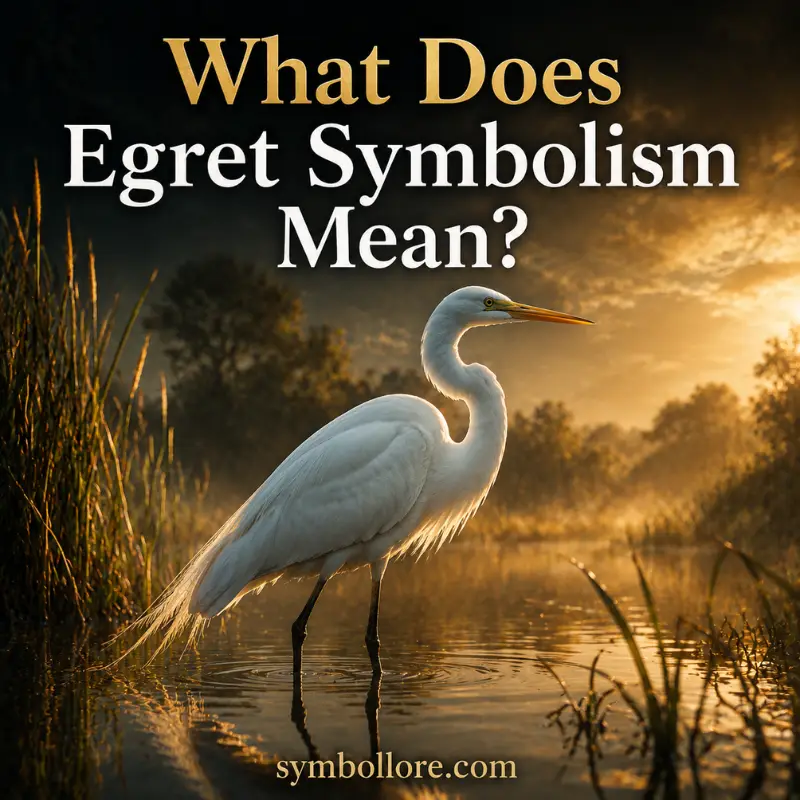
The egret represents calm awareness followed by purposeful action. It appears still while hunting, yet its attention remains active. For that reason, the bird can symbolize a person who watches carefully, protects energy, and moves only when action has a clear purpose.
Its graceful appearance adds meanings of dignity and composure. Meanwhile, its ability to feed alone encourages associations with independence and self-trust. These meanings do not require belief in supernatural signs. A person can use the egret as a psychological or artistic reminder to remain composed without becoming passive.
Balance is another important theme. Egrets walk through unstable mud and moving water while maintaining a controlled posture. Symbolically, that image can represent staying centered while circumstances change.
Why Egrets Represent Patience and Precision
Egrets earn their association with patience through observable feeding behavior. A great egret may walk slowly through shallow water or stand motionless while watching for fish, frogs, and other prey. When an opportunity appears, it strikes rapidly with its bill.
The Cornell Lab of Ornithology’s Great Egret guide
describes the species as a deliberate hunter that wades or waits before making a quick strike. That behavior matters because it explains the symbolism without requiring a mystical claim. The bird physically demonstrates alert stillness followed by accurate action.
Therefore, patience in this symbol does not mean avoiding decisions. It means gathering information, resisting needless urgency, and recognizing the moment when waiting is no longer useful. Precision completes the lesson: calm preparation should eventually lead to a clear move.
White Egret Symbolism: Purity, Peace, and Grace
A white egret commonly symbolizes purity, peace, clarity, and grace. Its bright feathers create a strong visual contrast against dark water, green marshes, and muddy shorelines. Artists and spiritual writers often interpret this contrast as keeping one’s purpose clear in complicated surroundings.
Purity should not be understood as moral perfection. In a personal interpretation, it may mean simplifying priorities, releasing distraction, or approaching a decision with honest intentions. Peace can also describe controlled behavior rather than a life without conflict.
Grace comes from the bird’s posture and movement. Its curved neck, long legs, and measured steps give it an elegant appearance. Yet that elegance serves practical survival. As a result, the egret can represent beauty joined with competence rather than beauty that exists only for display.
Egret, Heron, and Crane Symbolism Are Not Identical
Egrets are members of the heron family, Ardeidae, but “egret” is not a completely separate biological group. The name generally describes certain herons with white or buff plumage and decorative breeding feathers. Great egrets belong to the genus Ardea, while snowy egrets belong to Egretta.
Cranes belong to a different bird family. In flight, cranes usually extend their necks, whereas herons and egrets normally retract theirs. This biological distinction matters because many online accounts transfer crane traditions directly to egrets.
Older myths may also say “heron” without identifying a modern species. The Benu bird of Egyptian tradition and Athena’s heron in Greek literature should therefore not automatically be presented as specific egret references. They can provide related water-bird context, but honest interpretation should preserve the original identification and uncertainty.
Cultural and Historical Meanings
Egret meanings vary among communities, periods, and artistic traditions. There is no universal Indigenous, Asian, Celtic, or Christian interpretation. Claims about an entire culture should be treated cautiously unless they identify a community, source, artwork, or historical period.
Some accounts of southeastern Native American traditions connect white heron or egret feathers with peaceful roles. However, tribal nations have distinct beliefs, and an animal’s meaning in one community should not be assigned to all Native peoples.
East Asian artwork often gives cranes powerful meanings such as longevity, noble character, or transcendence. Those documented crane associations are sometimes applied to egrets online because both are elegant long-legged birds. The visual connection is understandable, but the species should still be named correctly.
Christian interpretations of a white egret as purity or faith are generally modern symbolic readings. The Bible lists heron-like birds in dietary passages but does not establish a developed doctrine of egret symbolism.
American Conservation and the Egret’s Modern Meaning
In the United States, the great egret has a documented connection with survival, protection, and environmental responsibility. During the late 1800s, hunters killed large numbers of egrets for ornamental breeding plumes used in fashion. Public opposition helped strengthen the early bird-conservation movement.
The National Audubon Society’s field guide
explains that the great egret was nearly eliminated from the United States before protection allowed it to recover. Audubon later adopted a flying great egret as its emblem. Consequently, the bird represents more than abstract renewal; it recalls a real conservation campaign.
U.S. law now protects native migratory birds through measures including the Migratory Bird Treaty Act.
The U.S. Fish and Wildlife Service
explains that unauthorized killing, capturing, selling, trading, or transporting protected species is prohibited. This protection means found feathers, eggs, nests, and birds should be left undisturbed unless lawful authorization applies.
Spiritual Meaning of Seeing an Egret
Seeing an egret can be interpreted as a reminder to observe before acting. The bird’s behavior may prompt reflection on whether you need more patience, a clearer boundary, or the confidence to make a timely decision. That is a personal interpretation, not a prediction of future events.
Consider four parts of the encounter:
- Behavior: Was the bird waiting, feeding, flying, nesting, or defending space?
- Setting: Did it appear near calm water, a crowded road, or a changing landscape?
- Emotion: Did you feel peaceful, alert, hopeful, unsettled, or simply curious?
- Current concern: What decision or transition was already occupying your attention?
A still egret may suggest patient observation. A bird taking flight could represent release or a change in perspective. Several egrets together may challenge the idea that independence requires isolation.
Egret Dream Meaning
An egret in a dream often represents patience, self-control, emotional clarity, or independence. The most useful interpretation comes from the dream’s events and your response to them, not from a fixed dictionary of omens.
A peaceful white egret may reflect a wish for simplicity or calm. An egret catching food could represent successful timing. One trapped in polluted water might express concern about restricted choices, neglected emotions, or environmental loss. An aggressive bird may symbolize the need to defend a boundary.
Write down the bird’s color, behavior, surroundings, and your strongest emotion. Then connect those details with current experiences. Dreams often combine recent memories and private associations, so a personal connection can matter more than a generalized spiritual meaning.
How Species and Color Change the Meaning
Different egret species can inspire different symbolic emphasis. The interpretation still depends on context, but accurate identification adds useful detail.
- Great egret: Its size, slow stalking, and conservation history support meanings of dignity, patience, resilience, and recovery.
- Snowy egret: Its active feeding style and bright yellow feet can suggest energy, resourcefulness, and graceful movement.
- Cattle egret: Its habit of following grazing animals can represent adaptation, cooperation, and finding opportunity in changing environments.
- Reddish egret: Its energetic, almost dance-like hunting style may symbolize experimentation, boldness, and flexible problem-solving.
- Dark morph: A darker reddish egret may evoke mystery or inward reflection, but it is not a negative sign.
Color should support an interpretation rather than control it. Behavior and personal context usually offer stronger clues.
Egret Symbolism in Art, Tattoos, and Personal Practice
An egret works well in art or tattoos when the design reflects a specific value. A motionless bird can represent patience. An egret striking at the water can show decisive timing, while one in flight may express freedom, change, or renewed direction.
The setting can refine the message. Reeds suggest flexibility, open water can suggest emotional clarity, and a sunrise may represent renewal. An Audubon-inspired design can honor conservation, but copying protected artwork or organizational branding should be avoided.
Cultural imagery requires more care. Do not add Indigenous, Egyptian, or East Asian sacred elements merely because a general symbolism page associates them with an egret. First identify the actual tradition and bird species. A simple naturalistic design often communicates grace and resilience without borrowing religious imagery that has no personal connection.
FAQs
An egret sighting is sometimes interpreted as good luck, especially when the encounter feels peaceful or arrives during a transition. However, the bird does not predict an outcome. Its patient hunting and controlled movement can instead serve as a practical reminder to notice opportunities and act thoughtfully.
A white egret commonly symbolizes purity, inner peace, clarity, grace, and spiritual renewal. These meanings draw heavily from its white plumage and calm appearance. They are modern or personal interpretations unless connected to a specific documented religious or cultural tradition.
Yes. Patience is one of the strongest behavior-based egret meanings. The bird may wait or move slowly while watching for prey, then strike with speed and accuracy. Symbolically, this combination represents alert waiting, good timing, and action supported by careful observation.
Egret meanings emphasize white plumage, grace, purity, and conservation, while broader heron symbolism often stresses independence, observation, and self-reliance. Biologically, egrets are types of herons. Historical references to a heron should not be relabeled as egret symbolism unless the species can be identified.
A dream egret may represent patience, emotional balance, independence, or the need for well-timed action. Its behavior provides the best clue. A hunting egret may suggest opportunity, while an injured or trapped bird could reflect limits, vulnerability, or neglected needs.
Yes. Egrets often forage alone, which supports an association with independence and self-trust. However, they may nest in colonies and gather with other birds. The fuller lesson is that healthy independence can coexist with community, cooperation, and shared protection.
Conclusion
Egret symbolism brings together patience, precision, peace, grace, independence, and renewal. Its strongest meanings arise from what the bird visibly does: it remains alert, moves carefully, and acts decisively when an opportunity arrives.
Cultural history adds depth, but egrets should not be confused automatically with every heron or crane found in myth. Whether encountered in nature, dreams, or art, the egret is most useful as a grounded reminder to seek clarity, respect timing, and balance self-reliance with connection.


