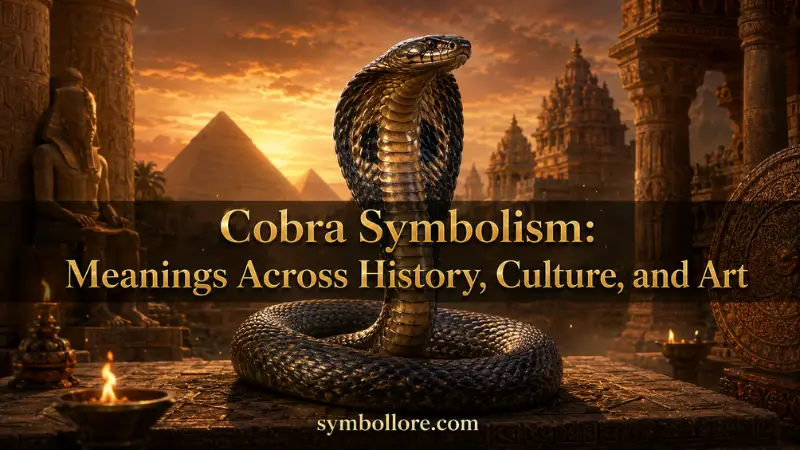
Cobra symbolism commonly represents power, protection, alertness, danger, transformation, and controlled authority. Its raised body and expanded hood create an unmistakable warning display, while its venom gives the animal a close association with death and fear.
These meanings are not universal. Ancient Egyptians used the rearing cobra as an emblem of royal and divine protection. Hindu and Buddhist traditions developed distinct stories about sacred serpents, while modern people use the cobra in tattoos, dreams, jewelry, and personal-growth imagery.
Quick Answer
Cobra symbolism represents protective power, visible authority, danger, awareness, and transformation. Ancient Egyptian imagery connected the rearing cobra with royalty and divine defense, while South Asian traditions associate sacred serpents with guardianship and spiritual forces. In modern art, dreams, and tattoos, the cobra may also communicate strong boundaries, renewal, courage, or a concealed threat.
Key Takeaways
- The raised hood symbolizes warning, readiness, and controlled strength.
- Egyptian cobra imagery represented royalty and divine protection.
- Hindu and Buddhist serpent traditions have distinct meanings and stories.
- Skin shedding supports modern associations with renewal and personal change.
- Dream and tattoo meanings depend on context, emotion, and design.
- Spiritual interpretations express beliefs, not guaranteed future events.
Cobra Meanings at a Glance
| Context or Feature | Common Meaning | Reason or Historical Connection |
|---|---|---|
| Expanded hood | Warning and boundaries | The display makes the cobra appear larger when threatened |
| Venom and fangs | Danger and hidden power | The animal can defend itself with a medically serious bite |
| Shedding skin | Renewal and transformation | A new outer layer appears after the old skin is shed |
| Egyptian uraeus | Royalty and protection | Rearing cobras appeared on royal and divine headdresses |
| Sacred nāga | Guardianship and spiritual power | Serpent beings protect places, teachings, water, or sacred figures |
| Coiled cobra | Stored energy and readiness | The compact pose suggests power held in reserve |
| Cobra tattoo | Strength, survival, or defiance | Modern meaning changes with pose, color, and personal purpose |
What Does Cobra Symbolism Mean?

Cobra symbolism centers on power that is visible but not always used. A cobra may rise, spread its hood, and warn a threat before biting. Therefore, the animal naturally suggests authority, readiness, self-defense, and the ability to command attention.
The cobra also carries opposing meanings. It can protect or harm, remain still or strike, and inspire reverence or fear. That duality makes it useful in religious art, royal imagery, storytelling, and tattoos. However, no single definition applies across every culture. The artwork’s time, location, pose, and surrounding symbols determine the most credible interpretation.
Why the Cobra Became a Symbol of Power
The cobra’s defensive display explains much of its modern symbolic force. When threatened, a cobra can raise the front of its body and spread elongated neck ribs into a hood. The pose increases its apparent size and warns another animal to retreat.
The Smithsonian’s National Zoo explains that king cobras generally prefer escape,
although they may defend themselves when cornered or protect their eggs. This behavior matters symbolically because the expanded hood does not simply mean uncontrolled aggression. It can represent a boundary made clear before force becomes necessary.
Venom adds another layer. It associates the cobra with concealed capability, mortality, and serious consequences. Together, the hood and venom create an image of strength that demands respect.
Cobra Symbolism in Ancient Egypt
In ancient Egypt, the upright cobra represented royal authority, divine power, and active protection. The stylized form is commonly called the uraeus, derived from a Greek term for the rearing cobra. It appeared above the forehead on crowns and headdresses.
The Metropolitan Museum of Art identifies the cobra with Wadjet,
an ancient goddess associated with royalty. A raised head and expanded hood showed the serpent prepared to defend the ruler. The uraeus eventually appeared on royal women and certain deities as well.
Cobra friezes also protected symbolic spaces. According to another
Met Museum description of uraeus decoration,
rows of rearing cobras appeared along shrines and represented defense against Egypt’s enemies. In this context, cobra symbolism was not a vague sign of “mystery.” It communicated legitimate rule, divine support, and fierce guardianship.
Cobras and Nāgas in Hindu Traditions
Hindu traditions include many sacred serpent figures, commonly called nāgas. English descriptions may call these beings cobras because artists often give them expanded hoods. However, a mythic nāga is not merely a zoological cobra. Nāgas may appear as serpents, human-serpent beings, divine figures, or multiheaded guardians.
Serpents appear beside major Hindu deities in different roles. Vishnu rests upon Shesha or Ananta, the cosmic serpent. Shiva is often shown wearing a serpent, which may be interpreted through ideas such as mastery, power, time, fear, or death. These images belong to particular theological and artistic traditions, so their meanings should not be reduced to a generic “cobra spirit animal.”
Nāga Panchami and related practices also demonstrate respect for serpents in parts of South Asia. Interpretations vary by community, text, location, and ritual. Protection, fertility, water, cosmic order, and reverence for nature may all be relevant, but they should not be treated as interchangeable.
Cobra and Nāga Meaning in Buddhism
In Buddhist art, the nāga often acts as a protector of the Buddha, sacred teachings, or holy places. The best-known example is Muchalinda, a serpent king who shelters the meditating Buddha during heavy rain.
A twelfth-century Cambodian sculpture at The Met
shows the Buddha seated beneath Muchalinda’s multiple serpent hoods. The museum notes that Khmer artists popularized this configuration, although the scene appeared earlier in South and Southeast Asian art.
This image supports meanings such as guardianship, shelter, devotion, and calm during adversity. Nevertheless, it represents a mythic nāga within a Buddhist narrative, not proof that every cobra carries the same religious meaning. Historical identification depends on the figure, pose, setting, and tradition.
Transformation, Healing, and Spiritual Awakening
Transformation is a common modern cobra meaning because snakes periodically shed their outer skin. People use this visible biological process as a metaphor for releasing an old identity, recovering after hardship, or beginning another stage of life.
Healing is a more complicated association. Serpents appear in several medical, religious, and mythological traditions, but readers should not assume that every healing symbol depicts a cobra. Likewise, an artistic serpent does not provide physical protection or medical treatment.
Some modern spiritual interpretations connect the cobra’s coiled form with kundalini, a concept described through a serpent-like energy in certain yoga and tantric traditions. This is a religious or spiritual framework, not a scientifically verified force. Used carefully, the cobra can represent heightened awareness or inner change without turning belief into a factual prediction.
Danger, Fear, and Personal Boundaries
The cobra can symbolize a serious threat because it is venomous and visually intimidating. In stories or art, a dark space, exposed fangs, forward movement, or a striking pose may emphasize death, betrayal, conflict, or danger.
However, an expanded hood does not automatically mean an attack has begun. It is also a warning. As a personal symbol, the cobra may therefore express a firm boundary: notice the signal, maintain a safe distance, and do not force the situation further.
This interpretation differs from aggression. Aggression seeks conflict, while a boundary communicates what will not be accepted. A coiled or watchful cobra can consequently represent emotional control, restrained power, and readiness rather than violence.
Cobra Dream Meaning
A cobra in a dream may reflect fear, pressure, authority, self-protection, or an important change. Dreams do not come with fixed dictionaries, so the emotional experience matters more than a universal prediction.
Consider four details:
- Behavior: A chasing cobra may reflect pressure, while a calm one may suggest watchfulness.
- Emotion: Fear, curiosity, respect, and confidence point toward different personal associations.
- Location: A cobra at home may feel personal; one at work may relate to authority or competition.
- Outcome: Escaping, observing, being bitten, or protecting the snake changes the dream’s focus.
A dream cannot reliably predict betrayal, wealth, pregnancy, death, or supernatural attack. Recurring distressing dreams may reflect stress or disrupted sleep. If they affect daily life, speaking with a qualified health professional is more useful than treating the image as a certain omen.
Cobra Tattoo Symbolism
A cobra tattoo often represents strength, survival, protection, defiance, transformation, or respect for danger. The precise message depends on the design rather than the animal alone.
Common design signals include:
- Raised cobra: Warning, courage, confrontation, or strong boundaries.
- Coiled cobra: Patience, stored energy, restraint, or readiness.
- Cobra with a crown: Rule, sovereignty, ambition, or authority.
- Egyptian cobra: Royal protection, Wadjet, or ancient Egyptian influence.
- Cobra and flowers: Beauty paired with danger, growth, or impermanence.
- Shedding cobra: Recovery, reinvention, and leaving the past behind.
- Black or red cobra: Modern intensity, secrecy, threat, passion, or aggression.
Someone using Egyptian, Hindu, or Buddhist imagery should research the specific symbol before copying it. A respectful tattoo understands the figure’s identity and cultural setting instead of using sacred imagery only as decoration.
What a Real Cobra Encounter Means
A real cobra encounter is first a wildlife-safety situation, not a message that must be decoded. Keep your distance, avoid sudden attempts to touch or capture the snake, move other people and pets away, and contact trained local wildlife personnel when necessary.
Symbolically, a safe observer might later connect the event with awareness, boundaries, or respect for nature. That personal reflection is valid as long as it does not replace practical caution.
If a venomous snake bites someone, seek emergency medical care immediately. Do not cut the wound, suck out venom, apply folk remedies, or delay treatment while searching for spiritual meaning.
Common Misconceptions About Cobra Symbolism
Several popular claims require qualification.
First, not every serpent in art is a cobra. Artists may depict a nāga, another snake species, a hybrid deity, or a symbolic serpent with no exact biological identity.
Second, skin shedding does not mean a snake is literally reborn. Renewal is a human metaphor based on a natural growth process.
Third, cobra imagery is not always evil. Egyptian and Buddhist examples strongly support protection, authority, and guardianship.
Finally, seeing a cobra does not guarantee spiritual awakening or predict a future event. Spiritual readings depend on personal belief, while documented cultural interpretations depend on historical evidence.
FAQs
A cobra can be either positive or threatening. It represents protection, authority, awareness, and renewal in some settings, but danger, death, fear, or conflict in others. Its pose, cultural background, and surrounding imagery provide more reliable meaning than labeling it simply good or evil.
A raised cobra commonly symbolizes warning, readiness, power, and strong boundaries. The meaning comes partly from the animal’s defensive display, during which it lifts its body and spreads its hood. In royal or religious art, the same posture may indicate protection and authority.
The rearing cobra, or uraeus, represented royalty, divine authority, and protection. It was closely associated with the goddess Wadjet and appeared on royal and divine headdresses. Its forward-facing position suggested that it was ready to defend the ruler and the established order.
Yes, transformation is a widely recognized modern interpretation. It arises mainly from the snake’s ability to shed its old outer skin. People use this process as a metaphor for renewal, survival, personal growth, or releasing an identity that no longer fits.
Spiritual interpretations include alertness, inner power, protection, awakening, restraint, and transformation. These meanings vary across belief systems. They should not be treated as scientific facts or combined carelessly with specific Hindu, Buddhist, or ancient Egyptian teachings.
A cobra tattoo may represent courage, survival, authority, warning, protection, or change. A raised hood usually emphasizes confrontation and boundaries, while a coiled pose may suggest restrained power. Crowns, flowers, color, and religious elements can significantly alter the intended message.
No reliable evidence shows that a cobra dream predicts danger or another future event. It may reflect fear, stress, authority, self-defense, or change based on the dreamer’s experiences. The cobra’s behavior, setting, and emotional effect provide the most useful clues.
Conclusion
Cobra symbolism combines power, protection, danger, alertness, transformation, and authority. Its biological warning display helps explain modern ideas about boundaries and restrained strength, while historical traditions give the image more specific meanings. The Egyptian uraeus signified divine kingship, and South Asian nāga imagery developed through distinct Hindu and Buddhist settings.
The most accurate interpretation considers culture, period, pose, and purpose. A cobra can guard, threaten, transform, or command respect, but it does not carry one fixed message in every artwork, dream, or personal experience.


