
A color symbolism chart summarizes the ideas, emotions, and cultural messages associated with different colors. For example, red may suggest love, energy, danger, or political power. Blue can represent peace and trust, yet it can also express sadness.
These meanings are useful starting points rather than universal rules. Culture, history, shade, setting, and personal experience can all change an interpretation. Therefore, readers should examine how and where a color appears before deciding what it communicates.
Quick Answer
A color symbolism chart connects common colors with ideas such as passion, trust, growth, hope, royalty, purity, or grief. However, no color has one fixed meaning. Its message depends on cultural tradition, visual setting, shade, surrounding colors, and the artist’s or designer’s purpose.
Key Takeaways
- Red can represent love, power, anger, or danger.
- Blue often suggests trust, peace, distance, or sadness.
- Cultural traditions can give the same color opposite meanings.
- Darker and lighter shades may carry different emotional tones.
- Color psychology does not prove a universal emotional response.
- Context should guide every symbolic interpretation.
Color Symbolism Chart at a Glance
| Color | Common positive associations | Possible negative associations | Context to check |
|---|---|---|---|
| Red | Love, energy, courage, celebration | Anger, blood, danger, aggression | Romance, warnings, politics, festivals |
| Orange | Warmth, creativity, confidence, enthusiasm | Excess, impatience, loudness | Autumn, safety wear, branding |
| Yellow | Joy, hope, sunlight, knowledge | Caution, illness, betrayal, fear | Road signs, religion, art |
| Green | Nature, growth, health, renewal | Envy, inexperience, decay | Environment, finance, faith |
| Blue | Trust, peace, loyalty, wisdom | Sadness, coldness, distance | Business, water, spirituality |
| Purple | Royalty, creativity, mystery, spirituality | Arrogance, mourning, artificiality | Religion, luxury, fantasy |
| Pink | Affection, tenderness, care, playfulness | Immaturity, fragility, stereotypes | Romance, fashion, gender codes |
| Brown | Earth, stability, honesty, comfort | Poverty, dirt, dullness | Nature, rustic design, clothing |
| Black | Power, elegance, formality, mystery | Death, fear, evil, grief | Fashion, funerals, authority |
| White | Purity, peace, simplicity, newness | Emptiness, coldness, mourning | Weddings, medicine, funerals |
| Gray | Balance, restraint, neutrality, maturity | Boredom, uncertainty, sadness | Business, technology, weather |
| Gold | Wealth, achievement, divinity, honor | Greed, excess, pride | Awards, religion, luxury |
How to Read a Color Symbolism Chart
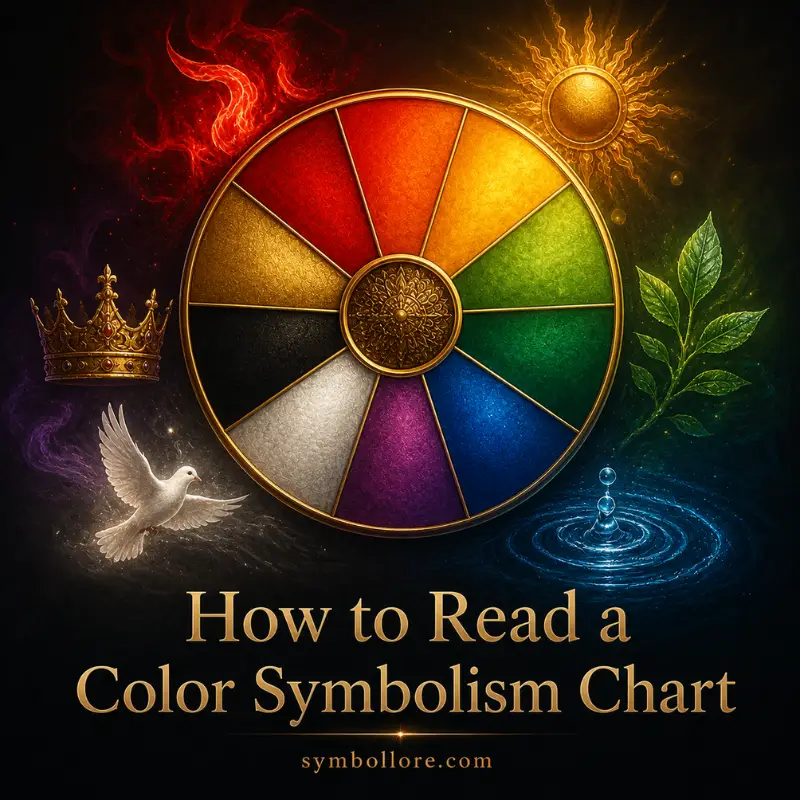
A chart gives you possible meanings, not a final verdict. Before selecting an interpretation, ask five questions:
- Where does the color appear? A red traffic signal works differently from a red rose.
- Who created or selected it? An author, artist, community, or brand may have a specific purpose.
- Which culture and period apply? Traditions change across places and generations.
- What shade appears? Pale blue may seem gentle, while navy can suggest authority.
- Which colors and objects surround it? Red beside green may evoke Christmas in the United States.
Personal associations matter too. A green room may feel restful to one person but remind another person of a hospital. Therefore, strong interpretations combine the chart with visible evidence.
What the Main Colors Symbolize
Red carries some of the strongest contrasting meanings. Blood and fire connect it with danger, sacrifice, violence, and urgency. Meanwhile, roses, hearts, and wedding traditions connect it with affection, vitality, and celebration. The Smithsonian’s
Its collection demonstrates why one color can support several meanings rather than one universal definition.
Blue often conveys calm, trust, loyalty, water, sky, or spiritual distance. It may also suggest coldness and sorrow, especially in phrases such as “feeling blue.” Green usually represents vegetation, fertility, health, renewal, or permission to proceed. However, it can also imply envy, sickness, or inexperience.
Yellow brings sunlight, hope, warmth, and intellectual energy to many compositions. Yet caution signs and stories about illness can give it an uneasy effect. Orange combines some of yellow’s warmth with red’s activity. As a result, it often communicates friendliness, creativity, autumn, or visibility.
Purple has long-standing links with rank, wealth, religion, magic, and imagination. Black may communicate elegance and authority in formal clothing, but death or evil in another setting. White frequently suggests innocence, cleanliness, peace, or an untouched beginning. Still, it serves as a mourning color in several cultural traditions.
Why Color Meanings Change Across Cultures
Color meanings develop through religion, politics, available materials, ceremonies, language, and shared history. Consequently, a familiar American association may not transfer safely to another community.
Red illustrates this difference clearly. Many Americans connect it with love, danger, or urgent action. In Chinese celebrations, it commonly represents happiness and good fortune. White provides another contrast: American weddings often use it for purity or new beginnings, while some Asian funeral traditions use it for grief.
Even within one society, meanings change over time. Political movements can claim a color, businesses can popularize new associations, and fashion can reverse older gender codes. A chart should therefore name the relevant tradition instead of claiming that “the East” or “the West” speaks with one voice.
Research also finds both shared patterns and cultural differences. A peer-reviewed
The findings matter because they challenge the idea that a single emotional label applies equally to every audience.
Color Symbolism in Art and Literature
In art and literature, color works as a clue that gains meaning through repetition, contrast, character, and plot. A writer may connect white clothing with innocence early in a story, then stain it to show lost innocence. A filmmaker might drain color from a scene to create emotional distance.
Readers should begin with evidence inside the work. Note which character wears the color, what happens when it appears, and whether its meaning changes. A green light might represent hope in one narrative, jealousy in another, or simply a physical signal.
Art history also resists fixed definitions. The Metropolitan Museum of Art notes that
red has carried many political associations in different works and periods.
This range shows why the object, artist, date, and surrounding imagery matter more than a generic list alone.
Color Psychology and Symbolism Are Different
Color symbolism describes meanings that people attach to colors. Color psychology studies relationships between color and human thought, emotion, attention, or behavior. The two fields overlap, but they do not make identical claims.
Research has found recurring color-emotion patterns. A 2025 systematic review covering more than a century of studies reported reliable links such as yellow with joy and black with sadness. However, the
review of color and emotion research
also treats these links as associations shaped by methods and conditions. It does not prove that a color will produce the same response in every viewer.
Therefore, statements such as “blue always makes people calm” go too far. Preference, brightness, task, culture, personal memory, and surrounding design can alter the result.
How Shades and Color Combinations Change Meaning
Shade and brightness can shift a color’s symbolic tone. Light blue may feel open, soft, or youthful. Navy often appears disciplined, conservative, or professional. Bright red feels energetic and immediate, while burgundy can seem mature, formal, or luxurious.
Combinations create another layer of meaning. Red and white may suggest romance, medical care, or a national identity. Black and orange strongly evoke Halloween in the United States. Green and gold may communicate nature and prestige, while blue and gray can feel calm or corporate.
Contrast also controls which color dominates. A small red object in a muted scene may become an urgent focal point. The same red inside a crowded, multicolored design may lose that force. Always interpret the whole palette rather than isolating a single swatch.
Color Meaning in Branding and Communication
Brands use color to establish a tone, organize information, and help people recognize products. Blue may support a message of reliability, while green can fit environmental or wellness themes. Orange can make a service feel approachable and active.
However, a popular association does not guarantee the desired response. Industry conventions, audience expectations, competitor palettes, and actual wording also influence the message. A financial company could use pink successfully if its wider identity communicates competence and trust.
Use this short selection test:
- Define the message before selecting the color.
- Identify the audience and cultural setting.
- Compare light and dark variations.
- Test the palette beside real words and images.
- Ask several target users what they notice.
- Check legibility and accessibility before publishing.
Spiritual and Ceremonial Color Meanings
Spiritual meanings belong to particular traditions rather than a single global system. Purple can represent penitence or royalty in some Christian settings. Saffron and orange robes carry specific religious importance within Hindu and Buddhist traditions. Green also has deep associations with Islam, life, and paradise.
Ceremonies create their own meanings. White wedding clothing has become familiar in the United States, while red bridal clothing holds celebratory importance in several Asian traditions. Funeral colors also vary.
Writers should identify the community, ritual, location, and period behind any claim. Words such as “may symbolize” are more accurate than declaring that a color always has one spiritual message. Personal aura charts and modern mystical systems can be described as beliefs, but they should not be presented as scientifically proven facts.
Accessibility: Never Rely on Color Alone
Color must not be the only method used to communicate instructions or status. A red error box, for example, should also include an icon and a clear written message. Otherwise, some people with color-vision differences may miss the information.
The World Wide Web Consortium explains that
information conveyed by color also needs another visual or textual cue.
Its guidance matters for charts, links, forms, buttons, maps, and warning messages because meaning must remain available without hue perception.
Text also needs sufficient contrast against its background. Under WCAG Level AA guidance, normal text generally needs a contrast ratio of at least 4.5:1, while qualifying large text needs at least 3:1. Symbolism should strengthen a design, not make essential information difficult to read.
Common Color Symbolism Mistakes
The most common mistake is treating a short chart as a universal dictionary. A symbolic meaning becomes persuasive only when the object, culture, story, or design supports it.
Other frequent errors include:
- Confusing an association with a guaranteed psychological effect
- Assuming every member of a culture reads a color identically
- Ignoring shade, brightness, material, and lighting
- Interpreting a color without studying nearby objects
- Using spiritual claims without naming their tradition
- Relying on color alone in charts or digital interfaces
- Forcing symbolism onto an ordinary descriptive detail
A careful interpretation uses several clues. If only one clue supports the proposed meaning, present it as a possibility rather than a fact.
FAQs
Red commonly symbolizes physical energy, courage, action, and strength. Black may represent authority or controlled power, while brown can suggest endurance and stability. The best choice depends on whether the intended strength is energetic, formal, grounded, spiritual, or emotional.
White often symbolizes peace, surrender, simplicity, or reconciliation in American and European settings. Blue can also represent calm, harmony, and peaceful stability. Cultural and religious settings may use these colors differently, so surrounding symbols should confirm the meaning.
Yellow often symbolizes hope because of its connection with sunlight, warmth, and a new day. Green can express hope through growth, spring, recovery, and renewal. In literature or art, repetition and narrative events determine which association is strongest.
No. Black can represent elegance, authority, sophistication, mystery, protection, rebellion, or grief. Formal clothing often gives it a polished meaning, while a funeral setting connects it with mourning. Context determines which interpretation makes sense.
Colors gain meaning from many sources, including nature, religion, history, language, politics, and personal experience. Red connects with both roses and blood, so it can suggest love or violence. Different communities may also preserve separate traditions around the same hue.
No. Color can contribute to attention, expectation, or emotional association, but it cannot reliably determine an individual’s behavior. Culture, setting, preference, contrast, wording, and past experience also influence how a person responds.
Conclusion
A color symbolism chart offers a useful starting point for understanding how colors communicate passion, trust, growth, grief, purity, authority, and other ideas. Still, the chart should guide interpretation rather than control it.
Check the culture, period, shade, combination, object, and creator’s purpose before choosing a meaning. In practical design, test the full palette with its intended audience and keep every message accessible without color. Context turns a general association into a credible interpretation.


