Heron symbolism commonly centers on patience, wisdom, independence, balance, and renewal. These meanings come partly from the bird itself: a heron can stand almost motionless while watching shallow water, then move with remarkable speed when the right moment arrives. Its solitary hunting style also makes it an easy image for self-reliance and quiet observation.
Yet the heron does not carry one universal meaning. Ancient Egyptian traditions connect a heron-like sacred bird with creation and renewal, while Japanese folklore gives white herons and other herons associations with purity, transition, spirits, and the boundary between life and death. In China and Japan, artistic traditions also give white herons distinct meanings.
Quick Answer
Heron symbolism most often represents patience, wisdom, independence, balance, precision, and renewal. These associations grow naturally from the bird’s stillness, solitary hunting, long periods of observation, and sudden decisive movements. However, the meaning changes by culture and context: an Egyptian sacred bird, a Japanese white heron, and a modern American wildlife image should not automatically be interpreted in the same way.
TL;DR
- Herons commonly symbolize patience because they wait carefully before striking.
- Their solitary feeding behavior supports modern associations with independence and self-reliance.
- Their movement between water, land, and air can inspire ideas of adaptability and transition.
- Ancient Egyptian heron imagery is strongly connected with creation, renewal, and the sacred Bennu bird.
- Japanese traditions give herons more complex meanings involving purity, transition, spirits, and mortality.
- A heron sighting does not have one scientifically established supernatural message.
Heron Meanings at a Glance
| Context | Possible Meaning | Why the Association Exists | Important Limit |
|---|---|---|---|
| Still heron at water | Patience and observation | It waits before making a precise strike | A symbolic reading, not a scientific message |
| Solitary hunting | Independence and self-reliance | Herons often forage alone | They can still breed and nest socially |
| Sudden strike | Timing and decisive action | Long stillness can end in rapid movement | Not every behavior carries symbolic intent |
| White heron in East Asian art | Purity and grace | White plumage has strong visual symbolism | Meanings vary by artwork and tradition |
| Ancient Egyptian heron imagery | Creation and renewal | The Benu bird was linked with divine renewal | Benu should not simply be equated with every modern heron |
| Japanese folklore | Transition and otherworldliness | Herons appear in stories involving spirits, death, and ritual | These meanings belong to specific traditions |
| Modern American imagery | Calm, nature, solitude | Herons are familiar wetland birds | Personal interpretation differs |
What Does Heron Symbolism Mean?
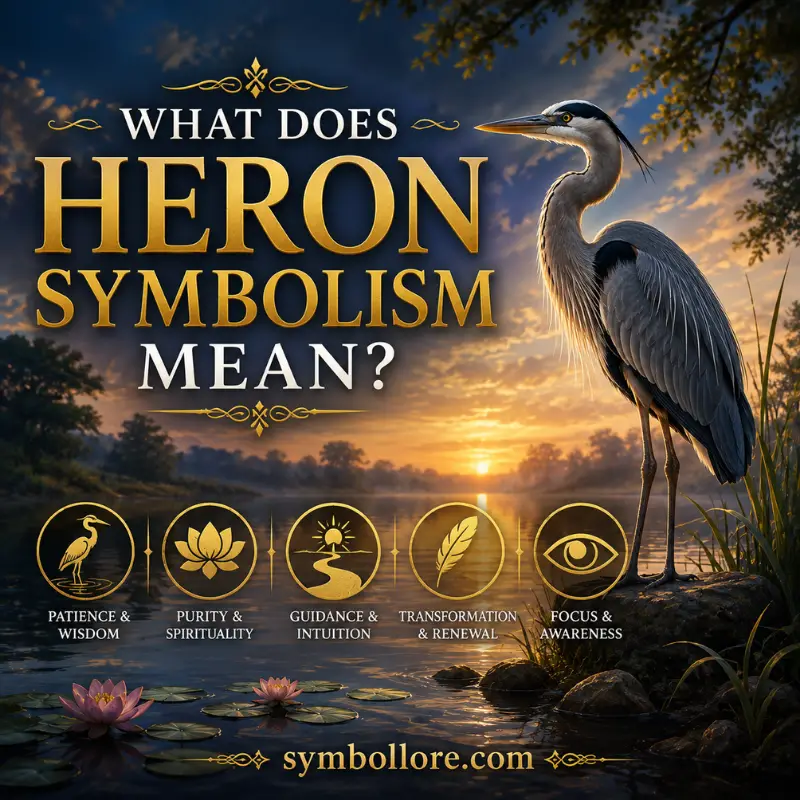
At its broadest, heron symbolism expresses quiet strength rather than forceful power. The bird does not need constant movement to survive. It watches, conserves energy, and acts when an opportunity appears.
That behavioral pattern explains why modern symbolic interpretations repeatedly emphasize patience and timing. A heron standing at the edge of a pond looks inactive, but its stillness is purposeful. The bird is observing its surroundings and waiting for prey to come within reach.
This creates an especially useful symbolic contrast: stillness does not necessarily mean passivity. A person may pause, gather information, and remain calm while still preparing for decisive action.
The heron also lends itself to meanings of independence. Its long-legged silhouette often appears alone in wetlands, rivers, ponds, and coastal areas. That visual solitude has encouraged interpretations involving self-possession, contemplation, and the ability to follow one’s own path.
Still, symbolism should not be confused with biology. Herons are not permanently solitary creatures, and their appearance alone does not prove that someone needs isolation. The symbolic lesson comes from the human response to observable behavior.
Why Herons Symbolize Patience and Precision
Patience is probably the most intuitive modern meaning attached to the heron.
A hunting heron may remain almost motionless for an extended period. Instead of chasing prey continuously, it watches the water and waits for a useful opportunity. Then its head and neck can move rapidly enough to capture prey.
That combination of long observation and brief action creates a strong metaphor for deliberate decision-making. Heron symbolism can therefore suggest:
- Wait before reacting.
- Observe the situation carefully.
- Conserve energy when immediate action is unnecessary.
- Recognize the difference between hesitation and preparation.
- Act decisively when the conditions are right.
This interpretation is particularly useful because it does not require a supernatural explanation. The symbolic association begins with something people can actually observe.
The heron can therefore represent patience as an active skill, not passive waiting. Its lesson is closer to “watch carefully so that you can act well” than “do nothing.”
Independence, Solitude, and Self-Reliance
Herons are frequently pictured alone, so solitude has become another important part of their symbolic vocabulary.
A lone heron standing beside a river can evoke privacy, contemplation, independence, and distance from social noise. In modern art and writing, this makes the bird useful for representing someone who is comfortable thinking independently.
However, “solitude” should not automatically mean loneliness. A symbolic heron can represent chosen solitude: time spent alone to observe, recover, think, or make a decision.
That distinction matters. Independence does not require rejecting other people. Instead, the heron can symbolize the ability to maintain an inner direction while remaining connected to the wider world.
This idea also appears in the symbolism of other birds. For example,
Blue Heron Symbolism: Meaning, History, and Life Lessons
similarly connects the blue heron with patience, independence, balance, and purposeful action.
Balance and the Heron’s Relationship With Water
Balance is another common modern interpretation of heron imagery. The bird’s long legs and narrow body create a distinctive visual impression as it moves through shallow water.
Symbolically, that appearance can suggest maintaining stability in uncertain conditions. Water itself often carries emotional or transformational meanings in literature and art, while the heron’s ability to stand within it creates an image of remaining composed while circumstances shift.
The association is especially useful when the heron appears in a symbolic scene with:
- still water;
- reeds or marshland;
- reflections;
- dawn or dusk;
- a solitary shoreline;
- a bird standing on one leg.
These elements can strengthen themes of reflection, calm, transition, or emotional control.
Yet there is no universal symbolic code in which “heron plus water” automatically means one specific thing. Artists and writers create meaning through context. A heron beside dark water in a funeral painting may communicate something very different from a heron painted in bright spring wetlands.
Heron Symbolism in Ancient Egypt
Ancient Egyptian heron symbolism is among the strongest documented historical associations.
The Benu bird, a sacred bird represented in heron-like form, was associated with creation and renewal and connected with deities including Atum, Re, and Osiris. The Metropolitan Museum of Art notes that the Benu was linked with acts of creation and renewal and that Greek writers later associated related imagery with the phoenix.
This symbolism is more specific than the modern claim that “herons symbolize rebirth.” The ancient Egyptian tradition involved a particular sacred bird and a religious system with its own cosmology.
Museum objects provide important evidence. The Met’s collection includes a scarab showing a heron associated with the Benu and describes the bird’s connection with creation and renewal. The British Museum also documents a heart scarab with a heron image connected to the sun god and daily renewal.
The Egyptian association therefore gives heron imagery a historically grounded connection with:
- creation;
- renewal;
- solar cycles;
- divine transformation;
- rebirth.
That does not mean every heron image today inherits ancient Egyptian religious meaning. Modern artists may borrow the visual idea without intending to reference Egyptian theology.
Heron Symbolism in Japan
Japanese heron symbolism is particularly rich because the bird appears in folklore, literature, performance, and visual art.
White herons have been associated with purity and transition, while other herons can carry darker or more mysterious meanings. National Geographic’s account of Japanese folklore notes that herons have appeared in Japanese literature, art, and folklore for more than a millennium. It also describes associations with spirits, death, purity, and movement between worlds.
The Japanese term sagi can refer to herons and egrets, which creates another reason for caution when translating older sources into modern English. A historical reference to a white bird should not automatically be assigned to the exact species a modern English speaker imagines.
The Shirasagi-no-Mai, or White Heron Dance, provides a striking example of symbolic performance. Dancers dress as white herons and move through a ceremonial procession. The tradition has a long history and is performed at Sensoji Temple in Tokyo.
In this context, the heron is not simply a symbol of patience. It becomes part of a ritual and artistic language involving purity, grace, protection, transition, and the relationship between the human and spiritual worlds.
White Heron Symbolism in East Asian Art
White herons have also developed distinctive meanings in Chinese and Japanese art.
A Philadelphia Museum of Art collection record for Kano Naonobu’s White Heron and Lotus explains that the white heron became associated with purity because of its unusually white appearance. The same record notes a Chinese wordplay involving the pronunciation of “heron” and “good fortune.”
This is an important example of how symbolism can arise from language as well as appearance.
A symbol may gain meaning because:
- the object looks like an existing ideal;
- its behavior suggests a human quality;
- its name sounds like another meaningful word;
- artists repeatedly place it beside another symbolic object;
- religious or literary traditions give it a particular role.
Therefore, East Asian heron symbolism should not be reduced to a generic list such as “heron equals luck.” The exact image, language, artwork, and historical period matter.
The combination of a white heron and lotus, for example, creates a different symbolic field from a dark night heron appearing alone in a Japanese ghost story.
Herons and the Symbolism of Transition
Herons naturally occupy spaces where different environments meet. They can stand at the edges of rivers, marshes, lakes, tidal areas, and other wetlands.
That physical position makes the bird especially useful as an image of transition and thresholds.
A heron can symbolically represent:
- moving from one stage of life to another;
- pausing between two choices;
- adapting to changing circumstances;
- observing before entering unfamiliar territory;
- living between emotional and practical concerns.
Japanese traditions strengthen this association because some heron stories connect the bird with spirits, death, and another world.
The idea should still be handled carefully. Saying that a heron “represents transition” is a symbolic interpretation. Saying that seeing a heron proves someone is crossing into the afterlife would be an unsupported supernatural claim.
The distinction keeps symbolism meaningful without turning folklore into fact.
Heron Symbolism in Native American Contexts
Claims about “Native American heron symbolism” require particular care.
There is no single Native American religion or universal Indigenous interpretation of the heron. Hundreds of nations have distinct languages, histories, ceremonies, clan systems, and relationships with animals.
Historical and museum collections do, however, document herons within specific Indigenous contexts. The Smithsonian’s National Museum of the American Indian, for example, holds a Heron clan necklace identified as Seneca [Cattaraugus] and made in 1969. The Smithsonian also documents an Ojibway-associated totem pole that includes a crane or heron among its figures.
These records show that heron imagery can have a place in particular Indigenous cultural contexts. They do not justify assigning one fixed meaning to every Native nation.
For responsible symbolism writing, the safest approach is to identify the specific community whenever evidence permits. A claim such as “the heron means wisdom to all Native Americans” is far too broad.
Heron Symbolism in Art and Literature
Artists often use herons because their shape communicates meaning before a viewer understands the surrounding story.
A standing heron can create a feeling of silence. A flying heron can suggest release or movement. A white heron may suggest purity. A dark or night heron can create a more mysterious mood.
Literature can make the symbolism even more specific. Sarah Orne Jewett’s “A White Heron” is a well-known example in which a rare bird becomes part of a conflict involving nature, human desire, and the decision to protect something wild rather than surrender it.
This kind of literary symbolism demonstrates an important principle: a symbol’s meaning comes from its role in a work, not simply from a universal dictionary.
Likewise, Japanese Noh traditions use the heron in ways connected with transformation and the boundary between ordinary and supernatural experience. National Geographic’s discussion of the Noh play Sagi describes the heron as part of a story involving an emperor, a captured bird, dance, and release.
Blue Heron Symbolism and Modern American Meaning
In the United States, the great blue heron is one of the most recognizable heron images. Its tall body, blue-gray feathers, long neck, and association with wetlands make it especially common in wildlife art, photography, gardens, conservation imagery, and tattoos.
Modern American interpretations often emphasize:
- patience;
- independence;
- quiet confidence;
- observation;
- balance;
- connection with nature;
- deliberate action.
These meanings fit the bird’s appearance and behavior, but they should not be presented as ancient American doctrine. Much of this symbolic language is contemporary and interpretive.
The distinction is especially important when discussing spiritual meanings. A person may personally view a blue heron encounter as meaningful, but that private interpretation is not proof of a universal omen.
For a related comparison,
Egret Symbolism: What This Graceful Bird Represents
explains how white plumage, patience, grace, and independence can shape symbolic interpretations while also distinguishing egrets from cranes and other birds.
What Different Heron Colors Can Suggest
Color can change the emotional effect of heron symbolism, although color meanings are not fixed across cultures.
White heron
A white heron can suggest purity, grace, clarity, or transition. These associations have strong support in particular East Asian artistic traditions, including the Philadelphia Museum of Art example discussed above.
Blue heron
Blue-gray plumage often inspires modern associations with calmness, reflection, independence, and emotional depth. These are largely interpretive associations rather than a single historical doctrine.
Dark or night heron
A dark heron can create a mood of mystery, secrecy, solitude, or the unknown. In Japanese folklore, darker heron imagery can carry more unsettling or otherworldly associations than the idealized white heron.
The key is to treat color as part of a larger visual context rather than assigning a permanent definition to every shade.
Heron Symbolism in Tattoos, Gifts, and Personal Art
A heron tattoo often works because its symbolism can support several related ideas without requiring one religious interpretation.
Someone may choose a heron to represent patience after a difficult period, independence after leaving an old situation, or a commitment to act thoughtfully rather than impulsively.
A pair of herons can suggest partnership and shared direction, while a single heron can emphasize individuality or solitude. A heron beside water may strengthen themes of reflection and transition.
However, tattoo symbolism is personal. There is no universal authority that says every heron tattoo means one particular thing.
The same principle applies to gifts and artwork. A heron print can communicate calmness or a connection with wetlands, but its meaning depends on the recipient and the circumstances.
Common Misconceptions About Heron Symbolism
Several popular claims become misleading when they are presented without cultural or historical limits.
“Herons always symbolize good luck.”
Not necessarily. Some traditions and modern interpretations connect herons with favorable outcomes, but other traditions give them darker or more complex meanings.
“The Egyptian Bennu was simply a normal heron.”
The Benu was a sacred mythological bird represented in heron-like form. It should not be treated as a straightforward description of an ordinary modern species. Museum evidence connects it with creation and renewal.
“All Native American cultures see the heron as a wisdom symbol.”
This is an overgeneralization. Indigenous nations have distinct traditions, and evidence should be tied to a particular community.
“Seeing a heron means someone is sending you a spiritual message.”
That may be a personal spiritual belief, but it is not a scientifically established fact.
“Heron and crane symbolism are identical.”
They overlap in some artistic settings, but the birds belong to different groups and have different cultural histories. Similar appearance does not erase those differences.
How to Interpret a Heron Symbol in Context
The most useful interpretation begins with the specific heron and the setting rather than a generic symbolism list.
Ask five questions:
- What is the bird doing? A still bird suggests patience differently from one flying away.
- What does it look like? White, blue-gray, or dark plumage can change the visual mood.
- Where does it appear? A wetland, funeral image, painting, tattoo, or story creates different meanings.
- Which culture or historical period is involved? Ancient Egypt and modern America should not be treated as one symbolic tradition.
- What role does the bird play? A sacred figure, literary character, wildlife subject, or personal emblem may each carry a different message.
This approach is more reliable than asking what a heron “always” means.
It also prevents a common mistake: confusing a personal interpretation with historical evidence. Symbolism can be meaningful without being universal or supernatural.
FAQs
Spiritually, a heron is often interpreted as a symbol of patience, inner reflection, independence, and purposeful action. Modern spiritual traditions may also connect it with transition or intuition. These interpretations are personal or tradition-specific, rather than scientifically established messages attached to every heron encounter.
In ancient Egyptian religion, the heron-like Benu bird was associated with creation and renewal and connected with deities such as Atum, Re, and Osiris. Museum evidence shows that Benu imagery had religious and funerary significance. It is more accurate to discuss the sacred Benu tradition than to claim that every Egyptian heron had one universal meaning.
A white heron can symbolize purity, grace, clarity, and transition. In East Asian art, its white appearance contributed to associations with purity, while Japanese folklore gives white herons additional meanings connected with ritual, spirits, and transition. The exact interpretation depends on the artwork or tradition.
A heron sighting can be interpreted as good luck in some personal or cultural contexts, but it does not objectively predict a fortunate event. A more grounded interpretation is to view the sighting as an opportunity to reflect on patience, observation, nature, or timing.
There is no single Native American meaning for the heron. Different Indigenous nations have distinct traditions and relationships with birds. Museum records document specific heron-related cultural objects and identities, such as the Seneca Heron clan necklace, but those records should not be turned into a universal Indigenous symbolism chart.
No. Herons and cranes can share visual associations such as grace and patience, but they are different birds with different cultural histories. East Asian traditions often give cranes especially strong associations with longevity and good fortune, while heron traditions can emphasize purity, transition, or otherworldliness. Species identification matters.
A heron tattoo can represent patience, independence, balance, self-reliance, nature, or thoughtful action. A white heron may emphasize purity or grace, while a blue heron may suggest calmness and individuality. Ultimately, tattoo symbolism is personal rather than governed by one universal meaning.
Conclusion
Heron symbolism is strongest when it is understood as a language of patience, observation, independence, precision, and renewal. The bird’s quiet hunting style explains many modern interpretations, while historical traditions add deeper layers. Ancient Egyptian Benu imagery connects a heron-like sacred bird with creation and renewal, and Japanese traditions associate different herons with purity, ritual, transition, and the spirit world.
The most grounded interpretation depends on context. A heron in a museum artifact, a Japanese performance, a modern American photograph, and a personal tattoo may carry very different meanings. Rather than treating the bird as a fixed omen, it is more useful to see it as a symbol of knowing when to watch, when to wait, and when to act.


