

Black-capped chickadee symbolism commonly centers on resilience, cheerful courage, communication, friendship, and resourcefulness. These ideas arise partly from the small North American bird’s real behavior: it remains active through cold winters, stores food, investigates its surroundings, and uses complex calls within social flocks.
However, the bird has no single universal meaning. Indigenous traditions, modern spiritual beliefs, tattoos, dreams, and personal encounters belong to different interpretive settings. Separating those layers makes the symbolism more accurate, respectful, and useful.
Quick Answer
Black-capped chickadee symbolism represents resilience, alert communication, adaptability, community, and joy during difficult periods. Its year-round presence and energetic behavior make it a natural image of quiet strength. Still, seeing one is not objective proof of luck or a supernatural message; its meaning depends on cultural tradition and personal context.
Key Takeaways
- Winter survival supports the chickadee’s association with resilience.
- Complex calls inspire meanings tied to communication and awareness.
- Social flocks suggest cooperation without erasing independence.
- Food caching connects the bird with memory and preparation.
- Indigenous meanings should always be attributed to specific nations.
- Sightings become symbolic through context, not fixed prediction.
Black-Capped Chickadee Meanings at a Glance
| Meaning | Behavioral or Cultural Connection | Important Distinction |
|---|---|---|
| Resilience | Remains active during severe northern winters | Survival requires adaptation, not constant cheerfulness |
| Joy | Lively motion and bright-sounding vocalizations | Human listeners assign the emotional tone |
| Communication | Uses varied songs, contact notes, and alarm calls | Calls convey bird information, not human prophecy |
| Community | Joins winter flocks, including mixed-species groups | Flocks also contain rank and competition |
| Resourcefulness | Stores individual food items for later retrieval | Preparation is a metaphor, not intentional teaching |
| Courage | Curiously approaches unfamiliar sounds and feeders | Curiosity should not be confused with fearlessness |
| Wisdom | Appears in specific Indigenous traditions and modern symbolism | Meanings differ among nations and belief systems |
What Does a Black-Capped Chickadee Symbolize?
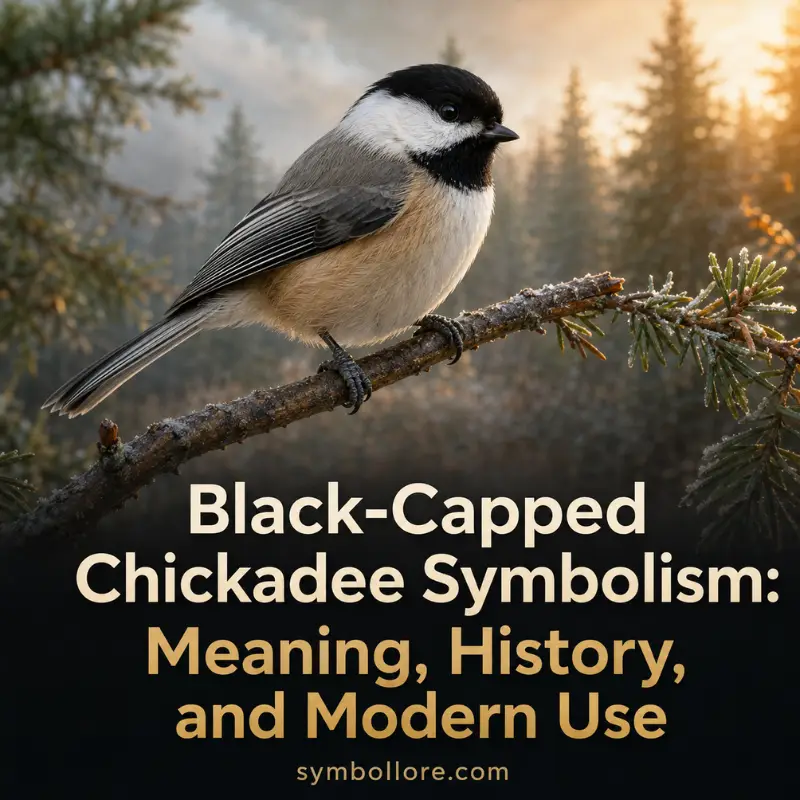
The black-capped chickadee most often symbolizes quiet resilience, optimism, clear communication, social connection, and intelligent preparation. It does not represent power through size or dominance. Instead, its appeal comes from remaining lively, attentive, and capable in demanding conditions.
That symbolism is a modern synthesis rather than one ancient, universal code. Birdwatchers may see an adaptable woodland songbird. A spiritual reader may view the same encounter as encouragement, while a tattoo wearer might use it to remember family or perseverance. Therefore, the strongest interpretation begins with the bird’s real traits and then considers the observer’s circumstances.
This distinction prevents a common mistake: presenting every popular association as inherited folklore. Some meanings have identifiable cultural roots, while others developed from recent nature writing, art, and personal experience.
Why the Bird Represents Resilience and Hope
Resilience is the clearest behavior-based interpretation. Black-capped chickadees live throughout much of northern North America and remain in their range during winter. Rather than making a long seasonal migration, they manage cold conditions through food storage, insulation, sheltered roosts, and short-term reductions in nighttime body temperature.
The bird’s winter visibility also shapes its hopeful image. A lively chickadee moving among bare branches creates an immediate contrast with a quiet, frozen landscape. Consequently, people may read its presence as proof that life can remain active during a difficult season.
The Cornell Lab of Ornithology’s life-history account
documents its habitat, feeding, flocking, and food-caching behavior. Those facts support a metaphor of adaptation. They do not prove that the bird arrives to predict a favorable outcome.
Communication, Awareness, and the Chick-a-dee Call
Black-capped chickadees symbolize communication because their vocal system carries real social information. Their sounds include the familiar chick-a-dee call, a clear fee-bee song, contact notes, high alarm sounds, and aggressive gargles. These signals help coordinate movement, maintain relationships, and respond to danger.
Moreover, the number and pattern of “dee” notes can change with alarm conditions. Other birds in mixed flocks may also react to chickadee warnings.
The Cornell Lab’s guide to black-capped chickadee sounds
explains these calls and their known contexts.
Symbolically, this behavior can suggest speaking clearly, listening closely, and adjusting a message to its urgency. Yet hearing repeated “dees” is not a coded forecast about the listener’s future. Most likely, the bird is communicating about its immediate environment.
Community, Cooperation, and Healthy Boundaries
Chickadee spiritual meaning often includes friendship and community because these birds form winter flocks. They may travel with nuthatches, kinglets, woodpeckers, and other small woodland birds. Shared vigilance and information can help flock members locate food and notice predators.
Still, this social life is not a simple picture of perfect harmony. Black-capped chickadee flocks have dominance relationships, and individuals use aggressive calls around rank, space, or food. Thus, a more complete symbolic lesson combines cooperation with boundaries.
For a person, the bird can represent staying connected without losing independence. It may suit someone building a support network, learning to communicate needs, or recognizing that healthy communities include both mutual care and personal limits.
Intelligence, Memory, and Resourcefulness
The species has an especially strong connection with memory and preparation. It stores seeds and other food in separate locations, then returns to many of those caches later. This behavior allows a tiny bird to use brief opportunities and spread risk across its environment.
In 2024, researchers studying food-caching chickadees reported sparse, event-specific activity patterns in the hippocampus, a brain region involved in memory. The peer-reviewed
compared these patterns to neural barcodes linked with individual caching events.
This finding gives resourcefulness symbolism a firm behavioral foundation. As a personal emblem, the chickadee may represent planning carefully, remembering what matters, or using limited resources well. It does not mean that every sighting predicts new knowledge or academic success.
Indigenous Traditions and Cultural Respect
Some Native American chickadee traditions associate the bird with knowledge, truth, warning, success, or attentive listening. However, “Native American meaning” is not one unified belief. Hundreds of sovereign nations maintain distinct languages, histories, oral traditions, and relationships with local birds.
Cherokee stories and traditions have connected the chickadee with truthful knowledge or warning. In certain Plains traditions, seeing or hearing a chickadee may be associated with success, including within dreams or visions. The educational collection
Native American Chickadee Mythology
offers a brief nation-attributed starting point and links to related stories.
These traditions should not be blended into a generic “tribal” message or repackaged as a universal spirit-animal reading. When writing, teaching, or designing a tattoo, name the specific nation and use reliable community-connected sources whenever possible.
Black, White, and Gray Color Symbolism
The black cap, white cheeks, and gray back create a striking visual contrast. Modern interpreters sometimes read black as mystery or protection, white as clarity, and gray as balance. Together, the colors may suggest holding opposing experiences—fear and hope, grief and renewal, caution and trust—at the same time.
However, this color symbolism is largely a contemporary personal reading. There is no strong evidence that the plumage carried one established historical color code across cultures. The black cap also serves a biological role in species appearance; it was not created to communicate a human moral lesson.
Therefore, color-based meaning works best in visual art, memorial jewelry, or tattoo design when presented as the wearer’s interpretation. It should not be described as an ancient fact without a traceable source.
What Seeing a Black-Capped Chickadee May Mean
Seeing a black-capped chickadee may serve as a personal reminder to remain alert, communicate, prepare, or accept support. The encounter gains meaning from the observer’s situation rather than from a fixed omen dictionary.
A practical interpretation uses three questions:
- What was the bird doing? Calling, feeding, approaching, or joining a flock suggests different themes.
- What was happening in your life? A difficult season may make resilience meaningful, while conflict may highlight communication.
- What did you feel? Calm, recognition, grief, or curiosity helps explain why the moment stood out.
First, identify ordinary behavior. Then consider the emotional association. This approach leaves room for spiritual belief without turning a natural wildlife encounter into guaranteed prediction.
Dreams, Tattoos, Memorials, and Personal Symbols
A chickadee dream may reflect persistence, communication, belonging, or a need to notice small details. Dreams are highly personal, however, and no scientific method assigns one fixed meaning to a particular bird. The dream’s setting, actions, and emotional tone offer better clues than the species alone.
A chickadee tattoo commonly represents cheerful strength, home, friendship, family, or endurance. A bird on a winter branch emphasizes resilience, while two chickadees can suggest partnership. Calls, seeds, or native plants may add themes of voice, preparation, and place.
For remembrance, the bird can honor someone who loved nature or brought warmth into difficult moments. It is wiser to choose details tied to that person than to claim that every chickadee is a literal visit from the deceased.
Black-Capped Versus Carolina Chickadee Meaning
Black-capped and Carolina chickadees inspire similar symbolism, but they are different species. Both have black caps, dark throat patches, pale cheeks, social behavior, and recognizable calls. Because of that resemblance, either may evoke communication, curiosity, adaptability, and community.
Location and voice offer the best practical clues. Black-capped chickadees mainly occupy northern areas, while Carolina chickadees occur farther south and east. Their ranges meet in a hybrid zone, making identification harder. The black-capped species usually gives a slower two-note whistle, while the Carolina’s song often contains more notes.
The National Audubon Society field guide
provides size, appearance, habitat, and range information. Accurate identification matters when an article or artwork claims species-specific significance.
What Chickadee Symbolism Does Not Prove
Symbolism does not prove that a chickadee predicts luck, carries a message from a deceased person, or reveals a certain future event. Those ideas may hold spiritual or emotional value, but they are matters of belief rather than established ornithology.
Likewise, one bold bird does not mean the entire species lacks fear. Chickadees investigate sounds and sometimes approach people, yet they still assess threats, issue alarms, compete, and escape predators. Their apparent cheerfulness is also a human impression of quick movements and bright calls.
A grounded interpretation does not remove wonder. Instead, it gives each layer the right label: biology describes behavior, cultural history records attributed traditions, and personal symbolism explains what the encounter means to an individual.
FAQs
Many modern symbolism guides and some cultural traditions treat a chickadee as a favorable sign. Still, no sighting guarantees luck or success. A grounded interpretation treats the bird as a reminder of optimism, awareness, and readiness rather than a prediction that circumstances will automatically improve.
A nearby chickadee often means that food, cover, a feeder, or simple curiosity attracted it. Symbolically, the visit may suggest paying attention, communicating clearly, or finding courage in small actions. Its personal meaning depends on the moment and should not replace the ordinary biological explanation.
A chickadee at a window may symbolize awareness, reflection, or a message that demands attention in personal spiritual practice. In reality, it may see a reflection, investigate movement, or approach a feeder. Repeated window strikes require practical prevention because collisions can seriously injure birds.
Some people adopt the chickadee as a comforting remembrance symbol, especially when the bird appears during grief. However, there is no objective evidence that it contains or carries a person’s spirit. Its value can remain genuine as a private association with memory, love, resilience, or shared experiences.
In a romantic context, a chickadee can represent companionship, communication, loyalty, and mutual support. A pair makes a fitting symbol for partners who remain connected while retaining individual strength. This is primarily a modern interpretation inspired by pair bonds and social behavior, not a universal marriage tradition.
Some contemporary spiritual systems use “spirit animal” for a personal guide associated with resilience, sociability, and voice. The term should not be presented as a universal Indigenous practice, because Native nations have distinct beliefs and protocols. “Personal animal symbol” may be more appropriate outside a specific cultural tradition.
A black-capped chickadee tattoo often means resilience, joy, resourcefulness, home, or connection with loved ones. Its pose and setting refine the message. Snow may represent surviving hardship, a seed can suggest preparation, and multiple birds may honor family or community.
Conclusion
Black-capped chickadee symbolism draws its strongest meanings from a small bird’s remarkable life: enduring northern winters, storing food, sharing warnings, and moving within social flocks. These traits support associations with resilience, communication, intelligence, hope, and community.
Still, folklore, Indigenous traditions, spiritual readings, and personal meanings should not be treated as interchangeable. The most respectful interpretation starts with accurate behavior, identifies the cultural source when one exists, and leaves personal significance to the person experiencing the encounter.


