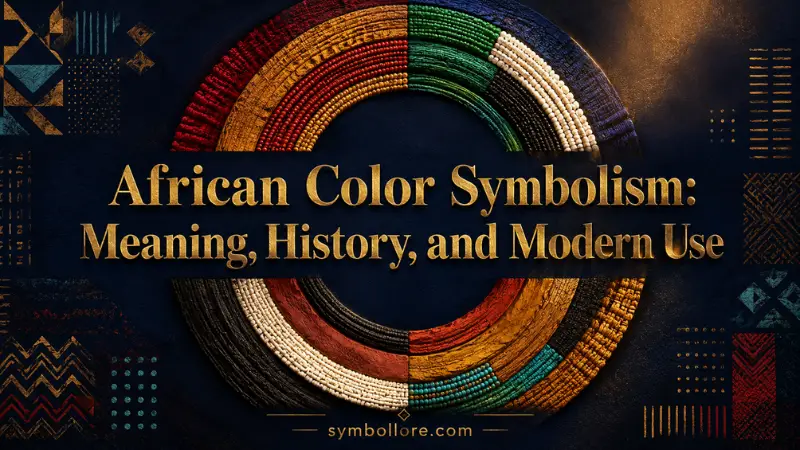
African color symbolism is not a single code shared by every community on the continent. A color may signal life, spiritual power, status, mourning, protection, or political identity, depending on the people, object, occasion, and combination in which it appears.
That context matters because Africa contains extraordinary cultural and linguistic diversity. UNESCO notes that the continent is home to about one-third of the world’s languages, underscoring why one universal symbolic dictionary cannot represent all its communities. This guide explains broad associations while grounding the meanings in documented examples.
Quick Answer
African color symbolism uses color to communicate cultural identity, social position, spiritual ideas, life stages, memory, and political values. However, no color has one fixed meaning across Africa. Interpret the hue together with its community, material, pattern, wearer, event, and neighboring colors rather than relying on a continent-wide color chart.
Key Takeaways
- African communities do not share one universal color dictionary.
- Meaning changes with the object, occasion, maker, wearer, and location.
- Materials such as indigo and ochre add historical context.
- Color combinations often communicate more than isolated hues.
- Pan-African colors belong to a specific modern political tradition.
African Color Meanings at a Glance
| Color or Palette | Possible Association in Some Contexts | Documented Example | Important Caution |
| Red and orange | Blood, heat, force, identity, sacrifice, or struggle | Yoruba pupa, Himba ochre, and Pan-African red | These traditions do not assign red exactly the same meaning. |
| White and pale tones | Coolness, wisdom, love, purity, or spirituality | Yoruba funfun and white in some Zulu bead combinations | White does not carry one meaning across all communities. |
| Black and dark tones | Mediation, difficulty, peoplehood, ancestry, or maturity | Yoruba dudu, Zulu pairings, and Pan-African black | Meaning depends strongly on surrounding colors. |
| Blue and indigo | Coolness, status, trade, identity, or authority | Yoruba chromatic categories and regional indigo textiles | The dye, textile, and community may matter more than “blue” alone. |
| Gold and yellow | Prestige, visibility, celebration, or political identity | Costly Ghanaian kente and Ethiopian-derived national palettes | Kente’s status does not prove that every yellow thread means wealth. |
| Red-brown ochre | Beauty, protection, identity, ancestors, or life stages | Himba otjize and Xhosa ocher-colored clothing | Ochre may have practical and social functions at the same time. |
| Red, black, and green | Struggle, the people, and the future | Marcus Garvey’s Pan-African palette | This is a modern political system, not an ancient continent-wide code. |
Why African Color Symbolism Has No Single Code
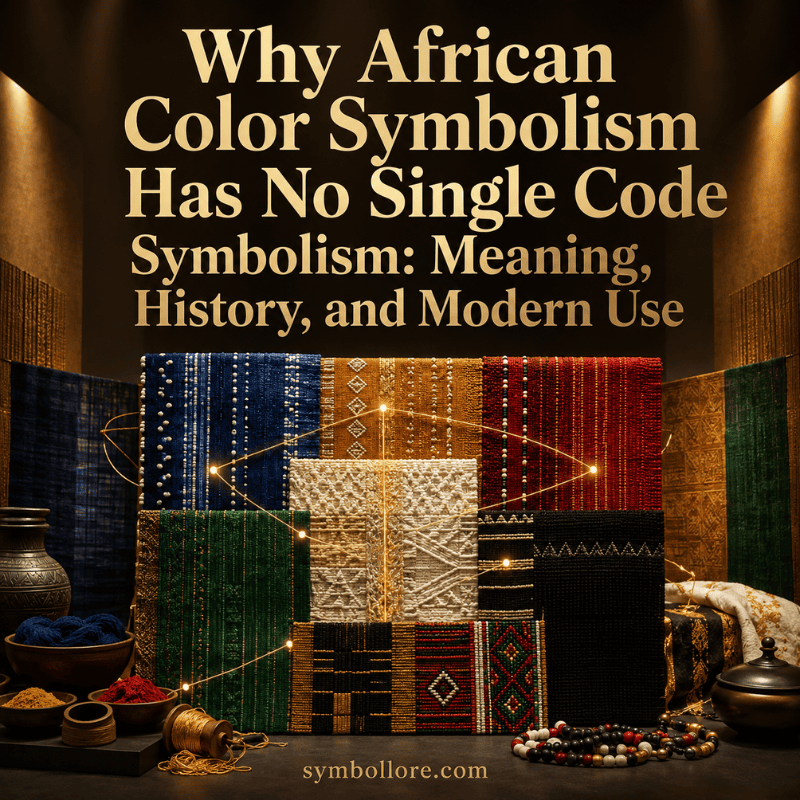
African color symbolism changes because meaning belongs to communities, not continents. A woven cloth from Ghana, a beaded belt from South Africa, and ochre applied to skin in Namibia come from different languages, histories, materials, and social systems.
Their colors should not be interpreted as interchangeable.
Even communities within one region may classify colors differently. Meanings can also change with age, gender, status, ceremony, or historical period. Museum scholarship on Zulu beadwork notes that there is no direct correlation between one color and one definition. Some messages were personal enough to be fully understood only by the maker and people close to her.
A useful guide can identify recurring associations. However, it should present them as starting points for research, not fixed translations.
How Cultural Context Changes a Color’s Meaning
Cultural context determines whether a color communicates status, emotion, spirituality, family position, or political belonging. Before interpreting a garment or artwork, identify six elements:
- Community: Who made and used the object?
- Location: Where did the tradition develop?
- Material: Is the color produced with glass beads, plant dye, clay, metal, or synthetic paint?
- Object: Does it appear on ritual clothing, a wall, flag, body, mask, or prestige textile?
- Occasion: Is the object connected with marriage, mourning, leadership, initiation, worship, or protest?
- Combination: Which patterns and neighboring colors complete the message?
This method prevents a common error: removing one hue from the visual system that gives it meaning. In many African textiles and beaded objects, pattern, material, and composition communicate alongside color rather than serving as decoration around it.
Red Symbolism: Life, Heat, Identity, and Struggle
Red frequently carries strong meanings, but those meanings are not identical. In Yoruba color theory, reds and oranges belong to pupa, a chromatic category associated in one documented ceremonial object with blood, battle heat, aggression, and the iron deity Ogun. The category describes more than one narrow shade.
Among Himba communities in Namibia, red is visible through otjize, a paste containing ground ochre, butterfat, and other ingredients. It may express beauty, clan identity, health, ancestry, and passages through life while also protecting the skin from environmental conditions.
Within the modern Pan-African palette, red represents struggle. These examples show why “red means power” is incomplete: the hue participates in different cultural systems with different histories.
Red, White, and Black in Yoruba Color Theory
Yoruba color theory demonstrates why English color names cannot always describe another culture’s visual categories precisely. The Metropolitan Museum of Art documents three broad groupings: pupa, funfun, and dudu.
Pupa includes reds and oranges and can evoke warmth, blood, force, or aggression. Funfun includes white, silver, and pale gray tones associated with coolness, age, or wisdom. Dudu includes dark and generally cool colors. In the museum’s example, black, green, and blue forms provide mediating or moderating qualities between the visual heat of pupa and the coolness of funfun.
These categories show that chromatic meaning may depend on temperature, character, and relationships between tones. Simply translating pupa as “red,” funfun as “white,” and dudu as “black” loses some of the original system’s range.
Blue and Indigo Dye in African Textiles
Blue often gains significance from the history and value of indigo dye. Indigo-dyed cloth developed across several West and Central African textile traditions, including examples from Gambia, Senegal, Ghana, Nigeria, and Cameroon. The dye also moved through long-distance trade networks connecting regions of Africa with the Mediterranean and Middle East.
Its meanings differ by textile. In some Cameroonian ndop traditions, indigo-and-white cloth became connected with royal power, elite status, important ceremonies, and funerary settings. Elsewhere, indigo may be appreciated for its technical difficulty, beauty, local identity, or relationship with a particular resist-dye method.
Therefore, readers should ask what kind of cloth they are viewing. “Blue means peace” may appear in popular summaries, but the textile’s makers, production method, ownership, and ceremonial function provide stronger evidence.
Gold, Yellow, and Kente Cloth
Kente cloth shows how easily prestige can be mistaken for a universal color definition. Asante and Ewe kente traditions use narrow woven strips joined into larger garments. Historically, costly examples were associated with royalty, elite status, festivals, religious celebrations, and major life events.
Colors and patterns can carry meaning, yet the complete cloth remains the correct unit of interpretation. The V&A explains that kente designs may receive names based on proverbs, current events, or everyday objects. The Smithsonian likewise notes that each cloth can have several meanings and that warp designs may refer to a proverb or historical event.
Gold and yellow may contribute to an impression of brilliance or status. Still, a reader should not assume that every yellow section independently translates as “wealth” without information about the named design, weaver, patron, and occasion.
Red Ochre and Otjize Among Himba and Xhosa Communities
Red ochre can function as colorant, adornment, protection, and a marker of identity. Himba women traditionally apply otjize to skin and hair. University exhibition research describes the paste as part of beauty practices, physical protection, clan identity, spiritual well-being, and transitions through life stages.
Ocher-colored clothing also has specific histories among Xhosa communities. A Metropolitan Museum record explains that some Xhosa traditionalists continued coloring garments and bodies with red ocher after missionaries encouraged converts to abandon Indigenous dress. The clothing could therefore distinguish traditionalists while communicating home region, subgroup, marital status, and respect for ancestors.
These examples caution against reducing earth tones to “nature” or “grounding.” The pigment’s practical properties, source, application, wearer, and social history all contribute to its meaning.
Ndebele Beadwork and Southern African Color Combinations
Ndebele beadwork communicates through the complete object, not through a simple list of individual colors. Beaded aprons and garments can mark stages in a woman’s life, including childhood, puberty, and marriage. Their designs also became strong expressions of Ndebele cultural identity during colonialism and apartheid.
Geometric forms used in Ndebele beadwork appear in painted homesteads as well. British Museum documentation explains that distinctive house and bead designs developed in response to threats against Ndebele cultural identity. However, not every geometric shape or paint color carries a fixed coded message.
Zulu beadwork provides another warning about isolated definitions. White may be associated with love, but white paired with black can suggest difficulties surrounding love. The personal message depends on the color combinations, sequence, object, and relationship between the maker and recipient.
Pan-African Colors and Modern Political Identity
Pan-African colors belong to a defined modern political tradition. The red, black, and green palette was promoted through Marcus Garvey and the Universal Negro Improvement Association during the early twentieth century. It later became an important emblem of Black identity, liberation, heritage, and solidarity across the African diaspora.
The Smithsonian’s Kwanzaa guidance summarizes the colors as:
- Red: the struggle
- Black: the people
- Green: the future
These meanings should not automatically be projected onto older kente, beadwork, architecture, or ritual objects.
A second palette—red, gold, and green—also appears in African national, Ethiopian, Rastafari, and Pan-African settings. However, its history and meanings are not identical to Garvey’s red-black-green flag. Naming the specific movement, flag, country, or community prevents the two systems from being confused.
How to Interpret African Colors Respectfully
Interpret African colors by beginning with the named community and object. Avoid descriptions such as “Africans believe red means…” because they erase differences among traditions.
A reliable process is:
- Identify the maker or cultural attribution.
- Confirm the object’s location and approximate date.
- Study its material and production technique.
- Determine who wore, displayed, or commissioned it.
- Look for documented pattern names or color sequences.
- Compare museum records with knowledgeable community sources.
- Separate historical evidence from modern commercial explanations.
- State uncertainty when the original message is unknown.
Cultural traditions also evolve. Synthetic dyes, imported beads, colonial encounters, independence movements, urban fashion, and individual artists have introduced new palettes and uses. Change does not make a tradition inauthentic, but it does make dates and social settings essential to interpretation.
FAQs
Red can represent blood, heat, life force, beauty, conflict, identity, sacrifice, or political struggle, depending on the tradition. Yoruba pupa, Himba otjize, and Pan-African red provide three distinct examples, so no single definition applies across the continent.
In the modern Pan-African palette, red represents struggle, black represents the people, and green represents the future. Marcus Garvey and the Universal Negro Improvement Association helped establish this political color system, which later became important across the African diaspora.
White does not have one continent-wide meaning. Yoruba funfun can convey coolness, age, and wisdom, while white in some Zulu beadwork may relate to love. Its meaning must be identified through the specific community, object, ceremony, and accompanying colors.
Kente colors may contribute to the symbolic identity of a named design, but patterns, proverbs, historical events, and commissioning contexts also matter. It is safer to interpret a complete documented cloth than to assign one universal definition to each thread color.
Indigo became important through skilled dyeing traditions, regional production, trade, beauty, and social use. Different indigo textiles could communicate local identity, ritual importance, authority, or prestige, so the fabric’s origin and function are more informative than its blue appearance alone.
Designers should name the specific source tradition, research the complete pattern, and avoid presenting generic palettes as universally African. Sacred, ceremonial, political, or status-related designs may require additional care, especially when they are copied for commercial products without context or credit.
Conclusion
African color symbolism is best understood as a family of local visual languages, not one universal dictionary. Red may evoke heat, blood, identity, or struggle; white may suggest coolness, wisdom, or love; and the same color can change when paired with another.
Start with the specific community, object, material, and occasion. Museum records, cultural institutions, and knowledgeable community sources provide a stronger basis than generic color charts, helping readers appreciate meaning without flattening Africa’s cultural diversity.