

Blue jay symbolism commonly represents communication, courage, protection, loyalty, intelligence, and confident self-expression. These meanings grow largely from the bird’s loud calls, striking appearance, social behavior, and willingness to confront predators.
However, the blue jay has never carried only positive meanings. Its boldness can also suggest arrogance, aggression, gossip, theft, or deception. Cultural stories differ, while many spiritual interpretations are modern and personal rather than universal beliefs. Understanding that distinction reveals why this familiar North American bird inspires such varied reactions.
Quick Answer
Blue jay symbolism centers on bold communication, intelligence, courage, protection, loyalty, and adaptability. Its noisy calls and defensive behavior support these associations, while its opportunistic habits also connect it with trickery and aggression. Seeing one may inspire personal reflection, but it does not carry one scientifically proven or culturally universal message.
Key Takeaways
- Loud calls connect blue jays with communication and self-expression.
- Defensive behavior supports meanings of courage, protection, and boundaries.
- Intelligence can represent resourcefulness or cunning.
- Cultural interpretations vary among communities and historical periods.
- A sighting has no single supernatural meaning.
- Found feathers should generally remain where they are.
Blue Jay Meanings at a Glance
| Meaning | Behavioral or Cultural Source | Possible Personal Interpretation |
|---|---|---|
| Communication | Numerous loud and varied calls | Speak clearly and listen carefully |
| Courage | Confronting predators near nests | Defend something that matters |
| Protection | Alarm calls and group mobbing | Strengthen personal boundaries |
| Intelligence | Mimicry, food storage, and adaptability | Solve a problem creatively |
| Loyalty | Pair bonds and family cooperation | Support dependable relationships |
| Confidence | Conspicuous plumage and behavior | Stop making yourself unnecessarily small |
| Trickery | Opportunistic feeding and folklore | Question motives and appearances |
| Aggression | Territorial confrontations | Use assertiveness without dominating others |
What Does Blue Jay Symbolism Mean?
Blue jay symbolism expresses the power and risk of being noticeable. The bird does not move quietly through the landscape. Its crest, patterned wings, harsh voice, and confrontational behavior naturally suggest presence, confidence, and alertness.
That visibility creates both admiration and suspicion. One observer may see a courageous protector, while another sees a noisy intruder. Therefore, the blue jay can symbolize a voice used responsibly or one used to dominate. It may represent loyalty and vigilance, yet it can also warn against pride, gossip, territorial behavior, or misplaced aggression.
This dual meaning makes the bird more interesting than a simple good-luck sign. It represents the question of how a person uses intelligence, influence, and confidence.
Communication and Self-Expression
Communication is one of the clearest meanings attached to the blue jay. These birds produce piercing jay calls, softer notes, clicks, rattles, and imitations.
describes them as vocal and adaptable birds that can imitate the cry of a Red-shouldered Hawk.
As a result, modern symbolism often treats a sighting as encouragement to say what needs to be said. That message can apply to a difficult conversation, creative project, boundary, or truth someone has avoided expressing.
Still, volume is not the same as effective communication. The bird’s shadow meaning reminds people to listen, choose words carefully, and avoid speaking merely to command attention. Clear expression should create understanding rather than more noise.
Courage, Protection, and Personal Boundaries
Blue jays symbolize protection because they aggressively defend nests and territories. They may mob hawks, owls, cats, or other perceived threats. Their alarm calls can also alert nearby birds to danger.
Symbolically, this behavior represents courage that serves a purpose. It can suggest protecting a child, supporting a friend, confronting unfair treatment, or saying no when someone crosses a boundary. The message is not necessarily to become combative. Instead, it favors direct action when silence would leave something valuable unprotected.
The same quality has a warning built into it. Defensiveness can become hostility when every disagreement feels threatening. Blue jay symbolism therefore asks people to distinguish genuine danger from wounded pride.
Intelligence, Adaptability, and Trickery
Blue jays belong to the corvid family, which also includes crows, ravens, and magpies. Their varied calls, food-caching habits, curiosity, and ability to thrive around people support associations with intelligence and adaptability.
These qualities can represent practical thinking. A blue jay may inspire someone to plan ahead, gather resources, study a problem, or change tactics when an old approach fails. Intelligence becomes most valuable when it helps a person adjust without abandoning important principles.
However, cleverness has a darker side. Blue jays sometimes imitate hawks, raid nests, take food opportunistically, and compete forcefully at feeders. Folklore therefore casts them as thieves, gossips, or tricksters in some settings. Symbolically, the bird can warn that charm and intelligence do not always indicate honest intentions.
Loyalty and Family Bonds
Blue jay symbolism also includes loyalty, cooperation, and family protection. Mated birds form strong pair bonds, build nests together, and care for their young. Family groups may remain associated after fledglings leave the nest.
These behaviors explain why a pair of blue jays can represent committed partnership. The meaning applies to reliability, mutual defense, shared work, and remaining present during pressure. It does not have to refer only to romantic love.
Claims that every pair stays together permanently should be treated cautiously. Symbolism simplifies complicated animal behavior into human ideas. The more useful lesson is that loyalty requires action: providing help, communicating honestly, and protecting a relationship without trying to control it.
Spiritual Meaning of Seeing a Blue Jay
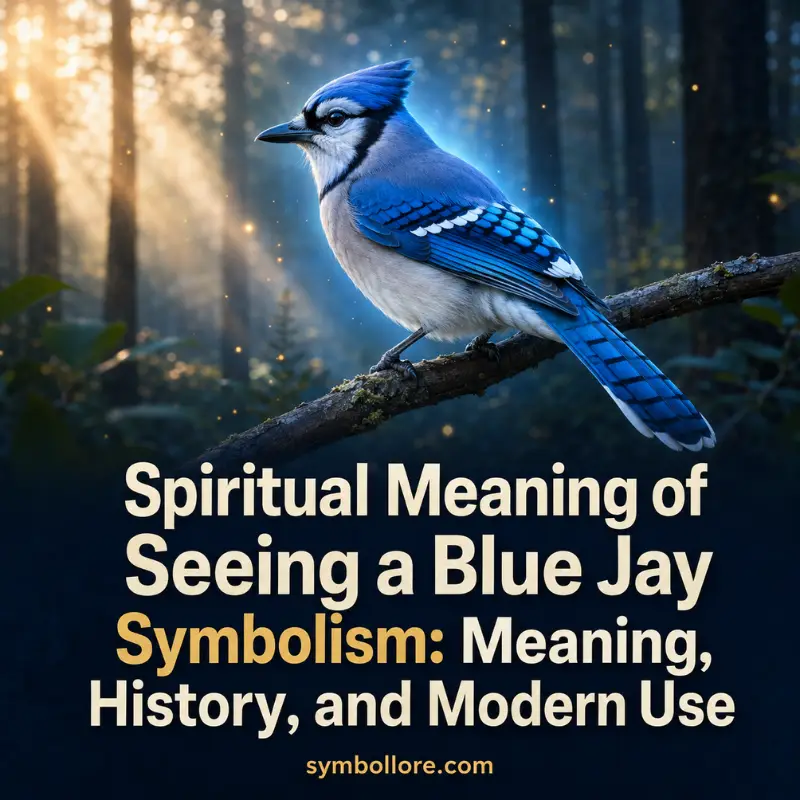
The spiritual meaning of seeing a blue jay is usually interpreted as a call to become alert, speak honestly, or defend an important boundary. A repeated visit may feel significant during grief, conflict, uncertainty, or personal change.
No scientific evidence shows that a blue jay sighting predicts an event or delivers a supernatural message. Blue jays visit places that provide suitable habitat, food, water, shelter, or nesting opportunities. Repeated appearances can therefore have an ordinary natural explanation.
Even so, an encounter can hold personal meaning. A person may use it as a prompt to consider what they have been avoiding. This reflective approach respects spiritual experience without presenting a private interpretation as an objective fact.
Blue Jay Symbolism in Cultural Traditions
There is no single Native American folklore meaning for the blue jay. Indigenous nations have distinct languages, histories, territories, and stories. In some traditions, jays appear as selfish, boastful, intrusive, or thieving characters. In certain Northwestern narratives, Bluejay is a complex trickster who may be foolish, greedy, clever, entertaining, or unexpectedly helpful.
These portrayals differ from modern internet claims that all Indigenous communities viewed the bird as a sacred messenger or universal sign of good fortune. Specific traditions should be named and sourced whenever possible rather than combined into one generalized belief.
Blue jays also appear in African American folklore from the American South. Some stories connected the jaybird with the devil, secrecy, reporting, or mysterious Friday journeys. Other tales gave it a role in creation. Together, these traditions show how one bird could represent mischief, danger, knowledge, and resourcefulness.
Blue Jay Dream Meaning
Blue jay dream meaning depends more on the dream’s action and emotional tone than on the species alone. A loudly calling bird may represent an unheard message or unresolved conversation. A defending jay could reflect protective instincts, while an attacking bird may suggest conflict or excessive defensiveness.
A calm blue jay might symbolize confidence, observation, or a desire for clarity. Meanwhile, a trapped or injured bird can represent difficulty expressing an idea. These are interpretive possibilities, not fixed predictions.
The dreamer’s personal experience matters most. Someone who enjoys blue jays will respond differently from a person who finds their calls aggressive. Details such as location, behavior, color, and emotion provide better clues than a universal dream dictionary.
Blue Jay Feather Meaning and U.S. Law
Blue jay feather meaning commonly includes truth, protection, confidence, loyalty, or the courage to speak. Because a feather suggests both the bird’s brilliant appearance and its ability to fly, it may also represent freedom, perspective, or spiritual aspiration.
Yet finding a feather does not prove that a particular event will occur. It can still become a meaningful moment without functioning as a prediction.
In the United States, do not automatically take a blue jay feather home. The U.S. Fish and Wildlife Service explains that
personal possession of protected migratory-bird feathers is generally prohibited
without authorization. Photographing the feather and leaving it where it was found is the safest response.
Blue Jay Tattoo Meaning
A blue jay tattoo can represent fearless expression, intelligence, protection, loyalty, or resilience. Its meaning often depends on the pose and accompanying elements.
An open beak emphasizes voice and communication. Raised wings may suggest freedom or readiness, while a nesting pair can represent partnership and family. Oak leaves or acorns reinforce preparation, strength, and a connection with eastern North American forests.
A darker design may highlight the trickster meaning, especially when paired with masks, keys, or watchful eyes. In contrast, brighter artwork often focuses on confidence and beauty. Because tattoos are personal symbols, the wearer’s story matters more than any standard interpretation.
The Science Behind Blue Jay Symbolism
The blue jay’s scientific name is Cyanocitta cristata, meaning roughly “crested blue chatterer.” It lives mainly across eastern and central North America, although some populations move seasonally. Its recognizable traits include a crest, black collar, white underside, and blue-patterned wings and tail.
Surprisingly, its feathers contain no ordinary blue pigment. Microscopic structures scatter light so that the plumage appears blue. The
Smithsonian’s explanation of structural color
shows how light and feather structure create this effect.
That visual transformation gives the bird another possible symbolic layer: appearances can be real to perception without being produced in the expected way. It offers a grounded metaphor for perspective, complexity, and looking beneath the surface.
How to Interpret a Blue Jay Encounter
Treat an encounter as an invitation to observe before assigning meaning. First, notice what the bird is doing. Calling, feeding, carrying nesting material, chasing a predator, and resting suggest different natural circumstances.
Next, consider what was happening in your own life when you noticed it. A blue jay may remind you of an avoided conversation, a relationship requiring support, or a situation calling for firmer boundaries. Finally, separate reflection from prediction. A useful interpretation helps you think or act more clearly; it does not require believing that the bird guarantees good luck, death, romance, or future news.
Also confirm the species. Bluebirds, Steller’s Jays, and California Scrub-Jays are different birds with separate habitats and cultural associations.
FAQs
Many modern interpretations consider it a positive sign of confidence, protection, or clear communication. However, some folklore connects blue jays with arrogance, gossip, or trickery. A sighting has no fixed predictive meaning, so its value lies mainly in personal and cultural interpretation.
Some people interpret a blue jay seen during grief as a comforting reminder of someone who died. This belief can carry genuine emotional value, but it is not a universal tradition or proof of communication from the dead. The encounter’s meaning remains personal.
A pair commonly represents partnership, loyalty, cooperation, and shared protection. These meanings reflect blue jays’ pair bonds and family behavior. For a person, the sighting may offer a reminder that strong relationships depend on honest communication and practical support.
They can represent either, depending on the tradition. Positive readings emphasize courage, intelligence, family, and protection. Negative interpretations focus on theft, noise, aggression, deception, or pride. Their symbolism is therefore better understood as complex rather than entirely fortunate or unfortunate.
Repeated visits usually mean the area provides food, water, shelter, or a convenient travel route. Spiritually, someone may interpret the pattern as encouragement to pay attention or speak clearly. The natural explanation and personal meaning can exist together without proving a supernatural cause.
No. Blue jays are larger, crested members of the corvid family, while bluebirds belong to the thrush family. Bluebird symbolism usually emphasizes happiness, hope, and renewal. Blue jay symbolism places greater weight on voice, boldness, vigilance, and intelligence.
Conclusion
Blue jay symbolism reflects the bird’s most noticeable qualities: a strong voice, sharp intelligence, protective behavior, social bonds, and fearless presence. Those traits support positive meanings such as communication, courage, and loyalty, but they also explain associations with pride, aggression, and trickery.
No sighting carries one guaranteed message. Cultural context, personal experience, and the bird’s actual behavior all matter. The most grounded interpretation is a reminder to communicate clearly, protect what deserves care, and use confidence without allowing it to become needless conflict.