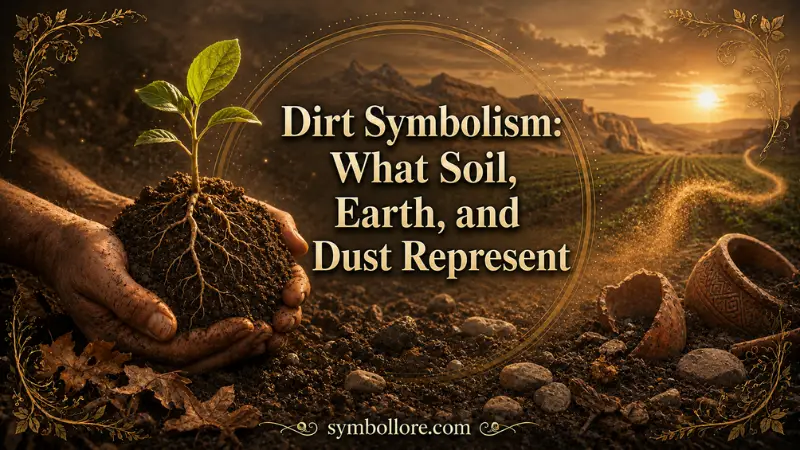
Dirt symbolism combines two opposing ideas: the earth that supports life and the grime people remove. As soil, dirt can represent growth, fertility, roots, humility, hard work, and renewal. As something dirty or out of place, it may suggest disorder, shame, neglect, moral compromise, or death.
The surrounding action determines which meaning fits. Planting in rich soil carries a different message from wiping dirt off a white shirt. Religious tradition, literary setting, personal experience, and language also shape the interpretation.
Quick Answer
Dirt symbolism most often represents life’s foundations, including growth, mortality, humility, work, and connection to the earth. It can also signify impurity, disorder, secrecy, or neglect when it appears where it does not belong. The correct meaning depends on the dirt’s condition, location, cultural setting, and the action involving it.
Key Takeaways
- Fertile soil commonly represents growth, nourishment, and future potential.
- Dust can emphasize human origin, humility, and mortality.
- Unwanted dirt may represent disorder, neglect, guilt, or violated boundaries.
- Buried dirt can suggest memory, secrecy, death, or transformation.
- Religious meanings belong to specific traditions and should not be generalized.
- Context matters more than any fixed symbolic dictionary.
Dirt Symbolism at a Glance
| Context or Image | Possible Meaning | Important Distinction |
|---|---|---|
| Rich garden soil | Fertility, potential, nourishment | Growth requires care and time |
| Seeds beneath dirt | Hidden beginnings, patience, hope | Progress may exist before it becomes visible |
| Dirt on clothing | Disorder, embarrassment, labor | The meaning changes with whether it is unwanted |
| Dust or ashes | Mortality, humility, impermanence | Often connected with death or human limits |
| Digging into earth | Discovery, work, memory, investigation | The digger may seek truth or hide it |
| Mud | Confusion, difficulty, transformation | Water makes it less stable than dry soil |
| Buried object | Secrets, preservation, repression | Burial can protect, conceal, honor, or erase |
| Cleaned-away dirt | Purification, restored order, release | Cleansing may be physical, social, or spiritual |
What Does Dirt Symbolize?
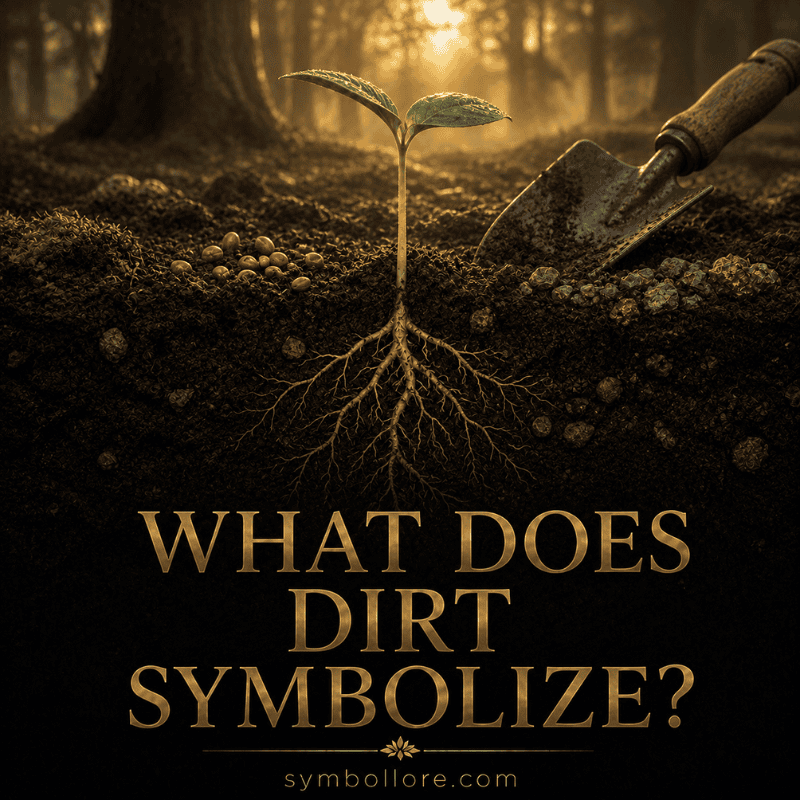
Dirt primarily symbolizes the basic material from which life grows and to which living bodies return. This makes it a strong image of beginnings and endings. It lies beneath polished surfaces, supports roots, receives decay, and turns organic remains into material that can support new life.
However, the English word dirt also carries negative associations. People use it for unwanted matter, damaging information, and behavior considered dishonest. Therefore, dirt symbolism can move between fertility and filth, belonging and displacement, honest labor and damaged reputation.
These meanings do not cancel each other. Instead, their tension gives the symbol its power. Dirt reminds readers that growth is often messy and that material treated as worthless in one place can become essential in another.
Why Dirt Can Mean Life and Renewal
Dirt represents renewal because healthy soil supports plants while continually processing dead organic material. Roots take hold beneath the visible surface, and seeds begin developing before shoots appear. As a result, soil becomes a natural metaphor for unseen potential, patience, and care.
This symbolism is grounded in physical reality.
The U.S. Department of Agriculture’s Natural Resources Conservation Service defines healthy soil
as a living ecosystem that sustains plants, animals, and humans. Soil is not simply dead brown matter.
Consequently, a seed covered with dirt usually does not signify burial alone. It can show that a new beginning needs darkness, protection, nourishment, and time. Compost provides a similar image: what has finished one form can contribute to another.
Dirt, Impurity, and Social Disorder
Dirt can signify impurity when it crosses an expected boundary. Soil in a garden belongs there, but the same soil on a hospital floor appears dangerous. The material has not necessarily changed; its relationship to its surroundings has.
Anthropologist Mary Douglas famously developed this approach in her study of purity and pollution.
A History of Anthropology Review discussion
explains her idea that dirt can function as matter in the wrong place. Removing it therefore restores a social or symbolic order, not merely physical cleanliness.
This principle helps explain phrases such as “dirty money,” “a dirty secret,” and “digging up dirt.” None refers primarily to soil. Instead, dirty marks information, conduct, or wealth as improper, hidden, contaminated, or outside accepted rules.
Spiritual and Religious Meanings of Dirt
In spiritual settings, dirt may represent grounding, sacred land, ancestry, humility, purification, fertility, or the cycle of life and death. Yet these meanings are not part of one universal spiritual system. Different communities understand land, burial, purity, and ritual through their own teachings.
Location can also change the association. Garden soil may suggest cultivation, while earth from a family homeland may represent belonging and ancestry. Graveyard soil can evoke mourning, memory, mortality, or communication with the dead in traditions where such practices exist.
Readers should distinguish documented community practice from modern personal symbolism. A contemporary writer may use dirt as a private sign of “grounding,” but that does not prove every historical culture gave it the same meaning.
Biblical Meaning of Dirt and Dust
In the Bible, dirt and dust can represent human origin, dependence on God, humility, mortality, judgment, or physical uncleanness. The surrounding passage determines the emphasis. Dirt is not consistently portrayed as evil.
In Genesis 2:7,
God forms the man from dust taken from the ground and gives him life. The image links human existence to earthly material while showing that life comes through divine action. Later references to returning to dust emphasize mortality and human limits.
Dust can also appear in actions of grief, repentance, rejection, or judgment. Therefore, biblical dirt symbolism should be interpreted through the individual passage rather than reduced to “sin” or “bad energy.”
Dirt Symbolism in Literature
In literature, dirt often reveals a character’s relationship with work, class, home, death, memory, or social respectability. An author may place soil under a farmer’s fingernails to show labor and belonging. Dirt on formal clothing may instead signal humiliation or the collapse of a carefully managed identity.
Soil can also represent attachment to place. The Soil Science Society of America’s educational resource on
notes its use in works involving birth, death, fertility, rejuvenation, displacement, and survival. Such examples show why “native soil” can stand for home rather than simple ground.
To interpret the symbol, examine who touches the dirt, how the character reacts, and what changes afterward. Pride suggests a different meaning from disgust, fear, or grief.
Dirt in Dreams
Dirt in a dream may reflect practical concerns, personal roots, unfinished work, embarrassment, hidden memories, or a desire for stability. Fresh garden soil often invites a different interpretation from a filthy room or a grave being opened.
Dreams do not come with scientifically established symbolic translations. Personal circumstances and recent experiences provide more useful clues than a prediction guide. Someone who spent the previous day gardening may dream of soil without any deeper message.
If the dream feels meaningful, record the emotion, action, and setting. Digging may reflect a search for something hidden, while cleaning dirt may suggest a wish to resolve disorder. These are reflective possibilities, not diagnoses or forecasts.
Dirt in American Culture and Language
American culture often connects dirt with agricultural labor, humble beginnings, toughness, and authenticity. Expressions such as “dirt poor,” “down to earth,” “pay dirt,” and “get your hands dirty” show how the language moves between hardship, realism, reward, and necessary work.
The Dust Bowl added a powerful historical dimension. During the 1930s, severe drought and damaging land practices contributed to enormous dust storms and migration from the Great Plains.
The Library of Congress overview of the Dust Bowl
records the displacement of hundreds of thousands of people.
In American stories, dust can therefore represent environmental loss, poverty, endurance, migration, and the consequences of mistreating land.
Dirt, Soil, Earth, Dust, and Mud
These related words overlap, but they create different symbolic effects:
- Dirt often emphasizes mess, common material, labor, or something unwanted.
- Soil usually suggests cultivation, fertility, ecology, and a place where roots grow.
- Earth can mean land, the natural world, material existence, or the planet.
- Dust suggests dryness, smallness, age, decay, mortality, or disappearance.
- Mud combines earth and water, so it often implies instability, difficulty, confusion, or transformation.
- Filth carries a much stronger judgment of extreme uncleanness or moral degradation.
Word choice matters. A poet who selects dirt instead of soil may deliberately make the material feel ordinary, rejected, physical, or uncomfortable.
How to Interpret Dirt Symbolism
A reliable interpretation begins with context, not a fixed meaning. Use three questions:
- Where is the dirt? Soil in a field belongs there; soil in a bed does not.
- What happens to it? Planting, digging, burying, cleaning, and throwing produce different meanings.
- How does the person respond? Pride may suggest honest labor, while shame may indicate social judgment.
Next, consider the larger setting. A biblical passage, modern novel, dream, ritual, and environmental photograph follow different conventions. Finally, compare the possible meaning with the work’s main conflict. The strongest interpretation should explain specific details without forcing every appearance of dirt into the same theory.
Common Misinterpretations
Dirt symbolism becomes misleading when readers treat one association as universal. Avoid these common mistakes:
- Dirt always means evil. Fertile soil often represents nourishment and renewal.
- Every dream predicts an event. Dreams may reflect memories, feelings, or recent activity.
- All religions use dirt alike. Teachings about earth and purity differ widely.
- Soil and filth mean the same thing. Their emotional tones are notably different.
- A symbol has one permanent definition. Setting, action, tone, and culture alter its role.
A grounded reading presents meanings as evidence-based possibilities. It does not claim hidden certainty where the text, tradition, or personal experience provides none.
FAQs
Dirt can be either positive or negative. Fertile soil commonly represents growth, nourishment, roots, and renewal, while unwanted dirt may signify impurity, disorder, neglect, or shame. Its location and the character’s response usually reveal which meaning is stronger.
Spiritually, dirt may represent grounding, humility, ancestry, sacred land, mortality, or the life-death-renewal cycle. These associations vary among religions and folk traditions. A personal interpretation should not be presented as a belief shared by every culture.
Digging can symbolize searching, discovery, labor, preparation, burial, or concealment. A person planting a seed prepares for growth, while someone hiding an object may represent secrecy or avoidance. The purpose of the digging supplies the essential clue.
Dirt on the hands may show honest labor, direct involvement, guilt, or contact with something considered improper. Garden soil can suggest care and productivity. In a crime story, the same visual detail might imply evidence, responsibility, or concealed actions.
Bodies and organic matter return to the earth, while soil supports new organisms and plants. This physical cycle makes dirt a natural image of mortality and renewal. It can represent an ending that also creates conditions for another beginning.
Throwing dirt can represent hostility, disrespect, accusation, or an attack on someone’s reputation. This meaning appears in the expression “throwing dirt at someone.” In another setting, throwing soil into a grave may instead express mourning, farewell, and recognition of mortality.
Conclusion
Dirt symbolism reflects the tension between life-giving soil and matter judged unclean or out of place. It can represent growth, roots, labor, humility, mortality, neglect, secrecy, or restored order. No single definition fits every appearance.
The most reliable interpretation comes from the dirt’s location, condition, associated action, and cultural setting. Treat spiritual and dream meanings as context-dependent possibilities, not universal predictions. Dirt becomes most meaningful when its physical role and emotional tone support the same reading.