
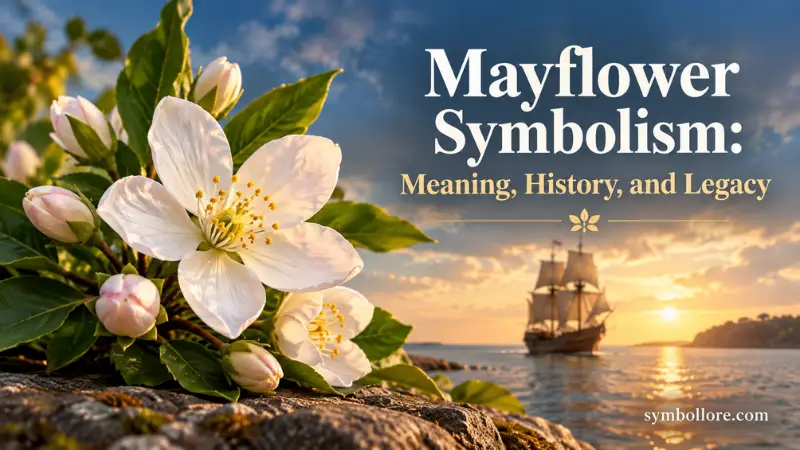
Mayflower symbolism has two connected but distinct sides. The mayflower plant represents renewal, hope, resilience, and the quiet return of life after winter. Meanwhile, the historic Mayflower ship can represent migration, courage, religious freedom, community, and the difficult beginnings of European settlement in New England.
These meanings grew from real events and natural features. The woodland flower blooms early despite harsh conditions, while the ship carried English passengers across the Atlantic in 1620. However, the ship also represents colonization and loss when viewed through Indigenous history. Therefore, context determines which meaning fits.
Quick Answer
Mayflower symbolism most often represents hope, renewal, endurance, new beginnings, and a journey toward an uncertain future. The flower gained these meanings because it blooms close to the ground in early spring. The Mayflower ship adds ideas of migration and freedom, although its legacy also includes colonization and the disruption experienced by Indigenous peoples.
TL;DR
- The mayflower plant symbolizes spring renewal, hope, and survival after hardship.
- Its low growth and early blossoms suggest quiet strength rather than dramatic power.
- Massachusetts uses the mayflower as an official symbol of regional identity.
- The Mayflower ship represents migration, risk, faith, community, and self-government.
- Indigenous perspectives connect the ship with settlement, disease, dispossession, and cultural loss.
- The flower and ship should not be treated as one universal spiritual symbol.
Mayflower Meanings at a Glance
| Form or context | Possible meaning | Why the association developed | Important limit |
|---|---|---|---|
| Early spring flower | Renewal and hope | It flowers as winter begins to release its hold | A seasonal meaning, not a universal belief |
| Low, trailing plant | Humility and quiet strength | It grows close to the forest floor | The meaning comes mainly from visual interpretation |
| Evergreen leaves | Endurance and continuity | Its leaves remain present beyond the flowering season | Not the same as formal evergreen traditions |
| Massachusetts emblem | Regional pride and heritage | The state officially recognizes the mayflower | Meanings outside New England may differ |
| Mayflower ship | Migration, courage, and freedom | Passengers crossed the Atlantic seeking a new settlement | Not every passenger traveled for the same reason |
| Ship in Indigenous history | Colonization and disruption | English settlement changed Native lands and communities | This perspective should not be reduced to a simple negative label |
| Modern personal design | A new chapter or difficult journey | The flower and ship both suggest movement beyond hardship | Personal intention remains the strongest guide |
What Does Mayflower Symbolism Mean?
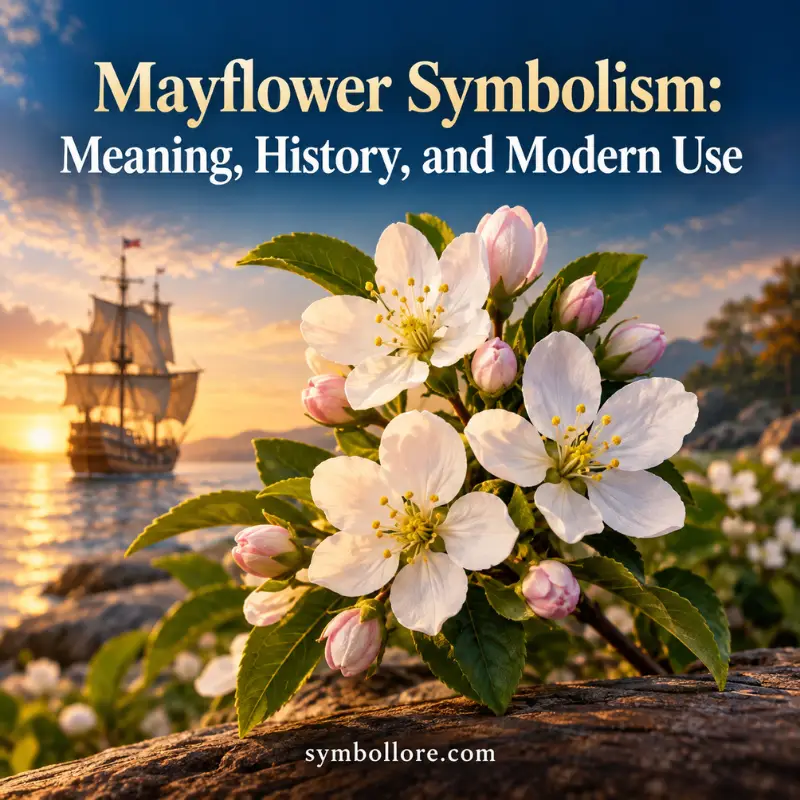
The mayflower commonly stands for renewal after a difficult period. Its flowers appear near the end of winter, so they can suggest that hardship does not last forever. This meaning resembles the hopeful themes found in
although each plant has a separate cultural history.
Resilience is another fitting meaning. The plant survives cold woodland conditions and spreads close to the ground. Its strength does not look forceful or imposing. Instead, it reflects patience, adaptation, and life protected beneath fallen leaves.
The name also brings the Mayflower ship into the symbolism. In that setting, it can represent a long journey, separation from home, risk, religious conviction, and the creation of a new community. Yet these ideas describe only part of the ship’s legacy.
The Flower and the Ship Are Different Symbols
The word “mayflower” can refer to several spring-blooming plants. In New England, however, it usually refers to trailing arbutus, or Epigaea repens. The small evergreen plant produces fragrant white or pink flowers in wooded areas.
The capitalized and italicized Mayflower refers to the English merchant ship that transported passengers across the Atlantic in 1620. Although the flower and ship share a name, they did not begin as one symbolic object.
Later American stories connected them. According to a popular tradition, English colonists named the woodland flower after the ship because they noticed it following their first difficult winter. This account helped link the blossom with survival and colonial memory. However, firm evidence for every detail of that naming story remains limited. It should be presented as tradition rather than established fact.
Why the Mayflower Represents Renewal
The mayflower’s strongest symbolic meaning comes from its blooming season. It can flower while the forest still looks brown and bare. As a result, its appearance creates a visible change from winter stillness to spring growth.
That seasonal pattern supports several related meanings:
- Hope returning after sadness
- Recovery following illness or loss
- A fresh beginning after a difficult year
- Trust in gradual improvement
- The return of warmth, beauty, and activity
The symbolism feels gentle because the plant does not tower above the landscape. A person must often look carefully to notice its blossoms among dry leaves. Therefore, it can represent small signs of progress that appear before a full recovery becomes visible.
This early-spring message also appears in
Still, lilacs often express youthful love and memory, while mayflowers place greater emphasis on endurance and the first return of hope.
Quiet Strength, Humility, and Protection
Trailing arbutus grows close to the earth, often forming low mats beneath trees. This habit gives the plant a grounded quality. In modern nature-based interpretation, it can symbolize humility, simplicity, and strength that does not seek attention.
The leaves and forest floor also protect the plant from severe weather. Therefore, mayflower imagery can suggest that vulnerable life sometimes survives through shelter, patience, and community. Strength does not always mean facing every danger openly. At times, it means conserving energy until conditions improve.
Its small size adds another layer. A tiny blossom can carry a noticeable fragrance, which makes it a fitting symbol of influence without physical power. In art or writing, it may represent a quiet person whose kindness or courage affects others.
These meanings arise from the plant’s appearance and growth. They do not prove that every historical culture assigned humility or protection to the mayflower.
Massachusetts State Flower and Regional Identity
Massachusetts officially recognizes the mayflower as its state flower. The designation appears in
Chapter 2, Section 7 of the Massachusetts General Laws.
This formal status turns a woodland plant into a public emblem of place.
For many New England residents, the mayflower can represent:
- The local landscape
- The arrival of spring
- State pride
- Continuity between generations
- Regional history
- Care for native plants
A state emblem does not automatically carry a spiritual meaning. Instead, it creates a shared civic association. The flower may appear in educational materials, gardens, public art, historical displays, and designs connected with Massachusetts.
The plant also serves as Nova Scotia’s floral emblem.
The Government of Canada’s overview of Nova Scotia’s symbols
connects the mayflower with another part of northeastern North America. Consequently, the blossom can express a wider attachment to Atlantic woodland landscapes.
What the Historic Mayflower Ship Symbolizes
The Mayflower ship carries more public and political meaning than the flower. In 1620, it transported 102 passengers from England to the coast of present-day Massachusetts. Some belonged to an English Separatist congregation. Others traveled for economic, family, or practical reasons.
Over time, Americans turned the vessel into a symbol of religious freedom, migration, courage, and national beginnings.
Plimoth Patuxet Museums describes Mayflower
as an iconic symbol of freedom. Its full-scale reproduction, Mayflower II, also represents historical memory and the postwar friendship between the United States and the United Kingdom.
The ship’s small size adds to its emotional power. Images of a wooden vessel crossing a dangerous ocean suggest uncertainty and endurance. Therefore, the ship can represent people leaving a familiar life without knowing whether their plans will succeed.
Still, this familiar American story needs careful limits. The passengers did not create the first community in an empty land. Indigenous nations had lived in the region for thousands of years.
Faith, Migration, and the Search for Belonging
For the English Separatists aboard the ship, migration had a strong religious purpose. They wanted to build a community where they could organize worship according to their convictions. This history helped the Mayflower become an American image of religious freedom.
However, “freedom” simplifies the passengers’ experiences if it becomes the only explanation. Not everyone on board belonged to the same congregation. Moreover, the religious outlook of the settlers differed from modern American ideas about equal freedom for all beliefs.
Migration offers a broader interpretation. The ship can represent leaving home, crossing cultural boundaries, and trying to establish a life in an unfamiliar place. American families sometimes use Mayflower ancestry as part of their family story. Meanwhile, writers and artists may use the vessel to represent exile, risk, homesickness, or the search for belonging.
The ship can also symbolize family separation. Some passengers left relatives and community members behind in Europe. Thus, the voyage involved both hope for a future and grief for a former home.
The Mayflower Compact and Community Order
Before the passengers established their settlement, 41 adult men aboard the ship signed the Mayflower Compact. The agreement created a basic framework for forming a civil government and following laws made for the colony’s general welfare.
Later American narratives treated the compact as an early step toward self-government. In that context, the ship represents cooperation, public duty, consent, and order during uncertainty.
However, the compact was not a modern constitution. It did not establish equal political participation for women, servants, Indigenous peoples, or every adult passenger. Therefore, it should not be described as complete democracy.
As a symbol, the compact shows how a group tried to create rules when existing authority felt unclear. That idea still appeals to Americans who connect community survival with cooperation. Yet historical accuracy requires acknowledging who could participate and who remained outside the agreement.
Indigenous Perspectives and the Colonial Legacy
The Mayflower does not carry the same meaning for every American. In traditional Pilgrim-centered accounts, it represents courage and a fresh start. From many Indigenous perspectives, however, its arrival belongs to a larger history of European colonization.
The passengers reached a region with established Native homelands, political relationships, trade systems, languages, and spiritual traditions. The Wampanoag and neighboring peoples were not background figures in someone else’s beginning. They were communities with their own histories before, during, and after the English arrival.
Furthermore, earlier European contact had helped spread diseases that caused severe population loss in coastal New England. The Plymouth settlement later contributed to growing pressure on Native land and authority. Relations included diplomacy and cooperation, but they also developed into conflict, dispossession, and violence.
Therefore, the ship may represent invasion, broken relationships, or cultural disruption as well as migration. Holding these meanings together does not erase the passengers’ hardships. Instead, it creates a fuller understanding of the symbol.
How Mayflower Symbolism Changed Over Time
The mayflower did not receive all its present meanings at once. Instead, natural observation, regional identity, public commemoration, and national storytelling gradually shaped its symbolism.
Before 1620
Trailing arbutus already grew in eastern North America before English colonists arrived. Indigenous peoples knew local plants through their own systems of language, land care, medicine, and community knowledge. A sweeping claim about one universal “Native American mayflower meaning” would be inaccurate because Native nations have distinct traditions.
During the colonial period
The ship became connected with the Plymouth settlement and the survival of its passengers. However, it did not immediately carry the same national status it holds today. Later generations built much of the familiar Pilgrim story.
During the 1800s and early 1900s
Public ceremonies, family societies, textbooks, monuments, art, and anniversary events strengthened the ship’s place in American memory. The flower also became a formal regional emblem. Massachusetts adopted it as the state flower in 1918.
In modern interpretation
Today, museums and educators often present a broader story. They still discuss the passengers’ journey, but they also center Wampanoag history and the lasting effects of colonization. As a result, mayflower symbolism now includes both inherited pride and historical reconsideration.
Pink and White Mayflower Meanings
Mayflower blossoms usually appear in shades of white or pink. Color can shape a modern design, although the plant does not have a fixed historical language for every shade.
White mayflowers can suggest freshness, peace, innocence, remembrance, or the clean beginning of spring. A white blossom in memorial art may feel calm and reflective. However, white does not automatically mean death, purity, or spiritual protection in every setting.
Pink blossoms often feel warmer. They may represent affection, gratitude, tenderness, emotional healing, or a hopeful relationship. Pale pink can create a gentle mood, while deeper pink adds energy and warmth.
Mixed pink and white blossoms can symbolize hope joined with love. For example, they may suit a recovery gift, family memorial, or artwork about returning home. Still, the occasion and accompanying message provide stronger evidence than color alone.
Modern American Uses
People use mayflower imagery in state art, local branding, historical exhibits, jewelry, tattoos, school projects, and spring decorations. Each setting emphasizes a different part of the symbol.
A woodland illustration usually points toward spring, native landscapes, and quiet endurance. In contrast, a ship with full sails emphasizes travel, faith, risk, or migration. Combining the ship and flower may represent New England identity or a personal journey followed by renewal.
The blossom can also work as a conservation symbol. Because trailing arbutus grows slowly and does not respond well to careless disturbance, its image can encourage respect for native woodland habitats. In this setting, hope becomes connected with responsibility rather than simple optimism.
For another image of movement and new possibilities,
emphasizes potential carried toward new ground. The mayflower differs because it survives in place and emerges again after winter.
Mayflower Tattoos, Jewelry, and Gifts
A mayflower tattoo can represent survival, a fresh start, Massachusetts roots, family history, or hope following a difficult season. A single blossom creates a quiet message, while a cluster can suggest family or community.
Design details make the intended meaning clearer:
- A flower emerging through dead leaves may represent recovery.
- Evergreen foliage can suggest lasting hope.
- A ship beneath the blossom may connect migration with renewal.
- Coordinates can honor Massachusetts or another meaningful place.
- A family name or date may mark heritage or a personal transition.
- Rough waves can emphasize danger, uncertainty, or endurance.
As jewelry, the blossom may suit graduations, recoveries, anniversaries, or moves to a new home. However, a Mayflower ship pendant carries a more historical message and may raise questions about ancestry or colonial identity.
The giver should consider the recipient’s relationship to that history. A flower-only gift usually communicates spring and hope more clearly than a colonial ship.
Dreams, Signs, and Spiritual Interpretations
Some people treat the mayflower as a personal spiritual reminder of hope, renewal, guidance, or protection. These meanings can support reflection, but they do not belong to one universal religious doctrine.
A dream about mayflower blossoms may reflect emotional recovery, spring memories, a connection with New England, or the wish to begin again. Meanwhile, a dream about the ship may concern travel, family history, uncertainty, faith, or separation from home.
Feelings within the dream provide useful context. Calm water may express readiness, while a storm may mirror anxiety about change. A flowering woodland can feel comforting, whereas damaged blossoms may reflect fragile hope.
Neither dreams nor unexpected sightings reliably predict future events. A person may still use the experience as a private reminder, but personal value should not become a claim of supernatural certainty.
Common Misunderstandings About Mayflower Meaning
One common mistake is treating the flower and ship as a single ancient symbol. Their meanings overlap today because later stories linked them. Yet the plant’s seasonal symbolism and the ship’s historical symbolism developed through different paths.
Another mistake is presenting every passenger as a Pilgrim seeking religious freedom. The passengers had different roles, backgrounds, and motives. Therefore, “migration” and “uncertain beginnings” often describe the voyage more accurately than one narrow purpose.
It is also misleading to portray the English settlement as the beginning of history in the region. Native peoples had long-established communities before 1620. The ship’s arrival marked a major change, not the opening of an empty land.
Finally, the mayflower is not a universal sign of luck. Finding one may feel hopeful because it signals spring. However, the plant does not guarantee success, romance, protection, or a spiritual message.
How to Interpret Mayflower Symbolism in Context
Start by identifying which mayflower appears. A blossom, sailing ship, Mayflower Compact, state emblem, and family crest do not communicate the same message.
Next, examine the surrounding details. Woodland leaves favor themes of nature and renewal. Ocean waves favor migration and risk. Massachusetts landmarks point toward regional identity, while dates or family names may indicate ancestry.
The emotional tone also matters. Bright spring light makes the flower feel hopeful. A faded flower beside a photograph may express remembrance. Likewise, a ship sailing toward sunrise may suggest opportunity, while the same ship approaching an occupied coast may raise questions about colonization.
Finally, consider who created the symbol. An artist’s statement, tattoo wearer’s explanation, community tradition, or museum label offers stronger evidence than a generic meaning list. Context allows several truths to remain visible without forcing one definition onto everyone.
FAQs
The mayflower flower commonly symbolizes hope, renewal, endurance, and the return of life after hardship. These meanings come mainly from its early blooming season and its ability to survive close to the woodland floor. They are nature-based interpretations rather than universal spiritual rules.
A popular tradition says English colonists noticed the flower after their first harsh winter and named it in memory of their ship. The story helped connect the blossom with survival and renewal. However, historical evidence for every detail remains uncertain, so it should be treated as regional tradition.
Yes. Massachusetts law recognizes the mayflower as the Commonwealth’s official flower. As a result, it represents state identity, New England landscapes, local heritage, and the arrival of spring.
The Mayflower ship can symbolize migration, courage, religious conviction, cooperation, risk, and the search for a new home. However, it can also represent European colonization and its harmful effects on Indigenous peoples. The viewer’s historical perspective strongly affects the meaning.
The ship often appears in American stories about religious freedom because some passengers belonged to an English Separatist congregation. Still, not every passenger shared that purpose, and their idea of religious liberty differed from modern equal-rights principles. Therefore, the meaning needs historical context.
Yes, a mayflower tattoo can represent recovery, hope, survival, or the start of a new chapter. Blossoms growing through fallen leaves make this meaning especially clear. A ship changes the design by adding migration, ancestry, faith, or colonial history.
There is no reliable evidence that seeing a mayflower predicts an event or delivers one fixed spiritual message. Still, someone may use the sighting as a personal reminder to remain hopeful or notice gradual progress. That reflection is personal rather than universal.
Conclusion
Mayflower symbolism brings together the quiet return of spring and the complicated memory of an Atlantic voyage. The flower most clearly represents hope, renewal, humility, and resilience because it blooms close to the ground after winter. The ship adds migration, courage, faith, community, and uncertain beginnings.
However, history changes the meaning. For some people, the Mayflower expresses freedom and family heritage. For others, it marks colonization and Indigenous loss. A grounded interpretation should first distinguish the blossom from the ship, then consider the creator, setting, and historical viewpoint behind the image.
Five Related Articles from symbollore.com
- Dogwood Tree Symbolism: What This Spring Tree Represents — https://symbollore.com/dogwood-tree-symbolism/
- Lilac Tree Symbolism: Meaning, History, and Cultural Roots — https://symbollore.com/lilac-tree-symbolism/
- Hawthorn Symbolism: Hope, Protection, and Folklore — https://symbollore.com/hawthorn-symbolism/
- Maple Seed Symbolism: Meaning, Growth, and Change — https://symbollore.com/maple-seed-symbolism/
- Evergreen Symbolism: Meanings, History, and Modern Uses — https://symbollore.com/evergreen-symbolism/


