Maple seed symbolism centers on potential, new beginnings, movement, and trust in gradual growth. These meanings come mainly from the seed itself. A maple seed carries future life in a small body, while its papery wing helps it spin away from the parent tree. That combination makes it a natural image of leaving home, adapting to change, and finding a place to grow.
People often call maple seeds “helicopters,” “whirlybirds,” or “keys.” Although maple leaves have well-documented meanings in Canada and Japanese art, the seed has no single ancient definition shared across cultures. Its modern meaning depends on the species, setting, artwork, and person using it.
Quick Answer
Maple seed symbolism most often represents potential, fresh starts, movement, freedom, and adaptable growth. The seed contains a future tree, while its wing lets the wind carry it toward new ground. However, these are mostly nature-based and modern interpretations; maple seeds do not have one universal spiritual or cultural meaning.
TL;DR
- A maple seed can represent a small beginning with long-term potential.
- Its spinning flight suggests movement, freedom, release, and playful joy.
- Wind dispersal connects it with uncertainty, trust, and adaptation.
- Paired maple seeds may suggest partnership, family, or connected paths.
- Maple-leaf traditions can add context, but they do not automatically define the seed.
- Dreams, tattoos, and gifts gain meaning from personal details rather than fixed rules.
Maple Seed Meanings at a Glance
| Context or feature | Possible meaning | Why the association fits | Important limit |
|---|---|---|---|
| Seed ready to fall | Potential or a new start | A future maple can begin inside a small fruit | Growth is possible, not guaranteed |
| Spinning seed | Movement, freedom, or play | The winged fruit turns as it descends | Often a modern visual reading |
| Seed carried by wind | Trust, uncertainty, or adaptation | Wind moves it beyond the parent tree | It need not imply fate |
| Joined pair | Partnership or family bonds | Maple fruits often develop as connected pairs | Species and designs vary |
| Seed taking root | Belonging and steady growth | Germination begins only in suitable conditions | Not every seed becomes a tree |
| Dry or damaged seed | Delayed hopes or lost potential | The image interrupts expected growth | Meaning comes from the scene |
What a Maple Seed Is and Why Its Form Matters
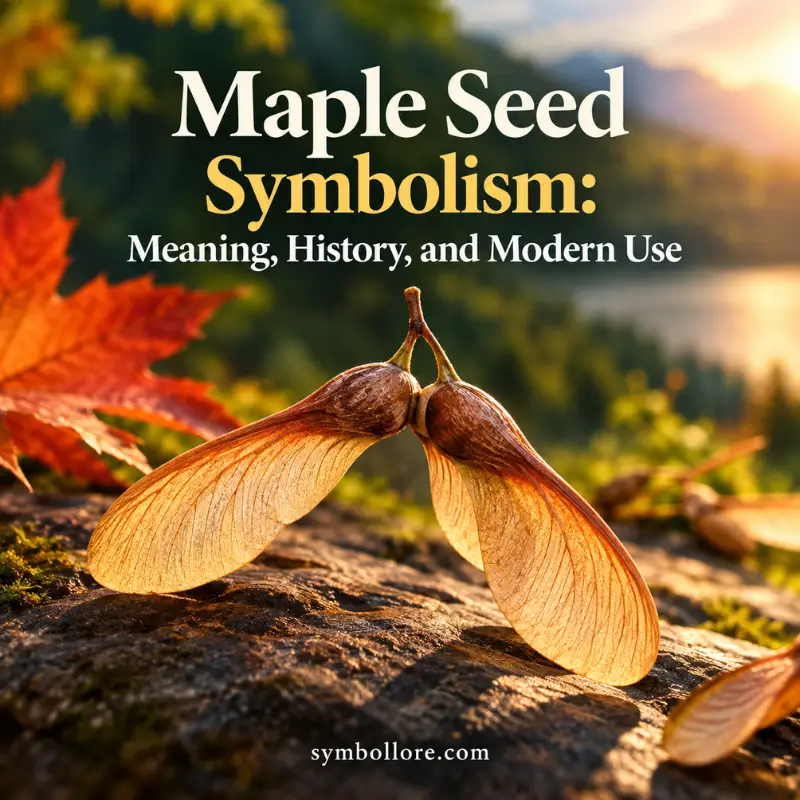
A maple “seed” is usually seen inside a winged fruit called a samara. Maples commonly produce two joined samaras. When mature, the pair can separate, and each wing carries one seed. Children often recognize these fruits by their spinning fall rather than by their botanical name.
The wing changes how the fruit moves through the air. As a samara drops, it rotates and descends more slowly than an unwinged object of similar size. Wind may then carry it away from the shade and competition beneath the parent tree. This visible journey gives the maple seed much of its modern symbolic power.
Different maple species do not produce identical samaras. Their size, color, angle, and season of maturity can vary. Therefore, a bright green spring samara may suggest freshness, while a dry brown autumn seed may emphasize readiness, release, or the close of a cycle.
What Does Maple Seed Symbolism Mean?
The clearest meaning is unrealized possibility. A maple seed is small and easy to overlook, yet it contains the living start of a tree. In art or personal symbolism, it can stand for an idea, skill, relationship, or life stage that has begun but has not reached maturity.
That potential remains realistic rather than magical. A seed needs suitable moisture, temperature, soil, light, and time. Many seeds never become trees. As a result, the image can express hope while also recognizing that support and conditions matter.
This makes the maple seed especially fitting for education, recovery, parenting, and long projects. It values early progress without pretending that every beginning leads to the same result. For a related seed metaphor,
places more emphasis on slow-growing strength and the mature oak.
Spinning Flight, Freedom, and Letting Go
The falling samara turns an ordinary act of dispersal into a graceful performance. Because the seed appears to fly, people may connect it with freedom, travel, imagination, and release. Its flight feels lighter and more playful than the direct drop of a nut or heavy fruit.
However, freedom is only one possible reading. The seed does not choose the wind or control its landing place. Therefore, the same image may express vulnerability, surrender, or life shaped by forces beyond personal control. A calm spinning seed can feel hopeful. By contrast, samaras swept through a storm may suggest instability or unwanted change.
The image also balances separation with continuity. The seed leaves the tree, yet it carries the tree’s living line forward. In this sense, release does not erase connection. It creates the chance for that connection to continue in a new place.
Paired Samaras and the Meaning of Connection
The joined form of many maple fruits invites another modern interpretation. Two wings meeting around a central point can suggest partners, siblings, parent and child, or two lives that share an origin. Jewelry makers and illustrators can strengthen this meaning by keeping the pair visibly connected.
Once the halves separate, the symbolism changes. Two samaras drifting in different directions may represent growing apart, children leaving home, or partners following separate paths. Still, both retain the same visual source. Therefore, the design can express distance without denying a shared history.
This paired meaning is an interpretation based on shape, not a universal historic belief. A botanical illustration may show two samaras simply for accuracy. Likewise, a single samara may reflect the artist’s preferred composition rather than loneliness or independence.
Roots, Belonging, and Finding the Right Place
A maple seed’s journey does not end when it lands. It must reach conditions where it can germinate and survive. That second stage supports meanings such as belonging, settlement, patience, and the search for a healthy environment.
For someone moving to a new city, beginning school, or entering a different community, the seed can represent carrying one’s identity into unfamiliar ground. It does not need to mean cutting ties with home. Instead, it can show how a life rooted in one place may continue elsewhere.
The metaphor also recognizes limits. Personal effort matters, but no seed grows through effort alone. A supportive setting can shape what becomes possible. That detail makes the maple seed a useful image for teachers, caregivers, mentors, and community programs that help people develop.
Maple Trees, Continuity, and Generational Life
Once the young tree becomes part of the image, maple seed symbolism expands beyond departure. A sequence of seed, sapling, and mature tree can represent childhood, adulthood, and legacy. It can also show how one generation creates opportunities for the next.
Maple trees add meanings of seasonal rhythm, endurance, shade, and rooted identity. Still, those ideas depend on the particular species and culture. A sugar maple in northeastern North America carries different associations from a Japanese maple in a temple garden.
This generational reading works well in family art. A large tree may represent grandparents or an established household, while small samaras stand for children and future branches. Similar family themes appear in
although dogwood carries its own spring and Christian associations.
North American History and the Maple-Leaf Distinction
Maples matter deeply in North American landscapes and histories. Indigenous peoples used maple sap, wood, and other resources long before European settlement. However, there is no single “Native American maple seed meaning.” Tribal nations have distinct languages, teachings, foodways, and relationships with local maple species. Broad spiritual claims erase those differences.
The best-documented public emblem is the maple leaf, not the seed. The Government of Canada’s
traces its rise as a Canadian identity symbol during the 1800s and its central place on the 1965 national flag. Canada later designated the maple as its national arboreal emblem in 1996, according to its overview of
A maple seed in a Canadian design may therefore inherit ideas of homeland, national identity, or cultural continuity. Yet that meaning comes from the wider maple context. A samara by itself is not as established a national emblem as the familiar leaf.
Japanese Maple Traditions Do Not Define Every Seed
Japanese maple imagery has a separate cultural history. It strongly emphasizes autumn color, seasonal attention, beauty, and change.
associated with momijigari, or autumn foliage viewing, centers mainly on the leaves rather than the samaras.
Museum objects show how maple foliage became part of Japanese visual culture.
An 18th-century writing box at The Metropolitan Museum of Art
uses scattered maple leaves to recall an autumn episode from The Tale of Genji. Likewise, Sakai Ōho’s Edo-period
makes luminous red and orange leaves the main subject.
These examples should not be turned into a claim that every Japanese maple seed means impermanence. If seeds appear beside autumn leaves, that reading may fit the larger seasonal scene. If young green samaras appear in spring, growth and emerging life may be more convincing.
Maple Seed Symbolism in Modern American Life
In the United States, maple samaras often carry childhood associations. Children toss them into the air, place them on their noses, watch them spin, or call them helicopters and whirlybirds. As a result, the seed may symbolize curiosity, outdoor play, summer afternoons, or a close memory of home.
This nostalgic meaning differs from formal religious or national symbolism. A photograph of seeds on a sidewalk may remind one viewer of childhood while another sees yard work. Therefore, the observer’s experience can matter as much as the object’s form.
The samara also fits modern design themes. Schools may use it for developing potential. Environmental groups may choose it for natural regeneration. Travel, relocation, and adoption art may use its flight to express a life carried toward new ground. In each case, the meaning becomes clear through words, setting, or related images.
Tattoos, Jewelry, Gifts, and Memorial Art
A maple seed tattoo can mark a fresh start, a move, personal growth, or freedom after a difficult period. A spinning seed may stress motion. A germinating seed may focus on recovery and rooted growth. Meanwhile, two joined samaras can honor a close relationship.
Names, dates, coordinates, roots, wind lines, and nearby leaves all change the message. For example, a samara beside a hometown coordinate may represent leaving while staying connected. A seed beside a child’s birth date may express hope for future growth. The wearer’s explanation remains more reliable than a generic tattoo list.
As jewelry or a gift, the shape suits graduations, new homes, births, travel, and career changes. It can quietly say, “Carry what formed you, then grow in your own place.” In memorial art, a drifting seed may represent a person’s influence continuing beyond one life. However, that meaning needs context because the seed alone does not automatically signify death.
How Color, Condition, and Motion Change the Meaning
Visual details can shift the emotional tone quickly. Fresh green samaras often suggest early life, energy, and possibility. Red or pink samaras can add warmth, vitality, or seasonal drama. Dry tan seeds usually feel mature and ready to disperse, while blackened or broken seeds may suggest interrupted plans.
Motion matters just as much. One seed floating gently creates a quiet, personal mood. Many seeds filling the air can suggest abundance, community, or rapid change. A seed caught on a branch may imply hesitation or delay. One resting on fertile ground shifts attention toward arrival and belonging.
Artists can also pair samaras with leaves. Bright foliage adds seasonal change, while bare branches make separation more prominent. Readers should interpret the whole scene rather than assign a fixed meaning from color alone. The same principle applies to
where movement and setting determine whether change feels peaceful, sad, or hopeful.
Spiritual Meanings, Dreams, and Signs
Some people use maple seeds as personal spiritual symbols of trust, release, renewal, or divine guidance. These readings can support prayer or reflection. However, they are not a shared doctrine found across major religions, nor do they prove that an outside force has sent a message.
A dream about spinning maple seeds may reflect a move, a new idea, family change, or a recent memory of being outdoors. The dreamer’s emotion offers the best clue. A joyful flight can feel freeing, while uncontrollable wind may mirror stress or uncertainty. Dreams do not reliably predict future events.
Likewise, finding a maple seed is usually an ordinary seasonal event. A person may still treat the moment as a reminder to begin, adapt, or let go. The reflection can have personal value without becoming a guaranteed omen.
Common Misunderstandings About Maple Seed Meaning
The largest mistake is presenting a modern nature metaphor as ancient universal knowledge. The samara’s meanings of freedom, potential, and movement make visual sense. Yet that does not prove that every culture assigned those definitions to maple seeds.
Another error is borrowing all maple-leaf symbolism. A leaf on a Canadian uniform has a recognized national context. Red maple foliage in Japanese art has a documented seasonal context. A green samara in a graduation card does not automatically carry either meaning.
It is also misleading to promise success. The seed represents possibility, not certainty. Growth depends on conditions, chance, and care. Finally, a samara design may be purely decorative or botanical. Symbolism becomes stronger when the creator, setting, text, or surrounding images support it.
How to Interpret Maple Seed Symbolism in Context
Begin with what the image actually shows. Then choose the simplest meaning supported by the full setting.
- Check the stage. Is the seed attached, falling, resting, or germinating?
- Notice the motion. A calm spiral differs from seeds driven by a storm.
- Study the number. One samara, a joined pair, and a large cluster create different relationships.
- Look for cultural markers. Canadian flags, Japanese gardens, family names, or local maps add specific context.
- Consider the occasion. A graduation gift, memorial, tattoo, and children’s illustration serve different purposes.
- Ask who chose it. The maker’s stated intention should outweigh a generic online definition.
This approach keeps the interpretation grounded. It also leaves room for personal meaning without turning that meaning into a claim about everyone.
FAQs
Maple seeds commonly symbolize potential, new beginnings, movement, and adaptable growth. Their meaning comes from a future tree held inside a winged fruit that travels on the wind. Still, this is mainly a modern nature-based interpretation rather than one universal historic belief.
People call them helicopters because their papery wings make them rotate as they fall. That spinning motion slows their descent and can help wind carry them from the parent tree. Other common names include whirlybirds and keys.
A joined pair can represent partnership, family, shared origins, or two connected paths. If the pair separates in an artwork, it may instead suggest independence or loved ones moving in different directions. These meanings come from visual form and context, not a fixed tradition.
A maple seed is not a widely established universal luck symbol. Some people may carry or gift one as a hopeful sign of opportunity and future growth. That personal use does not mean the object guarantees success or good fortune.
A maple seed tattoo often represents a new start, freedom, relocation, family connection, or growth after change. Details such as roots, wind, paired samaras, names, and dates make the meaning more specific. The wearer’s intention is the strongest guide.
Maple seeds in a dream may reflect transition, possibility, uncertainty, childhood memory, or the wish to find a place to belong. Feelings within the dream matter more than a fixed symbol list. The dream should not be treated as a dependable prediction.
No. Maple seeds are often read through potential, flight, and dispersal, while maple leaves have stronger documented roles in Canadian identity and Japanese seasonal art. The two can overlap when they appear together, but one should not automatically inherit every meaning of the other.
Conclusion
Maple seed symbolism draws its clearest meaning from a small winged fruit carrying life toward new ground. It can express potential, departure, freedom, family connection, and the search for conditions where growth can begin. Its spinning fall also brings movement and childhood wonder into modern American use.
Still, no single definition fits every samara. Canadian maple-leaf history, Japanese autumn imagery, personal memories, and artistic details create different contexts. A grounded reading starts with the seed’s stage, motion, color, and setting. The most useful takeaway is simple: a modest beginning can travel, adapt, and grow, but it still needs the right place and care.
Five Related Articles from symbollore.com
- Japanese Maple Symbolism: Meaning, History, and Beauty — https://symbollore.com/japanese-maple-symbolism/
- Acorn Symbolism: Meaning, History, and Modern Use — https://symbollore.com/acorn-symbolism/
- Falling Leaves Symbolism: Meanings of Change, Loss, and Renewal — https://symbollore.com/falling-leaves-symbolism/
- Dogwood Tree Symbolism: Meaning, Faith, and Renewal — https://symbollore.com/dogwood-tree-symbolism/
- Jacaranda Symbolism: Meaning, History, and Cultural Roots — https://symbollore.com/jacaranda-symbolism/