

Hawthorn symbolism centers on hope, protection, love, spring renewal, and respect for boundaries. These meanings come from the tree’s striking contrasts. Soft white blossoms arrive on thorny branches, dense hedges guard fields, and red berries follow the spring flowers. In Britain and Ireland, hawthorn also became closely tied to May celebrations, fairy-tree lore, and rules about when its branches could be cut or carried indoors.
No single meaning applies in every place. Victorian flower books emphasized hope, while Irish folklore often treated a lone hawthorn as a protected and potentially dangerous site. Christian tradition added another story through the Holy Thorn of Glastonbury. Modern Americans usually meet hawthorn through birth-flower guides, gardens, tattoos, gifts, and European folklore rather than through one shared custom.
Quick Answer
Hawthorn symbolism most often represents hope, protection, love, fertility, and renewal. Its spring blossoms suggest returning life, while its sharp thorns and use in hedges support meanings of defense and boundaries. In Irish and British folklore, however, the tree can also warn against disrespecting sacred or fairy-associated places, so its meaning depends strongly on context.
TL;DR
- Spring blossoms connect hawthorn with hope, renewal, love, and May.
- Thorns and dense hedges make it a natural symbol of protection and boundaries.
- Irish fairy-tree traditions can turn the tree into a warning about respect and restraint.
- Nineteenth-century flower books commonly assigned hawthorn the meaning “hope.”
- The Glastonbury Holy Thorn carries a separate Christian legendary meaning.
- Modern uses often combine old folklore with personal ideas about resilience and growth.
Hawthorn Meanings at a Glance
| Context or feature | Possible meaning | Why the association exists | Important limit |
|---|---|---|---|
| Spring blossoms | Hope and renewal | Flowers appear as the growing season returns | Seasonal meaning varies by climate |
| Thorny hedge | Protection and boundaries | Dense, sharp growth forms an effective barrier | This is also a practical use, not only a symbol |
| May customs | Love, fertility, and celebration | Blossoms were used in seasonal outdoor festivities | Customs differed by region and period |
| Lone Irish hawthorn | Fairy presence, caution, and respect | Folklore warned against damaging certain isolated trees | A cultural tradition, not a universal belief |
| Victorian bouquet | Hope | Flower-language books assigned a verbal message to hawthorn | Dictionaries did not always agree |
| Glastonbury Thorn | Faith, continuity, and sacred history | Christian legend links the tree to Joseph of Arimathea | The story is legend, not a biblical account |
| Red haws | Maturity, provision, and seasonal change | Fruit follows blossom and feeds wildlife into colder months | Mostly a modern contextual reading |
What Hawthorn Symbolism Means
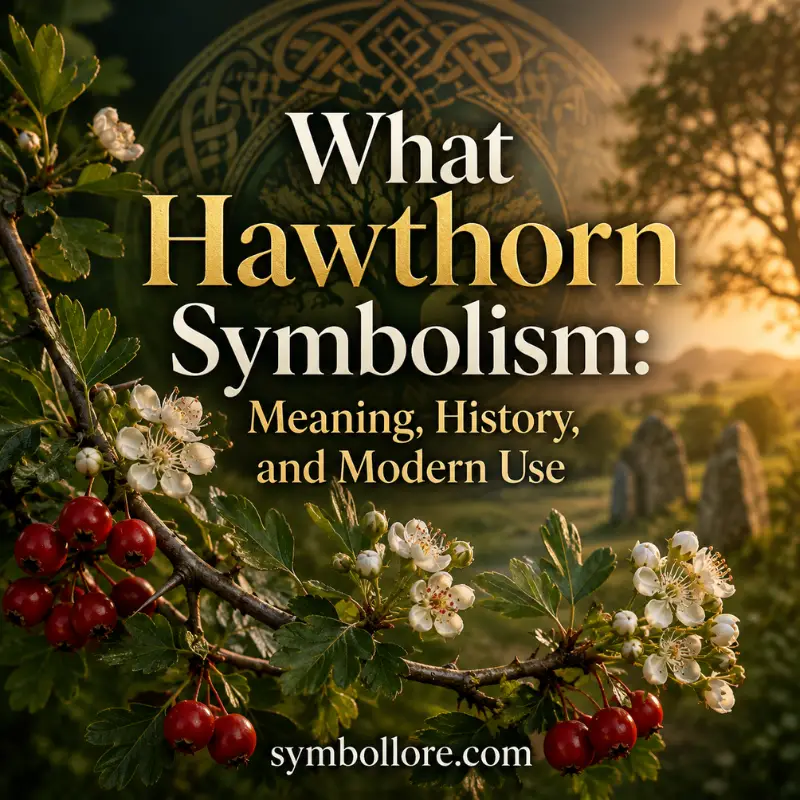
The strongest overall meaning is hopeful life protected by firm limits. Hawthorn does not present gentleness and strength as opposites. Instead, its flowers and thorns appear on the same plant. That pairing lets the tree represent affection that remains discerning, optimism that survives difficulty, or beauty that does not surrender its defenses.
The tree also marks transitions. It flowers near the shift from spring toward summer, grows along the edges of fields, and appears in stories about the boundary between ordinary and supernatural space. Therefore, “threshold” is a useful modern interpretation when the image includes a gateway, path, hedge, or lone tree. It should not be described as one fixed ancient meaning.
Hawthorn’s symbolic range includes tension. A flowering branch could belong to an outdoor celebration, yet bringing the same blossom indoors was considered unlucky in parts of Britain. A hedge protected a home, while damaging a special tree supposedly invited danger. These contrasts make context more important than a simple list of positive traits.
Why Blossoms, Thorns, and Hedges Shape the Meaning
Three visible features explain much of hawthorn’s meaning. First, masses of pale flowers transform the tree in spring. That sudden brightness supports hope, fresh beginnings, and returning vitality. Similar seasonal logic appears
although dogwood belongs to different cultural and religious stories.
Second, hawthorn branches carry sharp thorns. A thorn can defend, wound, or signal that something attractive should be approached carefully. As a result, hawthorn may express protection, caution, healthy limits, or the cost of crossing a boundary.
Finally, people have long used hawthorn in hedges. Its intertwined growth can make a living fence that shelters one area while excluding another. This practical role gives the protective meaning a concrete basis. The symbolism is not merely mystical; it grows from what the plant visibly does.
May Day, Spring Renewal, and Fertility
Hawthorn is often called the “May tree” because its blossoms are strongly associated with May in Britain. Seasonal customs used flowering branches and decorated “May bushes” outdoors.
The Trees for Life account of hawthorn folklore
also notes that the calendar change of 1752 affected how closely flowering matched May Day.
These customs link hawthorn with the return of warmth, community celebration, courtship, and fertility. Here, fertility means the renewal of land, animals, households, and human relationships within seasonal folk tradition. It should not be reduced to a promise about pregnancy or personal destiny.
Love also fits the tree’s May setting. Blossoms, garlands, dancing, and courtship all helped create a joyful association. Still, hawthorn love symbolism is more complex than the meaning of a modern romantic rose. Its thorns introduce caution, while old taboos remind readers that celebration had rules.
Irish Fairy-Tree Lore and Respect for Boundaries
In Irish folklore, a lone hawthorn could be understood as a fairy tree or as part of a place connected with the Otherworld. People sometimes avoided cutting, burning, or disturbing such a tree because the act was believed to bring misfortune. This tradition makes hawthorn a symbol of restraint: not every place exists for human use.
University College Cork’s detailed
separates several associations, including fairy belief, bad luck, protection, fertility, and healing. It also records hawthorn’s place in early Irish tree law and the ogham tradition. Those subjects belong to particular texts and periods, not to a vague universal “Celtic spirituality.”
The Irish National Folklore Collection preserves local accounts such as a 1930s Schools’ Collection entry about
a place remembered as a fairy tree.
Such records show what informants and communities reported. They do not prove supernatural events, but they do document the belief’s cultural reality. For more context on why traditional fairies can signal both wonder and danger,
see fairy symbolism in folklore.
Protection, Bad Luck, and the Hawthorn Paradox
Hawthorn can represent protection and danger at the same time. A thorny hedge guarded property and livestock, while branches sometimes appeared in protective folk practices. Yet a special tree might itself require protection. Cutting it could be framed as a violation rather than an act of defense.
The old indoor taboo adds another layer. In parts of Britain, people welcomed hawthorn in outdoor May decorations but feared that blossom brought inside might invite sickness or death. Its odor may have strengthened this association because cut flowers can release an unpleasant scent. However, the exact origin of a superstition rarely has one simple explanation.
Therefore, hawthorn is not best read as “good luck” or “bad luck” in isolation. It more often symbolizes a boundary governed by conditions. Respecting the place, season, and custom brings safety; ignoring those limits brings symbolic risk. That pattern explains why the tree works so well in stories about consequences.
Victorian Hawthorn Symbolism and the Meaning of Hope
Nineteenth-century flower-language books commonly assigned hawthorn the word “hope.” Its bright spring bloom made the choice feel intuitive: flowers returning after winter offered a visible image of better conditions ahead. Hawthorn could therefore carry encouragement without denying the hardship represented by its thorns.
An American edition of
printed hawthorn under “Hope” and connected it with May, weddings, and a brighter future. That book is useful evidence for nineteenth-century floriography. It is not proof that every Victorian used hawthorn in exactly the same way.
Flower dictionaries mixed literature, folklore, classical references, moral lessons, and editorial invention. Their entries could conflict. For that reason, “hope” is a documented floriographic meaning, but claims about a universal secret bouquet code go too far. Modern readers can still use hawthorn as a hopeful gift while recognizing where that convention came from.
Love, Marriage, and Emotional Resilience
Hawthorn’s connection with love comes mainly from spring courtship customs, wedding associations in flower literature, and the emotional contrast between blossom and thorn. It may represent love that is joyful but not naive. Affection can remain open while keeping healthy boundaries.
That combination also supports emotional resilience. The plant flowers despite its harsh outer defenses, then moves from blossom to fruit. In a modern personal reading, it can represent a heart that has endured pain without becoming closed. This is a reasonable metaphor, not a historical doctrine shared by every culture.
For a wedding or anniversary, hawthorn may suit a couple who values hope, protection, and a relationship that matures through changing seasons. However, old indoor taboos may matter to someone with British or Irish family traditions. Asking about the recipient’s background is more respectful than assuming that white blossoms always carry a cheerful message.
Christian Meaning and the Glastonbury Holy Thorn
The Christian meaning of hawthorn is most clearly represented by the Glastonbury Holy Thorn tradition in England. Legend says Joseph of Arimathea planted his staff at Glastonbury, where it rooted and became a thorn tree. The unusual thorn associated with the site flowered around spring and again near Christmas, linking it with sacred time and continuity.
Glastonbury Abbey’s account of the Holy Thorn
carefully describes the story as something many people believe. The abbey also records that thorn trees stood on Wearyall Hill by the 1530s and that later cuttings preserved the tradition after destruction during the seventeenth-century Civil Wars.
This legend can make hawthorn symbolize faith, survival, pilgrimage, and sacred memory. Still, the Bible does not identify hawthorn as Joseph’s staff or as Jesus’s crown of thorns. As with the later Christian legend attached to dogwood, devotional meaning should not be mistaken for scriptural fact.
Hawthorn in Literature and Art
Writers use hawthorn because the tree can shift quickly between beauty and unease. Blossoms can place a scene in spring, suggest love, or evoke a rural celebration. Thorns, tangled hedges, and solitary trees can instead mark danger, concealment, social limits, or entry into an enchanted landscape.
The Shakespeare Birthplace Trust’s guide to
hawthorn in Shakespeare and Victorian art
notes that Shakespeare referred to the plant in five plays. Different parts of the tree serve different dramatic purposes, from the “sharp hawthorn” in King Lear to its role in As You Like It.
Later fantasy continues the supernatural connection. A hawthorn wand, guarded grove, or flowering boundary can suggest a character who joins sensitivity with defensive power. Readers should interpret the complete scene rather than assigning the plant a single code word. An inviting bloom beside a dark path does different work from a hedge around a safe home.
Hawthorn Colors, Berries, and Forms
Color changes the emotional tone, but hawthorn has no universal color dictionary. White blossoms often suggest hope, innocence, peace, or a fresh start in modern Western use. Their meaning becomes more cautious when thorns, darkness, or indoor-superstition imagery appears nearby.
Pink or reddish blossoms may add affection, warmth, romance, or vitality. Cultivated varieties make these readings especially useful in gardens and art. However, color-based meanings are usually modern extensions rather than old, fixed traditions.
Red haws appear after the flowers and remain visible into the colder part of the year. They can suggest ripening, provision, continuity, or the results of patient growth. Because birds feed on the fruit, a modern ecological reading may emphasize reciprocity and support. In comparison,
bases continuity on foliage that remains green through winter.
Modern American Meaning and Use
Most Americans do not inherit one shared hawthorn custom. They may encounter the tree as a landscape plant, a May birth flower, an herbal reference, a family-name motif, or a feature in British and Irish stories. Consequently, American hawthorn symbolism often combines imported folklore with direct observation of blossoms, thorns, hedges, and fruit.
Hope and resilience remain the easiest meanings to understand without special background. Protection also reads clearly in a tattoo, logo, garden, or illustration because the thorns make the idea visible. A lone tree, fairy ring, or ribboned branch introduces more specific European folk associations and deserves careful explanation.
Hawthorn can also fit environmental art. A living hedge shelters wildlife while defining space, so it can represent coexistence rather than a hard wall. This modern reading emphasizes boundaries that protect life. It is an interpretation based on the plant’s role, not an ancient American tradition.
Hawthorn Tattoos, Gifts, and Memorials
A hawthorn tattoo can express hope after hardship, protective love, strong boundaries, or renewal. Blossoms emphasize tenderness and beginnings. Thorns make the design firmer, while berries can show maturity or the results of growth. A gate, path, fairy figure, or Christian element adds a more specific story.
As a gift, hawthorn suits encouragement, a May birthday, a new chapter, or a relationship built on care and resilience. Yet cut blossoms may carry an unlucky association for people familiar with British and Irish folklore. A botanical print, living tree, or clearly explained motif may be a better choice than an indoor bouquet.
In a memorial, hawthorn can join remembrance with continuing life. Spring flowers express renewal, while thorns acknowledge pain and protection. The meaning should reflect the person being honored. A family’s beliefs matter more than any online list of symbolic traits.
How to Interpret Hawthorn Symbolism Responsibly
Begin with the form you actually see. Is it a flowering branch, thorny hedge, lone tree, red-berried plant, or stylized tattoo? Then consider the setting. May decorations, an Irish field, a Victorian bouquet, and Glastonbury Abbey point toward different traditions.
Next, ask what the image is doing. A hedge enclosing a home suggests protection. A damaged lone tree may warn about disrespect. Fresh blossom after a hard winter supports hope. Red fruit after flowering can suggest fulfillment or seasonal maturity.
Finally, separate documented tradition from personal symbolism. “Victorian flower books gave hawthorn the meaning hope” is a historical claim. “This hawthorn appeared in my dream to promise success” is a personal belief. Both may matter to an individual, but they do not carry the same kind of evidence.
Several popular claims need caution:
- Hawthorn does not have one universal “Celtic” meaning.
- A fairy-tree story documents folklore, not a guaranteed supernatural event.
- The Glastonbury tradition is not stated in the Bible.
- White, pink, and red meanings are flexible unless a specific source defines them.
- Seeing hawthorn does not predict love, pregnancy, luck, or loss.
FAQs
Hawthorn often represents protected hope, renewal, and respect for unseen or sacred boundaries in modern spiritual use. Irish fairy-tree lore and the Glastonbury Thorn give it additional meanings in specific traditions. No single spiritual definition applies to every religion, culture, or individual.
Hawthorn symbolizes hope because its abundant blossoms make returning spring highly visible. Nineteenth-century flower-language books also recorded “hope” as its message. The thorns deepen the idea by suggesting that hope can survive difficulty rather than depend on easy conditions.
Hawthorn can be either, depending on the custom. Spring flowers and protective hedges carry positive associations, while damaging a fairy tree or bringing blossom indoors was considered unlucky in some Irish and British traditions. It is more accurate to describe a rule-bound symbol than a universally lucky plant.
In Irish folklore, hawthorn may symbolize fairy presence, protected places, caution, fertility, and the need to respect boundaries. Some lone trees received special attention and were left undisturbed. These beliefs varied by community, and they should not be generalized to every Irish person.
Yes, hawthorn can symbolize love through May courtship, seasonal fertility customs, weddings, and flower-language traditions. Its thorns add the ideas of protection and emotional boundaries. Therefore, it can represent mature or resilient affection rather than romance alone.
A hawthorn tattoo commonly expresses hope, resilience, protective love, or firm personal boundaries. Blossoms highlight renewal, while thorns emphasize defense and hard-won strength. Fairy, May Day, or Christian details should be used only when those traditions genuinely fit the wearer’s intended story.
There is no verified universal dream meaning for hawthorn. A dreamer might connect blossoms with hope, thorns with boundaries, or a lone tree with folklore and caution. The dream’s events and the person’s own associations offer better guidance than a fixed prediction.
Conclusion
Hawthorn symbolism brings hope and protection together in one vivid plant. Spring flowers suggest renewal, love, and life returning, while thorns and hedges express defense, caution, and clear boundaries. Irish fairy-tree lore, Victorian flower language, May customs, and the Glastonbury Holy Thorn add distinct meanings that should not be blended into one universal story. In modern American use, hawthorn works best as a symbol of resilient hope: something tender can endure hardship without giving up the limits that keep it safe. The most accurate interpretation begins with the tree’s form, cultural setting, and purpose.
Five Related Articles from symbollore.com
- Dogwood Tree Symbolism: What This Spring Tree Represents — https://symbollore.com/dogwood-tree-symbolism/
- Fairy Symbolism and Its Meaning in Folklore and Modern Culture — https://symbollore.com/fairy-symbolism/
- Evergreen Symbolism: Meanings, History, and Modern Uses — https://symbollore.com/evergreen-symbolism/
- Crepe Myrtle Symbolism: Meaning, Colors, and Cultural History — https://symbollore.com/crepe-myrtle-symbolism/
- Acorn Symbolism: Meaning, History, and Modern Use — https://symbollore.com/acorn-symbolism/


