

Hen symbolism commonly centers on nurturing, motherhood, home, fertility, abundance, protection, and everyday care. These meanings grow naturally from the hen’s visible role in caring for chicks, producing eggs, and remaining closely connected with human households and food systems. Yet the symbol is not universal. A hen can also represent good fortune, prosperity, peace, renewal, or even more complicated ideas depending on the culture, artwork, story, or ritual.
In Chinese and Japanese art, hens and chicks often appear within auspicious domestic imagery. The British Museum, for example, describes a Chinese “chicken cup” decorated with a rooster, hen, and chicks and notes that the chicken could function as a rebus for good luck. In Russian folklore, the hen appears in stories and beliefs connected with eggs, prosperity, and other layered ideas.
For modern readers, the strongest interpretation usually comes from context. A hen with chicks emphasizes care and family, an egg can suggest potential or abundance, while a hen in folklore may carry meanings that are much more specific to its tradition.
Quick Answer
Hen symbolism most often represents nurturing, motherhood, fertility, family, protection, abundance, and the comfort of home. These associations developed from the hen’s role in caring for young, laying eggs, and supporting household life. However, Chinese, Japanese, Russian, Korean, and other traditions give chickens and hens additional meanings, so the symbol should always be interpreted within its cultural and visual context.
TL;DR
- Hens commonly symbolize care, motherhood, family, protection, and domestic life.
- Eggs connect the hen with fertility, potential, renewal, and abundance.
- Chinese art can associate chickens with good fortune, while hen-and-chick imagery emphasizes family care.
- Russian folklore gives the hen a more complex role involving prosperity, eggs, creation, and changing fortune.
- A hen does not have one fixed spiritual meaning for every person or culture.
- Modern interpretations often use the hen as a symbol of home, caregiving, nourishment, and family responsibility.
Hen Meanings at a Glance
| Context | Possible Meaning | Why the Association Exists | Important Limit |
|---|---|---|---|
| Hen with chicks | Motherhood and protection | The hen guards and cares for her brood | Mainly a visual and behavioral association |
| Hen and egg | Fertility and potential | Eggs represent reproduction and new life | Does not prove a universal fertility symbol |
| Hen in the household | Home and nourishment | Chickens have long been raised for food and eggs | Meaning varies by society |
| Golden egg | Wealth and prosperity | Valuable eggs turn ordinary production into abundance | Often strengthened by folklore |
| Hen in Chinese art | Good fortune and family | Chicken imagery can carry auspicious wordplay and domestic meaning | Specific artwork and period matter |
| Hen in Russian folklore | Prosperity, creation, and uncertainty | Stories such as the Golden Egg connect the bird with wealth and loss | Folklore is not a single fixed doctrine |
| Rooster and hen pair | Household balance or peace | Male and female birds may create a family scene | The meaning depends on composition |
What Does Hen Symbolism Mean?
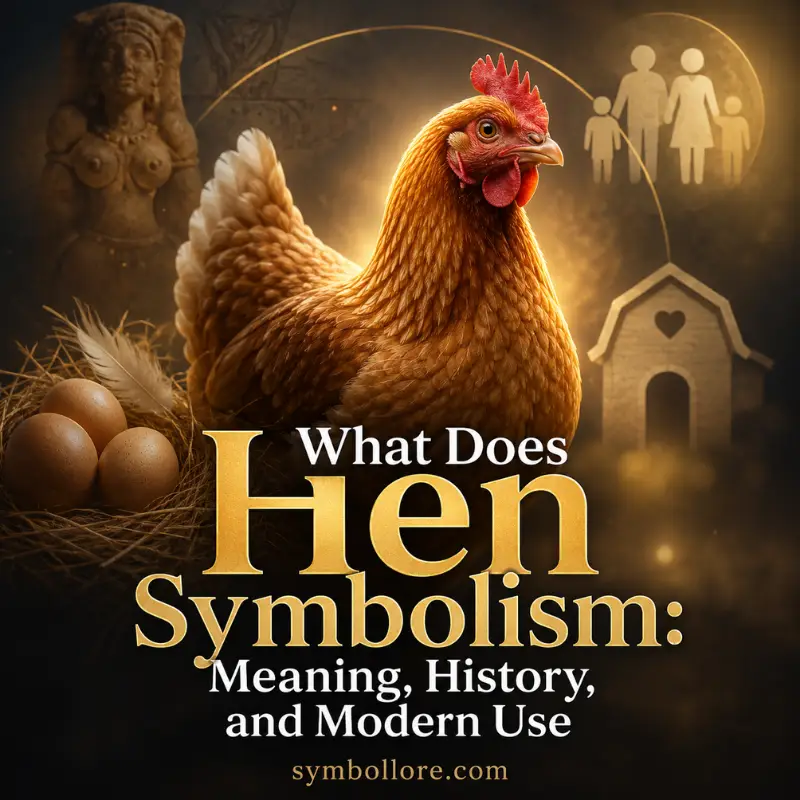
At its core, the hen is a symbol of care that produces something tangible. Unlike abstract symbols whose meanings depend mainly on religious texts or mythology, many hen associations begin with ordinary observation.
A hen sits on eggs, raises chicks, searches for food, and remains closely connected with the household. Those visible behaviors make ideas such as nurturing, responsibility, protection, and domestic stability easy to associate with the bird.
The egg adds another layer. It is both a food source and a reproductive object, so it naturally supports symbolic ideas of potential, fertility, birth, and renewal.
However, these interpretations should remain flexible. Symbolism is not a biological fact. A hen does not “mean” motherhood in the same fixed way everywhere. Instead, people repeatedly use familiar traits and cultural stories to create symbolic associations.
Why Hens Became Symbols of Motherhood and Care
The strongest hen meaning comes from the relationship between a mother hen and her chicks.
A hen gathering chicks beneath her wings creates an instantly recognizable image of shelter. In symbolic art, this can suggest a parent protecting children, a household providing security, or a community caring for vulnerable members.
This association is especially powerful because the image requires little explanation. Even someone unfamiliar with a particular folklore tradition can understand the visual message of a hen surrounded by chicks.
The symbol can also have a broader meaning: care involves responsibility. Feeding, protecting, guiding, and keeping young animals together are active forms of care. Consequently, the hen can represent practical love rather than romantic or abstract affection.
Modern interpretations often extend this idea to family life, caregiving, parenting, teaching, hospitality, and creating a safe home.
Hen Symbolism and Fertility, Eggs, and New Life
Eggs make fertility one of the most natural symbolic associations connected with hens.
An egg contains the potential for new life, while a hen repeatedly produces eggs. As a result, the combination of hen and egg can suggest creation, fertility, potential, renewal, and abundance.
This does not mean every historical culture treated the hen as a fertility goddess or sacred fertility symbol. Such claims require specific evidence. A safer interpretation is that the physical relationship between hen, egg, birth, and food supplied recurring metaphors for human ideas about life and prosperity.
The egg can also represent an opportunity that has not yet become visible. In that sense, a hen with eggs may symbolize something being developed quietly before its final result appears.
This interpretation works especially well in modern art, writing, and personal symbolism because it connects an ordinary household image with a universal human experience: potential comes before fulfillment.
Hen Symbolism in Chinese Art and Culture
Chinese traditions provide some of the clearest documented examples of chicken and hen symbolism.
The British Museum’s record for a Qing-dynasty “chicken cup” describes a scene containing a rooster, hen, and chicks. The museum notes that chicken imagery could operate as a rebus for good luck because the Chinese word for chicken, ji, sounds like the word for luck.
This linguistic connection is important because it shows that symbolism does not always come from an animal’s behavior. Sometimes language itself creates the association.
Hen-and-chick imagery can also communicate family care. The Hirshhorn Museum notes that paintings of roosters, hens, and chicks can symbolize caring parents within Chinese visual traditions.
That gives the hen a particularly useful symbolic range in Chinese art. The bird can participate in ideas of good fortune, family, parental care, and domestic prosperity, while the exact message depends on the composition.
A hen shown with chicks therefore should not automatically be reduced to “fertility.” The surrounding objects, artistic period, inscription, and intended visual pun may be more important.
Hen and Rooster Symbolism in Korea
Korean traditions give the broader chicken family another strong connection with light, auspiciousness, and new beginnings, although much of the documented material emphasizes the rooster rather than the hen.
The National Folk Museum of Korea describes the rooster as a bird associated with daybreak and the arrival of light. Traditional beliefs connected its crowing with the disappearance of evil spirits and the beginning of a new day.
Korean art also used paired cock-and-hen imagery within auspicious compositions. A nineteenth-century Korean painting titled Golden Cock and Hen combines the birds with the sun, clouds, a paulownia tree, and other auspicious imagery. The museum record describes the work as part of the established tradition of auspicious Korean painting.
The important distinction is that these meanings should not simply be transferred from rooster to hen. The rooster’s dawn symbolism comes specifically from crowing. The hen may participate in the same visual composition while contributing more strongly to family, domestic, or reproductive associations.
Hen Symbolism in Russian Folklore
Russian folklore gives the hen a particularly interesting symbolic role because the bird appears in stories involving eggs, prosperity, disappointment, and unexpected outcomes.
The folk tale commonly known as Ryaba Hen centers on a hen that lays a golden egg. An academic study of the hen symbol in Russian folklore notes that the golden egg became associated with wealth and prosperity, while the larger hen-and-rooster image has a more ambiguous symbolic history.
The story is valuable because it demonstrates how a symbol can contain opposing ideas. Gold suggests extraordinary wealth, yet the characters cannot make practical use of the golden egg. When the egg is accidentally broken, the hen promises a normal egg instead.
Thus, the hen can represent abundance that is not always useful, unexpected fortune, ordinary value, and the tension between what looks precious and what actually sustains life.
This is very different from simply calling the hen a “luck symbol.” Folklore often works through irony and reversal, so the surrounding story matters.
The Hen as a Symbol of Home and Domestic Life
The hen is strongly connected with home because chickens have historically lived close to human settlements.
A hen scratching in a yard, nesting near a household, or feeding chicks creates an image of ordinary domestic life. For that reason, the bird can symbolize home, routine, nourishment, self-sufficiency, and household responsibility.
This interpretation also explains why hen imagery can feel warm rather than grand. The symbol does not need a palace, temple, or heroic story. Its power comes from familiar daily tasks.
A hen can therefore work as a symbol of someone who quietly keeps a household functioning. In writing, the phrase “mother hen” similarly uses the bird to describe someone who watches over others.
The positive side is care and responsibility. The shadow side can be overprotection. A person who constantly shelters others may prevent them from becoming independent. Symbolically, the hen can therefore represent both healthy nurturing and excessive hovering, depending on context.
Hen Symbolism in Art and Family Imagery
Artists have repeatedly used hens because the bird makes relationships visible.
A single hen may appear ordinary. A hen beside chicks immediately creates a family scene. A rooster, hen, and chicks can create a broader household composition involving protection, reproduction, continuity, and generational life.
Japanese art provides an especially useful example. The Smithsonian’s National Museum of Asian Art preserves works showing roosters, hens, and chicks, including Kishi Ganku’s Rooster, Hen, and Chicks. The museum notes that the hen feeding a chick forms a central part of the scene.
Another Japanese work held by the San Antonio Museum of Art depicts a rooster and hen together and explains the broader symbolic tradition surrounding the rooster, including courage, virtue, and auspiciousness.
These works show why a hen should not be interpreted alone. In East Asian art, the species, posture, companion bird, plant, object, and setting can all change the message.
Golden Hen and Golden Egg Symbolism
Gold transforms ordinary hen imagery into a symbol of exceptional value.
A golden hen or golden egg may suggest wealth, prosperity, rare opportunity, abundance, or a gift beyond expectations. Yet folklore also warns against confusing visible value with practical value.
The Russian Golden Egg story is a good example. The golden egg is more valuable in appearance than the ordinary egg that follows it, but the ordinary egg is actually useful.
That contrast creates a deeper interpretation: abundance is not always measured by rarity or price.
In modern storytelling, a “golden egg” can therefore symbolize a valuable opportunity, while a “golden hen” may suggest a source of continuing prosperity. These are useful metaphors, but they should be treated as modern interpretive extensions unless a specific historical tradition supports them.
Hen Symbolism, Protection, and the Mother Hen Image
Protection is closely linked with the hen’s maternal role.
The familiar image of chicks staying close to a hen suggests a protective boundary. The hen becomes the center of a small family unit, while the chicks remain within her care.
This makes the bird useful as a symbol of safety, vigilance, responsibility, and protective love.
However, protection has limits. Symbolically, a hen can also represent excessive worry or controlling behavior. The expression “mother hen” can describe someone who cares deeply but may interfere too much.
That double meaning is worth remembering when interpreting hen imagery. Protection is not always passive kindness. It can involve setting boundaries, taking responsibility, and deciding when to let younger members become independent.
Hen Symbolism and Abundance
The hen’s association with abundance comes from several connected realities: eggs, chicks, food, reproduction, and household usefulness.
A productive flock can provide repeated resources rather than a single harvest. This makes the hen a natural image for steady provision.
That meaning differs slightly from wealth. Wealth suggests accumulated value, while provision suggests having enough to meet ongoing needs.
For this reason, a hen can symbolize the quieter form of prosperity that comes from consistency. A basket of eggs may communicate abundance without implying luxury.
In modern symbolic design, this makes hen imagery appropriate for themes involving farming, family businesses, food traditions, self-sufficiency, sustainability, and appreciation for everyday resources.
Hen Symbolism in Modern American Life
In the United States, hen symbolism is usually more informal than religious.
Americans may encounter the hen in children’s stories, farm imagery, decorative art, cooking culture, agricultural branding, Easter-related imagery, and expressions such as “mother hen.” The symbolic meaning is often easy to understand without belonging to a formal tradition.
A hen with chicks may suggest family care. A farmyard hen may represent simplicity or rural life. Eggs may symbolize nourishment, potential, or new beginnings.
Modern American symbolism also allows personal meaning to become important. Someone who grew up around chickens may associate a hen with grandparents, childhood, a family farm, or a particular home. That personal connection can be more meaningful than a generalized symbolism list.
The best interpretation therefore asks what the image is doing in its specific setting.
Hen Symbolism by Color and Form
Color can influence the impression created by hen imagery, but there is no universal historical color code for hens.
A white hen may suggest innocence, peace, cleanliness, or simplicity in modern Western visual language. A black hen may evoke mystery, night, protection, or darker folklore themes. A golden hen strongly suggests wealth or exceptional value because gold itself carries those associations.
A hen with chicks emphasizes motherhood and family. A hen beside an egg emphasizes fertility and potential. A hen paired with a rooster may suggest household partnership, reproduction, balance, or a traditional family structure.
These are interpretive possibilities rather than universal rules. The surrounding image should always take priority over a generic color chart.
What Hen Symbolism Does Not Automatically Mean
Popular symbolism lists sometimes turn the hen into a universal sign of luck, fertility, feminine energy, or spiritual protection. The evidence does not support treating all of these claims as one worldwide tradition.
Some meanings are well documented in particular contexts. Chinese chicken imagery, for example, has a documented linguistic association with good fortune. Russian folklore provides documented stories involving the golden egg and prosperity. Korean traditions provide strong evidence for rooster symbolism involving dawn and auspiciousness.
Those examples should remain separate.
A hen in one culture does not automatically carry the same meaning as a rooster in another. Nor does a modern spiritual interpretation become an ancient belief simply because many websites repeat it.
A responsible interpretation distinguishes documented tradition, folklore, modern symbolism, and personal belief.
How to Interpret a Hen Symbol in Context
When a hen appears in artwork, a dream, tattoo, story, logo, or personal experience, start with the image itself.
Ask four simple questions:
- What is the hen doing?
Feeding chicks, sitting on eggs, walking alone, or standing beside a rooster can create different meanings. - What surrounds the hen?
Eggs, flowers, gold, household objects, the sun, or other animals may change the symbolic message. - Where does the image come from?
Chinese porcelain, Korean folk painting, Russian folklore, and modern American design should not be interpreted through one symbolic dictionary. - What is the purpose of the image?
A family illustration, religious artwork, tattoo, children’s story, and agricultural logo may use the same bird differently.
This approach produces a more accurate interpretation than simply assigning one meaning to the animal.
Hen Symbolism in Dreams and Spiritual Interpretation
Modern spiritual and dream traditions sometimes interpret hens as signs of nurturing, fertility, home, protection, or opportunities developing quietly.
These interpretations can be useful as personal reflection, but they should not be presented as proven predictions.
For example, dreaming of a hen with chicks might remind someone of family responsibilities. A hen sitting on eggs might suggest patience while something develops. A lost hen could evoke concerns about belonging, responsibility, or protecting something vulnerable.
The emotional response matters more than a fixed dream dictionary. A peaceful hen may feel comforting, while an aggressive or frightened bird may represent conflict or anxiety.
There is no reliable evidence that a hen appearing in a dream predicts pregnancy, financial success, marriage, or a specific future event. Symbolic interpretation is best used as a way to explore meaning rather than forecast what will happen.
Hen Symbolism in Tattoos and Personal Design
A hen tattoo can carry several personal meanings, especially when the design includes eggs, chicks, flowers, or a farm setting.
A hen with chicks can represent motherhood, family loyalty, or protective love. A hen and egg can symbolize fertility, potential, or a new chapter. A golden hen can express prosperity or the value of something that continually provides.
A minimalist hen may instead represent home, rural identity, self-sufficiency, or connection with family history.
Because tattoos are permanent, cultural context matters. A design inspired by a specific Chinese, Korean, Japanese, or religious tradition should be researched before combining sacred or culturally specific imagery with unrelated modern symbols.
A naturalistic hen can carry a meaningful personal message without borrowing a tradition that belongs to another community.
FAQs
A hen may symbolize nurturing, protection, fertility, family, home, and patient care in modern spiritual interpretation. However, these meanings are not universal spiritual laws. A responsible reading should distinguish personal belief from documented cultural traditions and focus on the context in which the hen appears.
A hen and egg commonly suggest fertility, potential, creation, nourishment, and abundance. The egg represents something that can develop into new life, while the hen connects that potential with care and production. The exact meaning can change when the image appears in folklore, religious art, or a particular cultural tradition.
A hen with chicks most strongly represents motherhood, protection, family, caregiving, and responsibility. The image is powerful because the hen’s visible relationship with her young makes the symbolic connection easy to understand. In East Asian art, hen-and-chick imagery can also participate in broader ideas of family care and auspiciousness.
A hen can represent good luck in specific cultural contexts, especially Chinese traditions where chicken imagery has a documented linguistic connection with luck. It is not accurate, however, to claim that every culture treats the hen as a universal luck symbol.
A golden hen commonly suggests prosperity, wealth, abundance, or a valuable source of continuing benefit. Russian folklore provides an especially recognizable example through the story of the hen that lays a golden egg. That story also complicates the meaning by contrasting extraordinary wealth with the usefulness of an ordinary egg.
In Chinese art, chicken and hen imagery can carry associations with good fortune and family care. The chicken’s pronunciation provides a documented wordplay connection with luck, while images of hens and chicks can suggest caring parents. The exact message still depends on the artwork, period, accompanying symbols, and inscription.
A hen can symbolize fertility because eggs visibly connect the bird with reproduction, new life, and potential. However, “hen equals fertility” is not a universal historical rule. The association is strongest when eggs, chicks, birth, agriculture, or abundance are part of the surrounding context.
Conclusion
Hen symbolism is rooted most strongly in the ordinary but powerful ideas of care, family, nourishment, fertility, protection, and home. The hen’s relationship with eggs and chicks naturally supports these meanings, while folklore and art add more specific associations with prosperity, good fortune, renewal, and domestic life.
Cultural context matters. Chinese art can use chicken imagery for good luck and family care, Russian folklore gives the hen a complex relationship with prosperity and the golden egg, and Korean traditions place greater symbolic emphasis on the rooster’s connection with dawn and auspicious beginnings.
The most grounded interpretation is therefore not a single definition. Look at the hen’s behavior, companions, setting, cultural source, and purpose. Used this way, the hen becomes a rich symbol of the everyday forms of care that sustain life.


