
Happiness symbolism gives visible form to joy, contentment, hope, and shared celebration. A smile may express a passing positive emotion, while a bluebird, sunny yellow flower, or Chinese wedding emblem can carry a story shaped by art, custom, and memory.
These signs feel uplifting because they suggest light, warmth, freedom, connection, or abundance. Still, their cultural meanings are not universal. Period, community, setting, and personal experience determine whether a symbol communicates excitement, peaceful well-being, good fortune, love, or a private memory.
Quick Answer
Happiness symbolism commonly uses smiles, sunlight, yellow flowers, rainbows, bluebirds, and celebratory emblems to represent joy, hope, warmth, and connection. Their meanings come from visible qualities, literature, social customs, or personal memories. However, no single sign represents happiness in every culture or situation.
TL;DR
- Smiles provide the clearest visual expression of immediate joy.
- Sunshine and yellow suggest warmth, energy, and optimism.
- Bluebirds gained lasting meaning through literature and popular culture.
- Chinese wedding emblems express shared and marital happiness.
- Personal associations can matter more than standard definitions.
- Context determines whether a sign suggests joy, luck, or contentment.
Happiness Meanings at a Glance
| Context or Sign | Possible Meaning | Why the Association Exists | Important Limit |
|---|---|---|---|
| Smile or smiley | Cheerfulness and welcome | It copies a familiar joyful expression | A smile can also show politeness or irony |
| Sunshine | Hope, warmth, and vitality | Daylight reveals, warms, and supports life | Extreme heat can create a different meaning |
| Yellow or sunflower | Energetic joy and friendship | The bright color recalls sunlight | Yellow can also signal caution |
| Rainbow | Relief, hope, and possibility | Color appears after rain or against darkness | Religious and social meanings vary |
| Bluebird | Hopeful or home-centered happiness | Literature and popular culture reinforced the link | Not every bird tradition uses this meaning |
| Double happiness character | Marriage, harmony, and shared joy | Two 喜 characters form the wedding emblem 囍 | It belongs to a specific Chinese context |
| Red lantern | Celebration and auspicious joy | Red carries festive meaning in Chinese traditions | Red has different meanings elsewhere |
| Personal keepsake | Gratitude, comfort, or contentment | Memory gives an object emotional importance | The meaning may not be clear to others |
What Does Happiness Symbolism Mean?
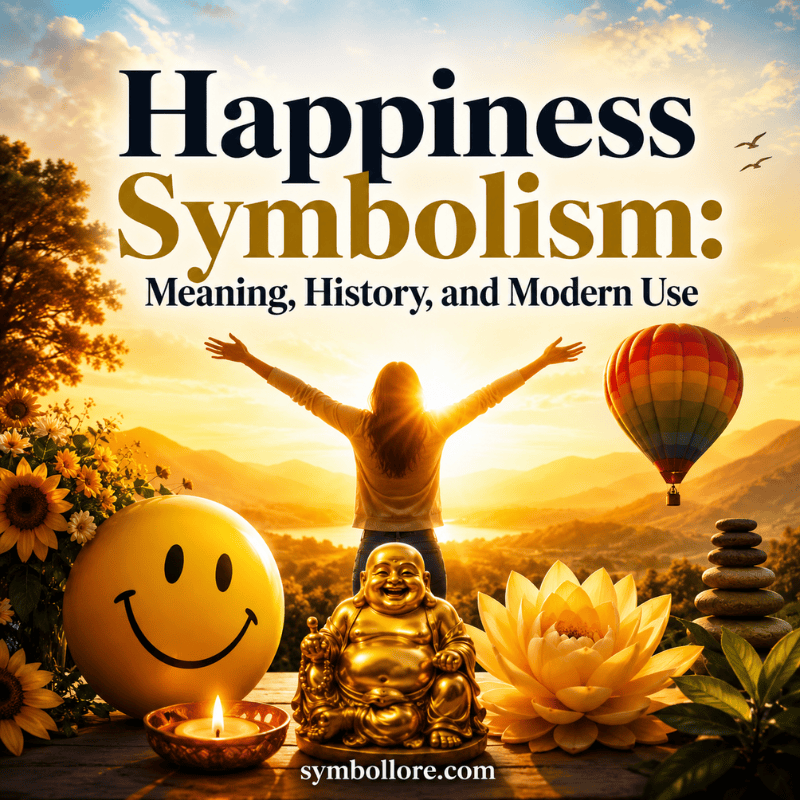
Happiness symbolism is the use of colors, gestures, animals, plants, objects, or written signs to represent a positive state. Yet “happiness” includes more than excitement.
The Greater Good Science Center’s explanation of happiness
includes joy, contentment, life satisfaction, purpose, and well-being.
Therefore, different images represent different kinds of happiness. Fireworks convey energetic celebration, while calm water may suggest peaceful contentment. A wedding emblem expresses shared joy, whereas a childhood toy might recall private comfort.
A symbol does not contain an emotion by itself. Instead, people create meaning through observation, tradition, repeated use, and memory. Happiness symbolism can become widely recognizable, but its interpretation still depends on the viewer and setting.
Why Smiles, Sunshine, and Upward Forms Suggest Joy
Many symbols of joy share visible features. They use light, open shapes, bright colors, upward movement, or relaxed human expressions. These qualities resemble how people display celebration and renewed energy.
For example, a smile turns the mouth upward. Rising balloons suggest lightness and release. Open flowers imply growth, while sunshine creates visibility and warmth. Dancing, music, and flowing lines add rhythm and movement.
However, these links are interpretations rather than laws of nature. A smiling person may feel nervous, and bright sunlight may feel harsh during a drought. Consequently, the physical feature explains the association, but context determines whether that association fits.
The Smiley Face in Modern American Culture
The smiley face is one of the clearest signs of cheerful friendliness in modern American culture. Its two eyes and curved mouth reduce a human expression to a graphic that people can recognize instantly.
According to the
Smithsonian’s history of the familiar smiley,
graphic artist Harvey Ball created his influential version in Worcester, Massachusetts, in 1963. An insurance company commissioned it during a workplace morale campaign. Ball drew the design quickly, and the company printed it on buttons, signs, and posters.
Its later history shows how symbolic meaning can expand:
- 1963: Ball’s yellow design served as a workplace morale graphic.
- Early 1970s: Buttons and “happy day” merchandise spread across the United States.
- Late twentieth century: Advertising and popular culture made the face globally familiar.
- Digital era: Emoticons and emoji turned facial symbols into everyday emotional punctuation.
Today, the design may communicate approval, friendliness, humor, reassurance, or irony. Therefore, even a familiar icon needs conversational context.
Yellow, Sunflowers, and Rainbows
The yellow color often suggests energetic happiness because people connect it with sunlight, warmth, and visibility. Sunflowers strengthen that effect through their broad golden blooms and sunlike form. Meanwhile, a rainbow adds variety, relief, and color after gray weather.
Research supports the recurring yellow-joy association without proving that yellow automatically changes mood. A cross-cultural study in Psychological Science examined 4,598 people from 30 nations.
found strong shared patterns, alongside differences shaped by language and geography.
That qualification matters. Yellow can also signal caution, illness, aging, or jealousy. Likewise, rainbows have religious, political, artistic, and personal uses beyond happiness.
A broader guide to changing color associations
shows why surrounding culture must remain part of the interpretation.
Sunshine, a sunflower, or a rainbow works best when the intended message is warmth, renewed hope, friendship, or visible celebration.
The Bluebird of Happiness in Literature and Popular Culture
The bluebird of happiness commonly represents hopeful joy, emotional renewal, and the idea that contentment may be closer than expected. Its small size, clear song, and bright appearance support that positive reading, but literature helped make the phrase especially familiar.
Maurice Maeterlinck’s play The Blue Bird follows children searching for a bird connected with happiness.
A Meiji Gakuin University discussion of the play
notes that later audiences have also read the bird as hope, peace, or love. The university’s theater scholar cautions that Maeterlinck did not impose one fixed interpretation.
That history makes the bird a literary emblem rather than a universal omen. In current U.S. use, it may appear in art, jewelry, greeting cards, and memorial designs. Readers seeking a species-focused explanation can compare
the bluebird’s links with hope and renewal.
Seeing one can inspire a personal reflection. However, it does not predict an event or prove that good fortune is approaching.
Double Happiness in Chinese Wedding Tradition
The double happiness symbol, 囍, joins two forms of 喜, a character connected with joy. In Chinese wedding tradition, the paired design usually represents marital happiness, harmony, and joy shared by two people and their families.
A University of Pennsylvania explanation of
identifies it as shuāngxǐ, or “double happiness,” and notes its strong connection with conjugal love. The design commonly appears on invitations, doors, paper cuttings, decorations, gifts, and wedding textiles.
Color deepens the message. The Smithsonian’s National Museum of Asian Art explains that
red became associated with auspicious and happy occasions in China.
It remains prominent in weddings, gift envelopes, Lunar New Year decorations, and red lanterns.
Still, 囍 should not become a generic decoration stripped of context. It expresses a particular ceremonial wish, not a universal promise of luck. Similar context-sensitive combinations appear in
Chinese bird imagery and visual wordplay.
Shared Joy and Personal Achievement Across Cultures
Some communities express happiness through individual freedom, excitement, or achievement. Others give greater weight to harmony, family connection, balance, or fulfilled social duties. These patterns influence which signs feel appropriate.
For instance, a trophy may represent personal success in one setting. A shared meal may better express collective well-being in another. Neither interpretation defines an entire nation or community. Age, region, religion, family practice, and individual personality also create variation.
Consequently, broad comparisons such as “Western happiness” and “Eastern happiness” can mislead readers. Cultures contain many competing values. A responsible interpretation names the particular custom and avoids turning one example into a rule for millions of people.
Happiness Symbolism in Art and Literature
Happiness symbolism in art and literature rarely depends on one object alone. Artists combine color, light, space, movement, and human interaction to build a visual language of joy.
An open window may suggest possibility. Spring growth can mark recovery, while dancing figures show social energy. Writers may use birdsong, music, feasts, gardens, or returning sunlight to suggest relief and belonging.
Contrast also matters. A small yellow flower may feel hopeful in a dark scene because its surroundings make it stand out. Conversely, an exaggerated smile can become unsettling when a story reveals hidden sadness. Therefore, readers should examine tone, plot, color, and placement before assigning a positive definition.
Choosing a Personal Symbol for Gifts, Tattoos, and Décor
A personal symbol should connect with the intended person, occasion, and message. Standard definitions can provide ideas, but memory often creates the strongest emotional connection.
Use this four-step method:
- Identify the source. Decide whether the meaning is cultural, religious, literary, modern, or private.
- Name the intended feeling. Choose between excitement, peace, gratitude, hope, love, or shared celebration.
- Check the setting. A wedding, memorial, tattoo, gift, and home decoration require different levels of cultural care.
- Explain the choice. Add a note or story when the meaning may not be obvious.
For example, a sunflower gift can express warmth and friendship. A bluebird tattoo might recall a loved one or a period of recovery. Meanwhile, 囍 suits a Chinese wedding context but may confuse recipients elsewhere.
The emotional truth of a private object does not require an ancient origin. Honesty makes a personal association more credible than invented folklore.
Common Misconceptions About Happiness Symbolism
Happiness symbolism does not operate as one worldwide code. A color, bird, or flower can carry opposite meanings in different periods and communities.
Another common mistake equates happiness with good luck. Luck concerns favorable events or chance. Happiness describes an emotion or broader state of well-being. Certain emblems represent both, but the ideas remain distinct.
Symbols also cannot guarantee emotional or material results. Displaying a joyful sign may provide encouragement or recall a valued relationship. However, it does not attract wealth, cure sadness, or predict the future.
Finally, popular use does not erase cultural ownership. When using a living community’s ceremonial emblem, identify its source and learn its appropriate setting.
FAQs
A smile is probably the most widely recognized sign of immediate happiness because it reflects a common human expression. However, no single emblem works everywhere. Bluebirds, sunshine, flowers, written characters, music, and family objects represent different forms of joy in different settings.
Yellow commonly represents energetic joy, warmth, and optimism in contemporary American design. Red communicates celebration and auspiciousness in several Chinese settings. Because colors carry multiple associations, the culture, shade, object, and occasion should guide the final interpretation.
The bluebird is a familiar representation of happiness in American and European literary culture. Hummingbirds may suggest lively joy, while dolphins often convey playfulness. Still, these readings come from particular stories, observations, and modern conventions rather than one worldwide animal code.
Sunflowers commonly express cheerful warmth because their bright yellow blooms resemble the sun. Yellow tulips, daisies, and some chrysanthemums can also suggest friendship or joy. Flower meanings change by color, region, occasion, and historical tradition, so no flower has one fixed definition.
The Chinese character 囍 primarily expresses doubled joy in marriage. It represents a happy union and celebration shared by the couple and their families. Although it can carry auspicious associations, reducing it to a general good-luck charm overlooks its strong wedding context.
Yes. A song, key, photograph, shell, place, or family object can become a private reminder of gratitude or contentment. Personal meaning comes from experience rather than historical agreement. If other people need to understand it, briefly explain the memory or value behind the choice.
Conclusion
Happiness symbolism turns emotion into something people can see, share, and remember. Smiles suggest welcome, sunlight and yellow convey energy, bluebirds carry literary hope, and Chinese wedding emblems celebrate a joyful union.
Yet meaning never rests in appearance alone. Culture, history, artistic setting, and personal memory shape every interpretation. The most grounded approach asks where a sign came from, why it gained its association, and whether that meaning fits the present occasion.