
Llama symbolism centers on endurance, service, prosperity, fertility, community, and a close relationship between people, animals, and the Andean landscape. These meanings did not arise from the llama’s appearance alone. They developed through thousands of years of domestication, herding, transportation, trade, textiles, ritual, and art in the Andes.
For many Andean societies, llamas were practical animals and important participants in social and religious life. They carried goods across difficult terrain, provided fiber and food, and appeared in offerings and ceremonial objects. Archaeological evidence shows that their symbolic importance existed long before the Inca Empire.
Today, people may also interpret the llama as a modern symbol of patience, resilience, cooperation, and carrying life’s burdens. Those readings can be meaningful, but they should not be confused with specific Andean traditions. Culture, historical period, and context determine which interpretation fits.
Quick Answer
Llama symbolism most strongly represents endurance, service, prosperity, fertility, and community, especially in connection with Andean pastoral life. Llamas carried goods, supported households, provided valuable materials, and took part in ritual practices. In modern symbolic use, the animal can also suggest resilience and steady progress, but these broader meanings are interpretations rather than universal spiritual rules.
TL;DR
- Llamas symbolize endurance partly because they carried goods across difficult Andean terrain.
- Their economic importance helped connect them with prosperity, service, and community.
- Andean archaeological evidence shows llamas had ritual importance as well as practical value.
- In Inka traditions, llama figures could be associated with livestock fertility and abundance.
- Modern Western symbolism often turns the llama into an image of resilience and carrying responsibility.
- Andean meanings should not be treated as one uniform belief shared by every community.
Llama Meanings at a Glance
| Context or Feature | Possible Meaning | Why the Association Exists | Important Limit |
|---|---|---|---|
| Pack llama | Endurance and service | Llamas transported goods through mountain landscapes | Practical usefulness does not create one universal symbol |
| Herd of llamas | Community and cooperation | Herding depends on relationships between people, animals, and land | Modern ideas about teamwork are partly interpretive |
| Llama figurine | Fertility and abundance | Inka and later Andean practices used camelid figures in pastoral rituals | Meanings vary by community and period |
| Ritual llama offering | Reciprocity and sacred exchange | Llamas appeared in offerings to important Andean beings and places | Ritual meanings were not identical everywhere |
| Llama fiber | Sustenance and continuity | Fiber supported clothing and textile traditions | Symbolic meaning depends on cultural setting |
| Llama caravan | Connection and exchange | Caravans linked highland communities with distant regions | Trade symbolism is historical rather than universal |
| Modern llama image | Resilience and individuality | Contemporary culture emphasizes the animal’s distinctive appearance and hardy reputation | Mostly modern interpretation |
What Does Llama Symbolism Mean?
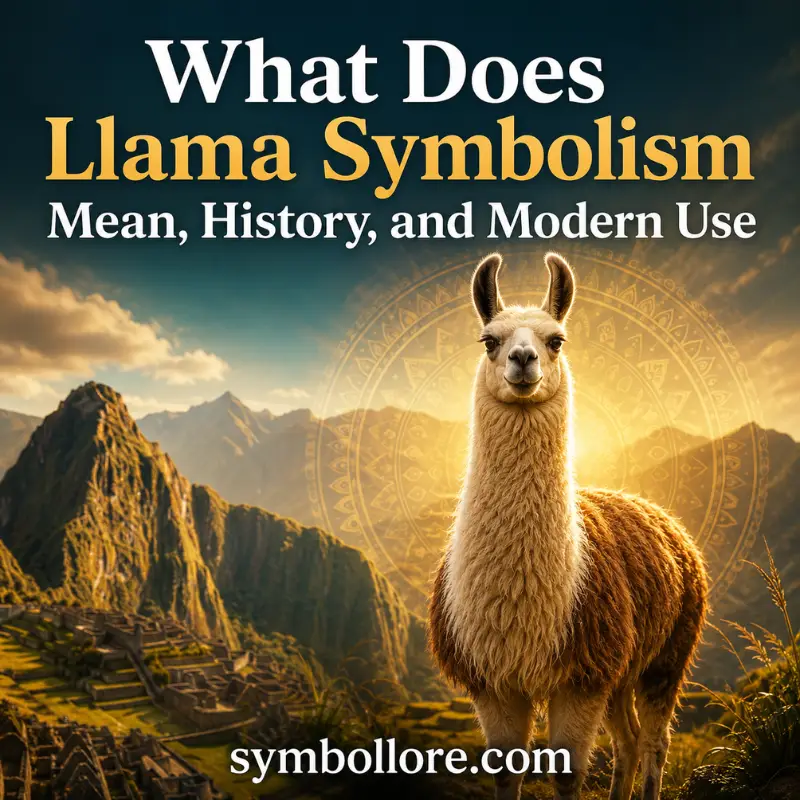
The strongest meaning of the llama comes from its relationship with human survival in the Andes.
Unlike a purely decorative animal, the llama performed essential work. People used llamas for carrying loads, obtaining fiber and meat, and supporting trade across difficult landscapes. Their usefulness made them closely tied to household welfare and regional exchange.
The relationship also went beyond economics. Archaeological and ethnographic research shows that camelids appeared in ritual settings across the Andes. This combination of practical value and sacred importance helps explain why the llama became such a powerful cultural image.
The Dallas Museum of Art describes Inka llama figures as representations of beasts of burden while also noting their ceremonial significance. One Inka stone camelid effigy was connected with rituals intended to promote agricultural and pastoral fertility.
Therefore, the llama can symbolize both material support and the relationships that sustain life.
Why Llamas Symbolize Endurance and Resilience
Llamas are natural symbols of endurance because their historical role required steady movement through challenging terrain.
Andean communities used llama caravans to move goods between regions. This was especially important in landscapes where wheeled transportation was difficult or impractical. A llama could carry a load while traveling along mountain routes that connected settlements and trading areas.
The symbolism that develops from this role is fairly direct. A creature that repeatedly carries useful goods becomes an image of dependable work.
Modern readers often extend that idea into personal symbolism:
- carrying responsibility without giving up;
- making steady progress;
- adapting to difficult conditions;
- supporting other people;
- completing demanding work; and
- remaining useful during periods of hardship.
However, “resilience” is largely a modern interpretive label. Historical Andean communities did not necessarily reduce the llama to a single moral lesson about perseverance.
The better approach is to recognize the real relationship first. The symbolic idea of endurance grows from the animal’s practical role.
Service, Labor, and the Meaning of Carrying a Burden
A llama can symbolize service because carrying was one of its most important human-directed roles.
That symbolism has two sides. On one hand, carrying a load suggests reliability, usefulness, and contribution. On the other, the image can raise questions about how much responsibility one person or creature should be expected to carry.
This makes the llama especially useful in modern art or personal symbolism. A llama walking with a carefully balanced pack may represent responsibility handled with patience. A heavily burdened llama might instead suggest exhaustion or obligations that have become excessive.
The distinction is important.
The llama should not be turned into a simplistic symbol of “working hard no matter what.” Its historical importance came from a relationship between people, animals, landscapes, and systems of exchange. The animal’s labor supported communities.
In that sense, llama symbolism can represent shared responsibility, not just individual effort.
How Andean Life Shaped Llama Symbolism
The Andes created the conditions for an unusually close human relationship with camelids.
Research places the domestication of llamas and alpacas in the central Andes thousands of years ago. Archaeological studies show that camelids played major roles in pre-Hispanic economies and ritual systems.
Llamas could provide:
- transportation;
- meat;
- fiber;
- dung used as fuel or fertilizer;
- materials for exchange; and
- ritual offerings.
This broad usefulness helps explain why llama imagery appears in objects made for both everyday and ceremonial purposes.
The symbolism therefore developed from interdependence. People relied on llamas, while the health and reproduction of herds mattered to pastoral communities.
That relationship also explains why modern interpretations such as independence or rugged individualism can miss something important. Historically, the llama often points toward connection rather than isolation.
Llama Symbolism in Inka Religion and Ritual
Llamas held important roles in Inka religious practice, although their meaning cannot be reduced to one Inka “symbol.”
The American Museum of Natural History describes a silver llama figurine from the Island of the Sun at Lake Titicaca. The museum notes that llamas were sacrificed at the temple of the Sun and suggests that the figurine may represent a special white llama associated with the Inka ruler.
Other archaeological evidence shows that miniature camelid figures had ritual functions. The Dallas Museum of Art describes an Inka llama effigy, or illa, associated with agricultural and pastoral fertility rituals. Similar forms continue to appear in contemporary highland practices.
These examples suggest meanings involving:
- fertility;
- herd prosperity;
- ritual exchange;
- political authority;
- pastoral wealth; and
- relationships between humans and powerful nonhuman beings.
Yet these meanings belong to particular historical and cultural settings. It would be inaccurate to say that every Andean community understood llamas in exactly the same way.
Llamas, Fertility, and Prosperity
Llama symbolism is closely connected with fertility in several Andean pastoral traditions.
For a herding community, the growth of a healthy herd directly affected material security. More animals could mean more fiber, meat, transport capacity, and future breeding stock. As a result, herd reproduction could become part of ritual life.
Archaeological research has documented llama offerings in the Andes. One study of a site in northwestern Argentina found a ritual llama offering dating to approximately the first or second century CE. The researchers connect the find with social and ritual practices among agricultural communities.
Later evidence adds another layer. Research on northwestern Argentina describes llama breeding as a setting where economic and cosmological ideas were closely connected. Herd growth could be understood through ideas of luck and the favor of Pachamama, or Mother Earth, within the studied community.
Thus, the llama can represent abundance and fertility, but those meanings should remain tied to specific Andean pastoral contexts.
Llama Symbolism and Reciprocity With Nature
Another important theme is reciprocity.
Modern descriptions sometimes portray Andean traditions as simply “worshipping animals.” That wording is too broad. Many Andean practices involve relationships among people, animals, mountains, places, ancestors, and other beings understood as having significance or agency.
A University Press of Colorado study of Andean ritual describes contemporary llama caravans in southern Bolivia. During journeys, pastoralists perform rituals involving llamas, roads, mountains, Pachamama, ritual objects, and other participants.
This evidence offers a richer interpretation than simply calling the llama “sacred.”
The animal can represent a relationship in which human prosperity depends on responsible relationships with animals and the landscape.
That idea also helps explain why herd health and reproduction appear in ceremonial practices. The symbolic world and economic world were not always separate.
Llama Figurines and the Symbolism of Abundance
Small llama figures have particular importance because they transform a useful animal into a compact ceremonial image.
In Inka contexts, camelid figures could appear in metalwork, stone, shell, and other materials. The Metropolitan Museum of Art holds an Inka miniature camelid effigy dating to approximately 1400–1535 CE.
The Dallas Museum of Art provides a more explicit example. Its description of an Inka camelid-form vessel explains that the object was associated with agricultural and pastoral fertility. It also notes that related illa practices continue among some highland communities.
A small llama figure could therefore stand for more than the animal itself. In a ritual context, it could participate in hopes for a healthy herd and productive future.
This is one reason “abundance” is a better description than simply “wealth.” The emphasis can involve reproduction, food, livestock, land, and continuity.
Llamas in Andean Art and Textiles
Llamas appear frequently in Andean visual culture because they belonged to everyday life as well as ritual life.
Artists represented camelids in ceramics, metalwork, textiles, and small figures. The Dallas Museum of Art’s Inka objects show how llama imagery could appear within ceremonial collections and objects connected to imperial expansion and exchange.
Textiles are especially important because llama and alpaca fiber became essential materials for Andean clothing and weaving.
A llama motif in a textile should not automatically be assigned one symbolic meaning. The image might represent the animal itself, a pastoral community, a ritual association, an important resource, or a combination of these ideas.
This is a useful reminder about iconography. A picture of an animal is not always a symbolic code. Sometimes the animal is represented because it matters materially. Symbolic meaning emerges from the object’s use, setting, and cultural context.
Llama Symbolism in Modern American Culture
In modern American culture, the llama has developed meanings that extend beyond its Andean history.
Social media, children’s books, farm experiences, decorative art, clothing, toys, and internet humor have helped create a friendly and distinctive image of the animal. Modern symbolism often emphasizes:
- resilience;
- individuality;
- calmness;
- friendliness;
- curiosity;
- patience; and
- carrying life’s responsibilities.
These meanings are not necessarily traditional Andean interpretations. They often come from modern Western ideas about animal personality and visual appeal.
That distinction matters because llamas have become popular cultural images far from their historical homeland.
A respectful modern interpretation can appreciate the animal’s symbolism while still recognizing where its deeper historical meanings come from.
For comparison,
shows how another South American animal has acquired modern associations that combine real behavior with newer cultural interpretations.
Llama Symbolism in Contemporary Andean Communities
The llama is not simply an ancient symbol preserved in museums.
Contemporary Andean communities continue to maintain relationships with camelids through herding, ritual, textile production, and community life. Academic research documents ongoing ritual practices involving llama caravans and pastoral communities in Bolivia.
Research from Bolivia also describes symbolic clothing and decorations placed on llamas during agro-pastoral rituals. These practices express close relationships between animals and their human caretakers and reflect the continuing sacred importance of camelids in some communities.
This continuity is important.
It means that llama symbolism should not be framed only as something belonging to the Inca Empire. Inka history is one major part of the story, but living Andean cultures have their own practices and interpretations.
When discussing contemporary traditions, it is better to name the specific community or region whenever the evidence allows.
What Llama Symbolism Means in Dreams and Spirituality
Modern symbolism websites often assign detailed spiritual and dream meanings to llamas. These interpretations can be useful as personal reflection, but they should not be presented as established Andean doctrine.
For example, a person might interpret a llama in a dream as representing responsibility, patience, community, or an emotional burden. A llama carrying a heavy pack could become a metaphor for obligations. A relaxed llama might suggest the desire to slow down.
These are personal or contemporary symbolic readings.
There is no reliable evidence that seeing a llama in a dream predicts a particular event. Likewise, encountering a llama does not prove that a supernatural force is sending a specific message.
If a llama appears in a dream, consider:
- What was the animal doing?
- Was it carrying something?
- Was it alone or part of a herd?
- How did you feel around it?
- What responsibilities or relationships are important in your life now?
The answers can produce a more meaningful interpretation than a fixed dream dictionary.
Llama Symbolism and the Idea of Community
Community is one of the most useful modern interpretations because the llama’s history is deeply connected with pastoral and trading networks.
A single llama can carry a load, but llamas historically worked within larger human systems. Herds required care. Caravans connected communities. Fiber supported textile production. Animals contributed to household survival.
Andean caravan rituals provide an especially strong example. Research describes llamas traveling with people and ritual objects while communities recognized mountains, roads, and other parts of the landscape within the journey.
This makes the llama a useful symbol of interdependence.
The deeper lesson is not simply “work hard.” It is that survival often depends on relationships among people, animals, resources, and place.
For a broader comparison,
explores another animal whose symbolic meanings developed partly from cooperation, division of labor, and collective survival.
Strength Without Aggression
Llama symbolism offers a different model of strength from symbols based on predators or warriors.
The llama is not usually represented as a conquering animal. Its symbolic power comes from endurance, usefulness, survival, and the ability to keep moving through demanding conditions.
That makes it suitable for representing quiet strength.
A llama image can therefore communicate determination without suggesting aggression. This interpretation is especially common in modern design, where the animal’s unusual appearance and calm posture create a softer image of resilience.
Still, the idea of quiet strength is a modern interpretive extension. Historical evidence supports the llama’s importance and practical endurance more strongly than any universal moral lesson about personality.
This distinction keeps the symbolism grounded.
What Llama Symbolism Does Not Mean
Several popular claims about llamas deserve caution.
First, there is no single universal “llama meaning” shared by every Andean culture. The Andes contain many communities and historical traditions. Inka practices, Aymara traditions, and contemporary pastoral practices should not be treated as interchangeable.
Second, llamas were not simply peaceful spiritual animals. They were working animals, food sources, fiber producers, transport animals, and ritual participants. Their symbolic importance grew partly from this complex relationship.
Third, the phrase “llama spirit animal” should not be presented as an ancient Andean teaching unless a specific tradition supports the claim. Modern animal-spirituality language often combines personal belief with generalized ideas about animals.
Finally, a llama does not predict prosperity, fertility, or good fortune simply because it appears in someone’s life. Those are symbolic interpretations, not guaranteed supernatural messages.
The strongest evidence points instead to a long history of relationship, usefulness, ritual, and pastoral continuity.
How to Interpret Llama Symbolism Responsibly
The best interpretation begins with context.
If you are studying an Inka artifact, ask when and where it was made. If it is a contemporary Andean ritual object, identify the community and practice. If it is a modern American illustration, the intended meaning may be quite different.
Use these four questions:
- What is the setting? Museum object, ritual, artwork, dream, tattoo, farm, or commercial design?
- What is the llama doing? Carrying, standing, traveling, grazing, appearing in a herd, or participating in a ceremony?
- Who created or used the image? A specific Andean community, historical culture, contemporary artist, or modern designer?
- What evidence supports the interpretation? Look for historical records, archaeological context, community explanations, or the creator’s own statement.
For a broader animal comparison, brown bear symbolism demonstrates how endurance and protection can emerge from observed animal behavior while still varying across cultural settings.
The same principle applies to
where color and modern visual culture can add meanings that differ from older traditions.
Llama symbolism becomes more accurate when interpretation follows evidence instead of replacing it.
FAQs
A llama commonly symbolizes endurance, service, prosperity, fertility, community, and connection with the Andean landscape. These associations developed from the animal’s practical and ritual importance. Modern interpretations may add patience, resilience, and responsibility, but those meanings should not be treated as universal or automatically ancient.
Llamas became important because they supported transportation, food, fiber production, trade, and pastoral life. They also appeared in ritual practices and ceremonial objects. Their practical usefulness and religious significance developed together, creating a relationship much deeper than simple livestock ownership.
Inka traditions used llamas in economic and religious life. Llamas could be sacrificed in ceremonies, while miniature camelid figures appeared in ritual contexts. Some llama effigies were associated with pastoral and agricultural fertility. However, there was not one simple Inka meaning that applied to every llama image.
Yes, fertility is a documented association in some Andean pastoral and ritual contexts. Archaeological and ethnographic evidence connects camelid figures and rituals with herd reproduction and prosperity. This meaning belongs to particular traditions and should not be generalized to every Andean community or every llama image.
In contemporary personal spirituality, a llama may represent endurance, responsibility, patience, community, or resilience. These readings can provide a reflective framework, but they are not proof of a supernatural message. Specific Andean religious practices should be discussed separately from modern animal-spirituality interpretations.
A llama in a dream may represent responsibility, persistence, community, or the feeling of carrying a burden. The animal’s behavior and the dreamer’s emotions matter more than a fixed definition. Dreams do not provide reliable predictions, so the interpretation should remain personal rather than treated as an omen.
Llamas can be associated with prosperity and successful herd reproduction in specific Andean contexts, but there is no universal rule that llamas guarantee good luck. Modern people may use the animal as a positive symbol of resilience or abundance, yet that meaning remains interpretive.
Conclusion
Llama symbolism grows from a long relationship between people, animals, and the Andean landscape. Endurance and service reflect the llama’s historic work as a pack animal, while prosperity and fertility connect with pastoral life and documented ritual practices. Llama imagery also appears in Inka art and continues in some contemporary Andean traditions.
Modern American culture adds softer meanings such as resilience, patience, individuality, and responsibility. Those interpretations can be meaningful, but they should not replace specific Andean histories. The clearest reading of llama symbolism considers the animal’s role, the culture involved, the historical period, and the context in which the image appears.


