

Olive wreath symbolism most strongly represents victory, earned honor, excellence, peace, and shared unity. These meanings grew from ancient Greek customs, especially the practice of crowning Olympic champions with wreaths made from sacred wild olive branches.
However, the olive wreath does not have one fixed meaning in every setting. Ancient athletes received it as a religious and civic honor. Modern organizations often use it to suggest achievement, cooperation, diplomacy, or peaceful success. Its meaning also differs from that of the laurel wreath, even though modern designs often confuse the two.
Quick Answer
Olive wreath symbolism mainly represents victory, honor, excellence, peace, and unity. Its strongest historical meaning comes from ancient Olympia, where champions received wild olive wreaths called kotinoi. The olive branch later became a widespread emblem of peace, so modern olive wreaths often combine peaceful intentions with recognition of achievement.
TL;DR
- Ancient Olympic champions received olive wreaths as sacred prizes.
- The wreath represents victory based on excellence, discipline, and effort.
- Olive branches add meanings of peace, goodwill, and reconciliation.
- Greek religion connected the olive tree with sacred places and divine favor.
- Modern logos and awards use the design to communicate honor and unity.
- An olive wreath and a laurel wreath are historically different symbols.
Olive Wreath Meanings at a Glance
| Context | Possible Meaning | Why the Association Exists | Important Limit |
|---|---|---|---|
| Ancient Olympic Games | Victory and excellence | Champions received wreaths made from wild olive | This custom belonged specifically to Olympia |
| Greek religious setting | Sacred honor and divine favor | The prize came from a tree connected with the sanctuary of Zeus | Myth and documented history should remain separate |
| Peace emblem | Reconciliation and goodwill | Olive branches became recognized signs of peaceful intent | Peace relates more directly to the branch than the athletic crown |
| Award or logo | Achievement and distinction | Wreaths visually frame a name, badge, or accomplishment | Many modern designs actually use laurel leaves |
| Circular design | Unity and continuity | Interwoven branches form a complete or nearly complete ring | Ancient wreaths were sometimes open or horseshoe-shaped |
| Memorial design | Honorable remembrance | A wreath can publicly recognize a respected life or service | Meaning depends on text, location, and surrounding symbols |
What Does Olive Wreath Symbolism Mean?
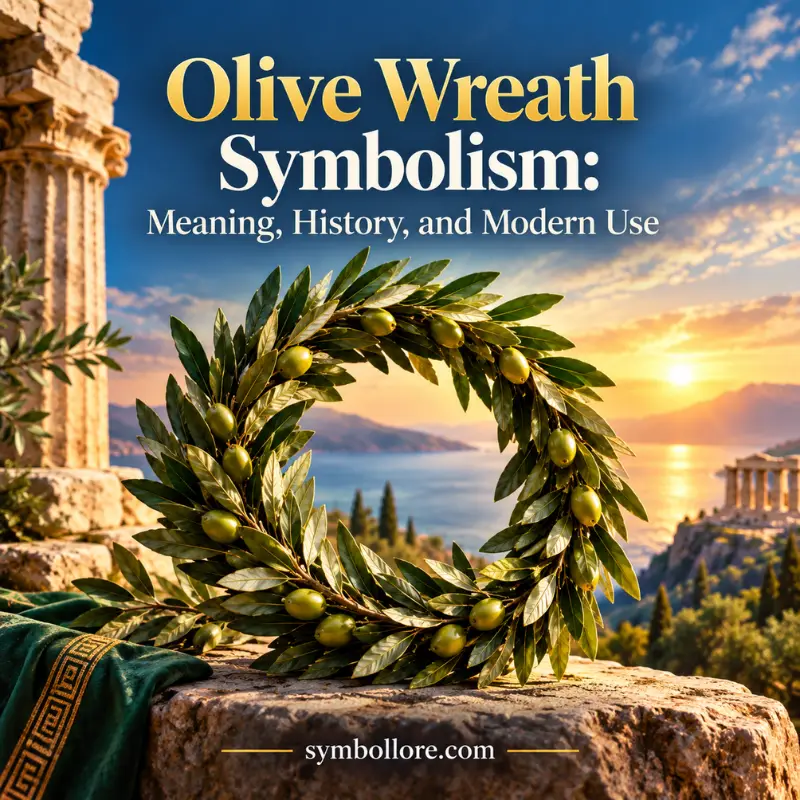
An olive wreath usually honors success that deserves public recognition. It can celebrate athletic ability, discipline, service, leadership, or a meaningful achievement. Unlike a jeweled crown, the traditional wreath uses simple plant material. Therefore, it can suggest that true honor comes from character and effort rather than wealth.
The olive plant adds another layer. Olive branches have long represented peace, goodwill, and the ending of conflict in Mediterranean and later Western imagery. As a result, a modern olive wreath can communicate peaceful victory: success achieved with dignity rather than destruction.
Context remains essential. A wreath above an athlete suggests competition. One surrounding a peace emblem suggests cooperation. In a memorial, it may express lasting honor.
The Ancient Olympic Origin of the Olive Wreath
The strongest historical foundation for the symbol comes from ancient Olympia. Winners did not receive gold, silver, and bronze medals in the modern style. Instead, an official crowned each champion with a wreath made from a wild olive branch.
The wreath was known as a kotinos.
According to the International Olympic Committee’s history of the ancient Games,
officials announced the victor’s name, father, and city before placing the olive crown on the winner. The public ceremony turned individual success into honor shared with the athlete’s community.
Olympia was also a religious sanctuary dedicated to Zeus. Therefore, the prize carried more than sporting value. It connected physical excellence, religious observance, public reputation, and civic identity.
The Archaeological Site of Olympia
preserves the setting in which these meanings developed. The site contained temples as well as athletic structures, showing that ancient competition and worship belonged to the same cultural event.
Why a Simple Plant Wreath Represented Great Honor
An olive wreath had little material value, yet it carried enormous social value. The prize showed that honor did not need to depend on precious metal. Recognition from judges, spectators, the sanctuary, and the wider Greek world gave the crown its importance.
The plant also came from a sacred setting. That origin made the wreath different from an ordinary branch gathered for decoration. It represented a recognized relationship between the victor, the festival, and the religious community.
The Metropolitan Museum of Art explains that
wreaths made from sacred plants,
including Olympia’s olive wreath, could be as prestigious as expensive prizes. Ancient Greek festivals used different plants. Olympia used wild olive, while other competitions used laurel, pine, or wild celery.
This distinction matters because the plant identified the event. An olive crown did not simply mean “winner.” It specifically evoked Olympic victory.
Victory, Excellence, and Earned Recognition
Victory remains the clearest meaning of the olive wreath. However, the symbol implies more than defeating an opponent. It also points to training, self-control, courage, and the ability to perform under pressure.
For this reason, the wreath often represents excellence rather than mere power. A champion had to meet the rules of the contest and prove superior skill in public. The crown made that judgment visible.
Modern schools, athletic organizations, award programs, and brands still use wreath designs for this purpose. A wreath around a name or number creates the visual language of distinction. It tells viewers that the enclosed person, title, or achievement deserves attention.
This idea overlaps with symbols of leadership and public responsibility. For example,
also examines how crowns can communicate authority, recognition, and the duties attached to elevated status.
Honor, Glory, and Public Memory
The olive wreath transformed a temporary victory into a lasting reputation. The physical leaves would dry and fade, but the champion’s name could survive through public records, stories, inscriptions, statues, and community memory.
Therefore, the symbol can represent glory without implying that the object itself lasts forever. Its deeper message is that an honorable act may outlive the material prize.
This contrast gives the wreath emotional depth. Fresh leaves suggest the immediate joy of success. Dried leaves can suggest memory, age, or the distance between a past achievement and the present.
Modern memorial emblems sometimes use wreaths for a similar reason. They frame names, dates, shields, and portraits to communicate respect. However, an olive wreath in a memorial should not automatically be read as an ancient Greek symbol. The surrounding words and images determine whether it means victory, peace, service, or remembrance.
Peace and Reconciliation
Peace belongs strongly to olive symbolism, although it comes more directly from the olive branch than from the Olympic crown. Ancient Mediterranean cultures used the branch in religious, political, and diplomatic settings. Later art and national emblems helped make it an internationally recognizable peace symbol.
When branches form a wreath, they can join the meanings of peace and honor. Such a design may celebrate reconciliation, successful diplomacy, or unity after conflict. It can also suggest that peace itself deserves recognition as an achievement.
The United States offers a familiar example of the branch’s political meaning.
The National Museum of American Diplomacy
explains that the olive branch and arrows in the Great Seal represent the powers of peace and war. The eagle faces the olive branch, emphasizing a preference for peace.
Still, not every olive wreath is a peace emblem. An athletic design may focus almost entirely on victory. Viewers should first examine the object, event, and accompanying text.
Sacred Olive Trees, Athena, and Greek Identity
Greek myth closely connects the olive tree with Athena and the city of Athens. In the well-known contest between Athena and Poseidon, Athena offers the olive tree. The gift supports ideas of cultivation, food, oil, prosperity, and civic life.
This story strengthens the olive’s associations with wisdom, useful abundance, and Greek identity. Yet it should not be treated as the documented origin of every Olympic wreath custom. The sacred olive at Olympia belonged to a different religious setting centered on Zeus.
In mythology, plants often receive meaning through their connection with a deity, city, ritual, or founding story.
Greek mythology color symbolism
shows a similar need for context: objects, materials, and scenes matter more than a simple universal code.
Athena’s olive tree and Olympia’s wild olive wreath support related meanings, but they are not interchangeable stories.
Olive Wreath and Divine Favor
Ancient Olympic competition took place within a religious festival. A victory could therefore be understood as both a human achievement and a sign that the champion had gained favor within a sacred event.
The wreath made that honored position visible. However, it did not prove that a god had permanently chosen the athlete or guaranteed future success. Ancient religious meaning was tied to the festival, sanctuary, and customs of the time.
Later readers sometimes describe the crown as a universal sign of divine blessing. That claim goes too far. The olive wreath had particular meanings within ancient Greek religious life. Other religions and cultures may use olive imagery differently.
A historically careful interpretation separates cultural belief from objective fact. It also avoids turning a specific Greek custom into a broad mystical promise.
Olive Wreath vs. Laurel Wreath
Olive and laurel wreaths often look similar, but they are not the same symbol. The olive wreath was the traditional victory prize at Olympia. Laurel had strong links with Apollo and served as the prize at the Pythian Games at Delphi.
Laurel later became closely associated with poetic, academic, military, and imperial achievement. Words such as “laureate” preserve that connection. Meanwhile, the olive wreath kept its strongest tie to the Olympic tradition.
The leaves can also help identify the plant:
- Olive leaves are usually narrow, with smooth edges and a muted gray-green appearance.
- Bay laurel leaves tend to look broader, darker, and more polished.
- Stylized logos may remove these details, making identification difficult.
- Designers sometimes call any classical leaf crown a laurel wreath, even when it resembles olive.
Therefore, viewers should not assume that every victory wreath shows olive. Historical setting, plant shape, and accompanying symbols provide better evidence.
The Shape of the Wreath: Unity and Continuity
Modern readers often connect a circular wreath with wholeness, unity, continuity, and an unbroken bond. Interwoven branches support this interpretation because separate stems and leaves combine to create one form.
However, ancient wreaths were not always perfect closed circles. Some looked more like open crowns or horseshoes. Therefore, claims that every ancient olive wreath specifically represented eternity lack strong support.
The shape still matters in modern design. A closed wreath can suggest inclusion or collective identity. An open wreath may guide attention toward a central name, star, shield, or image. Paired branches can create balance without forming a complete ring.
The olive tree’s evergreen nature can also encourage ideas of endurance. The related history of
explains why plants that keep their foliage often suggest continuity, resilience, and lasting life.
Biblical and Jewish Context
Genesis 8 describes a dove returning to Noah with a freshly plucked olive leaf. Many Christian artists and writers later connected this scene with peace, reconciliation, hope, and restored life after the Flood.
However, the biblical text names an olive leaf rather than an olive wreath. It indicates that the floodwaters had fallen enough for plant life to become accessible. Later tradition expanded the image into the familiar dove-and-olive-branch emblem of peace.
Interpretations also differ across religious communities.
A Jewish explanation of the olive branch
notes that traditional Jewish commentary can emphasize endurance and faith rather than treating the leaf only as a simple peace sign.
Therefore, a Christian or biblical olive design should not automatically inherit the athletic meaning of an Olympic wreath. The dove, ark, cross, text, or religious setting changes the interpretation.
Roman and Later European Use
Romans adopted and adapted many Greek wreath customs. Yet Roman crowns followed a detailed system in which different plants and materials signaled different honors. Laurel, oak, grass, myrtle, and olive could carry separate meanings.
Consequently, it is inaccurate to describe every Roman victory crown as an olive wreath. The famous Roman triumphal crown was generally associated with laurel. Olive imagery could still appear in art, coinage, ritual, and peaceful personifications, but its meaning depended on the exact setting.
Later European artists reused classical wreaths to express victory, fame, authority, learning, and virtue. Over time, historical plant distinctions became less clear. Decorative artists often selected leaves for appearance rather than precise classical meaning.
That blending explains why modern audiences may interpret olive and laurel wreaths in nearly the same way, even though their ancient uses differed.
Olive Wreath Symbolism in Modern America
In the United States, olive wreaths appear in logos, certificates, sports graphics, invitations, military-style emblems, nonprofit branding, and decorative art. Most viewers read them as signs of accomplishment, prestige, peace, or classical tradition.
Common modern uses include:
- framing a winner’s name on an award;
- honoring academic or athletic excellence;
- representing peaceful leadership;
- decorating Greek cultural events;
- expressing Mediterranean heritage;
- surrounding initials in wedding designs;
- recognizing service or remembrance.
Color changes the mood. Green leaves feel natural, peaceful, and traditional. Gold leaves suggest prestige, formal honor, or exceptional achievement. Black wreaths can feel solemn, official, or memorial. The combination of black and gold often intensifies ideas of status and recognition, as explained
Olive Wreaths in Tattoos, Jewelry, and Gifts
An olive wreath tattoo often represents a personal victory. It may mark recovery, graduation, athletic success, military service, or the completion of a difficult goal. Some people choose it as a commitment to peace, while others use it to honor Greek ancestry.
Placement and added details refine the meaning. A date can identify a specific achievement. A dove emphasizes peace. Initials may turn the wreath into a memorial or family emblem. An Olympic-style torch or athletic object highlights competition.
Olive wreath jewelry can carry similar meanings. It may celebrate success without using a conventional trophy image. In wedding gifts, the wreath may suggest unity, goodwill, and a lasting partnership.
Still, no tattoo or gift has an automatic meaning. The wearer’s purpose matters more than a generic online interpretation.
Common Misconceptions About Olive Wreaths
Several popular claims need careful correction.
First, olive and laurel wreaths are not identical. Olympia used wild olive, while Delphi used laurel. Modern art often blends their appearance, but historical accuracy requires the distinction.
Second, the olive wreath was not valuable because it was expensive. Its worth came from sacred custom, public recognition, and the champion’s achievement.
Third, the circular form did not necessarily represent eternity in every ancient setting. That meaning often reflects later symbolic interpretation.
Finally, the wreath is not automatically biblical. Scripture mentions olive trees, branches, leaves, oil, and fruit, but the Olympic-style olive crown comes from a Greek athletic and religious context.
How to Interpret an Olive Wreath
Begin by identifying where the symbol appears. A sports medal, diplomatic logo, memorial plaque, wedding invitation, and tattoo will not communicate exactly the same message.
Next, look for supporting details:
- A torch, stadium, or athlete points toward Olympic victory.
- A dove suggests peace or reconciliation.
- A shield or eagle may indicate civic or national identity.
- A name and dates may create a memorial meaning.
- Gold coloring emphasizes prestige and achievement.
- Greek lettering or architecture may highlight cultural heritage.
- Religious text can shift the meaning toward faith or restoration.
Finally, distinguish documented history from personal meaning. A person may choose the wreath as a private sign of survival or inner peace. That interpretation can be meaningful without becoming a universal historical rule.
FAQs
An olive wreath most often symbolizes victory, honor, excellence, peace, and unity. Its victory meaning comes mainly from ancient Olympia, while its peaceful meaning grows from the wider use of olive branches as signs of goodwill and reconciliation.
Ancient Olympic champions received wild olive wreaths because the prize belonged to Olympia’s sacred festival tradition. The simple crown publicly honored athletic excellence and connected the winner with the sanctuary, judges, spectators, and the victor’s home city.
No. The ancient Olympic Games used wild olive wreaths, while laurel wreaths had strong ties to Apollo and the Pythian Games. Modern artists often blur the difference, so leaf shape and historical context help identify the intended plant.
No. An olive wreath may represent peace, but its strongest historical Olympic meaning is victory and honor. A dove, handshake, national seal, or diplomatic setting makes the peace interpretation more likely.
A gold olive wreath usually combines achievement with prestige, excellence, or formal recognition. The gold color adds ideas of high value and distinction, while the wreath keeps its connection with victory and honor.
An olive wreath tattoo may represent a personal victory, peace, discipline, Greek heritage, or honorable remembrance. Dates, words, doves, athletic objects, and initials can make the wearer’s intended meaning clearer.
It can have religious meaning in an ancient Greek setting because the Olympic Games formed part of a festival associated with Zeus. However, the wreath is not a universal religious symbol, and biblical olive imagery usually centers on branches, leaves, oil, or trees rather than Olympic crowns.
Conclusion
Olive wreath symbolism brings together victory, earned honor, excellence, peace, and unity. Its clearest historical root lies at ancient Olympia, where champions received sacred wild olive wreaths instead of modern medals. Later use of the olive branch as a peace emblem added ideas of reconciliation and goodwill.
Yet context remains decisive. An athletic wreath honors achievement, while a dove-and-wreath design stresses peace. Gold coloring adds prestige, and memorial wording can express lasting respect. Understanding the plant, setting, and surrounding images reveals a more accurate meaning than treating every classical leaf crown as the same symbol.
Five Related Articles from symbollore.com
- Greek Mythology Color Symbolism: Meaning and Context — https://symbollore.com/greek-mythology-color-symbolism/
- Hera Symbolism: Marriage, Power, and Ancient Meaning — https://symbollore.com/hera-symbolism/
- Evergreen Symbolism: Meanings, History, and Modern Uses — https://symbollore.com/evergreen-symbolism/
- King Symbolism: Meaning, History, and the Responsibilities of Power — https://symbollore.com/king-symbolism/
- Black and Gold Symbolism: What These Colors Mean Together — https://symbollore.com/black-and-gold-symbolism/


