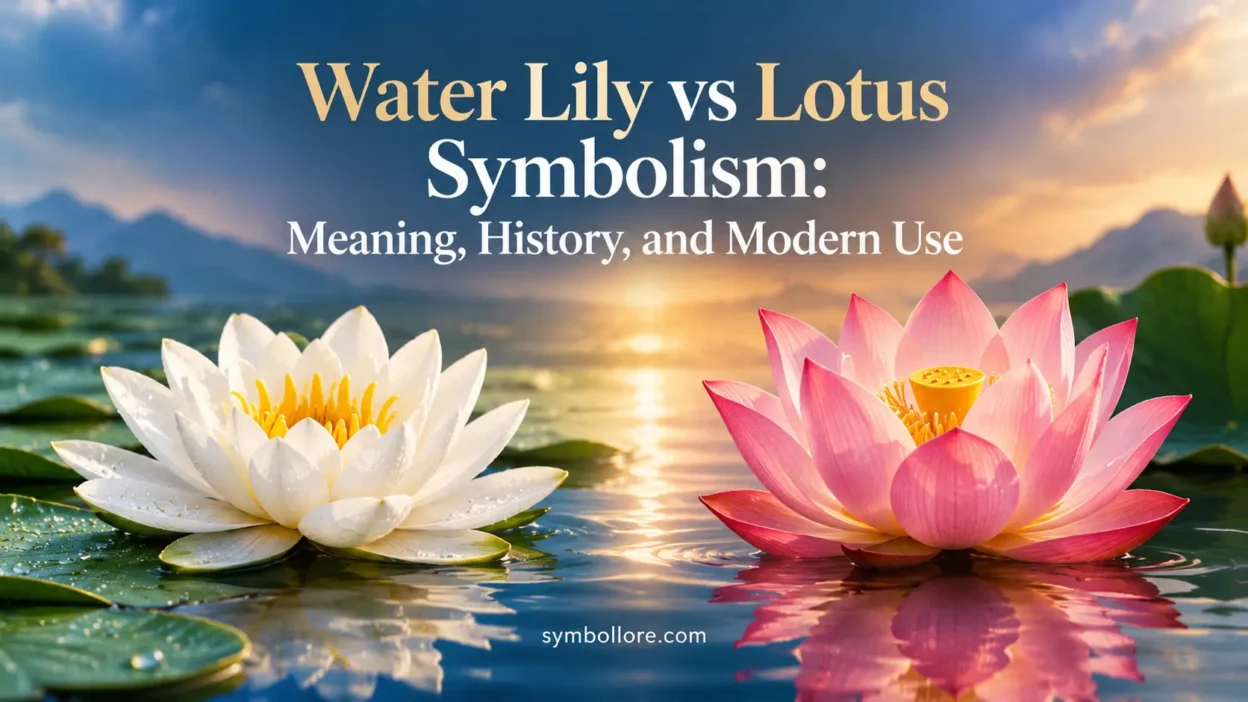
Water lily vs lotus symbolism can seem confusing because both flowers grow in water and share meanings of purity, beauty, and renewal. However, their cultural histories reveal important differences.
The water lily has strong connections to rebirth in ancient Egyptian art. Meanwhile, the sacred lotus plays a central symbolic role in Buddhism and Hinduism, often representing spiritual awakening and rising above suffering.
Their similar appearance also leads to confusion in paintings, tattoos, and religious artwork.
This guide explains seven key symbolic meanings, the cultural traditions behind each flower, and how to tell a water lily from a lotus.
Quick Answer: Water Lily vs Lotus Symbolism
Water lilies commonly symbolize rebirth, peace, beauty, and renewal, while lotus flowers often represent spiritual purity, enlightenment, and overcoming adversity. Ancient Egyptians associated certain water lilies with the sun’s daily return. In Buddhist and Hindu traditions, the sacred lotus holds important religious meanings. Both flowers can symbolize growth, but their histories and cultural uses are not identical.
Key Takeaways (TL;DR)
- Water lily symbolism: Strongly associated with rebirth and rejuvenation in ancient Egypt. Modern interpretations also include peace and emotional balance.
- Lotus symbolism: Traditionally represents purity and spiritual awakening, especially in Buddhist and Hindu contexts.
- Historical difference: The ancient Egyptian “lotus” was often a type of water lily, not the sacred Asian lotus.
- Botanical difference: Water lilies generally have floating, notched leaves, while mature lotus leaves often rise above the water.
- Shared meaning: Both flowers can inspire ideas about beauty, change, and growing through difficult circumstances.
What Is Water Lily vs Lotus Symbolism?
Water lily vs lotus symbolism refers to the spiritual, historical, and personal meanings attached to these two aquatic flowers.
Both grow from underwater structures rooted in muddy soil. Their attractive blooms appear at or above the water’s surface, creating a striking contrast with their surroundings.
This natural pattern helps explain why people associate them with purity, renewal, and transformation.
However, water lilies and lotuses belong to different botanical families.
Water lilies generally belong to the family Nymphaeaceae, including plants in the genus Nymphaea.
True lotuses belong to the family Nelumbonaceae, which includes the genus Nelumbo.
The sacred lotus, Nelumbo nucifera, is especially important in Asian religious art.
An unusual historical detail adds to the confusion. Ancient Egyptians called certain water lilies lotus flowers, and that terminology continues in museums and popular writing.
Understanding the plant and its cultural setting is the first step toward interpreting its meaning correctly.
The 7 Key Symbolic Meanings of Water Lilies and Lotuses
Although the two flowers have distinct histories, several symbolic themes overlap.
1. Purity and Inner Beauty
The lotus is a major symbol of purity in Buddhist and Hindu traditions.
It grows in muddy conditions yet produces a beautiful flower above the water. This contrast provides a powerful image of remaining spiritually pure while living in an imperfect world.
Water lilies may also represent innocence and beauty, especially in modern flower symbolism.
However, the lotus has a more clearly documented religious connection to spiritual purity.
Key difference: Lotus purity carries strong traditional religious significance, while water lily purity often reflects broader artistic or personal interpretation.
2. Rebirth and Renewal
Rebirth is one of the strongest historical meanings of the water lily.
In ancient Egypt, certain water lily flowers closed at night and reopened in the morning.
This pattern connected them with sunrise, creation, and the daily renewal of life.
The lotus also represents renewal, but its significance often relates to spiritual development and liberation from suffering.
As a result, both flowers express the idea of beginning again.
Their symbolic stories, however, developed in different cultural settings.
3. Spiritual Enlightenment
The sacred lotus has a particularly important connection to enlightenment.
In Buddhist imagery, lotus flowers and lotus seats appear with Buddhas and bodhisattvas.
The flower can represent the possibility of developing wisdom and compassion despite difficult surroundings.
Water lilies do not have the same universal role in Buddhist symbolism.
A person may choose to interpret a water lily as spiritual awakening, but that is not the same as a documented traditional association.
4. Peace and Emotional Balance
Water lilies often suggest quietness and peace in modern nature-inspired symbolism.
Their broad leaves rest on calm ponds, creating an image of stillness.
This makes the flower popular in artwork about reflection, relaxation, and emotional well-being.
The lotus can also symbolize inner peace.
In Buddhist contexts, that meaning connects more closely with spiritual discipline, wisdom, and freedom from harmful attachments.
Symbolic contrast: Water lilies may suggest finding calm in everyday life, while lotus imagery can express a deeper spiritual path toward inner clarity.
5. Strength and Resilience
Both flowers grow in environments that may appear muddy or difficult.
For this reason, people sometimes use them as symbols of resilience.
The lotus has an especially familiar association with overcoming adversity.
Its emergence above the water creates a visual metaphor for moving beyond hardship without losing one’s values.
Water lily symbolism may instead emphasize adapting to one’s surroundings and continuing to grow.
Neither flower has to represent a struggle. These meanings depend on the cultural context and the individual interpreting the image.
6. Beauty and Transformation
The beautiful appearance of both flowers makes them natural symbols of transformation.
A water lily opening across a pond may suggest a new phase of life.
Its connection with ancient Egyptian renewal also gives this image historical depth.
The lotus often represents a more specifically spiritual transformation.
In religious art, it may express the journey from confusion toward wisdom or from suffering toward liberation.
Both flowers remind people that growth can produce something beautiful.
7. Connection Between Nature and Spirituality
Water lilies and lotuses connect the visible natural world with deeper human ideas.
Their roots remain underwater while their leaves and flowers reach toward light.
This contrast can inspire reflection on the relationship between physical life and spiritual purpose.
The meaning is especially important for the sacred lotus in Asian religious traditions.
Meanwhile, the water lily offers a strong example of how ancient Egyptians observed nature and developed religious symbols from seasonal and daily patterns.
Water Lily vs Lotus: Main Differences Explained
Water lilies and lotuses look similar, but several features make them easy to distinguish.
| Feature | Water Lily | Lotus |
|---|---|---|
| Botanical family | Nymphaeaceae | Nelumbonaceae |
| Common genus | Nymphaea | Nelumbo |
| Typical leaf position | Floats on water | Often rises above water |
| Leaf shape | Usually has a notch | Round, usually without a notch |
| Flower position | At or near water surface | Usually elevated above water |
| Flower colors | White, pink, yellow, blue, and more | Commonly pink, white, or yellow |
| Major historical association | Ancient Egyptian rebirth | Buddhist and Hindu sacred symbolism |
| Common spiritual theme | Renewal and tranquility | Purity and enlightenment |
| Modern personal interpretation | Emotional balance | Overcoming adversity |
Not every species follows every visual pattern. Some water lily flowers rise above the surface, and young lotus leaves may float.
The leaf notch, flower structure, and seedpod provide more reliable identification clues than symbolism alone.
Water Lily Symbolism in Ancient Egypt
Ancient Egyptian water lily symbolism is one of the most historically significant aspects of this comparison.
In ancient Egyptian art, the flower commonly described as the blue lotus was actually a water lily, Nymphaea caerulea.
The flower’s daily opening and closing made it an important symbol of the sun’s cycle.
Rebirth and the Rising Sun
Egyptians associated the opening water lily with the sun emerging each morning.
This represented creation, rejuvenation, and life returning after darkness.
Water lily images appeared in tomb decorations, objects, and religious artwork.
Their presence could express hopes for renewal beyond death.
The Blue Water Lily and Nefertem
The blue water lily also had associations with Nefertem, an Egyptian deity linked with the flower and its fragrance.
These connections gave the plant a sacred role beyond its natural beauty.
The water lily was therefore more than a decorative motif.
It helped express ancient Egyptian ideas about creation, regeneration, and divine life.
Why Egyptian Lotus Symbolism Is Often Confused
Modern readers may assume that every ancient image called a lotus represents Nelumbo nucifera.
That assumption is incorrect.
Many famous Egyptian lotus designs portray water lilies from the genus Nymphaea.
This distinction matters when interpreting historical artwork or choosing a culturally inspired tattoo.
Lotus Symbolism in Buddhism
The sacred lotus holds a central place in Buddhist visual culture.
Its growth from muddy water into a clean, open flower provides an image of spiritual development.
Purity of Mind
The lotus can represent the possibility of developing a clear mind despite life’s difficulties.
Its surroundings do not prevent the flower from blooming.
Similarly, Buddhist teachings use the lotus to illustrate qualities such as wisdom, compassion, and freedom from attachment.
Enlightenment and Awakening
Lotus flowers frequently appear beneath Buddhas and bodhisattvas in religious images.
The lotus seat expresses spiritual purity and elevated understanding.
Different Buddhist traditions may interpret details of the image differently.
However, the broad connection between the lotus and enlightenment is well established.
The Importance of Lotus Colors
In Buddhist art, colors can carry different symbolic associations.
White often suggests purity, while red may represent compassion.
Blue is sometimes connected with wisdom.
Pink may be associated with the Buddha, depending on the artistic and religious tradition.
These meanings are not universal rules across every Buddhist school or historical period.
Lotus Symbolism in Hinduism
The sacred lotus also appears frequently in Hindu religious art and literature.
It represents concepts such as purity, beauty, creation, and spiritual understanding.
Lakshmi and the Lotus
Lakshmi, the Hindu goddess associated with prosperity and good fortune, is often depicted sitting or standing on a lotus.
The flower helps communicate beauty, auspiciousness, and divine purity.
Its appearance reinforces the importance of the lotus in Hindu sacred imagery.
Brahma and Creation
Brahma, a deity associated with creation, is often depicted emerging from a lotus connected with Vishnu.
This image gives the flower a powerful association with cosmic creation.
The lotus therefore carries meanings that extend beyond personal growth.
Detachment and Spiritual Growth
Lotus imagery can also express remaining unaffected by impurity or harmful attachments.
This idea appears in Hindu philosophical traditions, where the flower serves as a metaphor for spiritual discipline.
The meaning is related to, but not identical with, Buddhist interpretations.
Water Lily vs Lotus Symbolism by Color
Flower color can influence symbolic interpretation, but historical evidence varies by tradition.
White Water Lily vs White Lotus
White water lilies often suggest peace, innocence, and renewal in modern symbolism.
White lotuses have stronger established connections with spiritual purity in Asian religious imagery.
Both may represent cleanliness or clarity, but their cultural backgrounds differ.
Pink Water Lily vs Pink Lotus
Pink water lilies may symbolize affection, beauty, and gentle emotions in modern flower interpretation.
Pink lotus imagery can hold religious importance in Buddhist traditions.
The pink sacred lotus is also common in Hindu art.
Blue Water Lily vs Blue Lotus
The ancient Egyptian blue lotus was a blue water lily.
It was connected with sunrise, regeneration, and sacred Egyptian imagery.
In Buddhist art, a blue lotus can symbolize wisdom and spiritual insight.
However, the blue lotus in Buddhist iconography should not automatically be identified with the same plant as the Egyptian blue water lily.
Yellow Water Lily vs Yellow Lotus
Yellow water lilies may inspire associations with sunlight, optimism, and happiness.
The American lotus, Nelumbo lutea, produces pale yellow flowers.
Modern interpretations sometimes connect yellow lotus flowers with hope or vitality.
Still, these broad color meanings should not be presented as universal ancient traditions.
Water Lily vs Lotus Tattoo Meaning
Water lily and lotus tattoos can communicate similar ideas, but choosing one over the other may change the message.
A water lily tattoo may represent peaceful growth, personal renewal, or a connection with nature.
Someone interested in ancient Egyptian history might choose a blue water lily to express rebirth.
A lotus tattoo often symbolizes spiritual awakening, purity, or resilience.
For someone connected with Buddhist or Hindu traditions, it may carry specific religious meaning.
The flower’s design also matters.
A lotus with a raised stem and distinctive seedpod differs from a floating water lily with a notched leaf.
Before selecting a tattoo, consider whether you want the flower’s historical meaning, religious significance, or a personal symbol of growth.
Examples of Water Lily and Lotus Symbolism in Everyday Life
These flowers appear in decoration, jewelry, artwork, and personal reflection.
Their meanings change depending on how people use them.
Example 1: A Water Lily Painting
A painting of water lilies on a still pond may suggest tranquility and appreciation for nature.
The meaning grows from the atmosphere and the artist’s choices.
It does not automatically carry an ancient religious message.
Example 2: Lotus Jewelry
Someone may wear lotus jewelry as a reminder of resilience or spiritual growth.
For a practicing Buddhist or Hindu, the image may carry a more specific religious meaning.
The wearer’s intention helps determine its personal significance.
Example 3: An Egyptian-Inspired Design
A blue water lily motif may express rebirth and the return of light.
When a design draws from ancient Egyptian art, identifying the plant correctly helps preserve its cultural context.
Example 4: Flowers in a Meditation Space
Water lily imagery may help create a calm atmosphere.
Lotus imagery may also serve as a reminder of spiritual teachings or personal goals.
In either case, the symbol itself does not guarantee peace or spiritual progress.
Common Misconceptions About Water Lily and Lotus Symbolism
Several misunderstandings appear when people compare these flowers.
Misconception 1: Water Lilies and Lotuses Are the Same Flower
They are different botanical plants.
Their similar appearance does not make them members of the same family.
Misconception 2: Every Ancient Lotus Was a True Lotus
Ancient Egyptian lotus imagery commonly refers to water lilies.
Ignoring historical naming conventions can lead to inaccurate interpretations.
Misconception 3: Only the Lotus Represents Rebirth
Water lilies have a strong documented connection to rebirth in ancient Egyptian culture.
In fact, this is one of their most important historical associations.
Misconception 4: Flower Colors Have Universal Meanings
Color associations depend on religion, culture, time period, and personal interpretation.
A pink flower does not automatically have the same meaning in every tradition.
Misconception 5: One Flower Is Spiritually More Powerful
There is no objective way to measure spiritual power through a flower symbol.
The lotus has a more prominent place in certain religious traditions.
However, that does not make a water lily personally less meaningful.
Important Botanical and Historical Facts
A few verified facts help explain why the flowers developed different symbolic identities.
First, the two plants belong to separate botanical families. Their shared aquatic habitat makes them look similar, but they are not close relatives.
Second, the lotus has a distinctive water-repellent leaf surface. Water droplets can roll across it and remove dirt. This natural feature makes it an especially fitting image for purity.
Third, water lily species differ in their daily flowering patterns. Some bloom during daylight hours, while others open at night. The ancient Egyptian interpretation concerns particular water lilies, not every species worldwide.
Finally, historical terminology matters. Museums may use the word “lotus” for Egyptian water lily objects because that name reflects long-standing artistic and historical usage.
These details prevent botanical facts from being confused with religious or personal beliefs.
People Also Ask About Water Lily vs Lotus Symbolism
Which flower represents spiritual enlightenment?
The sacred lotus has the stronger traditional connection to spiritual enlightenment, particularly in Buddhism. Its growth above muddy water often illustrates the possibility of wisdom and purity despite suffering.
Does a water lily symbolize rebirth?
Yes. Ancient Egyptian water lilies symbolized rebirth and rejuvenation. Their daily opening was associated with the returning sun and renewal of life. This meaning has stronger historical support than many modern water lily interpretations.
Do lotus and water lily flowers both represent purity?
Both can represent purity, but the association has different levels of historical support. The sacred lotus has a well-documented role in Buddhist and Hindu religious symbolism. Water lily purity is often a broader modern or artistic interpretation.
Frequently Asked Questions
A water lily often suggests tranquility in modern artwork because its leaves and flowers appear on quiet water. The lotus can also represent peace, especially when connected with Buddhist teachings. Neither flower is inherently more peaceful. The intended meaning depends on the design, tradition, and personal interpretation.
The lotus is widely used as a symbol of overcoming hardship. Its growth from muddy water into an open flower makes it a powerful metaphor for spiritual development. Water lilies may also represent resilience and renewal, but their strongest documented ancient meaning centers on rebirth in Egyptian culture.
A water lily may symbolize gentle affection, emotional peace, or a relationship entering a new phase. These are mostly modern personal interpretations rather than universal historical meanings. Its significance often depends on flower color, artistic context, and the feelings someone connects with it.
Yes. Lotus symbolism can include renewal, transformation, and personal growth. Its strong religious associations with purity and enlightenment also make it meaningful for people starting a new spiritual chapter. However, the lotus is not limited to new beginnings, and its meaning changes across cultures.
In ancient Egyptian contexts, the flower called the blue lotus is generally a water lily, Nymphaea caerulea. However, the term “blue lotus” may also appear in different artistic or religious settings. Identifying the cultural context is important before assuming two images represent the same species.
The sacred lotus commonly represents purity, beauty, creation, and auspiciousness in Hindu traditions. It appears in depictions of deities such as Lakshmi and Brahma. Its meaning depends on the specific deity, religious teaching, and artistic setting rather than one universal interpretation.
Choose a water lily if you connect with tranquility, Egyptian rebirth imagery, or personal renewal. A lotus may be more appropriate if you want to express spiritual purity, enlightenment, or resilience. If your design draws from a specific religion or culture, research its traditional meaning before choosing the final artwork.
Conclusion: Water Lily vs Lotus Symbolism
Water lily vs lotus symbolism shares themes of beauty, purity, renewal, and growth, but the flowers carry different historical associations.
Water lilies have a strong connection to rebirth in ancient Egyptian culture. The sacred lotus holds deep religious importance in Buddhism and Hinduism, especially as a symbol of purity and spiritual development.
Understanding these differences helps you interpret paintings, tattoos, jewelry, and religious images more accurately.
Ultimately, the most meaningful interpretation respects the flower’s cultural history while allowing space for personal reflection.