Mental health symbolism gives visible form to experiences that can be difficult to express in words. A green ribbon can communicate awareness and solidarity. A semicolon can represent continuation after a difficult period. In art, an empty room, isolated figure, or distorted landscape can express loneliness, fear, or psychological distress.
These meanings did not all come from one tradition. Some developed through modern advocacy movements, while others grew from art, literature, cultural practices, and personal experience. Therefore, mental health symbolism is best understood as a collection of related visual languages rather than one universal system.
The most important distinction is context. A symbol can suggest hope in one setting and grief in another. Its meaning depends on its history, the community using it, and the surrounding image or story.
Quick Answer
Mental health symbolism represents ideas such as awareness, hope, survival, recovery, resilience, emotional struggle, and support. The green ribbon is widely used for mental illness awareness, while the semicolon became associated with continuing a life story through Project Semicolon. Other images, such as butterflies, trees, empty spaces, and expressive artwork, can represent transformation or psychological experience, but their meanings are not universal.
TL;DR
- Mental health has no single symbol that controls every interpretation worldwide.
- The green ribbon is strongly associated with mental health awareness and advocacy.
- The semicolon became a modern symbol of continuation through Project Semicolon.
- Art can use isolation, darkness, distorted forms, and empty spaces to express psychological experiences.
- Natural symbols such as butterflies, trees, and flowers may suggest healing or change, depending on context.
- Personal and cultural meaning should not be treated as a fixed psychological fact.
Mental Health Meanings at a Glance
| Symbol or Image | Possible Meaning | Why the Association Exists | Important Limit |
|---|---|---|---|
| Green ribbon | Mental health awareness, solidarity | Advocacy groups use the ribbon to make mental health visible | It does not identify a person’s diagnosis |
| Semicolon | Continuation, survival, hope | Project Semicolon connected punctuation with continuing a life story | Its meaning comes from a modern movement |
| Butterfly | Transformation, change, recovery | Metamorphosis provides a natural metaphor for change | Not an official mental health emblem |
| Tree | Growth, stability, resilience | Roots and continued growth support these associations | Meanings vary across cultures |
| Empty chair | Absence, loneliness, loss | An unused place makes absence visible | Context determines whether the absence is painful |
| Open door | Possibility, support, transition | An open threshold suggests access and movement | It can also represent uncertainty |
| Dark or distorted landscape | Fear, distress, isolation | Artists can alter space and color to express inner states | Artistic meaning is not a clinical diagnosis |
What Does Mental Health Symbolism Mean?
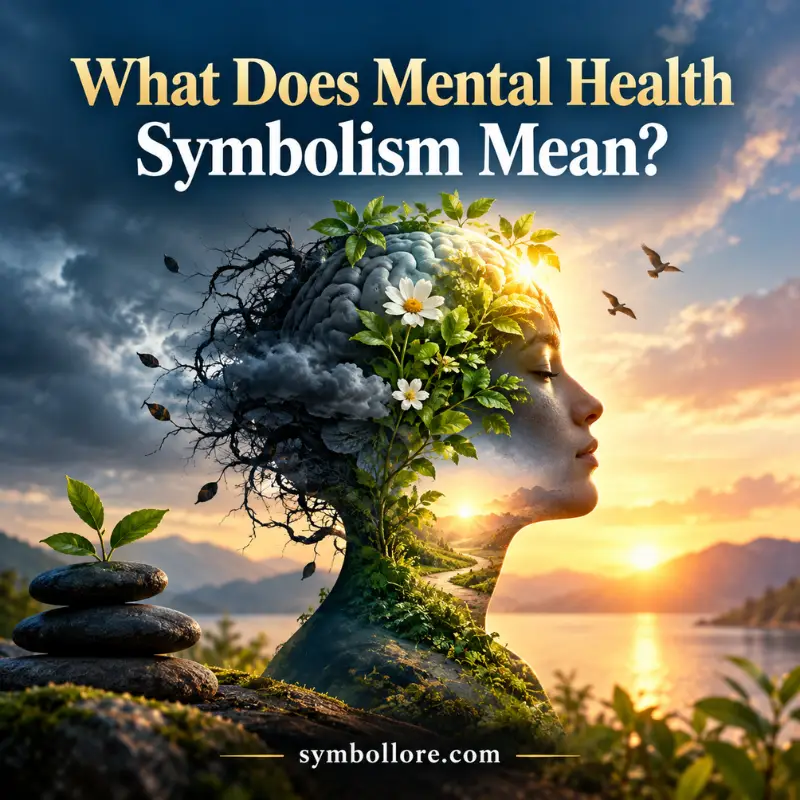
Mental health symbolism refers to images, objects, colors, marks, and artistic forms that people use to communicate ideas about psychological well-being and emotional experience.
The strongest modern examples are connected to awareness and advocacy. The green ribbon, for example, has been used to support people living with mental illness and to promote mental health awareness. The National Alliance on Mental Illness describes the green ribbon as a sign of support for people living with mental illness.
Other symbols communicate more personal ideas. Someone may choose a tree to represent stability or a butterfly to represent transformation. Those meanings can be meaningful without being official.
This distinction matters because a symbol cannot diagnose a person. Wearing a green ribbon does not tell you what someone is experiencing. Likewise, a semicolon tattoo does not provide enough information to determine someone’s mental health history.
Mental health symbolism works best as a language of communication. It can make an invisible experience easier to discuss.
Why Mental Health Has More Than One Symbol
There is no single visual mark that can represent every mental health experience.
Mental health includes ordinary emotional well-being, psychological distress, diagnosed conditions, recovery, grief, trauma, advocacy, and many other experiences. A symbol created for one purpose cannot automatically represent all of them.
Modern awareness movements have therefore developed different visual languages. The green ribbon emphasizes awareness and solidarity. The semicolon has a more specific history connected with survival and suicide-prevention messaging.
This variety also reflects personal experience. One person may connect strongly with a ribbon, while another may find a flower, tree, or abstract image more meaningful.
Symbolism is especially useful when direct language feels difficult. A small visual sign can communicate support without requiring someone to explain their entire experience.
The Green Ribbon and Mental Health Awareness
The green ribbon is one of the clearest examples of modern mental health symbolism.
Green ribbons have been used to support people living with mental illness and to encourage public awareness. NAMI has promoted green ribbon imagery during Mental Health Month and other awareness efforts.
The ribbon format itself also benefits from visual simplicity. A ribbon is easy to wear, reproduce, photograph, and display in public campaigns. That makes it useful for creating a shared sign of solidarity.
The color green can add another layer of meaning. Green is often associated with growth and renewal in modern visual culture. However, it would be too broad to claim that green naturally means mental health everywhere.
The important association comes from repeated social use. Advocacy gives the green ribbon a recognizable public meaning.
NAMI’s discussion of the green ribbon
The Semicolon as a Symbol of Continuation
The semicolon has one of the clearest documented origins among modern mental health symbols.
Project Semicolon gained widespread attention in 2013 after founder Amy Bleuel shared her semicolon tattoo. The movement connected the punctuation mark with the idea of continuing a life story rather than ending it.
The metaphor works because a semicolon separates two parts of a sentence without bringing the sentence to a final stop. Project Semicolon turned that grammatical feature into a personal symbol.
Its meaning is therefore more specific than simply “mental health.” It has become associated with survival, hope, suicide prevention, and continuing through emotional struggles.
The symbol also shows how modern communities can create new symbolism. The semicolon did not require thousands of years of tradition. Its meaning developed through a contemporary movement and the people who adopted it.
Project Semicolon’s history of the symbol
Butterflies, Trees, and Other Symbols of Recovery
Natural imagery often appears in discussions of emotional healing because physical transformation provides an easy visual metaphor.
A butterfly can suggest transformation because its life cycle involves dramatic physical change. In a mental health context, a person might use it to represent personal development or movement from one stage of life to another.
A tree can suggest resilience because it remains rooted while continuing to grow. Its branches may also evoke connection, while its changing leaves can suggest cycles and transition.
These interpretations are useful when presented as symbolic associations rather than established psychological meanings.
The difference is important. A butterfly does not have an official mental health meaning simply because people use it in recovery art. Its meaning comes from the context in which someone chooses it.
This is also why internal symbolism should not be treated as a universal code. A tree in a memorial artwork may communicate remembrance. A tree in a wellness design may suggest growth. The image stays the same, but the surrounding message changes.
Mental Health Symbolism in Art
Art provides one of the richest settings for mental health symbolism.
Artists can communicate emotional states through color, composition, posture, facial expression, distortion, scale, and empty space. These choices can express feelings that are difficult to describe literally.
Edvard Munch’s The Scream is a major example. The Metropolitan Museum of Art describes Munch’s work as expressing emotions including fear, dread, loneliness, and sexual longing. The screaming figure in The Scream personifies existential horror.
The image demonstrates an important principle of symbolism: psychological meaning can emerge from the relationship between several visual elements.
The distorted figure alone does not establish one universal meaning. The intense sky, setting, body posture, and surrounding forms work together. Munch’s own account of the experience that inspired the work also provides important context.
The Metropolitan Museum’s broader discussion of Symbolism also connects Munch’s Frieze of Life with illness, loneliness, despair, and mental suffering.
The Metropolitan Museum of Art’s overview of Symbolism
Isolation as a Symbol of Psychological Struggle
Isolation is one of the most common visual ways to represent emotional distress.
Artists may place a person far from other figures. A character might sit alone in a large room. A window may separate someone from the outside world. An empty chair may represent a person who is absent.
These images work because physical separation can make emotional separation visible.
However, being alone does not automatically mean loneliness. Solitude can also represent independence, peace, reflection, privacy, or creative focus.
This distinction is central to responsible symbolism. The image should be interpreted alongside facial expression, posture, lighting, setting, narrative, and other visual clues.
For a broader example of how isolation becomes symbolic, see
Loneliness Symbolism: Powerful Meanings in Art and Life.
The article examines empty spaces, windows, roads, water, and barriers as different visual forms of separation.
Color and Mental Health Symbolism
Color can influence symbolic interpretation, but color meanings are rarely universal.
Green has a strong modern connection with mental health awareness because advocacy organizations have used green ribbons and related imagery.
Blue may suggest calmness, sadness, distance, or introspection in particular artistic contexts. Black can suggest grief, darkness, absence, or power. White may communicate peace or emptiness.
None of these interpretations should be treated as a fixed psychological code.
Artists often use several colors together. Lighting can also change a color’s emotional effect. A soft green room may feel restorative, while a harsh green light could create tension.
Therefore, color symbolism should be read within the complete composition rather than interpreted from a color chart alone.
Mental Health Symbolism Across Culture and Context
Mental health symbolism changes when cultural context changes.
Modern American mental health awareness has developed through advocacy campaigns, nonprofit organizations, social media, art, education, and personal storytelling. The green ribbon and semicolon are strong examples of symbols shaped by relatively recent movements.
Older cultural traditions should not automatically be relabeled as “mental health symbols.” A religious flower, sacred geometric design, or traditional healing image may have its own established meaning that is broader than modern psychological wellness.
The same rule applies to Indigenous symbolism. A symbol belonging to a specific community should be discussed within that community’s traditions rather than presented as a generic “healing symbol.”
This approach prevents cultural flattening. It also makes the interpretation more useful because readers can see where an association actually came from.
Mental Health Symbolism in Literature and Storytelling
Literature often uses symbolic settings and objects to express psychological states.
A locked room can suggest confinement. A storm can mirror emotional turmoil. A journey can represent personal change. A broken mirror can raise questions about identity or self-perception.
Yet literary symbolism belongs to the work in which it appears. A storm does not automatically mean depression in every novel.
The author’s language, plot, characters, historical period, and recurring images all matter.
This is why readers should distinguish between an established literary interpretation and a modern personal association. A symbol can support several readings when the text leaves room for them.
The broader SymbolLore approach to objects and literary imagery follows this same principle: meaning depends on culture, history, setting, and use.
Modern American Uses of Mental Health Symbols
In the United States, mental health symbols appear in awareness campaigns, educational materials, jewelry, clothing, artwork, social media posts, tattoos, and community events.
The green ribbon is especially suited to public campaigns because it can be displayed without requiring a long explanation. It allows people to communicate support for mental health awareness in a simple visual form.
The semicolon has also become highly recognizable in popular culture. Project Semicolon documents how the symbol spread beyond its original social-media origins and into broader public awareness efforts.
Modern use can also be highly personal. Someone may place a symbol on a necklace or artwork as a private reminder of resilience.
In this setting, the meaning belongs partly to the individual. The public association may provide a starting point, but personal experience can add another layer.
What Mental Health Symbols Can and Cannot Communicate
Mental health symbols can communicate awareness, solidarity, hope, identity, remembrance, and support.
They can also start conversations. A ribbon on someone’s clothing may make it easier to discuss mental health. A piece of artwork may help a viewer recognize an emotional experience that is difficult to describe.
However, symbols have clear limits.
A symbol cannot diagnose a mental health condition. It cannot tell you whether someone is currently struggling. It cannot replace professional assessment or treatment.
The same symbol can also mean different things to different people. Therefore, interpreting someone’s personal symbol without asking them can lead to an inaccurate conclusion.
The most respectful approach is to treat symbolism as communication rather than evidence of a person’s private psychological state.
How to Interpret a Mental Health Symbol Responsibly
Start with the visible evidence.
Ask what the symbol actually shows. Then consider where it appears, who is using it, and what other images surround it.
For example, a green ribbon displayed during a mental health awareness campaign has a fairly clear public association. A green flower in a private painting requires a more cautious interpretation.
Next, identify the historical or cultural source. If the meaning comes from an advocacy movement, name the movement. If it comes from an artwork, consider the artist’s own context.
Finally, separate observation from interpretation.
“The image shows one person standing alone” is an observation. “The person represents depression” is an interpretation. The second statement needs stronger contextual evidence.
This method prevents symbolic readings from becoming guesses.
Common Misconceptions About Mental Health Symbolism
One common misconception is that mental health has one universal symbol. In reality, different movements and communities use different signs for different purposes.
Another misconception is that every healing symbol has an ancient psychological meaning. Many popular associations are modern reinterpretations.
It is also misleading to claim that a symbol can reveal someone’s diagnosis. Visual symbolism communicates ideas, but it does not provide clinical evidence.
Finally, symbolic hope should not be confused with guaranteed recovery. A butterfly may represent transformation, and a semicolon may represent continuation, but neither symbol predicts what will happen to an individual.
Good symbolism leaves room for uncertainty. It respects both the history of the image and the personal meaning attached to it.
FAQs
No single symbol universally represents every aspect of mental health. The green ribbon is widely used for mental health awareness, while the semicolon has a more specific modern history connected with Project Semicolon and messages of continuation and survival. Different organizations and communities may use additional symbols.
The green ribbon is commonly associated with mental health awareness and support for people living with mental illness. NAMI has used green ribbon imagery in mental health awareness efforts.
A semicolon can symbolize continuation, survival, hope, and the decision to continue a life story. Project Semicolon helped establish this modern association after its founder shared a semicolon tattoo in 2013.
A butterfly can symbolize transformation, change, and recovery in some modern mental health contexts. Its meaning comes from the natural metaphor of metamorphosis rather than from a universal mental health standard.
Yes. Artists can use figures, colors, spaces, distorted forms, and objects to express emotional or psychological experiences. Edvard Munch’s work provides a well-documented example of art expressing fear, loneliness, dread, and psychological anguish.
No. Symbolic meaning changes across cultures, historical periods, communities, and personal experiences. A symbol used in a modern American awareness campaign may have a different meaning in another cultural or historical setting.
No. A symbol cannot diagnose someone or reveal their private mental health status. People may use the same image for advocacy, personal reflection, friendship, remembrance, art, or simple visual preference.
Conclusion
Mental health symbolism gives people a visual language for awareness, resilience, struggle, recovery, and support. The green ribbon carries a strong modern association with mental health awareness, while the semicolon represents continuation through a specific contemporary movement. Art and natural imagery can add more personal and emotional layers.
Still, no symbol has one meaning for everyone. Culture, history, artistic context, and personal experience shape interpretation. The most responsible approach is to understand where a symbol came from, distinguish public associations from personal meanings, and avoid treating visual signs as psychological diagnoses. In that sense, mental health symbolism is most powerful when it opens conversation rather than pretending to speak for someone.


