
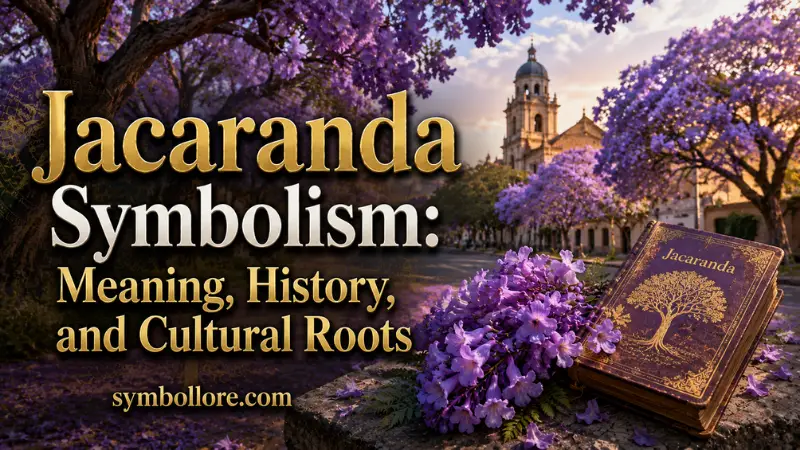
Jacaranda symbolism centers on renewal, temporary beauty, creativity, and a strong sense of place. These meanings grow from the tree’s sudden seasonal display. Its violet-blue flowers cover entire branches and later fall to form bright carpets below.
However, the jacaranda does not carry one universal meaning. In Pretoria, it has become a symbol of civic identity and student good luck. Across Australia, its flowers signal spring and approaching exams. Meanwhile, Buenos Aires, Mexico City, and Southern California connect the tree with local memory and urban beauty.
Understanding these settings reveals something important: jacaranda meanings developed through appearance, season, migration, and community experience rather than one ancient symbolic system.
Quick Answer
Jacaranda symbolism most often represents renewal, beauty, creativity, and belonging. Its vivid flowers appear seasonally and then fall, connecting the tree with fresh beginnings and the temporary nature of beautiful moments. Local meanings vary: jacarandas may represent city identity, spring celebrations, exam season, good luck, or personal change.
TL;DR
- Seasonal flowering connects jacarandas with renewal and fresh beginnings.
- Fallen purple blossoms can represent impermanence and the passage of time.
- Jacarandas symbolize civic pride in several cities outside their native range.
- Campus folklore links the flowers with exams, luck, and academic pressure.
- Purple-blue coloring inspires modern ideas of creativity and reflection.
- Wisdom, wealth, and spiritual awakening are modern interpretations, not universal traditions.
Jacaranda Meanings at a Glance
| Context or Feature | Possible Meaning | Why the Association Exists | Important Limit |
|---|---|---|---|
| Seasonal flowering | Renewal and new beginnings | Bare or quiet branches become covered with color | Blooming seasons differ by climate |
| Fallen blossoms | Impermanence and transition | Bright flowers eventually carpet the ground | The flowers do not always represent loss |
| Purple-blue canopy | Creativity, wonder, and reflection | Unusual color creates a dreamlike visual effect | Color meanings vary by culture |
| Pretoria streets | Civic identity and belonging | Generations have grown up with the city’s planted trees | Jacarandas are not native to South Africa |
| Australian campuses | Exams, pressure, luck, or failure | Flowering overlaps with the academic calendar | Folklore differs among universities |
| Personal art or gifts | Growth, memory, or a new chapter | The seasonal return provides a useful metaphor | The recipient’s intention matters most |
What Does Jacaranda Symbolism Mean?

The strongest jacaranda meaning is visible renewal. During flowering season, a tree that previously blended into the landscape becomes impossible to overlook. Purple-blue clusters fill its canopy, while fallen blossoms change the appearance of streets and sidewalks.
This dramatic shift makes the jacaranda a natural symbol of something valuable becoming visible. It can represent a talent finally recognized, hope returning after difficulty, or a new stage of life beginning.
Beauty is equally important. However, jacaranda beauty does not remain untouched. Wind, rain, footsteps, and passing traffic gradually disturb the fallen flowers. Consequently, the tree can represent both celebration and the knowledge that beautiful moments do not last forever.
Why the Bloom Cycle Suggests Renewal
Jacaranda flowers return according to a seasonal cycle. Although flowering times differ by location, communities often recognize the first purple clusters as a sign that the year has entered a new phase.
That dependable return supports meanings such as recovery, hope, and another opportunity. A person might use a jacaranda image to mark graduation, moving to a new place, rebuilding after hardship, or beginning a creative project.
Still, renewal does not mean erasing the past. A mature tree carries years of growth while producing new flowers. Therefore, it can express change that develops from experience rather than a completely clean beginning.
This interpretation resembles the renewal associated with other flowering trees.
However, the meaning of crepe myrtle
emphasizes lasting color and endurance through summer heat. Jacaranda symbolism places greater emphasis on sudden transformation and seasonal atmosphere.
Falling Flowers and the Beauty of Impermanence
A flowering jacaranda creates two striking images. First, thousands of blossoms appear overhead. Later, those flowers fall and form a purple carpet beneath the tree.
That movement from branch to ground can symbolize impermanence, transition, and the passage of time. The flower remains beautiful, but its form and location change. As a result, jacaranda imagery can express the value of appreciating an experience before it passes.
The idea does not need to feel sad. Fallen blossoms may create a festive, playful, or romantic setting. Children walk through them, photographers use them as colorful backgrounds, and neighborhoods wait for the display each year.
Context determines whether the image suggests loss or joyful change. A single fading blossom in memorial art feels different from a lively street covered in fresh flowers.
The broader symbolism of falling leaves and natural transition
offers a useful comparison.
South American Roots Do Not Create One Ancient Meaning
The jacaranda genus is native to tropical and subtropical regions of the Americas. The species most commonly planted as an ornamental tree, Jacaranda mimosifolia, comes from subtropical South America.
Even the name has South American roots, although sources disagree about its exact Indigenous language and original translation. Some connect it with Tupi, while others identify a Guaraní origin. Therefore, claims that the word unquestionably means “fragrant” or “hard wood” deserve caution.
More importantly, native origin does not prove one ancient spiritual meaning. South America contains many nations, Indigenous peoples, languages, and histories. It would be inaccurate to turn them into a single “South American belief.”
Reliable evidence does not establish a universal precolonial doctrine in which jacarandas represented wisdom, wealth, or spiritual awakening. Those meanings appear mainly in recent flower guides, decorative art, and personal interpretations.
Jacaranda as a Symbol of Buenos Aires
In Argentina, jacarandas connect native flora with modern city identity. French-Argentine landscape architect Carlos Thays helped introduce trees from northern Argentina into the parks and avenues of Buenos Aires during the development of its public landscape.
Today, their violet flowering season has become part of the city’s visual calendar.
The Buenos Aires city government describes jacarandas
as part of the capital’s identity. Here, the tree suggests spring, urban beauty, and belonging.
Jacarandas also appear in Argentine culture. María Elena Walsh’s 1966 children’s song “Canción del Jacarandá” turns falling blue flowers into a playful, memorable image. The song helped place the tree within childhood experience and cultural memory.
Therefore, Argentine jacaranda meaning is not merely an abstract list of qualities. It grows from native geography, city planning, music, seasonal repetition, and shared experience.
Pretoria and the Meaning of Civic Belonging
Pretoria offers one of the clearest documented examples of jacaranda symbolism. The trees are not native to South Africa, yet extensive street planting transformed their flowers into a defining part of the city’s appearance.
The first two documented jacarandas in Pretoria were planted in 1888. Street planting began in 1906 and expanded afterward. Over time, poems, songs, festivals, radio names, tourism routes, public art, and community memories strengthened the association.
A historical study of
concludes that the trees hold cultural, social, aesthetic, and historical value. The city’s nickname, “Jacaranda City,” reflects this connection.
In this setting, jacarandas represent belonging created over time. Their history also raises a difficult question: can a non-native tree become cultural heritage? Pretoria shows that ecological status and emotional significance can exist in tension. A plant may be introduced while still becoming deeply connected to a community’s sense of home.
How Jacarandas Became a Symbol of Australian Spring
Jacarandas reached Australia through nineteenth-century plant exchange and colonial horticulture. They later became familiar street and garden trees in warm regions.
Although they originated in South America, people sometimes mistake them for Australian natives because they appear so frequently in local landscapes. That confusion matters. The tree can represent Australian spring without becoming an Indigenous Australian symbol.
As Australian Geographic’s cultural history
explains, purple flowering moves across Australian cities as temperatures change. Sydney, Brisbane, Perth, Adelaide, and other communities have developed strong seasonal associations with the display.
Grafton, New South Wales, has held a jacaranda festival since 1935. Its celebrations, tree planting, performances, and local traditions turn flowering into a shared civic event. In this context, the jacaranda represents spring, community continuity, public celebration, and pride in a recognizable landscape.
Jacarandas, Exams, and “Purple Panic”
Australian campus folklore gives the jacaranda a more anxious meaning. In several universities, its flowering overlaps with final assignments and exams. Students see the purple canopy and realize that study time is running out.
At the University of Sydney, the famous quadrangle jacaranda became closely associated with end-of-year examinations. According to the university’s account of
the Quad Jacaranda and its folklore,
students joked that the bloom warned them it might already be too late to begin studying.
Similar Queensland traditions call exam-season stress “purple panic.” Some students say that a falling flower predicts failure.
Pretoria offers the opposite belief. There, campus folklore says that a blossom landing on a student’s head means the student will pass. This contradiction proves that falling flowers have no universal luck meaning. The stories are local traditions built around a shared academic calendar.
Mexico City: An Introduced Tree Becomes a Spring Icon
Mexico City shows how an introduced tree can become part of local identity. During the early twentieth century, Japanese gardener and landscape specialist Tatsugorō Matsumoto recommended jacarandas for the capital.
City leaders had considered flowering cherry trees similar to those planted in Washington, D.C. However, Mexico City’s climate did not provide the conditions needed for a comparable cherry blossom display. Jacarandas offered a more suitable alternative.
The history presented by
explains how the trees spread through the capital’s streets and parks. Their violet flowers now provide one of the city’s most recognizable signs of spring.
In this setting, the jacaranda can represent adaptation, cultural exchange, and an adopted sense of home. However, it remains an introduced species. A respectful interpretation can celebrate its place in the city while acknowledging the importance of native plants and ecological planning.
Jacaranda Symbolism in Modern American Life
Jacarandas grow most visibly in warm parts of the United States, especially Southern California, Florida, Arizona, and Hawaii. Therefore, American associations are usually regional rather than national.
Horticulturist Kate Sessions helped popularize jacarandas in Southern California. The trees became especially common in Los Angeles during the 1920s and 1930s. Later street-planting projects strengthened their presence.
The Los Angeles Public Library’s history of jacarandas
shows how the tree became part of the region’s built landscape.
For residents, flowering can evoke neighborhood memory, late spring, graduation season, and life in a warm city. A street lined with mature jacarandas may represent home more strongly than an online flower dictionary ever could.
Modern Americans may also connect the tree with creativity, personal renewal, or unusual beauty. These flexible meanings come mainly from appearance and personal experience, not a single established national tradition.
What Purple and Blue Jacaranda Flowers Represent
Jacaranda flowers often look lavender, violet, purple-blue, or nearly blue depending on light and variety. These changing hues create much of the tree’s emotional effect.
In contemporary Western design, purple commonly suggests imagination, dignity, creativity, mystery, or spiritual reflection. Blue may convey calmness, trust, wisdom, or emotional distance. A jacaranda image can draw from either group of associations.
However, color should not determine the entire meaning. Purple does not automatically make the tree royal or spiritual. Likewise, a blue-looking flower does not prove an ancient connection with wisdom.
The setting provides stronger evidence. Purple flowers surrounding graduates can suggest achievement. The same flowers beside an empty bench may express memory or absence. SymbolLore’s
explains why color meanings must be read through culture, purpose, and surrounding details.
Jacarandas in Gifts, Tattoos, Memorials, and Art
A living jacaranda tree makes a meaningful gift when there is enough space and a suitable climate. It may celebrate a new home, graduation, recovery, birth, or long-term commitment. Because the tree grows and flowers repeatedly, it can represent a future that develops over time.
Jacaranda tattoos often express renewal, creativity, home, or a memorable place. A full flowering tree may suggest growth and stability. One falling blossom can emphasize a brief but important moment. Roots may add ancestry or belonging, while a street scene can honor a particular city.
In memorial art, falling flowers may represent cherished beauty and passing time. However, jacaranda is not an established funeral flower across all cultures.
Pairing it with another bell-shaped flower also changes the message.
For example, Campanula symbolism
tends to emphasize gratitude, humility, and loyal affection. The intended meaning should come from the person, event, and design rather than flower shape alone.
Popular Claims That Need Caution
Online guides often say that jacarandas universally represent wisdom, wealth, prosperity, good luck, rebirth, and spiritual awakening. These claims mix reasonable modern metaphors with unsupported cultural generalizations.
Renewal has a clear basis because the flowers return seasonally. Local luck traditions also exist among students. However, they contradict one another: a falling blossom predicts success in one place and failure in another.
Wisdom may come from modern blue and purple color associations or the tree’s link with universities. Wealth may reflect the historical prestige of ornamental avenues and planned gardens. Neither meaning appears to be a universal ancient tradition.
The jacaranda also has no specific biblical meaning. Scripture does not identify it as a sacred tree or connect it with a particular event. People may give it personal Christian significance, but that is a modern devotional interpretation.
Finally, seeing jacarandas does not predict a guaranteed event. Symbolism can support reflection, memory, and creative expression. It cannot prove what will happen next.
How to Interpret a Jacaranda Symbol
Begin with the setting rather than selecting the first meaning from a list. Ask where the jacaranda appears and what is happening around it.
A useful interpretation considers:
- Location: Does the image refer to Pretoria, Buenos Aires, Sydney, Mexico City, Los Angeles, or another place?
- Season: Are the flowers opening, fully developed, falling, or fading?
- Human activity: Are people celebrating, studying, grieving, traveling, or returning home?
- Form: Does the image show one flower, a full tree, roots, a street, or a carpet of blossoms?
- Personal history: Does the person associate jacarandas with childhood, school, family, migration, or a particular neighborhood?
- Cultural evidence: Is the claimed meaning documented in that community, or is it a recent personal interpretation?
This method preserves the symbol’s flexibility without turning every possible meaning into historical fact.
FAQs
A jacaranda tree commonly symbolizes renewal, beauty, creativity, transition, and belonging. These meanings come from its dramatic seasonal flowers and the strong identity it gives to certain streets and cities. Local traditions may add meanings related to spring, education, luck, or community pride.
Jacarandas can symbolize good luck in specific campus traditions, but the belief is not universal. Pretoria folklore says a falling flower can predict exam success. Some Australian students tell the opposite story and associate the same event with failure. These are playful local beliefs, not reliable predictions.
A falling jacaranda flower may represent impermanence, transition, passing time, or the need to appreciate a beautiful moment. In campus folklore, it can also carry a luck-related meaning. The surrounding image and local tradition provide more information than the falling flower alone.
A purple jacaranda may represent creativity, dignity, imagination, reflection, or unusual beauty in modern Western design. However, these associations come partly from broader purple color symbolism. They should not be presented as one fixed ancient meaning shared by every culture.
The jacaranda has no specific documented biblical meaning because the Bible does not name the tree. Christians may personally connect its seasonal flowering with renewal, creation, or hope. Such an interpretation can be meaningful, but it remains modern and personal rather than scriptural.
A jacaranda in a dream may reflect personal memories of spring, school, home, change, or a particular city. Opening flowers can suggest anticipation, while falling blossoms may express time passing. Dreams do not have a proven universal code, so the dreamer’s feelings and experiences matter most.
No. The jacaranda species most widely planted in Australia and South Africa comes from subtropical South America. However, generations of street planting, festivals, campus traditions, and community memories have made the tree culturally important in both countries.
Conclusion
Jacaranda symbolism draws its strongest meanings from visible change. A quiet canopy becomes filled with violet-blue flowers, and those flowers eventually fall across the ground. This cycle supports ideas of renewal, beauty, transition, and appreciation for temporary moments.
Yet place gives the tree its deepest meaning. Jacarandas express civic identity in Pretoria, Buenos Aires, and Mexico City, spring celebration in Australia, and neighborhood memory in Southern California. Therefore, the most accurate interpretation considers location, season, personal experience, and cultural evidence. The jacaranda does not deliver one universal message, but it can powerfully represent how people create belonging around a changing landscape.
Five Related Articles from symbollore.com
- Crepe Myrtle Symbolism: Meanings, Colors, and Culture — https://symbollore.com/crepe-myrtle-symbolism/
- Dogwood Tree Symbolism: What This Spring Tree Represents — https://symbollore.com/dogwood-tree-symbolism/
- Campanula Symbolism: Love, Gratitude, and Humility — https://symbollore.com/campanula-symbolism/
- Falling Leaves Symbolism: Meanings of Change, Loss, and Renewal — https://symbollore.com/falling-leaves-symbolism/
- Color Symbolism Chart: What Different Colors Mean — https://symbollore.com/color-symbolism-chart/


