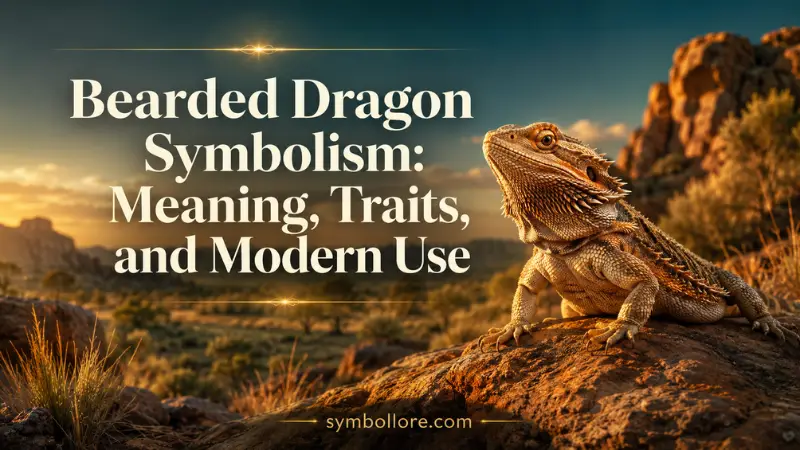
Bearded dragon symbolism most often centers on resilience, adaptability, self-protection, patience, and renewal. These modern associations make sense when you look at the real Australian lizard: it survives demanding environments, regulates its behavior carefully, communicates through striking visual displays, and sheds its skin as it grows.
However, these meanings should not be confused with an ancient universal tradition. The real bearded dragon belongs to the genus Pogona. It is different from the supernatural dragons found in Chinese, European, biblical, and other mythological traditions.
Quick Answer
Bearded dragon symbolism commonly represents adaptability, resilience, calm strength, healthy boundaries, and personal renewal. Much of this meaning is a modern interpretation of the animal’s real behavior, including basking, defensive displays, shedding, and visual communication. It should not be treated as a single ancient spiritual meaning shared by all cultures.
Key Takeaways
- Bearded dragons commonly represent resilience and adaptability.
- Their defensive display can suggest protection and firm boundaries.
- Shedding naturally lends itself to renewal and transformation metaphors.
- Basking can represent patience, balance, and deliberate use of energy.
- Spiritual and dream meanings remain interpretations, not scientific predictions.
Bearded Dragon Meanings at a Glance
| Trait or Behavior | Common Symbolic Meaning | Why the Connection Makes Sense |
|---|---|---|
| Thriving in dry habitats | Resilience | Suggests endurance under difficult conditions |
| Adjusting behavior | Adaptability | Reflects responding to changing circumstances |
| Inflating the beard | Protection | Creates a strong defensive display |
| Territorial signaling | Boundaries | Represents clearly communicating limits |
| Shedding skin | Renewal | Offers a natural metaphor for growth |
| Basking | Patience and balance | Shows deliberate regulation rather than constant action |
| Visual communication | Self-expression | Body signals convey social information |
What Does Bearded Dragon Symbolism Mean?
The broadest modern meaning is calm resilience: being capable of defending yourself without living in constant aggression. A central bearded dragon can appear relaxed while basking, yet it can rapidly change posture and display its beard when circumstances demand it.
That contrast gives the animal much of its symbolic appeal. It can represent knowing when to conserve energy, when to adjust, and when to stand firm.
The real animal also provides a better foundation for interpretation than its dramatic name does. The
Australian Museum’s central bearded dragon profile
explains that its threatening appearance relies heavily on making itself look larger and spikier. Symbolically, that can suggest assertiveness and strategic self-defense rather than brute force.
Adaptability and Resilience in Bearded Dragon Symbolism
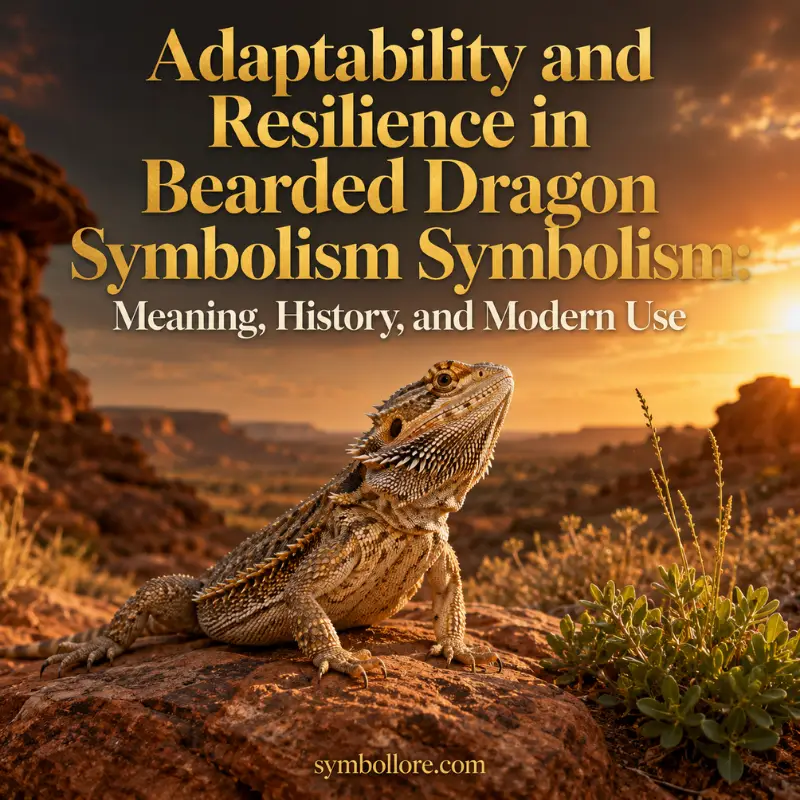
Adaptability is a natural association because Pogona vitticeps is an Australian lizard suited to dry and variable environments. The
Animal Diversity Web account of the species
describes its Australian range, habitat, behavior, and success in captivity.
That does not prove that the animal spiritually “means” adaptability. Instead, the biology provides an understandable source for the metaphor.
Resilience follows closely. A bearded dragon can symbolize the ability to respond to circumstances without abandoning your basic nature. For someone using animal imagery as a personal reminder, that can mean adjusting a plan, preserving energy, or accepting change while continuing toward a goal.
The useful lesson is flexibility with stability—not simply enduring every difficult situation indefinitely.
Protection and Healthy Boundaries
Protection is another strong modern interpretation. When threatened, a bearded dragon can flatten its body, expand its throat, darken its beard, and make itself appear more formidable. Therefore, its appearance lends itself naturally to ideas about defense.
The symbolism becomes more interesting when framed as boundaries rather than aggression. A defensive display communicates a limit before physical conflict becomes necessary.
In personal symbolism, the bearded dragon can consequently represent saying no clearly, protecting time and energy, or recognizing when a situation requires firmness. It is a good emblem for someone who wants confidence without needless confrontation.
Still, human relationship advice should not be treated as literal animal behavior. The connection is metaphorical: an observable reptile defense strategy inspires a human idea about appropriate self-protection.
Transformation, Shedding, and Renewal
Transformation and renewal are commonly linked with reptiles because they shed old skin during growth. For symbolic interpretation, the visible removal of an old layer creates an intuitive image of transition.
However, shedding does not mean that a bearded dragon literally represents rebirth in zoology. It is a normal biological process. The symbolic meaning comes from what humans see in that process.
Used carefully, this metaphor can stand for leaving an outdated habit behind, moving into another stage of life, recovering after difficulty, or accepting gradual personal growth. Unlike a dramatic “rebirth,” shedding also suggests that transformation can be ordinary and repeated.
That distinction makes the symbol more realistic: growth does not always require becoming somebody entirely different.
Basking, Thermoregulation, and the Symbolism of Balance
Basking can inspire associations with patience, awareness, warmth, and balance. Yet the actual reason is biological. As an ectothermic reptile, a bearded dragon relies heavily on environmental heat to regulate its body temperature.
Research has made this connection especially interesting. A study published by the
found that Pogona vitticeps can alter skin reflectance in response to temperature.
As a metaphor, thermoregulation offers something more useful than the vague claim that the animal “worships the sun.” It can represent recognizing what you need, finding appropriate conditions, and using energy deliberately.
Thus, a basking bearded dragon may work as a personal symbol for restoration: pause when necessary, then act when conditions are right.
Color Change, Head Bobbing, and Arm Waving
Bearded dragons communicate visually, making self-expression another reasonable symbolic theme. Color change, head bobbing, posture, and arm waving can all carry biological functions in particular contexts.
Their color is especially interesting because different body regions serve different purposes. Research shows that temperature influences some changes, while the beard and chest can become much darker during social interaction. Therefore, a black beard should not automatically be assigned a supernatural meaning.
Symbolically, these displays can suggest communication, confidence, social awareness, or responding appropriately to context.
Likewise, head bobbing and arm waving should not be reduced to rigid human translations. Their significance depends on the animal and situation. The broader metaphor is stronger: communication is more than words, and context changes the meaning of a signal.
History and Cultural Context: What We Can Actually Support
There is no good reason to treat the real bearded dragon as interchangeable with every creature called a “dragon.” Pogona refers to living Australian agamid lizards, while famous dragons in mythology are culturally distinct supernatural beings.
This matters because online symbolism articles sometimes connect bearded dragons directly to ancient China, biblical dragon imagery, or unrelated ancient reptiles. Similar names do not establish historical continuity.
The safest historical approach is therefore modest. Modern bearded dragon meaning often grows from contemporary observation, pet keeping, animal-spirituality writing, tattoos, and broader lizard symbolism.
Specific Indigenous Australian traditions also deserve precision. Australia contains many distinct Aboriginal and Torres Strait Islander peoples, languages, stories, and relationships with Country. A broad statement such as “Aboriginal culture says bearded dragons mean X” erases that diversity unless a specific community and reliable source support the claim.
Spiritual Meaning and Spirit-Animal Interpretations
In contemporary spiritual writing, bearded dragons may represent inner strength, adaptability, protection, awareness, and transformation. Some people also use the animal as a spirit animal or personal guide.
Those beliefs can be meaningful without being presented as scientifically proven messages. A useful interpretation asks what characteristic of the animal feels relevant to the person.
For example, someone facing major change might focus on adaptability. A person learning to set limits might choose the defensive beard as a reminder of boundaries. Someone recovering from a difficult period could interpret shedding as renewal.
This approach leaves room for personal spirituality while avoiding claims that seeing a particular animal guarantees a future event, blessing, warning, or supernatural outcome.
Bearded Dragon Dream Symbolism
Dream symbolism is best interpreted through the dreamer’s circumstances rather than a universal dictionary. A bearded dragon in a dream could represent protection, adjustment, vulnerability, confidence, or change, but none of those interpretations is automatic.
Start with three details:
- Notice what the animal was doing.
- Identify how you felt during the dream.
- Consider your personal relationship with bearded dragons.
A calm animal basking may suggest something different from one displaying a dark beard defensively. Likewise, a reptile keeper who loves beardies will bring different associations to a dream than someone who fears reptiles.
Therefore, dreams can be useful prompts for reflection, but they should not be treated as reliable predictions.
Bearded Dragon Tattoos and Modern Personal Symbolism
A bearded dragon tattoo can represent quiet strength, individuality, adaptation, protection, or survival. Unlike a generic mythical-dragon tattoo, it can also express a genuine connection with reptiles or a beloved pet.
The pose can sharpen the message. A basking design emphasizes calm and self-possession. An alert animal with an expanded beard suggests courage or boundaries. Shed-skin imagery can emphasize change, while a natural Australian landscape can highlight the species’ identity and environmental origins.
For the clearest symbolism, choose the meaning first and let the design support it. This prevents the artwork from relying on inaccurate cultural claims merely because the animal happens to carry the word “dragon” in its common name.
FAQs
A bearded dragon can represent good luck in someone’s personal symbolism, but good fortune is not a universal traditional meaning of the species. Modern interpretations more commonly emphasize adaptability, resilience, protection, renewal, and calm strength. Personal or spiritual beliefs may add other meanings.
Spiritually, some people interpret an encounter as a reminder to adapt, conserve energy, protect boundaries, or remain steady during change. There is no scientifically established supernatural message attached to an encounter, so the most responsible interpretation considers both the animal’s behavior and the observer’s beliefs.
A bearded dragon dream may represent adjustment, protection, transformation, or assertiveness, depending on the dream. Its behavior and your emotions matter more than a fixed dream-dictionary definition. Dreams do not provide scientifically reliable predictions of future events.
Yes, transformation is a common modern symbolic interpretation, largely because bearded dragons shed their skin as they grow. The connection is metaphorical rather than an established biological meaning. Shedding can offer a useful image for releasing old patterns and entering another stage of personal growth.
Not inherently. Bearded dragons are real Australian lizards in the genus Pogona, while the Chinese dragon is a mythological and culturally specific being. Sharing the English word “dragon” does not make their histories or symbolism equivalent.
Its association with resilience draws largely from its adaptation to Australian environments and its flexible defensive and behavioral responses. Humans can turn those observable characteristics into a metaphor for staying steady under pressure. Resilience is therefore a modern interpretation rather than a scientifically measurable symbolic property.
Conclusion
Bearded dragon symbolism is strongest when it stays connected to the real animal. Adaptability, resilience, protection, healthy boundaries, balance, and renewal all have understandable links to the lizard’s habitat, defensive displays, basking, communication, and shedding.
At the same time, modern interpretation should not be mistaken for documented ancient tradition. Separating Pogona from mythical dragons makes the symbolism more accurate, not less meaningful. Ultimately, the bearded dragon offers a grounded image of quiet strength: adapt when conditions change, conserve energy wisely, and stand firm when necessary.