Ant symbolism centers on disciplined effort, cooperation, patience, foresight, and strength that exceeds apparent size. These meanings come less from mystery than from what people observe: ants build colonies, divide work, communicate, gather resources, and solve problems through coordinated action.
However, the symbol has a shadow side. A swarm can suggest pressure, conformity, invasion, or small worries multiplying. Religious texts, fables, myths, dreams, tattoos, and modern work culture therefore use ants differently. Context determines whether the ant represents admirable persistence or exhausting overwork.
Quick Answer
Ant symbolism most often represents hard work, teamwork, patience, preparation, resilience, and strength in numbers. Because ants live in organized colonies, they can also symbolize community and shared responsibility. In negative settings, however, ants may represent conformity, relentless busyness, invasion, irritation, or small problems accumulating until they become difficult to ignore.
Key Takeaways
- Ants commonly represent disciplined, consistent work.
- Colony life connects them with teamwork and community.
- Food gathering suggests preparation and future planning.
- Small size paired with strength symbolizes resilience.
- Swarms may represent pressure, conformity, or accumulating worries.
- The meaning changes with the cultural and personal context.
Ant Symbolism Meanings at a Glance
| Symbolic Meaning | Behavioral or Visual Basis | Common Context |
| Hard work | Repeated foraging and nest maintenance | Careers, goals, personal discipline |
| Teamwork | Coordinated colony activity | Families, communities, organizations |
| Preparation | Gathering and managing resources | Saving, studying, future planning |
| Strength | Carrying burdens despite small size | Adversity, courage, persistence |
| Organization | Specialized tasks and communication | Leadership, systems, productivity |
| Patience | Gradual progress through repeated actions | Long projects and personal growth |
| Conformity | Individuals moving as part of a mass | Social pressure and loss of identity |
| Overwhelm | Large numbers entering one space | Stress, irritation, unresolved problems |
What Ant Symbolism Means
Ant symbolism describes the meanings people attach to the insect’s appearance and behavior. The strongest associations are industriousness, cooperation, patience, preparation, and organized community. These ideas arise because an ant rarely appears impressive alone, yet a colony can build, defend, gather, and adapt on a much larger scale.
No single interpretation applies everywhere. One ant carrying food may suggest persistence, while hundreds covering a surface may create an image of invasion or anxiety. An ant in a religious passage, dream, tattoo, advertisement, or kitchen also serves a different purpose. Therefore, the surrounding action matters more than the insect alone.
A useful interpretation asks what the ants are doing, how the scene feels, and which cultural tradition frames it.
Why Ant Behavior Became Symbolic
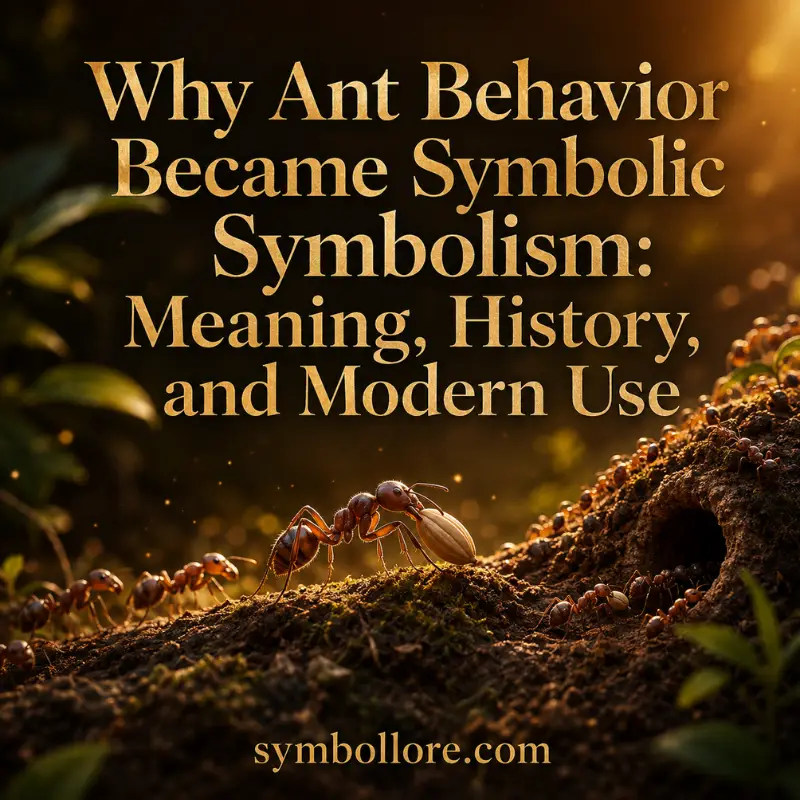
Ant behavior naturally produces metaphors about coordinated effort. Ants are eusocial insects that live in colonies with overlapping generations, cooperative care of young, and a reproductive division between colony members. Within an ant colony, division of labor may include foraging, defense, nursing, nest maintenance, gardening, and waste removal.
This coordination does not require a human-style supervisor. Ants respond to local conditions, physical contact, chemical cues, and pheromone trails. Their self-organization allows many small actions to create an orderly result. Smithsonian material on leaf-cutter ants, for example, describes colonies containing numerous specialized jobs that support the whole community.
Ants also alter soil and move seeds. The ecological process known as myrmecochory occurs when ants transport seeds, often carrying them toward their nests.
That behavior adds less familiar associations with renewal, stewardship, and the hidden work supporting an ecosystem.
Core Positive Meanings of Ants
The most common positive ant meaning is steady effort. Ants suggest that large goals rarely depend on one dramatic action. Instead, progress develops through repeated work, attention to details, and a willingness to continue when results remain small.
Collective effort forms the second major meaning. A colony survives because individuals contribute to a shared system. As a human symbol, this can represent family cooperation, workplace coordination, mutual support, or a community pursuing a common purpose.
Ants also represent long-term planning and resourcefulness. Their visible gathering behavior has encouraged people to associate them with saving, preparation, and using available materials wisely. Finally, their size makes them a symbol of resilience. The message is not that strength eliminates difficulty. Rather, persistence, adaptation, and cooperation can make a difficult burden manageable.
The Shadow Side of Ant Meaning
Ant imagery can represent unhealthy effort as easily as productive effort. A person compared with an ant may seem disciplined, but the comparison can also suggest endless labor, limited freedom, or a life reduced to assigned tasks.
Large numbers of ants may symbolize social conformity. In this reading, the individual disappears into the colony, follows a predetermined path, and serves a system without questioning it. Writers and artists often use this image when criticizing crowded cities, rigid workplaces, bureaucracy, or mass behavior.
Ants can also represent accumulated irritation. One small concern may seem harmless, yet many neglected concerns can become overwhelming. Therefore, a dream or artwork filled with ants may reflect mental clutter, constant obligations, or boundaries that feel invaded.
This negative interpretation does not cancel the positive one. It asks whether dedication remains purposeful or has turned into burnout.
Ant Symbolism in the Bible and Quran
Biblical ant symbolism emphasizes initiative, wisdom, and preparation. Proverbs 6:6–8 directs the idle person to observe the ant, which gathers provisions without a human-style ruler forcing it to work. The lesson concerns self-discipline and timely action rather than physical strength alone.
The Quran gives the ant a different narrative role. In Surah An-Naml 27:18–19, an ant warns the others to enter their homes so Solomon’s approaching forces do not crush them unknowingly. Solomon understands the warning, smiles, and responds with gratitude and prayer. The scene can support themes of alertness, communication, care for the community, and humility before even a very small creature.
These passages show why religious meanings should remain text-specific. The Bible uses the ant as a model of preparation, while the Quranic account highlights warning, protection, understanding, and gratitude.
Ants in Aesop’s Fable and Greek Myth
Aesop’s fable about the ants and the grasshopper helped establish the ant as a Western symbol of preparation. In the familiar story, the ants store food during the productive season, while the grasshopper spends the time making music. Winter exposes the consequences of their different choices.
The fable’s traditional moral praises timely work and preparation. However, modern retellings sometimes question whether productivity should eliminate generosity, creativity, or rest. That tension keeps the story relevant: planning matters, but work should not become the only measure of human worth.
Greek tradition provides another association through the Myrmidons, the warriors connected with Achilles. Later accounts linked their name with the Greek word for ants and told of ants transformed into people. The connection encouraged meanings such as discipline, loyalty, courage, coordinated action, and fierce defense of the group.
Cultural Meaning Requires Context
Ants do not carry one identical meaning across every society. Similar observations can produce related ideas, such as work or cooperation, but each religious text, story, proverb, ritual, and artistic tradition places those observations within its own values.
For that reason, claims such as “ants mean good luck in one culture” should be treated carefully unless a specific community, source, period, and practice are identified. A regional proverb does not automatically represent an entire continent. Likewise, a recent spiritual website does not prove an ancient belief.
Terms such as “spirit animal” and “totem” also require care. In general modern usage, people may use them as personal metaphors for admired traits. However, totems and spiritual relationships with animals can hold specific meanings within particular Indigenous traditions. Those traditions should not be reduced to a generic personality label.
The most respectful approach identifies the actual source instead of claiming a universal cultural rule.
Dreams and Ants in the House
Dreams about ants often reflect the dreamer’s associations with work, order, irritation, or social pressure. A single ant may suggest a small task requiring patience. A line of ants may represent routine, coordination, or following a path. A swarm may express stress, crowding, repeated obligations, or a problem that has spread.
Emotions provide the best clue. Calm observation supports meanings such as diligence or cooperation. Disgust, panic, or helplessness points more strongly toward invasion, anxiety, or lost control. Dreams do not provide reliable predictions, so they work best as prompts for reflection rather than fixed omens.
Real ants inside a home usually have practical causes. They may be seeking food, water, shelter, warmth, or relief from changing outdoor conditions. Cleaning food residue, fixing moisture sources, and sealing entry points offer a more useful first response than assuming a supernatural message.
Black, Red, Flying, and Dead Ant Meanings
Color and species interpretations are flexible modern associations, not universal historical rules.
Black ants commonly suggest quiet persistence, routine work, hidden organization, or ordinary concerns. Because black is also linked with secrecy and the unknown, black ants may represent unnoticed tasks or problems developing beneath the surface.
Red ants or fire ants often suggest urgency, anger, defense, pain, or intense motivation. Their bites and defensive behavior make them a stronger image of boundaries and consequences.
Flying ants may represent transition because winged ants leave established colonies during reproductive flights. Symbolically, this can suggest independence, expansion, or a new stage emerging from an old structure.
Dead ants may suggest exhaustion, interrupted effort, the end of a routine, or a group system that no longer functions. However, the scene’s emotional tone remains more important than the color or condition alone.
Ant Tattoos, Art, and Modern Culture
Ant tattoos usually represent persistence, teamwork, modest strength, discipline, or loyalty to a group. A single ant can emphasize individual endurance. A trail of ants may symbolize a journey made through small steps, while several ants carrying one object can represent shared responsibility.
Design details change the message. Mechanical or geometric ants suggest systems, engineering, and precision. An ant combined with a leaf may emphasize nature and ecological cooperation. Fire-ant imagery can communicate defense, toughness, or anger. A broken line of ants may represent independence from conformity.
In American advertising and workplace culture, ants often appear as models of efficiency. Sports teams and community organizations may use them to express unity and determination. Yet artists also use ant-like crowds to criticize overwork, consumer systems, urban density, or the loss of individuality.
This dual use makes the ant especially effective: it can praise teamwork while questioning what the group demands from each member.
How to Interpret an Ant Encounter
Interpret ant symbolism by examining the full situation rather than searching for one automatic meaning.
- Notice the action. Carrying, building, swarming, biting, scattering, and dying suggest different themes.
- Identify your emotional response. Admiration may point toward persistence; discomfort may indicate pressure or invasion.
- Consider your current circumstances. Work deadlines, group conflict, financial planning, household stress, or personal goals may shape the association.
- Check the source tradition. A biblical passage, Quranic story, Greek myth, dream, tattoo, and real infestation require different interpretive rules.
Finally, separate reflection from prediction. An encounter may inspire a useful insight, but it does not prove that a specific future event will occur. The strongest reading is the one that fits the context without forcing certainty.
FAQs
Seeing an ant is not universally considered good luck. Some modern interpretations connect ants with coming rewards because they symbolize effort, preparation, and resource management. However, other contexts associate them with irritation or invasion. The meaning depends on the action, setting, cultural source, and observer’s response.
A line of ants commonly symbolizes coordination, routine, discipline, and movement toward a shared goal. It may also suggest following an established system without questioning it. A calm, orderly line tends to support positive meanings, while an endless or oppressive line may represent conformity or repetitive obligations.
In relationships, ants can symbolize cooperation, reliability, shared responsibilities, and building a stable life through small efforts. They may also warn that one person carries too much of the workload. The image invites reflection on whether both people contribute and whether practical duties leave room for affection and rest.
An ant can represent decentralized leadership rather than command from one dominant figure. Colony activity emerges through communication, specialized roles, and responses to changing needs. As a leadership symbol, the ant favors coordination, clear responsibilities, adaptability, and service to a shared purpose instead of personal status.
An ant bite may symbolize a small but urgent issue demanding attention. Because the sensation is sharp and difficult to ignore, it can represent crossed boundaries, accumulated irritation, or consequences arising from a neglected problem. This is a modern interpretive association rather than a universal spiritual rule.
Ants symbolize patience because their visible achievements result from repeated, gradual actions. They gather, transport, build, repair, and adapt without creating an immediate dramatic result. As a human metaphor, the ant suggests that consistency can matter more than speed, especially during long projects or difficult periods.
Conclusion
Ant symbolism draws its power from a clear contrast: one ant appears small, but organized ants can accomplish work far beyond the scale of the individual. This makes the ant a lasting symbol of diligence, preparation, resilience, community, and shared responsibility.
Still, the same image can warn against conformity, invasion, or relentless overwork. Religious texts, fables, myths, dreams, and modern art each emphasize different qualities. The most reliable interpretation considers the ant’s behavior, the source tradition, the emotional tone, and the real circumstances surrounding the image.


