
Gecko symbolism usually centers on adaptability, resilience, renewal, resourcefulness, and quiet protection. These meanings come largely from the animal’s real behavior. Many geckos climb smooth surfaces, stay active after dark, vocalize, and escape predators by releasing a tail that can later regrow.
Still, biology does not prove that every gecko is a supernatural messenger. Documented cultural traditions, modern spiritual practice, and personal interpretation form separate layers of meaning. Keeping those layers distinct makes the symbol richer, more accurate, and more respectful.
Quick Answer
Gecko symbolism represents the ability to adjust, recover, and move carefully through change. Its gripping feet suggest finding support, while tail loss and regrowth suggest survival followed by imperfect renewal. A sighting may feel meaningful, but no universal rule makes it a guaranteed omen of luck, danger, or spiritual intervention.
TL;DR
- Geckos commonly represent adaptability, resilience, renewal, and alertness.
- Their gripping feet suggest finding support in difficult conditions.
- Tail regrowth symbolizes recovery, though real regeneration has costs.
- Cultural meanings differ and should remain connected to their sources.
- Sightings, dreams, and tattoos gain meaning through personal context.
Gecko Meanings at a Glance
| Trait or Context | Possible Meaning | Important Limit |
|---|---|---|
| Adhesive toe pads | Adaptability and secure progress | Not every gecko species climbs the same way |
| Tail release | Letting go to survive | Loss carries real physical costs |
| Regrown tail | Recovery and renewal | The replacement may differ from the original |
| Nighttime activity | Awareness and patience | Darkness does not prove mystical power |
| Chirping or clicking | Communication and presence | Calls have biological functions |
| Indoor appearance | Home, protection, or opportunity | Insects and entry gaps usually explain the visit |
| Hawaiian moʻo context | Continuity, genealogy, and reptilian beings | It belongs to a specific cultural setting |
| Tattoo or artwork | Personal resilience or transformation | Color and design meanings are not universal |
What Does Gecko Symbolism Mean?
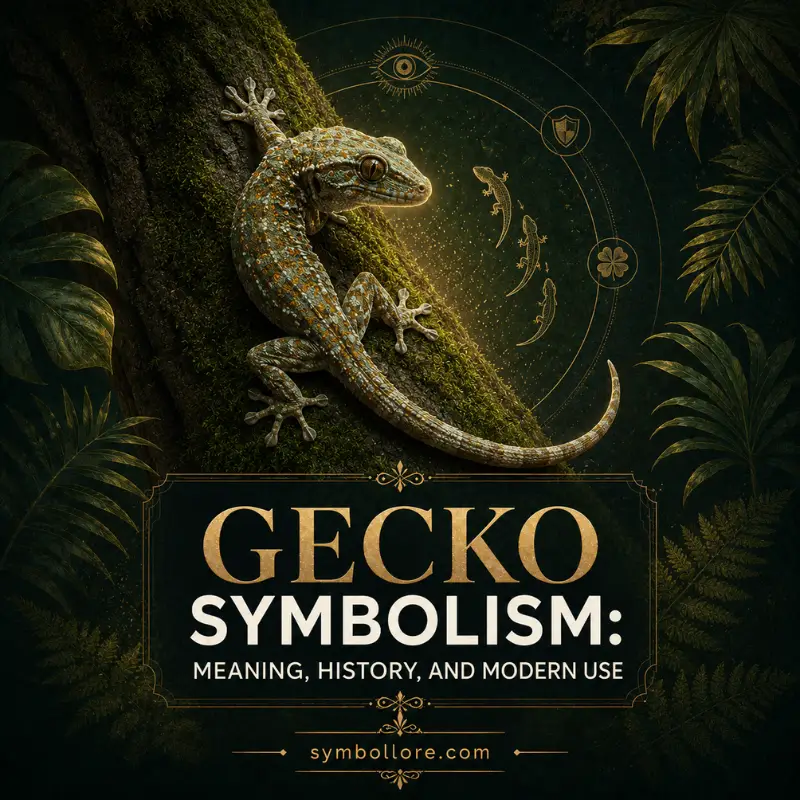
Gecko symbolism describes flexible strength. A gecko survives through grip, timing, awareness, speed, and the ability to release a threatened body part. Therefore, it offers a different image of power from animals associated with size or physical dominance.
The strongest modern meanings include adaptability during change, resilience after loss, patience before action, and resourcefulness when familiar methods stop working. Its small size can also represent underestimated ability. A person may identify with the gecko when beginning again, changing direction, or finding an unconventional way through a difficult situation.
However, the symbol carries a shadow side. Flexibility can become inconsistency, privacy can become avoidance, and letting go can become a habit of abandoning commitments too quickly. A balanced interpretation asks whether adaptation protects growth or merely prevents necessary action.
How Real Gecko Traits Shape Its Meaning
The clearest interpretations begin with observable traits. Many climbing geckos have microscopic hair-like structures called setae on their feet. These structures create temporary molecular attraction with a surface; the animal does not rely on glue or suction.
UC Berkeley’s explanation of gecko adhesion
supports the association with grip, balance, and finding support where ordinary footing seems absent.
Still, symbolic meaning remains an analogy. Toe pads evolved for movement and survival, not to teach human lessons. Biology explains why the image feels convincing, but a person supplies the reflective meaning.
This distinction also prevents inaccurate generalization. Geckos form a varied group, and not every species has identical feet, colors, habitats, or behavior. A symbolic reading should identify the feature being interpreted instead of treating every gecko as biologically interchangeable.
Adaptability, Resilience, and Resourcefulness
Adaptability is the gecko’s central modern meaning because many species thrive across changing surfaces, climates, and human-built environments. Symbolically, that suggests changing methods without losing the goal. Someone may take a new route, learn a different skill, or adjust expectations while continuing forward.
Resilience adds the ability to function after disruption. Meanwhile, resourcefulness emphasizes using what is available instead of waiting for perfect conditions. These meanings work especially well during relocation, career change, recovery, or a demanding new responsibility.
The gecko does not suggest endless adjustment to harmful conditions. Sometimes the resourceful choice is to create a boundary or leave. A related guide to
another lizard’s boundary and renewal themes
shows how different reptiles can express similar ideas through different behaviors.
Tail Autotomy, Regeneration, and Renewal
Tail autotomy is the ability to release the tail along a built-in fracture area when a predator seizes it. The detached tail may continue moving, distracting the threat while the gecko escapes. This behavior creates a powerful metaphor for giving up one thing to protect something more important.
Regeneration then adds renewal, but it should not be described as effortless rebirth. The replacement tail may have a different shape, color, tissue structure, or function. Moreover, scientific research shows that tail loss and regrowth require energy and can affect movement, survival, social behavior, or reproduction.
A review of the costs of lizard tail loss
explains these trade-offs.
Symbolically, recovery does not erase what happened. It creates a usable future that may look different from the past.
That differs from a moth’s full life-stage change,
which represents transformation through metamorphosis rather than repair after injury.
Protection, Nocturnal Behavior, and the Gecko’s Voice
Protection appears in gecko meaning through alertness, concealment, quick retreat, and a close association with houses. This is defensive intelligence rather than force. The gecko notices conditions, waits for the right moment, and avoids a needless fight.
Nocturnal behavior also inspires ideas about patience, intuition, privacy, and awareness during uncertain periods. Yet darkness alone does not make an animal mystical. It simply creates a useful metaphor for moving carefully when complete information is unavailable.
Geckos are also unusually vocal compared with many other lizards. Some produce chirps, clicks, squeaks, or calls during social contact, courtship, territorial encounters, or distress.
The University of California discussion of lizard communication
notes that some geckos communicate through quiet chirps. Consequently, the gecko can represent a small presence that still knows when to use its voice.
Gecko Symbolism in Hawaiʻi: Moʻo and Cultural Context
Gecko symbolism does not have one meaning shared by every culture. Hawaiʻi provides a documented example of why specific language and context matter. The Hawaiian term moʻo can refer to reptilian beings and includes lizards, geckos, and skinks. It also carries ideas connected with continuation, succession, and genealogical links.
The National Park Service’s discussion of
moʻo, genealogy, and oral tradition
explains these related meanings. Other Hawaiian accounts describe powerful lizard-like water beings connected with particular places. These traditions are deeper and more specific than the generic claim that every gecko is a household guardian.
Therefore, readers should not merge Hawaiian, Polynesian, Asian, African, or modern New Age ideas into one ancient doctrine. The same care applies when studying
documented cobra imagery across cultures.
Each tradition deserves its own sources, place, period, and community context.
House Gecko Meaning: What Seeing One Indoors May Suggest
A house gecko usually appears indoors because it found insects, warmth, moisture, shelter, or an entry gap. Porch lights attract moths and other prey, so geckos often wait near windows, doors, and illuminated walls. The encounter has an ecological explanation before it receives a symbolic one.
Texas A&M AgriLife Extension notes that house geckos can reduce insect numbers.
Its house-gecko management guide
recommends sealing cracks and using a container for humane relocation when removal is necessary.
After considering the literal cause, a person may still treat the visit as a reflective sign. The gecko could suggest paying attention to home life, adjusting to a new condition, or handling a small problem before it grows. However, it does not guarantee prosperity, predict a visitor, or prove that unseen energy has entered the house.
Gecko Spirit Animal and Gecko Totem in Modern Spirituality
A gecko spirit animal commonly represents flexible thinking, recovery, careful observation, and knowing when to remain still or move. As a modern reflective framework, it may help someone examine how they respond to uncertainty, setbacks, exposure, or changing expectations.
The phrase gecko totem requires more care. “Totem” comes from Indigenous cultural and kinship contexts and should not be used to invent a universal Native American gecko belief. No single Indigenous worldview speaks for every nation or community.
People who use these terms personally should describe the gecko as an inspiration, emblem, guide, or archetype unless they are discussing a specific documented tradition. This approach keeps the personal meaning while avoiding unsupported claims about cultures to which the interpretation does not belong.
Gecko Dream Meaning
Gecko dream meaning depends on the animal’s actions, the setting, and the dreamer’s emotions. Dreams combine memory, stress, imagination, recent experiences, and personal associations. Therefore, one image cannot reliably predict the same event for everyone.
Consider the scene:
- A gecko climbing a wall may reflect progress through an unusual method.
- A dropped tail may suggest escape, sacrifice, or fear of losing something.
- A hidden gecko may represent privacy, avoidance, or a concern not yet faced.
- A chirping gecko may point toward communication that demands attention.
- Several geckos in a house may reflect comfort, unease, family activity, or a recent real encounter.
Ask what the gecko did, how you felt, what changed during the dream, and which current situation resembles that pattern. Those questions offer more value than a fixed dream dictionary.
Gecko Tattoo Meaning, Colors, and Design Choices
Gecko tattoo meaning often centers on resilience, adaptability, survival, renewal, agility, or connection with a tropical home. A person may also choose the animal simply because they admire reptiles or keep geckos as pets. Personal affection is a valid meaning and does not need an ancient explanation.
Design details can sharpen the message. A climbing gecko suggests progress and determination. A curved gecko with a visible tail emphasizes continuity, while a missing or differently colored tail can mark recovery after loss. Open eyes suggest alertness, and a nighttime background adds privacy or careful intuition.
Colors do not carry fixed gecko-specific rules. Green may suggest growth, orange may express energy, and blue may feel calm or imaginative, but these are broad modern color associations. A naturalistic tokay, leopard, crested, or day gecko design should respect the real species before adding personal symbolism.
FAQs
Some households and modern spiritual writers interpret a gecko as a sign of luck, protection, or welcome change. However, no universal belief makes every sighting fortunate. The meaning depends on culture and personal experience, while insects, shelter, and warmth usually explain the animal’s presence.
Spiritually, a house gecko may represent adaptability, watchfulness, protection, or attention to domestic life. Treat this as a reflective interpretation rather than a prediction. First consider why the gecko entered, then ask whether its behavior connects with a current concern about home, change, or boundaries.
The gecko symbolizes renewal because some species can release a threatened tail and later grow a replacement. Still, the new tail may differ from the original, and regeneration requires energy. Therefore, the strongest metaphor is recovery with change, not a perfect return to an earlier condition.
Negative meanings include avoidance, excessive secrecy, unreliable behavior, or releasing responsibilities whenever pressure appears. These interpretations emerge when useful flexibility becomes instability. The shadow lesson is to distinguish genuine danger from ordinary discomfort before deciding whether to hide, adapt, confront, or leave.
A gecko tattoo can represent survival, adaptability, agility, renewal, or affection for reptiles. Its pose and details shape the message. Climbing emphasizes persistence, a regrown tail suggests recovery, and a realistic species design may express personal identity, place, or a connection with a pet.
The meanings overlap, especially around renewal, alertness, and adaptability. However, geckos add species-related themes such as adhesive climbing, nighttime activity, vocal calls, and tail release. General lizard symbolism should not automatically be presented as a documented belief about every gecko species.
Conclusion
Gecko symbolism most strongly represents adaptability, resilient recovery, alertness, resourcefulness, and quiet protection. Its meaning becomes clearer when real traits, documented traditions, and modern personal interpretations remain separate.
A gecko does not guarantee luck or deliver one fixed message. Instead, its grip, timing, voice, and imperfect regeneration offer useful metaphors for meeting change without pretending that recovery erases loss. Whether the symbol appears in a house, dream, tattoo, or cultural story, context determines its most responsible meaning.