
Knight symbolism centers on courage, honor, loyalty, and strength placed in service of a duty. The image draws power from a clear tension: an armed person can protect others or threaten them. Chivalric stories judge how the knight uses that power, especially when keeping a promise becomes dangerous.
Yet a shining suit of armor does not prove good character. Medieval knighthood was a military and social position, while the faultless protector belongs largely to an ideal. Literature and art can celebrate that ideal, question it, or expose its failures.
A saint confronting a dragon, a chess knight, and a school mascot therefore carry different meanings. Their shared appearance matters, but their actions, setting, and history provide the stronger clues.
Quick Answer
Knight symbolism most often represents courage, honor, loyalty, protection, and service because chivalric ideals connect fighting skill with duties toward others. It can also express status, religious commitment, or the struggle to act rightly under pressure. These meanings come mainly from European history and its later adaptations, so a specific story or image may challenge them.
TL;DR
- Chivalry gave military strength a language of honor and obligation.
- Historical rank and admirable behavior were separate things.
- Armor shows power; actions reveal whether that power protects or harms.
- Christian art, medieval romance, and chess use knights differently.
- Modern tattoos and mascots adapt the image to personal values and group identity.
Knight Meanings at a Glance
| Context or image | Possible meaning | Why it fits | Important limit |
|---|---|---|---|
| Knight guarding another person | Protection and responsibility | Armed strength stands between danger and someone vulnerable | Look for actual care, rather than power alone |
| Knight honoring a difficult promise | Loyalty and integrity | Commitment survives a personal cost | A promise may conflict with another duty |
| Elaborate armor and a fine horse | Rank, wealth, and prestige | Equipment makes resources and standing visible | Splendor does not establish virtue |
| Knight on a quest | Moral testing and growth | An unfamiliar journey puts values under pressure | The task may expose pride or failure |
| Saint George fighting a dragon | Christian faith and deliverance | The saint defeats a threat within a religious legend | The scene has a specific Christian setting |
| Knight beside Death and the Devil | Steadfastness amid fear and temptation | Dürer’s rider continues through a threatening landscape | This reading belongs to a particular artwork |
| Horse-shaped chess knight | Mounted warfare; a modern metaphor for ingenuity | Its identity recalls a rider, while its move differs from other pieces | Strategy metaphors are interpretations, not an ancient code |
What Does Knight Symbolism Mean?
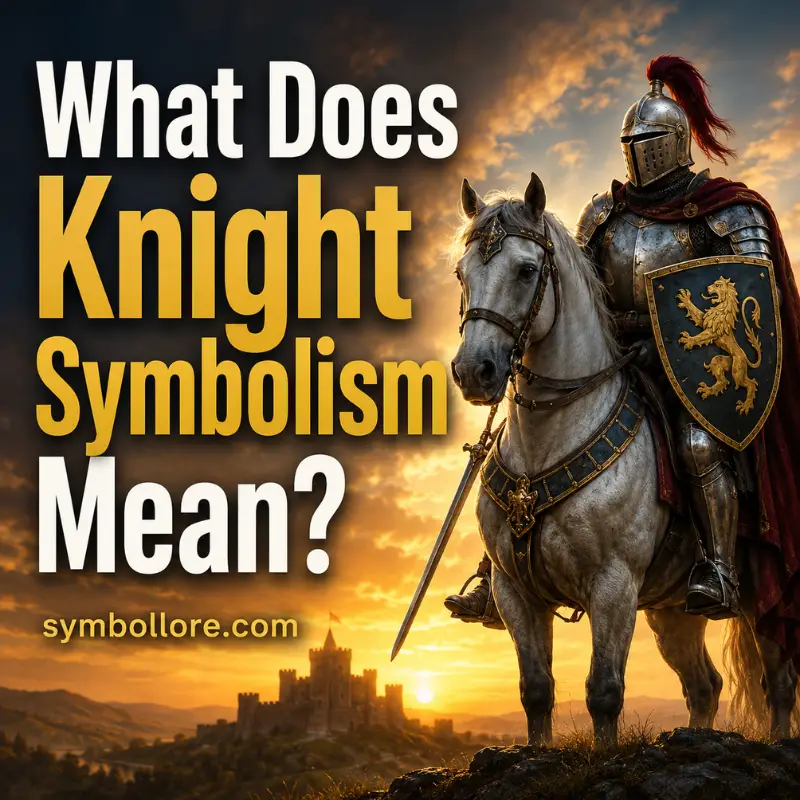
The knight’s central symbolic problem is how to use strength responsibly. Courage supplies the ability to face danger. Honor supplies a standard for conduct. Meanwhile, loyalty connects the individual to a person, community, faith, or promise.
These qualities work together, but they can also pull apart. A brave fighter may serve a cruel ruler. Likewise, someone may protect a friend while breaking a public duty. Such conflicts give knightly stories their moral weight.
Protection also requires more than defeating an opponent. An image of a knight listening to a frightened traveler suggests care through attention. By comparison, a rider towering over helpless people may suggest control. The equipment stays similar, yet the relationship changes the meaning.
For that reason, the knight can represent an ethical question as well as an admired answer: what does this person do with power?
How Medieval Chivalry Shaped the Image
The familiar ideal grew within medieval European warrior and court cultures. Knights had military roles, while chivalry supplied expectations about worthy conduct. Those expectations reached beyond fighting into reputation, generosity, courtship, and public behavior.
Getty traces an early code emphasizing bravery, loyalty, and generosity to the eleventh and twelfth centuries. Later, illustrated manuscripts helped spread these values through aristocratic life.
Its exhibition on chivalry in the Middle Ages
explains how warfare, tournaments, and courtly display shared this ideal.
However, chivalry was broader than one checklist followed uniformly across Europe. A courtly romance, a religious account, and a battlefield narrative could emphasize different demands. Nor does an ideal describe every person who claimed it. Praising mercy does not establish that every knight showed mercy.
This distinction prevents two mistakes. Treating knights as flawless heroes turns aspiration into history. Treating them only as empty villains misses why their ideals could inspire loyalty, criticism, and compelling stories.
Reading Armor, Shields, Swords, and Horses
A knight’s equipment makes physical power visible before the figure takes any action. Armor encloses a vulnerable body. A shield can intercept danger, while a sword can cause it. Together, these objects support the tension between defense and force.
For a modern illustration, a raised shield may emphasize readiness to protect. Meanwhile, a drawn sword makes immediate action more likely. A lowered weapon can suggest restraint or a pause, although the surrounding scene must confirm that reading.
The face matters too. A closed helmet hides expression and can make a figure seem remote or threatening. By contrast, a visible, tired face can bring attention back to the person inside. Neither choice has one permanent meaning.
The horse adds movement, height, and a sense of command. However, a mounted figure alone does not prove knighthood. Look for the work’s title, costume, arms, and narrative setting.
Finally, distinguish damage within an image from damage to an object. A painted dent may suggest experience or vulnerability. Corrosion on an actual helmet may simply record age and storage conditions.
Loyalty, Service, and Conflicting Duties
Loyalty becomes meaningful when a knight must choose what deserves allegiance. In a story, service to a ruler may offer a clear purpose. Yet that purpose can weaken when the ruler behaves unjustly.
This is where the knight differs from the king as a symbol. The ruler usually embodies governing authority; the knight often embodies action taken within a larger order.
Our discussion of royal authority and responsibility
develops the ruler’s side of that relationship.
Consider a fictional knight ordered to seize food from hungry villagers. Obeying could preserve loyalty to a superior while violating a duty of protection. Refusing could look disloyal while showing moral courage. The story’s consequences determine which value the author supports.
Similarly, protecting someone does not always mean deciding everything for them. A modern guardian figure can express service by making another person safer and more able to act. This reading shifts attention from the protector’s glory toward the person receiving help.
Why a Quest Becomes a Test of Character
A quest gives a knight a goal that ordinary status cannot secure. A title may open a castle gate, but it cannot guarantee honesty, sound judgment, or courage. Once familiar support falls away, behavior carries more weight than reputation.
For readers, separate the outward task from the inward test. Finding an object may be the stated goal. Keeping faith, resisting pride, or admitting weakness may be the deeper challenge.
This distinction also helps writers avoid a flat heroic symbol. A victory has greater meaning when the character risks losing something beyond a fight. Perhaps the knight must accept help, surrender praise, or show mercy to an enemy.
Failure can therefore reveal as much as success. A defeated knight who accepts responsibility may gain moral depth. Conversely, a celebrated winner may expose the emptiness of a public reputation.
Sir Gawain: An Ideal Put Under Pressure
Sir Gawain and the Green Knight makes knightly virtue visible, then tests its limits. In this late medieval English poem, Gawain carries a shield bearing a gold pentangle, a five-pointed figure with interlocking lines.
The narrator connects that unbroken design with truthfulness and a network of virtues. Christian meanings join bodily abilities and ethical duties.
The poem’s description of Gawain’s shield
makes the emblem an image of integrated character.
However, Gawain later conceals a green girdle because he believes it can protect his life. His fear puts honesty under pressure. He survives the encounter, but the hidden gift exposes a gap between his ideal image and his conduct.
The episode gives the knight a human scale. Wanting to live does not erase Gawain’s courage, yet it complicates his claim to perfect integrity. His response to that failure becomes part of the test.
The changing role of the girdle also shows why
needs close reading. An object’s meaning can shift as its owner’s understanding changes.
Saint George and the Dragon: Faith in Action
Saint George’s dragon encounter places the armed protector within a Christian legend. Here, rescue carries a religious meaning beyond a general victory over danger.
Paolo Uccello’s Saint George slaying the dragon, dated around 1430, provides a specific example. The National Gallery of Victoria explains the subject as an allegory of Christian conversion. Its account connects the scene with the medieval Golden Legend: George rescues a princess, kills the dragon, and brings the people to Christianity. See the museum’s discussion of
The warrior therefore represents faith expressed through decisive action within this tradition. The painting presents the legend; it does not document a historical dragon encounter.
Also, the dragon’s role here should not define every dragon elsewhere.
Comparing dragon meanings across cultural settings
helps explain why another dragon may serve as a guardian. Identify the particular story before assuming that the armored human represents good and the creature represents evil.
Dürer’s Knight: Steadfastness Beside Death
Albrecht Dürer’s 1513 engraving Knight, Death, and the Devil presents courage through continued movement. An armored rider passes through a rough landscape beside threatening figures. Death holds an hourglass, placing the rider’s journey beside the fact of mortality.
The Metropolitan Museum of Art interprets the rider as an embodiment of moral virtue. It also suggests a possible connection with Erasmus’s writing on the Christian soldier. The museum’s account of
supports a reading of resolve amid fear and temptation.
Notice what the knight does: he continues. The scene does not need a rescue or a visible victory to express firmness of purpose. Danger remains close, so perseverance becomes the action that matters.
This is a supported interpretation of one work, rather than proof of every detail of Dürer’s intent. Still, it offers a useful distinction: symbolic courage can mean staying committed while knowing that life is limited.
Black, White, and Green Knights Need Context
Color can shape a knight’s first impression, but it does not establish character by itself. In a modern design, white or bright armor may suggest openness, purity, or an ideal protector. Dark armor may suggest secrecy, menace, grief, or deliberate distance.
Those are possible visual readings. A story can give a dark-armored figure generous actions or expose a polished hero as vain. Therefore, behavior should test the first impression created by color.
The Green Knight provides a stronger example of meaning built within a work. His extraordinary appearance unsettles Arthur’s court and introduces a challenge to its reputation. Reducing him to “green means growth” leaves out the encounter that gives him significance.
For historical imagery, check whether color identifies a person, household, or group before treating it as an emotion. A painted shield can carry a specific identity. It need not function as a personality chart.
The Chess Knight: A Different Kind of Power
The chess knight preserves the image of a mounted fighter within a game of competing forces. Its familiar horse-shaped form gives the military role a compact visual identity.
The medieval Lewis chess pieces offer a useful historical comparison. National Museums Scotland dates them probably to the late twelfth or early thirteenth century and likely to Norway. Its account of
places chess within elite medieval society, where play displayed skill and strategy in a warlike setting.
Modern chess adds another layer of interpretation. The knight’s L-shaped move and ability to jump over intervening pieces can suggest ingenuity or an unexpected approach. A designer might therefore choose it to represent flexible thinking.
However, that metaphor grows from the game’s movement rules. It does not establish a medieval belief that knights universally symbolized unconventional thought. A chess emblem may refer to tactical skill, personal enjoyment, or a particular club before it suggests moral honor.
Knight Symbolism in Modern American Life
American uses often turn the knight into a figure of team spirit, helpfulness, or personal resolve. A mascot can invite supporters to identify with courage and a shared cause. Meanwhile, fantasy stories can test whether a heroic title matches a character’s choices.
The University of Central Florida offers a documented mascot example. Its university magazine records the arrival of a golden-armored mascot in 1994 and the name Knightro in 1995. The account of
shows how the armored figure became part of campus events and athletic identity. Reading that use as shared resolve follows its sporting context.
Everyday language makes another adaptation. Calling someone a “knight in shining armor” usually praises timely help or a hoped-for rescuer. Depending on tone, the phrase can also question an unrealistic expectation that another person will solve everything.
The protective theme overlaps with
guardian imagery in faith and art,
although the figures carry different backgrounds. A knight mascot does not imply religious devotion. Likewise, a modern story can give knightly courage to characters whose identities differ from the familiar medieval male ideal.
Knight Tattoos and Designs: Making the Meaning Clear
A knight tattoo can express chosen values such as endurance, loyalty, protection, or recovery after hardship. These are personal interpretations unless the design clearly refers to a named story, artwork, or tradition.
Begin with an action that supports the intended message. A figure sheltering someone makes protection clearer than armor alone. Meanwhile, a weary knight still moving can express perseverance. An open face or lowered weapon may support humility when the figure also shows respect toward others.
Companion objects also matter. A crown introduces authority or service; a dragon introduces a relationship that needs explanation. If the creature stands beside the knight peacefully, their partnership changes the usual combat scene.
Before finalizing a design, describe it in one plain sentence: “This figure guards someone vulnerable,” or “This person continues after defeat.” Then check whether a viewer can see that action. A personal meaning can remain private, but the image should give the intended reading some support.
FAQs
A knight is a more specific figure than a warrior. “Warrior” names a broad fighting role, while a knight evokes particular European histories of rank, service, and chivalric conduct. Modern fiction can expand that pattern, but treating every culture’s armed hero as a knight erases useful differences.
A kneeling knight may suggest prayer, homage, an oath, grief, or surrender. The figure’s hands, gaze, companions, and setting help distinguish these possibilities. For example, kneeling before an altar supports a devotional reading, while kneeling before a ruler may emphasize allegiance or the granting of status.
A broken sword does not automatically mean dishonor. Within a story or design, it may suggest defeat, exhausted strength, loss, or a refusal to continue fighting. Check who broke it and why, since deliberate renunciation creates a different meaning from damage suffered while defending another person.
Yes, a knight symbol can express secular values such as reliability, teamwork, or courage. Its religious meaning depends on identifying details and context. A named saint, devotional setting, or explicitly Christian narrative supports that reading; an armored figure alone does not establish a statement of faith.
An empty suit of armor can suggest absence, a lost protector, or an impressive role without anyone fulfilling it. However, a museum display may simply show how the equipment fits together. Treat emptiness as symbolic when the artwork or story draws attention to the missing person.
Students should connect a visible detail to an action and then explain its effect. A useful claim might read: “The knight’s polished armor promises honor, but his refusal to help exposes that promise as empty.” Support the interpretation with the specific scene instead of a general list of meanings.
Conclusion
Knight symbolism joins the ability to act with the responsibility to choose well. Its lasting appeal comes from that demanding relationship between power and conduct. Courage, loyalty, and protection gain meaning when a person must risk comfort, status, or safety to uphold them.
Yet culture and context determine the precise reading. A Christian saint, a flawed literary hero, and a chess piece each ask for different evidence. Begin with the figure’s setting, then study the equipment, companions, and actions. The most revealing clue is often what the knight chooses when strength alone cannot solve the problem.
Five Related Articles from symbollore.com
- King Symbolism: Meaning, History, and the Responsibilities of Power — https://symbollore.com/king-symbolism/
- Green Symbolism in Literature: 7 Meanings and Classic Examples — https://symbollore.com/green-symbolism-in-literature/
- Green Dragon Symbolism: Culture, Dreams, and Tattoos — https://symbollore.com/green-dragon-symbolism/
- Guardian Angel Symbolism: Protection, Faith, and Art — https://symbollore.com/guardian-angel-symbolism/
- Fairy Symbolism and Its Meaning in Folklore and Modern Culture — https://symbollore.com/fairy-symbolism/