Lock and key symbolism commonly represents access, protection, privacy, trust, authority, secrecy, and the right to enter or remain outside. These meanings grow from the objects’ practical relationship: a lock restricts access, while a key provides the means to overcome that restriction. Together, they create a visual language about boundaries and permission.
The pair has appeared in practical objects, religious art, decorative metalwork, heraldry, literature, jewelry, and modern design. Historical examples also show that locks and keys could communicate wealth, ownership, office, or social responsibility.
Yet the meaning is never completely fixed. A locked door can suggest safety in one scene and imprisonment in another. A key can represent trust, authority, opportunity, or exclusion. The surrounding story, culture, period, and relationship between the people involved determine which interpretation makes the most sense.
Quick Answer
Lock and key symbolism most often represents protection, privacy, trust, access, authority, secrecy, and controlled entry. The association comes directly from the objects’ functions: the lock creates a boundary, while the key grants authorized access. In religion, art, relationships, and modern design, the pair can take on more specific meanings, so context matters more than any universal symbolic rule.
TL;DR
- A lock commonly represents protection, privacy, boundaries, secrecy, or restriction.
- A key often represents access, permission, authority, knowledge, or responsibility.
- Together, a lock and key can symbolize trust, compatibility, intimacy, or controlled access.
- Christian art uses keys prominently as an attribute of Saint Peter and a symbol of ecclesiastical authority.
- Historical decorative locks and keys could also communicate wealth, craftsmanship, status, and office.
- Modern meanings depend strongly on the relationship, setting, design, and personal intention.
Lock and Key Meanings at a Glance
| Context | Possible Meaning | Why the Association Exists | Important Limit |
|---|---|---|---|
| Locked door | Protection, privacy, secrecy | A lock prevents unauthorized entry | It can also suggest confinement |
| Key | Access, permission, authority | A key allows controlled entry | Not every key represents power |
| Matching lock and key | Trust, compatibility, connection | Each object is designed to work with the other | The romantic reading is largely contextual |
| Lost key | Exclusion, uncertainty, lost access | Without the key, the protected space remains closed | It may simply describe a practical problem |
| Open lock | Freedom, release, opportunity | The barrier is no longer preventing entry | The surrounding scene determines the emotional tone |
| Ornate historical key | Status, wealth, office, craftsmanship | Keys could be valuable objects and signs of responsibility | Meaning varies by culture and period |
| Religious keys | Spiritual authority and stewardship | Christian iconography connects keys with Saint Peter | This meaning belongs specifically to the Christian tradition |
| Broken lock | Vulnerability, failed protection, disruption | A damaged barrier can no longer perform its function | It can also represent repair or liberation |
What Does a Lock Symbolize?
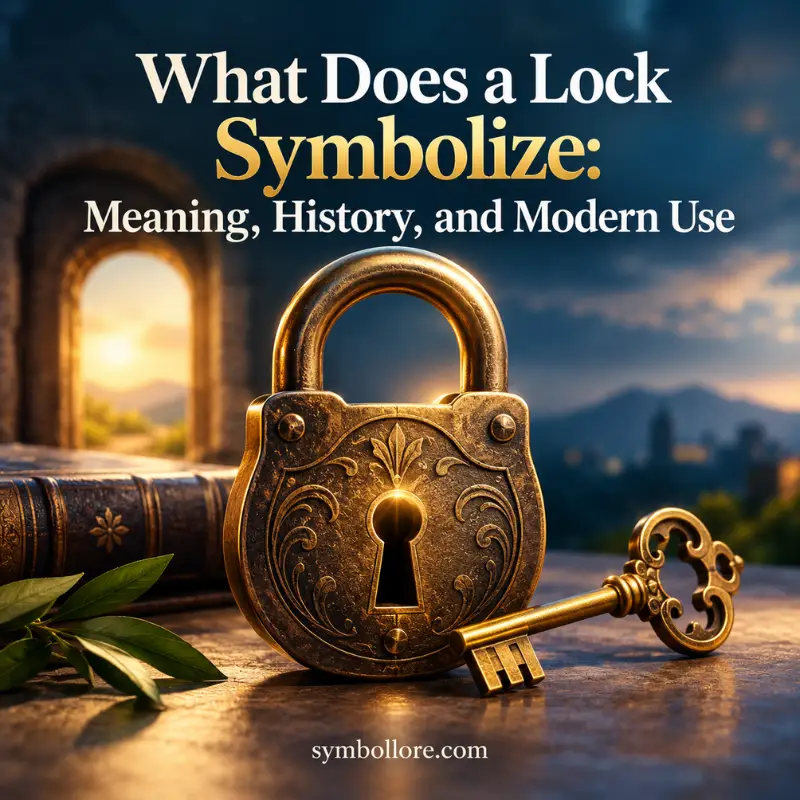
A lock primarily symbolizes protection and controlled access.
Its physical purpose is simple: it prevents something from being opened, entered, removed, or used without the appropriate means of access. That function naturally creates symbolic associations with privacy, security, boundaries, secrecy, and possession.
A locked chest, for example, visually separates valuable contents from outsiders. A locked room separates private space from public space. A locked diary protects personal thoughts. In each case, the object creates a boundary between what is available and what is withheld.
Historical European locks show how important this function became. The Metropolitan Museum of Art notes that elaborate Gothic locks and keys were used on doors, coffrets, and storage chests, while the increasing use of locks in late medieval Europe has been linked to urbanization, material wealth, and private ownership.
That history helps explain why the lock can symbolize more than physical safety. It can represent the human desire to decide who gets access to something valuable.
What Does a Key Symbolize?
A key commonly symbolizes access, permission, authority, responsibility, and opportunity.
The key differs from the lock because it represents the means of crossing a boundary. Holding a key can therefore imply that someone has been trusted with access.
Historically, keys could have practical and social value. A key might grant access to a household, chest, office, religious building, or collection of possessions. The Smithsonian’s National Museum of African Art describes Tuareg keys as symbols of wealth and status and notes that both locks and keys could receive elaborate decoration.
Keys could therefore communicate both ownership and responsibility. Someone carrying an important key was not necessarily the owner of everything behind the door. They might instead be a steward entrusted with access.
That distinction remains important today. Giving someone a key to a house can symbolize intimacy and trust. Giving an employee a key to a building can symbolize professional responsibility. Giving a person a key to a private room can represent a very different kind of permission.
Why Do Locks and Keys Symbolize Trust?
The symbolism of trust comes from controlled access.
A key does not merely open a door. It indicates that someone has been allowed to open it. In a symbolic relationship, giving another person a key can therefore communicate, “I trust you with what is behind this boundary.”
This idea can apply to physical and emotional spaces. A house key may represent belonging. A key to a private office may represent professional confidence. A metaphorical key may represent access to information, memories, or personal feelings.
The lock represents the boundary being protected, while the key represents the person who has permission to cross it.
This makes the pair particularly effective in storytelling. An author can show a character handing over a key instead of explaining that trust has developed. Likewise, taking a key away can communicate the withdrawal of permission.
However, trust should not be treated as an automatic meaning. A key can represent control or authority just as easily. The relationship between the people involved determines the emotional message.
Lock and Key Symbolism and Privacy
Privacy is one of the strongest meanings associated with a lock.
A locked object tells observers that something exists but is not available to them. That distinction makes the lock useful for representing private thoughts, hidden histories, confidential information, and personal boundaries.
A locked diary is an especially clear example. The physical barrier mirrors the emotional barrier between the writer and everyone else.
In literature and visual art, a locked room can work in the same way. It may contain a secret, a memory, a forbidden object, or simply a part of a character’s life that others cannot access.
The symbolism can also be positive. Privacy is not necessarily secrecy in a negative sense. A locked door may protect rest, safety, intimacy, or personal space.
This distinction matters because symbolic interpretations often become too simplistic. Locked does not automatically mean dishonest. A boundary can protect something valuable without implying wrongdoing.
The Key as a Symbol of Authority
Keys have also represented authority because controlling access gives a person power.
The person who holds the key can determine who enters, who remains outside, and when a protected space becomes available. In this sense, the key can symbolize institutional responsibility as well as personal control.
Historical European art provides evidence for this association. A Metropolitan Museum of Art publication discusses a sixteenth-century French key tradition in which the key functioned as a symbol of favor or office.
Religious art developed an especially influential version of this meaning.
In Christian iconography, Saint Peter is traditionally shown with keys because Matthew 16:19 describes Christ giving Peter the “keys of the kingdom of heaven.” The keys therefore became an attribute through which artists could identify Peter and represent his role within the Church.
The Vatican likewise explains that the crossed gold and silver keys in the insignia of the Holy See derive from the Gospel and symbolize spiritual and heavenly authority.
Here, the key does not mean ordinary household access. It belongs to a specific Christian theological and artistic tradition.
Christian Key Symbolism and Saint Peter
Christian key symbolism is one of the clearest historically documented examples of the key becoming a religious emblem.
In Matthew 16:19, Jesus tells Peter that he will receive the keys of the kingdom of heaven. Christian interpretation connected this language with authority to open and close, bind and loose, and exercise a particular form of stewardship.
The imagery became prominent in Christian art. Perugino’s Christ Giving the Keys of the Kingdom to St. Peter, painted for the Sistine Chapel in 1481–83, depicts Christ handing the keys to Peter. Smarthistory identifies the gold and silver keys as Peter’s established artistic attribute.
The Vatican’s explanation of the Holy See’s insignia gives the two keys specific meanings: the gold key refers to power in the kingdom of heaven, while the silver key refers to spiritual authority on earth.
This is an important example of why cultural context matters. It would be inaccurate to say that every key everywhere means Christian authority. Rather, Christian art created a particular and highly influential interpretation of the key.
Lock and Key Symbolism in Medieval and Early Modern Objects
Locks and keys were not only symbolic objects. They were also highly crafted functional objects.
The Metropolitan Museum holds European Gothic locks from the 15th and 16th centuries whose decoration drew on Gothic architecture. Some were complex mechanisms requiring multiple keys in sequence.
A 1531 Southern German padlock and key at the Met illustrates another aspect of the tradition. Its mechanism was designed to conceal the real keyhole and complicate access, while its craftsmanship elevated the lock beyond a simple security device.
A lock could therefore symbolize hidden knowledge or guarded value partly because real locks could literally conceal their mechanisms.
The objects also demonstrate an important historical point: decorative symbolism does not mean an object stopped being practical. A beautifully ornamented lock could remain a serious security device.
The combination of usefulness, craftsmanship, and controlled access gave locks and keys a rich visual vocabulary.
Lock and Key Symbolism in Different Cultural Contexts
There is no single worldwide tradition in which every lock and key has exactly the same meaning.
Collections and exhibitions show that keys and locks have appeared across Europe, Africa, China, and other cultural settings, often combining practical functions with local decorative traditions. Loyola University Chicago’s Museum of Art, for example, documented a collection spanning Roman, medieval, European, Chinese, and African locks and keys.
The symbolic meaning of a particular object should therefore be interpreted through its cultural setting.
A European Gothic lock may emphasize craftsmanship, private property, and elaborate architectural decoration. A Tuareg key may carry associations with wealth and status. A Christian key may represent religious authority. These meanings can overlap, but they should not be blended into a claim that all cultures share one symbolic code.
This culture-by-culture approach prevents the common mistake of turning a broad modern interpretation into an ancient universal belief.
Lock and Key Symbolism in Love and Relationships
In modern popular culture, a lock and key often symbolize love, intimacy, commitment, compatibility, and emotional access.
The reasoning is easy to understand. A lock protects something private, while a key represents the person who has been given access. When two people are represented by a matching lock and key, the image can suggest that one person has a special place in the other’s private emotional world.
Jewelry frequently uses this idea. One person may wear a key while another wears a lock, creating a paired object that represents connection.
Yet this romantic meaning should be understood as a modern cultural and personal interpretation, not a universal ancient rule.
The same design could communicate possession, dependence, secrecy, or control in another context. The symbolism becomes romantic when the surrounding relationship establishes love, mutual trust, and chosen intimacy.
Lock and Key Symbolism in Art and Literature
Writers and artists use locks and keys because the objects make invisible ideas visible.
A character searching for a key may be searching for access, knowledge, freedom, or a way back into a relationship. A locked door may represent something the character cannot yet understand. Finding the correct key can then mark a moment of discovery.
The metaphor works especially well because a key must correspond to a particular lock. This creates an image of fit and compatibility.
However, the interpretation depends on the work itself. A key in a mystery novel may simply be evidence. A locked room in a Gothic story may represent fear or confinement. A key in a religious painting may carry theological authority.
Good symbolic interpretation therefore begins with the actual text or image instead of applying a predetermined definition.
What Does a Broken Lock Symbolize?
A broken lock can represent vulnerability, failed protection, disrupted boundaries, or freedom from restriction.
The direction of interpretation depends on the surrounding story.
If a character breaks a lock to escape imprisonment, the broken mechanism may symbolize liberation. If a thief breaks a lock, it may represent violation and loss of security. If an old lock has rusted away, the image might suggest decay, abandonment, or the passage of time.
This makes condition especially important.
A new lock may emphasize security and preparation. A rusted lock can suggest neglect or age. An open lock may communicate permission or release. A forced lock can communicate violence against a boundary.
The object alone does not determine the meaning.
What Does a Lost Key Symbolize?
A lost key commonly symbolizes lost access, uncertainty, exclusion, or the inability to return to something familiar.
In a story, losing a house key may be a minor inconvenience. In a symbolic scene, however, it can represent separation from home, identity, memory, or belonging.
A lost key can also suggest that the solution to a problem is temporarily unavailable. The character knows that a locked space exists but cannot reach what lies beyond it.
In personal symbolism, the meaning depends heavily on the individual’s experience. Someone who associates a key with a childhood home may interpret a lost key differently from someone who associates it with work or independence.
There is no reliable universal rule that a lost key predicts a particular future event.
Lock and Key Symbolism in Modern American Culture
In the United States, locks and keys appear in everyday life as symbols of home ownership, independence, security, privacy, and responsibility.
Receiving the keys to a new home can represent a major transition into independence. A house key may also symbolize belonging to a household or being trusted with another person’s property.
The imagery appears in advertising, jewelry, tattoos, wedding gifts, graduation gifts, and decorative art. Its meaning is often shaped by familiar American ideas about personal space and individual ownership.
Modern digital life has also changed the metaphor. Passwords, encryption, access codes, and digital credentials now perform some of the functions once represented by physical keys. Yet the underlying symbolic structure remains similar: something is protected, and someone must have the proper means of access.
That continuity explains why the key remains an effective metaphor for knowledge, opportunity, permission, and trust.
How the Lock and Key Pair Represents Boundaries
The deepest meaning of the pair may be the relationship between boundary and access.
A lock says that not everything is available to everyone. A key says that access can be granted under particular conditions.
Together, they can therefore express:
- privacy without isolation;
- protection without hostility;
- trust without unlimited access;
- authority without ownership;
- intimacy without public exposure;
- opportunity that requires permission or preparation.
This is why the pair can communicate both positive and negative ideas.
A locked door can protect a family or imprison a person. A key can represent trust or control. A closed lock can preserve a secret or prevent someone from receiving something they need.
The strongest interpretation asks who controls the lock, who holds the key, and why access matters.
Common Misconceptions About Lock and Key Symbolism
One common misconception is that a lock and key always symbolize romantic soulmates. That is a popular modern interpretation, but it is not a universal historical meaning.
Another misconception is that every key represents good luck or opportunity. Keys have carried many different meanings, including authority, status, stewardship, religious symbolism, and practical responsibility.
It is also misleading to claim that a particular key color always has one fixed spiritual meaning. Gold and silver keys have specific meanings in the insignia of the Holy See, but that does not create a universal color code for all keys.
Finally, locks should not automatically be interpreted negatively. A boundary can represent healthy privacy, protection, or respect. The emotional meaning depends on whether the barrier is voluntary, protective, restrictive, or violated.
How to Interpret a Lock and Key Symbol
A useful interpretation begins with five questions:
- What is locked? A door, chest, diary, gate, or symbolic object creates a different context.
- Who holds the key? The key holder may represent trust, authority, ownership, or responsibility.
- Is access welcomed or forbidden? An open invitation creates a different meaning from forced entry.
- What is the condition of the lock? New, ornate, rusty, broken, hidden, or open mechanisms can change the message.
- What cultural setting surrounds the image? Religious art, historical metalwork, romance, literature, and modern design should not automatically receive the same interpretation.
The final step is to distinguish observation from inference.
“The character holds a key” is an observation. “The character has been given emotional access” is an interpretation. The second claim becomes stronger only when the story provides evidence for it.
FAQs
The main meaning is controlled access. The lock represents a protected boundary, while the key represents the permission, ability, or authority to cross that boundary. From this basic relationship come associations with privacy, protection, trust, secrecy, opportunity, and responsibility.
In modern relationship symbolism, a lock can represent a protected heart, private intimacy, commitment, or emotional boundaries. When paired with a key, it may suggest that one person has been trusted with special access to another person’s emotional world. This is a modern interpretive convention, not a universal ancient rule.
A key can symbolize spiritual authority, access, knowledge, stewardship, or passage. In Christianity, keys have a specific association with Saint Peter and the keys of the kingdom of heaven. Other spiritual interpretations vary and should be connected to their particular tradition rather than treated as universal.
A lock and key tattoo may represent love, trust, privacy, commitment, compatibility, protection, or personal transformation. Some designs divide the pair between two people, while others use both objects together. The tattoo’s meaning ultimately depends on the wearer’s intention and surrounding imagery.
Yes, a key can symbolize opportunity because it provides access to something previously closed or unavailable. This is especially common in modern metaphorical language. However, the historical meaning of a key is broader and can include authority, status, responsibility, ownership, and religious symbolism.
A broken lock may symbolize failed protection, vulnerability, violated privacy, or freedom from restriction. The surrounding context determines which reading is appropriate. A broken lock on a prison may suggest liberation, while a broken lock on a home may suggest intrusion or insecurity.
No reliable evidence shows that seeing a lock or key predicts a future event. Symbolic interpretation can help people reflect on themes such as trust, boundaries, privacy, or change, but it should not be presented as a guaranteed omen or supernatural forecast.
Conclusion
Lock and key symbolism is powerful because the objects express a basic human idea: access is controlled. The lock can represent protection, privacy, secrecy, and boundaries, while the key can represent trust, permission, authority, opportunity, and responsibility. Together, they can also suggest intimacy and compatibility when a modern romantic context supports that reading.
Historical objects, Christian art, decorative traditions, literature, and modern American culture have all expanded these meanings. The most reliable interpretation considers who holds the key, what the lock protects, how access is controlled, and which cultural or personal context surrounds the image. A symbol becomes clearer when its history and setting are examined rather than reduced to a single universal definition.
Five Related Articles from symbollore.com
Only two closely relevant published SymbolLore articles could be verified for this topic; no additional relevant URLs were found without forcing unrelated pages into the list.


