

Japanese maple symbolism is closely tied to autumn beauty, seasonal change, impermanence, reflection, and appreciation of nature. These meanings developed from the tree’s dramatic transformation in fall and from Japan’s long cultural tradition of viewing autumn foliage.
The Japanese maple, especially Acer palmatum, became a familiar subject in Japanese poetry, painting, gardens, textiles, and seasonal celebrations. Its brilliant leaves offered more than visual beauty: they gave artists and writers a way to express the passage of time and the value of moments that do not last.
Today, the tree can also suggest peace, elegance, maturity, or personal change. However, those meanings should not be treated as universal rules. The strongest historical associations come from Japanese autumn culture and the tradition of momijigari, or viewing maple foliage.
Quick Answer
Japanese maple symbolism most strongly represents autumn beauty, change, impermanence, and thoughtful appreciation of nature. Its meaning grew from the vivid transformation of its leaves and Japan’s centuries-old tradition of admiring autumn foliage. In modern use, the tree may also suggest peace, elegance, maturity, or renewal, but these interpretations depend on context.
TL;DR
- Japanese maple is one of the clearest visual symbols of autumn in Japan.
- Its changing leaves can represent beauty, transition, impermanence, and passing time.
- Momijigari, the practice of viewing autumn foliage, helped give maple leaves a strong cultural role.
- Japanese poetry, painting, textiles, gardens, and literature repeatedly use maple imagery as a seasonal motif.
- Red maple leaves often create a more dramatic meaning than green or yellow leaves because they mark the height of autumn color.
- In modern American gardens and artwork, Japanese maple symbolism often emphasizes serenity, refinement, nature, and graceful change.
Japanese Maple Meanings at a Glance
| Context | Possible Meaning | Why the Association Exists | Important Limit |
|---|---|---|---|
| Autumn foliage | Seasonal beauty | Japanese maples become vivid red, orange, or yellow | Primarily a seasonal association |
| Changing leaves | Transformation | The tree visibly changes as autumn arrives | Does not imply a fixed spiritual message |
| Falling leaves | Impermanence | Beauty reaches its peak before the leaves disappear | Meaning depends on artistic context |
| Maple viewing | Appreciation and reflection | Momijigari centers on observing autumn color | A cultural practice, not simply a belief |
| Japanese gardens | Elegance and harmony | Maples are used alongside stones, water, moss, and other plants | Garden design varies by period and place |
| Poetry and literature | Passing time and seasonal awareness | Maple foliage became a recurring poetic image | Individual works can give it different meanings |
| Modern American gardens | Peace and refinement | The tree has an ornamental, graceful form | Modern associations are not necessarily ancient Japanese meanings |
What Does Japanese Maple Symbolism Mean?
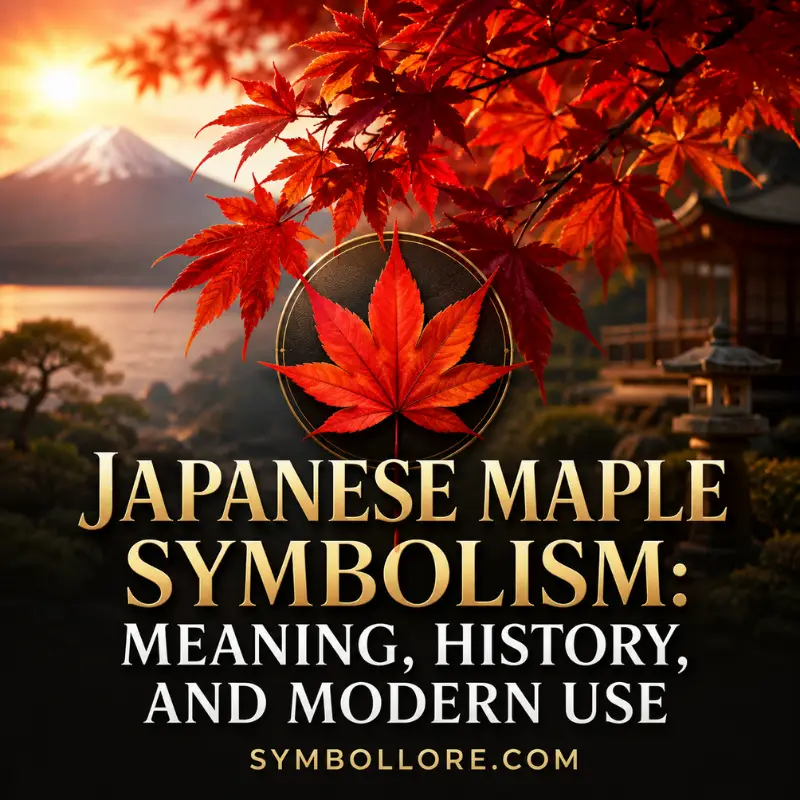
The strongest meaning is beauty made more valuable by its temporary nature. A Japanese maple does not remain visually unchanged throughout the year. Its leaves move from green toward brilliant autumn colors and eventually fall.
That visible sequence creates a powerful metaphor. The tree can represent a beautiful stage of life that deserves attention precisely because it will change.
This idea is particularly strong in Japanese autumn culture. Japan’s government describes Japanese maple as the tree that symbolizes autumn colors, noting its widespread presence in parks, gardens, temples, and shrines.
The meaning is therefore less about a single secret message and more about how people respond to seasonal change. A maple leaf can remind viewers to notice beauty while it is present.
Why Japanese Maple Became a Symbol of Autumn
The Japanese maple became closely associated with autumn because its leaves create one of the season’s most recognizable visual displays.
The Japanese word momiji can refer specifically to maple trees or their leaves, while kōyō describes the broader phenomenon of autumn foliage. The two terms share the characters 紅葉, connecting them visually and linguistically with changing leaves and red autumn color.
This distinction matters. Not every autumn tree in Japan is a Japanese maple. Yet the maple became especially representative because of its distinctive leaf shape and strong red coloration.
The Japanese government likewise identifies the Japanese maple as a symbolic tree of autumn color. Its leaves appear in landscapes ranging from natural forests to carefully designed temple and shrine gardens.
In symbolic terms, the tree became a natural shorthand for fall itself.
Momijigari and the Meaning of Seasonal Appreciation
One of the most important cultural contexts is momijigari, the tradition of going out to admire autumn foliage.
The word is often translated as “maple hunting,” but the activity involves viewing rather than hunting or collecting maple leaves. People travel to mountains, parks, gardens, temples, and other scenic places to experience autumn color.
The practice has deep historical roots. Japan’s government notes that appreciation of fall leaves became an important activity among aristocrats during the Heian period, when nobles traveled into the mountains and composed poetry about autumn foliage. Japanese maples were later planted around residences, temples, and shrines so people could enjoy the changing colors more closely.
Japan’s government overview of autumn colors and maple culture
This history gives Japanese maple symbolism an important quality: attention.
The maple is not simply admired because it is attractive. Its seasonal transformation encourages people to pause, travel, observe, write, paint, and share the experience with others.
Japanese Maple Symbolism and Impermanence
Impermanence is one of the most useful ways to understand the emotional power of Japanese maple imagery.
The leaf becomes most visually dramatic shortly before it falls. That contrast creates a natural metaphor for things that are beautiful precisely because they do not remain unchanged.
This does not mean every Japanese maple image automatically represents mortality. In many cases, it simply represents autumn. However, artists and writers can use the seasonal cycle to suggest passing time, maturity, departure, memory, or the temporary nature of beauty.
The broader symbolism of falling leaves works in a similar way. A leaf that separates from its branch creates a visible image of transition, while the seasonal nature of the process distinguishes it from imagery of sudden destruction.
This is why Japanese maple symbolism can feel reflective without necessarily being sad. The image can acknowledge change while still celebrating what exists in the present.
Japanese Maple in Japanese Poetry and Literature
Maple leaves became important seasonal images in Japanese poetry long before they became popular garden ornaments around the world.
The autumn leaf appears as a season word, or kigo, in Japanese poetry. Poets could evoke an entire season through a brief reference to changing maple foliage.
The connection also appears in The Tale of Genji. The Metropolitan Museum of Art documents Japanese artworks that use maple leaves to evoke autumn scenes associated with the classic work. One Edo-period writing box, for example, combines maple leaves with imagery connected to an autumn festival in The Tale of Genji.
The Met’s Japanese maple imagery from The Tale of Genji tradition
This literary history adds another layer to the symbol. Maple leaves can suggest not only nature but also refinement, seasonal awareness, courtly culture, poetry, and cultivated sensitivity.
Japanese Maple in Art and Traditional Design
Japanese maple imagery appears across painting, lacquer, textiles, ceramics, and decorative arts.
The Metropolitan Museum of Art holds an Edo-period work titled Autumn Maple by Sakai Ōho. The isolated maple tree, red and orange leaves, and carefully controlled composition show how autumn foliage could become the central subject of an artwork rather than a minor background detail.
Another Edo-period folding-screen work at the Met depicts people enjoying cherry blossoms and changing maple leaves as paired seasonal activities. The museum notes that outings to enjoy cherry blossoms and autumn maple colors had been cherished in Japan since ancient times.
The Metropolitan Museum of Art’s Autumn Maple collection record
Maple imagery also appeared on clothing. An eighteenth-century Japanese robe in the Met collection features maple leaves in a design associated with an autumn excursion connected to The Tale of Genji.
These examples show why seasonal beauty is a stronger historical interpretation than claims that the maple always means one specific spiritual quality.
The Japanese Maple, Color, and Symbolic Meaning
Color changes how Japanese maple symbolism feels.
Red maple leaves
Red is the most recognizable autumn maple color. It can emphasize vitality, intensity, maturity, beauty, and the height of seasonal change.
Because red foliage is especially striking, it often creates a more dramatic visual statement than green foliage. In traditional Japanese autumn imagery, crimson maple leaves became a defining feature of the season.
Orange and golden leaves
Orange and golden leaves can create a warmer interpretation. They may suggest autumn richness, warmth, maturity, and seasonal abundance.
However, these meanings are contextual. A golden maple in a garden may simply be an attractive autumn landscape rather than a deliberate symbolic statement.
Green maple leaves
Green leaves usually shift attention away from autumn symbolism. They can instead emphasize growth, vitality, freshness, and the living tree itself.
That distinction is useful when interpreting artwork. A green maple does not need to carry the same meaning as a crimson maple leaf.
Japanese Maple Symbolism in Gardens
Japanese maples have a strong relationship with garden design because their changing appearance can provide visual interest across the seasons.
Their delicate leaves, branching patterns, and autumn colors work especially well with stones, moss, water, pathways, and other plants. In Japan, maples became established features around temples, shrines, residences, and famous autumn-viewing locations.
The tree therefore can suggest quiet beauty, balance, refinement, and close attention to nature when used in a garden.
These meanings should still be treated as interpretations rather than fixed traditional definitions. A gardener may choose a Japanese maple simply because its form fits a landscape.
A similar distinction appears in modern plant symbolism more broadly. For example, falling leaves can represent transition or release in one artwork while simply communicating autumn in another.
Japanese Maple Symbolism in Modern American Life
In the United States, Japanese maple trees are widely valued as ornamental landscape plants. Their symbolic meaning often develops through their appearance rather than through a direct continuation of Japanese religious tradition.
An American gardener might associate a Japanese maple with peace, privacy, elegance, seasonal change, or a connection to nature. A writer might use it as a quiet image of aging or reflection. An artist might use red leaves to create an unmistakable autumn setting.
These are reasonable modern readings, but they should not be presented as universal Japanese meanings.
This distinction is important because Japanese maple has become global. Once a symbol moves between cultures, new associations often develop. Modern American interpretation can therefore coexist with, but should not replace, the tree’s documented Japanese history.
For comparison, other seasonal plants develop similarly localized meanings. Jacaranda symbolism, for example, varies according to local traditions, cities, seasons, and community experience rather than carrying one universal definition.
Jacaranda symbolism on Symbol Lore
Japanese Maple Symbolism in Art, Gifts, and Tattoos
A Japanese maple can work well as a symbolic image because its meaning is visually easy to communicate.
In art, a bright red maple can create an immediate sense of autumn and temporary beauty. A single falling leaf can make the image more personal and reflective. A full tree can suggest continuity, seasonal cycles, or a connection to place.
In gifts, the tree may communicate appreciation for nature, maturity, remembrance, or a peaceful transition. The meaning depends heavily on the relationship between the giver and recipient.
Tattoos require even more attention to context. A maple leaf does not have one universal tattoo meaning. A Japanese-style design may draw on autumn imagery and seasonal aesthetics, while a North American maple leaf may communicate a completely different national or regional identity.
Therefore, anyone choosing a Japanese maple design should consider which cultural tradition the image is referencing rather than relying on generic online symbolism charts.
Japanese Maple Symbolism vs. Generic Maple Symbolism
Japanese maple symbolism should not be confused with every meaning associated with maple trees.
Maple species have different cultural histories. In North America, maple trees can be connected with seasonal harvesting, syrup production, regional identity, and specific Indigenous traditions. Those associations do not automatically transfer to Japanese maple.
The Japanese tradition instead places particular emphasis on autumn foliage and seasonal viewing. Nippon.com describes the brilliant autumn red of momiji as especially representative of kōyō, while noting its long presence in poetry and seasonal culture.
That difference prevents an important symbolic mistake: treating every maple leaf as though it belongs to one worldwide symbolic system.
A Japanese maple in a Kyoto garden, a sugar maple in New England, and a maple leaf on a national emblem may all look related, but their cultural meanings can be very different.
What Popular Claims About Japanese Maple Symbolism Need Caution?
Several modern claims go further than the strongest historical evidence supports.
One common claim says that the Japanese maple universally symbolizes peace, prosperity, longevity, success, healing, protection, and spiritual awakening. Some modern sources make broad lists like these, but they should not be presented as a single traditional Japanese doctrine.
The better-supported interpretation centers on autumn, seasonal beauty, foliage viewing, poetry, art, and awareness of change. Japan’s official cultural material directly describes the Japanese maple as a symbol of autumn colors, while museum collections demonstrate its long use as a seasonal artistic motif.
Likewise, claims that a particular maple leaf predicts good fortune or delivers a supernatural message belong to personal belief or modern spirituality unless a specific tradition provides evidence.
A useful rule is simple: interpret the maple from its cultural setting rather than assigning it a fixed mystical definition.
How to Interpret Japanese Maple Symbolism in Context
When you encounter a Japanese maple in art, writing, design, or a personal setting, look at the complete scene.
Ask these questions:
- What season is shown?
Green foliage suggests a different stage of the year than brilliant red leaves. - Are the leaves attached or falling?
Falling leaves can emphasize transition, departure, or impermanence. - Where is the tree located?
A temple garden, urban park, private garden, and mountain landscape can create different associations. - What other symbols appear nearby?
Water, stones, birds, flowers, bridges, clothing, or seasonal objects may change the meaning. - Is the image specifically Japanese?
If so, look for references to momijigari, classical poetry, gardens, or traditional seasonal imagery. - Is it being used in a modern American setting?
The meaning may center more on serenity, landscape design, personal growth, or autumn nostalgia.
This approach is more reliable than assuming that one symbolic definition applies to every maple image.
FAQs
A Japanese maple most strongly symbolizes autumn beauty, seasonal change, and appreciation of nature. Its brilliant fall foliage also makes it useful for expressing impermanence and the passing of time, especially in Japanese poetry and art.
Japanese maple leaves are strongly associated with autumn because they develop vivid red, orange, and yellow colors as the season changes. Japanese culture has also developed a long tradition of viewing autumn foliage, known as momijigari.
A red Japanese maple leaf can represent autumn at its most vivid, along with beauty, maturity, transition, and the temporary nature of a season. In an artwork, the exact meaning depends on surrounding imagery and the creator’s purpose.
It can be. The tree becomes especially striking when its leaves change color shortly before falling, creating a natural image of beauty that does not remain permanent. Japanese seasonal art and poetry frequently use autumn imagery to evoke awareness of changing time.
Momijigari is the Japanese practice of going out to appreciate autumn foliage, especially colorful maple leaves. Historically, the practice was associated with elite seasonal outings and poetry before becoming a broader cultural activity.
No. Those meanings may appear in modern symbolic writing, but they should not be treated as universal traditional definitions. The strongest documented associations concern autumn foliage, seasonal appreciation, poetry, art, gardens, and changing nature.
No. Different maple species and cultures have developed different associations. Japanese maple symbolism is strongly connected with autumn viewing and Japanese seasonal aesthetics, while North American maple traditions can involve other histories, uses, and regional identities.
Conclusion
Japanese maple symbolism is best understood through autumn, seasonal beauty, change, and the value of temporary moments. The tree became culturally important in Japan because its vivid foliage offered a powerful subject for poetry, painting, gardens, textiles, and seasonal gatherings such as momijigari. Its symbolism is therefore rooted less in a fixed mystical code than in centuries of close attention to nature.
In modern American settings, the Japanese maple may also represent serenity, elegance, maturity, or personal transition. Still, context matters. A grounded interpretation respects the tree’s Japanese history while leaving room for the personal meanings people give it today.


