
Anteater symbolism represents patience, focused effort, intuition, self-reliance, and the ability to uncover what others overlook. These meanings come largely from the animal’s specialized feeding habits, strong sense of smell, solitary nature, and powerful defensive claws.
However, the symbol does not carry one universal spiritual message. Documented South American traditions, modern spirit-animal writing, dreams, tattoos, and personal encounters use the anteater differently. A careful interpretation considers the animal’s behavior, the cultural source, and the situation in which it appears rather than treating it as a guaranteed omen.
Quick Answer
Anteater symbolism commonly represents patience, persistence, resourcefulness, intuition, solitude, and hidden strength. Its long search for concealed insects inspires ideas about investigating beneath the surface, while its powerful claws suggest boundaries and self-defense. In dreams or spiritual practice, the anteater may encourage focused effort, but its meaning remains personal rather than predictive.
Key Takeaways
- Anteaters symbolize focused effort rather than rushed activity.
- Their strong sense of smell inspires associations with intuition and discernment.
- Solitary habits connect them with independence and healthy personal space.
- Powerful claws represent boundaries, protection, and unexpected strength.
- South American traditions differ and should not be blended into one belief.
- Conservation adds vulnerability and stewardship to the symbol’s modern meaning.
Anteater Symbolism at a Glance
| Anteater Trait or Context | Possible Symbolic Meaning | Important Distinction |
|---|---|---|
| Searching for hidden insects | Investigation and hidden truths | The meaning comes from observable feeding behavior |
| Long, sticky tongue | Precision and specialized skill | It may also represent choosing the right tool |
| Strong sense of smell | Intuition and discernment | This is metaphorical, not psychic evidence |
| Solitary lifestyle | Independence and introspection | Solitude is not the same as isolation |
| Powerful front claws | Protection and firm boundaries | Anteaters usually avoid conflict first |
| Slow, deliberate foraging | Patience and persistence | Focus matters more than speed |
| Mother carrying her young | Care and quiet devotion | Giant anteaters usually produce one offspring |
| Threatened conservation status | Vulnerability and stewardship | This meaning reflects present ecological reality |
What Anteater Symbolism Means
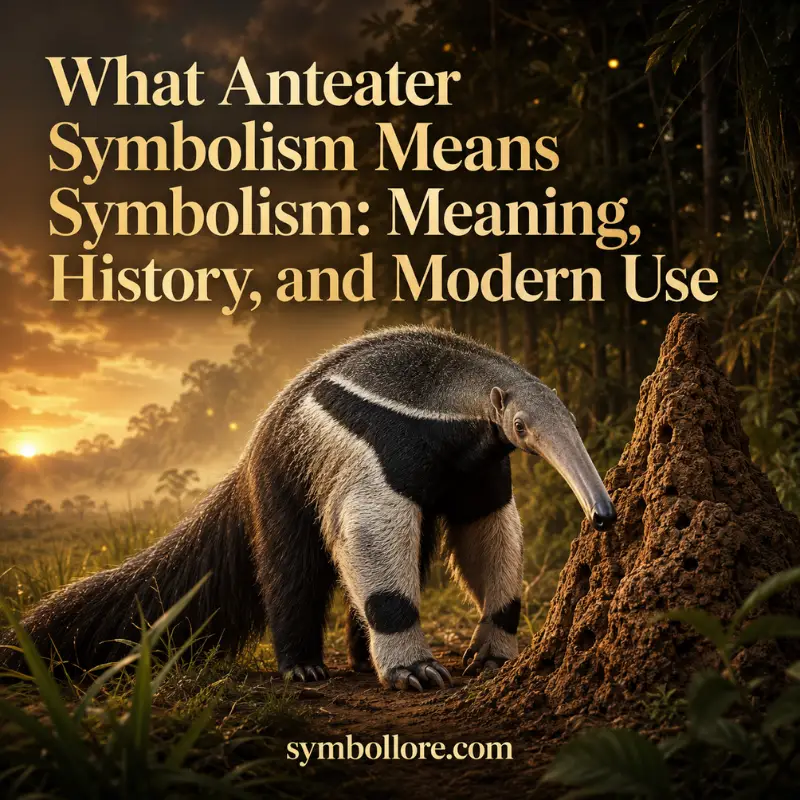
Anteater symbolism is fundamentally about finding value beneath the surface. An anteater does not chase obvious prey across open land. Instead, it detects concealed ant and termite colonies, opens a small part of the nest, gathers what it needs, and moves on.
Symbolically, this pattern can represent research, careful observation, and attention to details that other people dismiss. It may suit someone examining a difficult problem, looking for the cause of repeated conflict, or developing a highly specialized skill.
The animal also represents selective effort. It does not destroy every nest completely or remain in one location indefinitely. That behavior creates a useful lesson: progress may come from taking what is needed, avoiding waste, and continuing forward.
Therefore, the anteater is less a symbol of dramatic conquest than quiet effectiveness. It suggests that a person can achieve meaningful results through patience, precision, and methods suited to their own strengths.
How Anteater Behavior Shapes Its Symbolism
Real anteater behavior explains many modern interpretations. Giant anteaters have weak eyesight but a highly developed sense of smell. They locate ants and termites by scent, open nests with strong forelimbs, and collect insects with a tongue that can extend about two feet. They also walk on their front knuckles to protect their long claws.
These adaptations support several symbolic associations:
- Intuition: working with information that is not immediately visible
- Resourcefulness: using specialized abilities effectively
- Persistence: continuing a search until a useful source appears
- Discernment: identifying which opportunity deserves attention
- Hidden strength: appearing slow or unusual while possessing serious defenses
The Smithsonian National Zoo’s giant anteater profile
offers a reliable overview of these traits.
Not every anteater behaves exactly like the giant anteater. The name also includes northern and southern tamanduas and the much smaller silky anteater. Tamanduas climb and use prehensile tails, while giant anteaters live mainly on the ground. Consequently, symbolic interpretations based on size, climbing, or tail use should identify the species involved.
Anteater Spirit Animal and Spiritual Meaning
In modern spirituality, the anteater spirit animal often represents patient investigation, inner guidance, and confidence in an unconventional path. It may appeal to people who solve problems quietly, need time alone, or rely on skills that others do not immediately understand.
As a reflective symbol, the anteater may invite questions such as:
- Am I examining the real cause of this problem?
- Am I wasting energy on every small disturbance?
- Which sense, skill, or source of information have I ignored?
- Do I need more patience before acting?
- Am I protecting my time and attention?
These questions are more useful than assuming the animal predicts a specific event. Seeing anteater imagery does not prove that success, danger, or spiritual intervention is coming.
The spiritual meaning also includes groundedness because the giant anteater spends much of its time close to the earth while searching for food. Yet this is a modern metaphor, not a universal ancient doctrine. Spiritual use remains most responsible when it encourages self-reflection without claiming authority over another person’s future, health, or personality.
Anteater Totem and Power Animal
An anteater totem commonly represents a lasting identification with patience, self-reliance, discernment, and personal boundaries. Someone may choose it because those qualities reflect their values or the kind of person they hope to become.
A power animal is usually invoked more temporarily in contemporary spiritual practice. In that context, the anteater may symbolize support during research, difficult problem-solving, boundary-setting, or a period requiring steady effort.
The terms should not automatically be treated as interchangeable. They also should not be casually attributed to all Indigenous cultures. Online spirituality often uses totem broadly, although traditional totemic systems belong to specific communities and carry social, ceremonial, or kinship meanings that differ from personal animal preference.
For a general American reader, clearer language may include personal animal symbol, spiritual guide, or reflective archetype. These expressions preserve the intended meaning without suggesting participation in a tradition the person does not belong to.
The practical lesson remains the same: use your particular strengths, work patiently, and protect the resources required to continue.
Solitude, Boundaries, and Self-Reliance
Anteaters symbolize solitude because adults commonly live alone outside mating or mother-young relationships. Giant anteaters usually avoid conflict and may flee when threatened. However, they can rise on their hind legs and use their powerful claws when escape is no longer possible.
This combination creates a more nuanced symbol than simple loneliness. The anteater can represent:
- Comfort with one’s own company
- Time for uninterrupted thought
- Freedom from unnecessary approval
- Clear limits around personal space
- Peaceful behavior backed by firm defense
Its lesson is not to reject relationships. Instead, it distinguishes restorative solitude from harmful isolation. A person may need quiet time while still maintaining trusted connections.
The shadow side appears when independence becomes emotional withdrawal. Someone who identifies strongly with the anteater may ask whether privacy is supporting growth or preventing honest communication.
Likewise, boundaries should protect well-being without becoming hostility. The animal first avoids danger, then defends itself when required. Symbolically, this suggests a measured response: recognize the threat, create distance, communicate the limit, and use stronger action only when necessary.
Anteater Symbolism in South American Folklore
The documented cultural record is more specific and limited than many symbolism websites suggest. Anteater stories appear in parts of South America, but there is no single belief shared by every Indigenous community.
A 1977 McGill University anthropology thesis examines the great anteater’s role in South American mythology, including material connected with the Sherente and other traditions. This scholarly record shows that anteater imagery deserves serious cultural study, but it does not support a universal “Native American anteater meaning.”
One Shipibo narrative tells of an anteater tricking a jaguar during a diving contest and stealing its coat. The story presents the anteater as clever, comic, and capable of defeating a stronger animal through strategy. Other recorded stories connect the animal with transformation or conflict between the anteater and jaguar.
Kayapó ceremonial material also includes anteater masks. A museum description explains that a pàt mask has a long thread representing the animal’s tongue and appears among masks associated with myth and ceremonial naming.
Readers can examine the broader academic context through the
McGill thesis on the great anteater in South American mythology.
These examples support meanings such as cunning, transformation, ritual identity, and the reversal of expected power. Still, each story belongs to a particular cultural setting and should remain connected to that source.
Anteater Dream Meaning
An anteater dream may reflect focused problem-solving, hidden concerns, personal space, or irritation caused by many small issues. Dream interpretation works best when it begins with the dream’s events and emotions rather than a fixed dictionary definition.
Consider the following possibilities:
An anteater searching for food
This scene may reflect an investigation, research project, or effort to locate the real cause of a problem. The dream may encourage patience and closer attention to details.
An anteater breaking open a nest
The image can suggest uncovering information that was protected, buried, or ignored. It may also warn against disrupting a complicated situation without understanding what lies inside.
A calm anteater
A peaceful animal may represent comfort with solitude, steady progress, or confidence in a specialized approach.
An aggressive anteater
This scene may point toward violated boundaries, defensive anger, or a situation in which quiet resistance has reached its limit.
A baby riding on its mother
Young giant anteaters ride on their mothers’ backs and remain dependent for an extended period. In a dream, that image may represent protection, caregiving, inherited patterns, or gradual independence.
No dream image guarantees a future event. Its strongest meaning usually comes from the dreamer’s current concerns, emotional response, and personal associations.
What Seeing an Anteater May Mean
Seeing an anteater in person is first a wildlife encounter, not automatic proof of a supernatural message. People living or traveling within the animal’s Central and South American range may encounter one because its habitat, food sources, and activity patterns brought it nearby.
However, a sighting can still become personally meaningful. The observer may treat it as a prompt to slow down, examine a hidden issue, or use a neglected strength.
Repeated anteater images in media, art, or conversation may also stand out because the mind has begun noticing a subject connected with current concerns. Before calling the pattern an omen, ask:
- What was I thinking about when the image appeared?
- Which anteater trait attracted my attention?
- Does the symbol relate to patience, boundaries, research, or solitude?
- Am I noticing a real pattern or simply paying more attention now?
- What practical action would make the interpretation useful?
The value of the experience lies in the insight or action it encourages, not in proving that the encounter was arranged by an external force.
Anteater Tattoo Meaning
An anteater tattoo can symbolize patience, uniqueness, intuition, quiet strength, and independence. It is an uncommon animal design, which also makes it suitable for someone who values individuality or rejects obvious symbols.
Specific design elements can refine the meaning:
| Tattoo Element | Possible Meaning |
|---|---|
| Anteater digging | Investigation and persistence |
| Raised anteater | Defense and firm boundaries |
| Long tongue emphasized | Precision or specialized talent |
| Mother and young | Protection and patient care |
| Anteater with ants | Focus on small details |
| Anteater and jaguar | Intelligence confronting raw power |
| Forest setting | Connection with South American habitat |
| Geometric design | Order, analysis, and personal discipline |
A tattoo inspired by a named Indigenous narrative requires additional care. The design should not copy ceremonial masks, sacred forms, or community-specific imagery without understanding its origin and appropriate use.
A naturalistic anteater design avoids that issue while still expressing personal qualities. Including native grasses, termite mounds, or forest plants can connect the animal with its real environment rather than generic mystical imagery.
Conservation and Modern Anteater Symbolism
Modern anteater symbolism can include vulnerability, ecological specialization, and the responsibility to protect overlooked species. The giant anteater is listed as Vulnerable on the International Union for Conservation of Nature Red List. Habitat loss, fires, road deaths, low reproductive rates, and specialized feeding needs contribute to its decline.
The IUCN specialist group’s giant anteater profile
explains its conservation status and major threats.
This ecological context adds a contemporary lesson. The anteater’s adaptations make it effective within a particular environment, yet that specialization can become a weakness when habitats change rapidly.
Symbolically, it may therefore represent both mastery and dependence. Every individual relies on conditions that support their abilities. Protecting those conditions may involve preserving time, community, health, habitat, or access to necessary resources.
Conservation also changes the meaning of wildlife art and tattoos. The animal becomes more than a personal guide. It can represent biodiversity, respect for unfamiliar creatures, and concern for ecosystems that receive less public attention than those of more famous animals.
FAQs
Spiritually, an anteater commonly symbolizes patience, intuition, focused effort, independence, and the discovery of hidden truths. These are modern reflective meanings based partly on its behavior. They should not be treated as universal religious teachings or guaranteed messages about a person’s future.
An anteater is not universally recognized as a good-luck symbol. Some modern readers may interpret it positively because it represents resourcefulness and persistence. However, documented cultural stories give it several roles, including trickster, ceremonial figure, and unusual opponent of the jaguar.
An anteater in a dream may represent investigation, persistent effort, personal boundaries, or many small problems demanding attention. The animal’s actions matter. A calm anteater suggests something different from one that is digging, hiding, attacking, or carrying its young.
The anteater may symbolically suggest an observant, independent, patient, and highly specialized personality. Still, animal symbolism cannot diagnose character. A person may select the anteater because these qualities describe them, challenge them, or represent traits they want to develop.
Negative anteater symbolism may include isolation, excessive defensiveness, obsession with minor details, slow action, or dependence on a narrow method. These shadow meanings arise when useful traits become unbalanced. Careful focus can become fixation, while healthy solitude can become avoidance.
Anteaters generally avoid threats rather than seek conflict. However, giant anteaters have powerful front claws and can defend themselves seriously when cornered. This behavior supports their symbolic connection with peaceful boundaries backed by unexpected strength.
Conclusion
Anteater symbolism combines patience, discernment, self-reliance, boundaries, and the ability to uncover value beneath the surface. Its meanings grow from real adaptations, including specialized feeding, powerful claws, a strong sense of smell, and a largely solitary life.
However, no single interpretation applies everywhere. South American folklore, modern spirituality, dreams, and personal art use the animal in different ways. The strongest reading respects those differences while asking a practical question: what hidden issue, specialized strength, or necessary boundary currently deserves careful attention?