
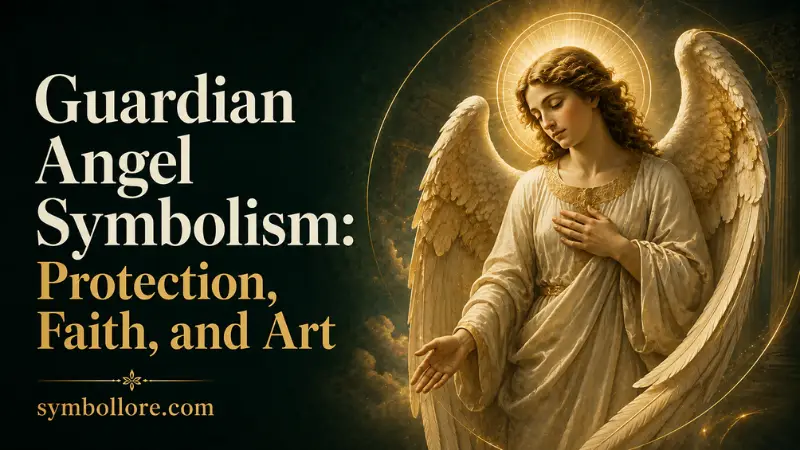
Guardian angel symbolism combines ideas of protection, guidance, hope, and an unseen presence that cares for vulnerable people. It appears in scripture, devotional traditions, paintings, jewelry, tattoos, films, and memorial objects. However, its meaning changes across religions and cultures. For some people, the guardian is a literal spiritual being. For others, the image represents conscience, love, memory, or reassurance during uncertain times.
Quick Answer: Guardian angel symbolism usually represents protection, spiritual direction, comfort, and the belief that people do not face danger or hardship alone. In art, a winged figure guiding a child often expresses watchful care. In tattoos and jewelry, the same figure may honor faith, commemorate someone who died, or symbolize personal resilience.
TL;DR
- Guardian angels most commonly symbolize protection, guidance, hope, and companionship.
- Christian traditions differ on whether scripture supports an individual angel for every person.
- Jewish and Islamic teachings contain protective angels but do not simply mirror the popular Western concept.
- Wings, light, gestures, staffs, and swords each add a distinct layer of meaning.
- Tattoos, feathers, dreams, and memorial objects often carry personal rather than doctrinal meanings.
Key symbols at a glance
| Image or attribute | Common interpretation | Important context |
|---|---|---|
| Angel above or behind a person | Watchfulness and protection | Often places the guardian between the person and danger |
| Wings | Movement between heaven and earth | Wings identify the figure visually but do not appear in every early depiction |
| Halo or radiance | Holiness and heavenly authority | Light can also express hope, revelation, or moral clarity |
| Guiding hand | Warning, reassurance, or direction | Pointing suggests advice; holding suggests active care |
| Staff or scroll | Sacred office, journey, or message | Common in images of guides and divine emissaries |
| Sword or flame | Defense, vigilance, and judgment | The weapon may signal danger as well as protection |
| Child or traveler | Innocence, vulnerability, and trust | The protected child became especially prominent in later devotional art |
What Does Guardian Angel Symbolism Mean?
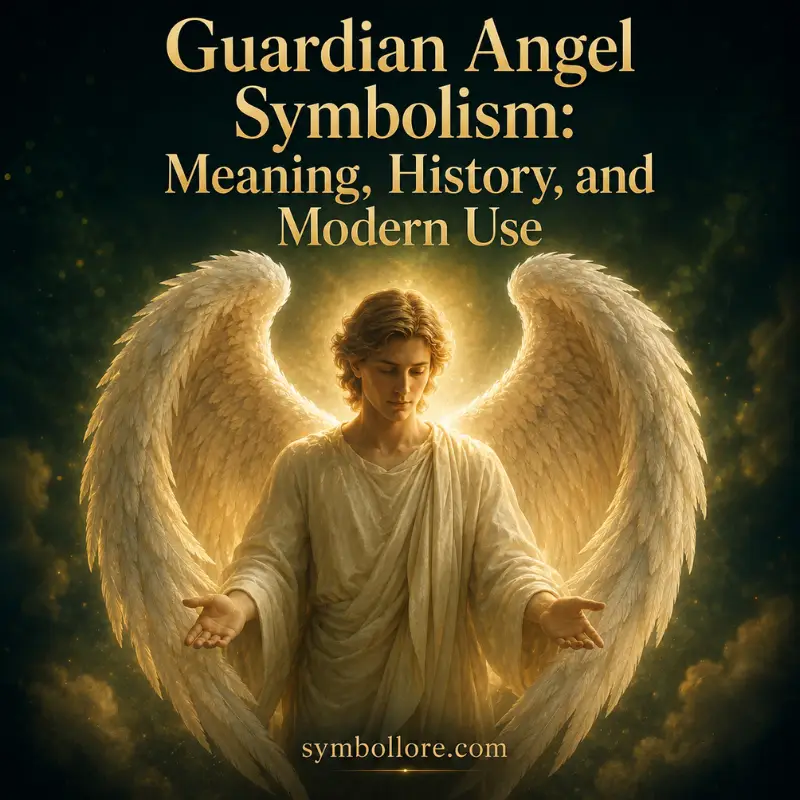
At its core, guardian angel symbolism expresses the hope that benevolent care surrounds human life. The guardian may appear as a heavenly being, an ancestor-like presence, a moral influence, or a poetic image of love that continues across distance and death.
Context determines the most likely meaning. A devotional card may affirm religious belief. A cemetery statue may express remembrance. Meanwhile, a painting of an angel steering a child away from a cliff emphasizes vulnerability and rescue. A tattoo may describe the wearer’s survival rather than a formal religious doctrine.
The image can also represent a personal protector. In that use, the guardian gives visual form to safety, intuition, or the memory of someone whose influence still guides the living.
Divine Protection and Spiritual Guidance
Protection is the symbol’s clearest theme. Artists often place an angel behind, above, or beside a smaller figure. That arrangement creates a visual barrier between danger and the person at risk. Outstretched arms, enclosing wings, and downward gazes strengthen the sense of watchful care.
Guidance adds a second layer. The angel does not always remove danger. Instead, the figure may point toward a path, raise a warning hand, or lead a traveler forward. Therefore, the image can suggest help that respects human choice.
This distinction matters. Protection implies shelter, while spiritual guidance implies direction and responsibility. Many religious interpretations combine the two: help may be available, yet people must still make ethical decisions. Readers interested in related imagery can compare these themes with
symbols of grace in faith and art.
Psalm 91 and Matthew 18:10: Christian Foundations
Christian discussions often begin with Psalm 91:11, which says that God commands angels to guard a person in their ways. Matthew 18:10 also warns against despising children because “their angels” behold the Father’s face. However, interpreters disagree about whether these passages prove that every individual receives one permanently assigned angel.
The BibleGateway discussion of biblical angels
notes that scripture supports angelic protection more clearly than the popular image of one named companion for each person. Catholic doctrine goes further.
Paragraph 336 of the Catechism of the Catholic Church
teaches that believers receive angelic care and intercession through life.
Consequently, the winged guardian has a strong Christian foundation, but not every church interprets that foundation in the same way. Careful writing should identify the particular tradition instead of calling one interpretation universally Christian.
Guardian Figures in Jewish and Islamic Traditions
Judaism includes many angels, yet the popular idea of a private, independent companion does not describe every Jewish teaching.
A Chabad explanation of guardian angels
describes an angel, or malach, as a messenger who carries out God’s will. It says the familiar personal-guardian concept does not belong to its account of Jewish theology, although God may send angels to help people.
Islam also describes angelic protection.
refers to successive angels before and behind a person, protecting by Allah’s command. The plural and the emphasis on divine command differ from the Western image of an autonomous companion.
These traditions share ideas of heavenly service and protection. Nevertheless, their theology, terminology, and devotional practices differ. A generic winged figure can evoke all three Abrahamic traditions in modern culture, but viewers should not assume that the traditions teach an identical concept.
Why Angel Wings, Halo, Light, and Swords Matter
Angel wings indicate movement, transcendence, and the ability to cross the boundary between earthly and heavenly realms. They also help viewers recognize an angel instantly. However, biblical descriptions do not always match the familiar human figure with two feathered wings.
A halo separates the sacred figure from ordinary characters. Gold or white radiance can suggest holiness, hope, revelation, or a presence that remains invisible to the protected person. Light also creates emotional contrast with cliffs, storms, darkness, or threatening creatures.
Gestures carry meaning as well. A hand on the shoulder conveys comfort. A raised hand warns. A pointing hand directs attention toward heaven or a safer path.
Finally, a sword represents defense and alertness. Flames may imply divine power, purification, or judgment rather than gentle comfort alone. Those associations overlap with broader
Religious Art: Archangel Raphael and the Book of Tobit
The story of Tobias and the Archangel Raphael helped shape the guardian image in Western religious art. In the Book of Tobit, Raphael accompanies Tobias on a journey, protects him, gives practical instructions, and helps restore his father’s sight. Catholic and Orthodox traditions include Tobit in their biblical canons, while many Protestant traditions classify it as deuterocanonical or apocryphal.
Artists turned the journey into a model of guided human life. Raphael often walks beside Tobias, holds his arm, or watches him cross difficult ground. A fish, dog, walking staff, or river identifies the story.
The Metropolitan Museum of Art describes Thomas Wilmer Dewing’s
as a treatment of Tobias’s pilgrimage with Raphael. Likewise, the National Gallery of Art’s guardian images frequently show a large winged adult guiding a child. Over time, artists simplified the biblical traveler into the universally recognizable protected child.
Guardian Angels as Moral Conscience in Stories and Film
Stories often turn the guardian into an external voice of moral conscience. The character may warn a protagonist, reveal the consequences of a choice, or restore hope after failure. This narrative device works even for audiences who do not treat angels as literal beings.
In popular culture, guardian angel symbolism can also represent a mentor, rescuer, fortunate coincidence, or loved one who appears at a decisive moment. Comedy sometimes portrays guardians as inexperienced helpers. Drama usually makes them witnesses to grief, danger, or moral change.
These stories preserve an important feature of older art: the guardian influences but does not control. The human character must choose. As a result, angel narratives often concern responsibility as much as rescue.
Guardian Angel Tattoo and Memorial Jewelry
A guardian angel tattoo can express faith, survival, courage, or remembrance. Some designs show an angel shielding a child. Others combine wings with a name, date, cross, clock, rose, or military insignia. A darker design with a sword may emphasize strength, while folded wings and bowed heads suggest mourning.
Placement also changes the message. A large back piece can make the wings seem to belong to the wearer. A small wrist or chest design feels more private. Meanwhile, memorial jewelry often uses a wing, feather, halo, or engraved phrase to keep a deceased person symbolically close.
Not every wearer claims a supernatural encounter. For many, the guardian represents a parent, friend, first responder, or inner strength. Protective eyes sometimes appear in the same designs, although their traditions differ. Compare them with these
before combining symbols.
Feather Symbolism, Dreams, and Modern “Signs”
White feathers, flashes of light, unusual dreams, and repeating numbers often appear in modern discussions of angels. People may interpret them as reassurance after bereavement or confirmation during a difficult decision. Such experiences can feel meaningful, especially when they connect with prayer or memory.
However, a feather or number sequence does not objectively prove an angelic presence. Feathers have ordinary natural causes, while the human mind readily notices patterns after assigning importance to them. Religious authorities also vary in their acceptance of claimed signs.
Dreams require similar care. An angelic dream may reflect comfort, fear, conscience, grief, or a desire for direction. Its emotional message can still matter without making the dream a prediction. Therefore, readers can respect personal meaning while distinguishing it from evidence or established doctrine.
How to Interpret Guardian Angel Imagery Responsibly
Start with the object’s setting. A church icon, Renaissance painting, tattoo, greeting card, and cemetery sculpture follow different conventions. Next, identify the figure’s action. Does the angel shield, point, carry, watch, or fight? Action usually reveals more than appearance alone.
Then examine the attributes. Wings suggest heavenly identity. Light signals sacred authority or hope. A sword implies vigilance. A staff suggests travel or office. Children emphasize vulnerability, while roads and bridges frame life as a journey.
Finally, ask who created the image and for whom. A museum label may connect it to a specific text. A family may use the same motif as a private memorial. Neither interpretation automatically cancels the other, but they belong to different levels of meaning.
Most importantly, separate three questions:
- What does the image conventionally symbolize?
- What does a particular religious tradition teach?
- What does the symbol mean to its owner or viewer?
That method allows for respectful interpretation without treating every personal association as historical fact.
Frequently Asked Questions
Guardian angel symbolism generally means protection, guidance, comfort, hope, or continued care. Religious viewers may understand the guardian as a real spiritual being. Other viewers may see it as a symbol of conscience, a deceased loved one, a mentor, or the strength that helped someone survive hardship.
The Bible describes angels protecting and assisting people. Psalm 91:11 and Matthew 18:10 frequently appear in discussions of guardians. However, Christians disagree about whether these passages establish one permanently assigned angel for every person. Catholic tradition explicitly teaches individual angelic care, while some Protestant interpreters remain cautious.
Angel wings commonly represent heavenly identity, freedom, speed, transcendence, and movement between divine and earthly realms. In protective images, enclosing wings can also suggest shelter. Still, the familiar two-winged human figure developed through artistic convention and should not describe every angelic form mentioned in religious texts.
A guardian angel tattoo may symbolize faith, personal protection, survival, courage, or remembrance. An angel with a child emphasizes care, while a sword adds strength and vigilance. Names and dates often turn the image into a memorial. The wearer’s explanation remains more reliable than any universal tattoo dictionary.
No objective evidence establishes that feathers or repeating numbers prove an angelic presence. Some people treat them as personal reminders of prayer, hope, or deceased loved ones. Others regard them as coincidence and normal pattern recognition. Their emotional value should not be confused with verifiable religious or scientific evidence.
Such a dream may reflect a need for safety, reassurance, direction, or moral clarity. It can also arise during grief or uncertainty. Religious dreamers may interpret it spiritually, while psychological interpretations focus on memory and emotion. The dream’s setting and the angel’s actions usually offer the most useful clues.
Conclusion
Ultimately, guardian angel symbolism gives visible form to protection, guidance, hope, and remembrance. Its winged figures draw from religious texts, devotional traditions, and centuries of art, yet modern people also adapt them for tattoos, memorials, and stories. The most reliable interpretation considers the image’s attributes, cultural setting, religious tradition, and personal context instead of assuming one universal meaning.