
Hannya mask symbolism centers on jealousy, anger, sorrow, obsession, and the emotional transformation of a woman into a demon. The horned face comes from Japanese Noh drama, where it represents a character whose destructive resentment has not erased her pain or humanity.
Therefore, the Hannya is more than a frightening monster. Its expression can shift from fury to grief as the actor changes the mask’s angle. Modern tattoos may add protection, survival, or self-mastery, but those meanings should remain distinct from the mask’s theatrical source.
Quick Answer
Hannya mask symbolism represents jealousy, resentment, grief, and the destructive transformation caused by uncontrolled attachment. In Noh theater, the mask depicts a female demonic character who remains sorrowful beneath her rage. Modern tattoos may also represent survival, warning, protection, or mastering painful emotions, although those interpretations are personal rather than universal stage meanings.
TL;DR
- The Hannya represents anger shaped by jealousy, grief, and obsessive attachment.
- Its eyes and brow retain sorrow beneath the demonic expression.
- Noh performers change its apparent emotion through angle, light, and movement.
- White, red, and dark masks relate to roles, not one universal color code.
- Modern tattoos can add protection, resilience, warning, or personal transformation.
Hannya Meanings at a Glance
| Context or Feature | Common Meaning | Important Distinction |
|---|---|---|
| Traditional Noh role | Female demonic spirit shaped by resentment | It is a specific theater mask, not every Japanese demon |
| Horns and fangs | Emotional and supernatural transformation | They show a changed human figure, not simple brute strength |
| Sorrowful eyes | Grief, humiliation, or attachment | Humanity remains visible beneath the anger |
| Raised angle | Force, rage, or confrontation | The effect comes from performance and lighting |
| Downward angle | Pain, regret, or sorrow | The fixed mask does not physically change |
| White, red, or dark treatment | Character, role, dignity, passion, or darkness | Colors do not form one universal transformation scale |
| Modern tattoo | Warning, survival, emotional control, or protection | The wearer and complete composition determine the meaning |
What Does Hannya Mask Symbolism Mean?
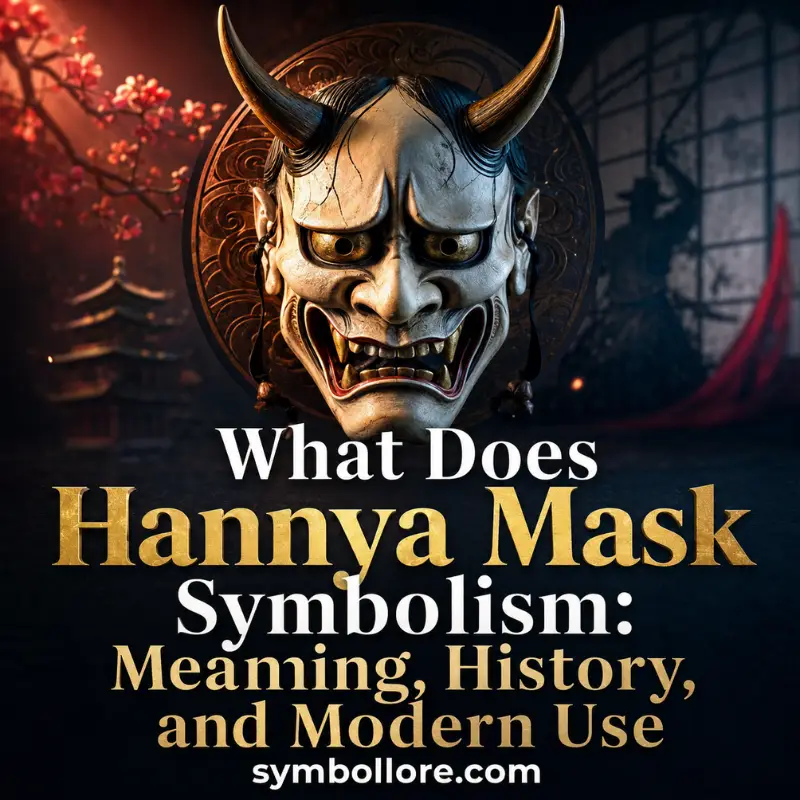
Hannya mask symbolism expresses what can happen when jealousy, humiliation, grief, and attachment grow destructive. The face belongs to a female demon, yet its suffering remains visible. Consequently, it communicates both a warning about uncontrolled emotion and compassion for the person trapped within it.
The mask’s horns and fangs show transformation. Meanwhile, its strained eyes and brows preserve human pain. This contrast prevents the Hannya from functioning as a flat emblem of evil.
In modern American art, the symbol may also express surviving betrayal, acknowledging anger, or refusing to let past suffering control the future. Those interpretations work best when creators identify them as personal developments rather than fixed ancient rules.
The Hannya in Noh Theater
The Hannya belongs first to Noh theater, a classical Japanese dramatic form that combines music, chanting, dance, costume, and controlled movement. The Nohgaku Performers’ Association explains that
Noh masks represent character types,
including women, spirits, deities, and demons.
Carvers traditionally shape a mask from one block of wood. They then use pigment, carved planes, and small differences around the eyes and mouth to create expressions that respond to light. The Hannya’s horns, metallic-looking eyes, and exposed teeth identify its demonic role.
An Edo-period Hannya in the British Museum
uses painted wood and represents a once-beautiful woman changed by jealous anger. The museum also connects that object with Aoi no Ue and Dōjōji.
Jealous Rage and Emotional Duality
Jealous rage drives many Hannya characters, but rage does not fully define them. The mask also conveys emotional duality: fury fills its mouth and teeth, while suffering remains around its brow and eyes.
This design asks the audience to recognize a cause behind the threat. Rejection, humiliation, loneliness, obsession, or betrayal may begin the transformation. However, the resulting violence still causes harm. Sympathy does not erase responsibility.
That tension gives the mask lasting power. It can represent both the person who suffers and the danger created when suffering turns outward. Therefore, the Hannya works as a warning without becoming a simple picture of wickedness.
How Teru and Kumoru Change the Expression
A skilled performer changes the apparent expression by moving the mask in relation to the stage lights. The Nohgaku Performers’ Association calls the brightening and clouding effects teru and kumoru.
When the actor raises or faces the mask toward the light, stronger highlights can make the eyes, horns, and teeth look forceful. The face appears confrontational or enraged. Conversely, tilting it downward creates shadows around the eyes. The same carved face can then look wounded or tearful.
This technique does not belong exclusively to Hannya. Noh performers use subtle head movements with several mask types. Still, the Hannya’s sharply divided features make the emotional change especially dramatic.
Aoi no Ue, Dōjōji, and Kurozuka
Three famous plays reveal why the Hannya cannot carry only one narrow meaning.
In Aoi no Ue, Lady Rokujō’s wounded pride and jealousy become a vengeful spirit.
The Noh Plays Database account of Aoi no Ue
describes an elegant noblewoman whose anguish turns into a female ogre. However, the ending also allows her spirit to regain peace.
Dōjōji connects obsessive pursuit with a woman’s serpent-like transformation beneath a temple bell. Fire, the bell, and the snake form are central to the drama. Readers can compare that destructive imagery with the broader
meanings of fire in stories and art.
In Kurozuka, an isolated woman reveals herself as a mountain demon. Yet the character’s loneliness and sadness remain important, even during her frightening transformation.
What Hannya Mask Colors Actually Mean
Hannya colors help define theatrical roles, mood, status, and performance tradition. However, many online charts incorrectly turn white, red, and black into a universal three-step transformation system.
A Noh terminology guide connects
three female-demon plays with distinct color contexts.
White suits the noble Lady Rokujō in Aoi no Ue. Red supports the passion of Dōjōji, while black reinforces the darkness surrounding the demoness in Kurozuka.
Therefore, color should be read with the play and mask type:
- White or pale: dignity, refinement, restrained suffering, or a noble role
- Red: passion, rage, exposed emotion, or dramatic intensity
- Dark red or black: danger, isolation, darkness, or a more monstrous role
- Blue, green, gold, or purple: usually modern artistic or tattoo choices
Color has no reliable meaning without context. SymbolLore’s
can clarify broader modern associations, but it should not replace Noh tradition.
Why the Name Hannya Is Connected With Wisdom
The name creates an intriguing contrast because hannya also relates to prajñā, a Buddhist term commonly translated as wisdom. However, scholars and reference works offer more than one explanation for how the demon mask received that name.
The Japanese Architecture and Art Net Users System entry on
notes a tradition connecting the name with Hannya-bō, a mask maker active around the late fifteenth or early sixteenth century. Other explanations connect it with Buddhist language or chants used in theatrical stories.
Consequently, the “wisdom versus jealousy” contrast makes a powerful modern interpretation. Still, it should not be presented as the proven reason for the name.
Why Hannya Is Not an Oni Mask
A Hannya is a specific dramatic mask for a woman transformed into a demonic figure. An Oni mask represents a much broader category of ogre-like beings found across Japanese religion, festivals, folktales, and art.
Both designs may have horns, fangs, intense eyes, and threatening expressions. However, their identities differ. Hannya retains a clear connection with human emotion, female roles, and particular Noh stories. Oni can vary widely in gender, behavior, purpose, and appearance.
Therefore, describing Hannya as simply “a female Oni” loses important theatrical context. Modern artists may blend the designs, but a hybrid artwork should not redefine the traditional categories.
Hannya Tattoo Meaning in Japanese Irezumi
A Hannya tattoo commonly represents jealousy, emotional pain, destructive passion, warning, or transformation. In Japanese irezumi, however, the complete composition matters more than one isolated color.
Snakes can strengthen themes of danger, obsession, or rebirth. Peonies may balance ferocity with beauty. Cherry blossoms can add impermanence, while fire intensifies passion and destruction. A dragon introduces another major tradition, so artists should study
Japanese dragon tattoo meanings
before combining the figures.
In tattoos, hannya mask symbolism may also express surviving betrayal or mastering anger. Placement does not create a universal meaning, although a large back, thigh, or arm design gives the artist more space for proper expression and background elements.
Before choosing a design, ask:
- Is the mask threatening, sorrowful, or balanced?
- Does the color follow a theatrical reference or personal preference?
- What do the surrounding flowers, flames, snakes, or waves add?
- Is the intended message suffering, warning, protection, or recovery?
Is Hannya Protective, Evil, or Good Luck?
The Hannya is neither a Christian-style devil nor a universal good-luck charm. Its theatrical source presents a dangerous female spirit whose anger grows from human suffering and attachment.
Some tattoo wearers and modern collectors use the fierce face as protection. In that interpretation, the frightening expression turns outward and warns danger away. Others wear it as a reminder to control jealousy, resentment, or obsessive behavior.
Those meanings remain valid as personal symbolism. However, the Hannya does not automatically guarantee protection, luck, or spiritual power. Likewise, calling it satanic imposes an unrelated religious category on a Japanese theatrical figure.
Using Hannya Imagery With Cultural Respect
Respectful use begins with learning what the mask represents. Buying Japanese-inspired décor, commissioning a tattoo, or drawing the face does not automatically constitute cultural appropriation. Problems arise when someone erases the source, invents “ancient” meanings, mocks the culture, or markets an imitation as an authentic performance object.
Use this checklist:
- Identify the design as Japanese and connected with Noh.
- Keep Hannya distinct from Oni, samurai face armor, and unrelated demons.
- Avoid claiming that every color follows an ancient fixed code.
- Credit named plays when a design clearly uses their characters or objects.
- Work with an artist who understands Japanese composition.
- Describe protection or personal recovery as a modern interpretation.
- Do not label reproductions as genuine stage masks without evidence.
This approach preserves creative freedom while keeping hannya mask symbolism connected to its cultural source.
FAQs
It represents jealousy, resentment, grief, obsessive attachment, and a woman’s transformation into a demonic figure. However, its sorrowful features show that pain and humanity remain beneath the rage. Modern art and tattoos may add warning, protection, survival, or emotional self-control.
The Hannya portrays a dangerous demonic character, but “evil” alone oversimplifies it. The mask also reveals grief, humiliation, and emotional suffering. Moreover, it comes from Japanese Noh rather than Christian demonology, so terms such as satanic do not accurately describe its cultural role.
In theatrical contexts, red can emphasize passion, exposed anger, or a forceful female-demon role, especially in associations with Dōjōji. It is not automatically the middle stage of one fixed transformation process. In tattoos, red may also be a modern choice for intensity, courage, or visual contrast.
Yes. No traditional rule restricts the design to one gender. A woman may choose it to represent anger, survival, grief, betrayal, emotional complexity, or self-mastery. The wearer’s meaning should complement the mask’s Japanese theatrical background rather than replace it with an invented universal claim.
Hannya identifies a specific Noh mask linked with female demonic transformation, jealousy, resentment, and sorrow. Oni refers to a much broader category of ogre-like beings. Although both may have horns and fangs, their stories, roles, appearances, and cultural uses are not interchangeable.
A dream may reflect anger, jealousy, fear, betrayal, hidden pain, or concern about losing emotional control. However, dreams do not have fixed predictive meanings. Consider who wore the mask, whether it threatened or protected you, and which emotion remained strongest after waking.
Conclusion
Hannya mask symbolism joins jealousy, resentment, grief, danger, and emotional transformation in one unforgettable face. Its horns and fangs reveal destructive rage, while its eyes preserve the sorrow of the human figure underneath.
The mask’s strongest meaning comes from Noh theater, its performance techniques, and plays such as Aoi no Ue, Dōjōji, and Kurozuka. Modern tattoos can add protection, resilience, or self-mastery. Still, accurate interpretation should separate those personal meanings from established theatrical context.


