
Green frog symbolism usually combines two layers: the frog’s changing life cycle and green’s links with growth, nature, health, and renewal. As a result, the image often suggests adaptation, recovery, abundance, or a fresh start.
Yet a living green frog is not a universal omen. It may be the North American species called the green frog, a green treefrog, or another naturally green species. Cultural history, dreams, tattoos, and doorstep encounters also produce different meanings. A reliable interpretation therefore begins with context, not a fixed spiritual dictionary.
Quick Answer
Green frog symbolism most often represents growth, transformation, renewal, adaptability, rain, and good fortune. These associations come from metamorphosis, wet habitats, seasonal calls, abundant eggs, and the modern meaning of green. However, the symbol changes by culture and setting; a real frog at home usually has an ecological reason, while dreams and spiritual readings remain personal interpretations.
TL;DR
- Green adds growth, health, nature, and prosperity to common frog meanings.
- Metamorphosis makes frogs vivid symbols of personal change.
- Egyptian and Korean traditions give frogs very different roles.
- A house visitor usually follows insects, shade, or moisture.
- Dreams and sightings invite reflection, not guaranteed predictions.
Green Frog Meanings at a Glance
| Context | Likely Meaning | Important Distinction |
|---|---|---|
| General modern use | Growth, renewal, adaptability | An interpretation, not a universal doctrine |
| Metamorphosis | Deep personal change | Many, but not all, frogs have a free-swimming tadpole stage |
| Green color | Nature, health, hope, prosperity | Green may also suggest envy, immaturity, or decay |
| Water and rain | Cleansing, fertility, seasonal return | Meaning developed from habitat and weather patterns |
| Ancient Egyptian object | Birth, fertility, protection | Applies to a specific historical tradition |
| Korean folktale | Disobedience, regret, filial duty | Contrasts with common prosperity readings |
| Dream | Transition or emotional processing | Action, feeling, and memory matter more than color alone |
| Home encounter | Change in personal symbolism | The frog may simply seek food, shelter, or moisture |
What Green Frog Symbolism Means
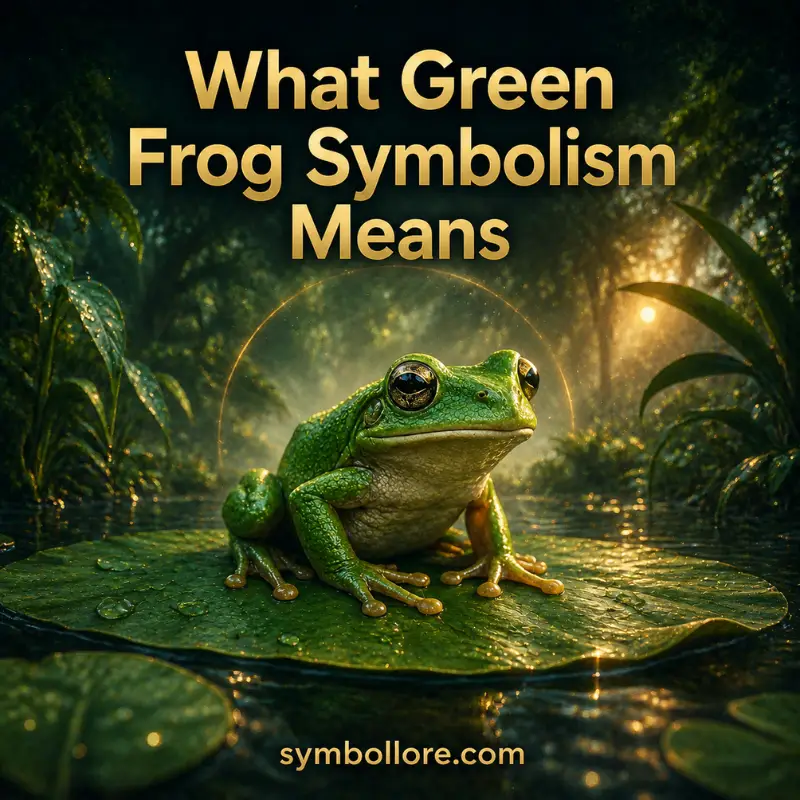
Green frog symbolism joins an animal known for dramatic development with a color widely associated with living plants. The resulting image commonly expresses growth that requires adaptation. It can also represent renewed energy after an unsettled period.
A useful green frog meaning should fit its setting. A logo may express environmental care, while jewelry may mark recovery or hope. In contrast, a story can assign the animal an entirely different moral role. Readers seeking the foundation beneath these variations can compare the site’s
broader amphibian associations.
The symbol works best as a metaphor, not a forecast. It can help someone describe change, but it cannot promise health, pregnancy, money, or a favorable event.
Why Frog Metamorphosis Suggests Transformation and Renewal
Frog metamorphosis makes transformation and renewal the animal’s strongest modern associations. In the familiar life cycle, an aquatic tadpole develops legs, changes its feeding system, loses its tail, and becomes an air-breathing froglet. The animal does not merely become larger; its body and way of living change.
The National Park Service overview of frogs and toads
explains this progression and also notes frogs’ ecological sensitivity. Therefore, the metaphor can represent a new identity, skill set, or environment rather than a small adjustment.
Still, the comparison has limits. Human change rarely follows a neat biological schedule. The symbol can frame a transition, but it does not prove that every difficult period will produce a desired result.
What the Color Green Adds to Frog Symbolism
Green strengthens associations with nature, growth, health, balance, and fresh beginnings. It also carries a financial connection in the United States because American paper money is commonly called “green.” Consequently, some modern designs use a green frog to suggest prosperity or good luck.
However, green is not automatically positive. It may represent envy, inexperience, sickness, artificiality, or something not yet ripe. Shade and setting also matter. A fresh leaf-green frog can feel lively, while a dark or unnatural green may create unease.
SymbolLore’s wider guide to color meanings
shows why color needs context. The frog’s posture, surroundings, and purpose should guide the interpretation alongside its hue.
Green Frog, Green Tree Frog, or Any Green-Colored Frog?
A “green frog” can mean three different things. It may identify the North American species Lithobates clamitans, refer to a green tree frog, or simply describe the color of an unrelated species. These categories should not be treated as biologically identical.
The National Park Service green frog profile
describes Lithobates clamitans as a semiaquatic frog found near shallow water. Despite its common name, the animal can appear green, bronze, brown, or a mixture. Ridges run from behind its eyes along its back.
By contrast, the
National Park Service’s green treefrog guide
describes an arboreal frog with adhesive toe pads. It may appear around windows while hunting insects attracted to lights. Identifying the animal first prevents a symbolic interpretation from being built on the wrong species.
Water Symbolism, Rain, Fertility, and Abundance
Water symbolism links frogs with cleansing, emotional movement, seasonal return, and life. Many frogs breed in ponds, wetlands, streams, or temporary pools. Their calls may become especially noticeable during warm, wet conditions. People can therefore connect their appearance with rain and renewed landscapes.
Fertility and abundance arise from the same visible biology. Frog eggs may appear in large groups, while tadpoles can become numerous in suitable water. These facts help explain the association, but they do not make a sighting a pregnancy or financial prediction.
Frogs also serve as an environmental indicator because their lives connect aquatic and land habitats. Their symbolic relationship with water can therefore express ecological responsibility.
The blue crab’s water-linked associations
offer a useful contrast centered on protection, home, and coastal identity.
Green Frogs Across Cultures: Heqet and the Korean Green Frog
Cultural evidence shows why no single interpretation works everywhere. In ancient Egypt, frog imagery could relate to birth and protection.
The British Museum’s Heket record
identifies Heqet as a frog goddess who protected women during childbirth. Surviving amulets provide material evidence for that historical connection.
The Korean green frog carries a different lesson.
According to the Academy of Korean Studies account of the folktale,
a disobedient frog always does the opposite of what its mother asks. After her death, it follows her final instruction, regrets the result, and cries beside her riverside grave whenever rain threatens it.
Consequently, the Korean story supports meanings such as remorse, filial duty, and habitual opposition. It does not simply repeat modern claims about wealth or healing.
Green Frog Spiritual Meaning Without Fixed Omens
Green frog spiritual meaning usually centers on renewal, emotional recovery, adaptability, and reconnection with nature. Someone entering a new stage may use the frog as a reminder to change habits while preserving what still works.
That personal use can be meaningful without becoming a claim about supernatural certainty. A repeated sighting does not prove that the universe has promised success. Likewise, the animal cannot diagnose spiritual imbalance or guarantee healing.
A grounded spiritual reading uses the encounter as a prompt. Notice what change already exists, which conditions support growth, and where flexibility would help. Then choose a practical response. The value lies in the reflection and action, not in predicting an outside event.
Seeing a Green Frog at Home: Meaning and Biology
A green frog near a house usually has a practical reason for being there. Porch lights gather insects, while gardens, drains, shaded walls, and damp ground offer food or shelter. A treefrog may climb a window because its toe pads make vertical surfaces accessible.
People may still interpret the encounter as a symbol of welcome change or a healthier relationship with nature. However, that personal layer should not replace wildlife care.
If a frog appears near your home:
- Keep pets and children at a distance.
- Turn off unnecessary outdoor lights that concentrate insects.
- Avoid pesticides, salt, and household chemicals.
- Leave the frog alone when it can exit safely.
- Contact a local wildlife professional if it appears injured or trapped.
Avoid unnecessary handling. Residue from lotion, soap, food, or chemicals can harm sensitive amphibian skin.
Green Frog Dream Meaning by Context
Green frog dream meaning depends more on the dream’s action and emotional tone than on a universal symbol list. A peaceful frog beside clear water may reflect readiness for change. Meanwhile, a trapped or injured frog may express concern about vulnerability, delay, or environmental harm.
Use four details to examine the dream:
- Action: Was the frog jumping, hiding, calling, escaping, or remaining still?
- Setting: Did it appear in water, a house, a garden, or an unfamiliar place?
- Emotion: Did you feel calm, disgusted, protective, fearful, or amused?
- Recent experience: Had you seen a frog, watched a film, or discussed change recently?
These clues produce a personal interpretation. They do not reveal a fixed prophecy or clinically proven subconscious message.
Green Frog Tattoo Meaning and Responsible Design
Green frog tattoo meaning commonly includes growth, resilience, humor, environmental care, or a major life transition. Design details sharpen the message. A tadpole-to-frog sequence emphasizes development, while rain or pond plants add renewal. A leaping pose can suggest decisive movement.
Color also changes the tone. Bright green may communicate vitality or playfulness. Darker shades can feel mysterious, earthy, or guarded. Meanwhile, a realistic Lithobates clamitans design may express attachment to local wetlands or wildlife.
Research borrowed cultural forms before using them. An Egyptian-style amulet or community-specific Indigenous design carries more history than a generic frog illustration. Personal art should not be presented as an authentic sacred emblem without the relevant cultural knowledge or relationship.
How to Interpret the Symbol Responsibly
A responsible interpretation combines observable facts with cultural and personal context. It allows meaning without turning an ordinary animal, artwork, or dream into guaranteed instruction.
Use this five-step method:
- Identify the subject. Determine whether it is a species, dream figure, charm, story, or design.
- Locate the context. Note the culture, period, setting, and creator when known.
- Connect visible traits. Consider color, water, metamorphosis, movement, and behavior.
- Separate evidence from belief. Label documented history, modern convention, and personal intuition accurately.
- Choose a useful response. Reflect, research, protect the animal, or revise the design as appropriate.
This framework keeps the interpretation specific, culturally respectful, and open to more than one meaning.
FAQs
A green frog can represent luck because frogs are associated with rain, fertility, renewal, and abundance, while green may suggest prosperity. However, a sighting does not predict a favorable event. Its strongest meaning comes from the observer’s culture, circumstances, and personal associations.
The Bible does not assign a separate meaning to green frogs. Frogs appear as a plague in Exodus 8 and as a comparison for unclean spirits in Revelation 16:13. Those passages support warning or disruption within specific narratives, not a rule that every real frog is a bad omen.
Symbolically, a frog jumping on you could represent sudden change, unwanted attention, or an opportunity that feels immediate. Practically, it may simply be escaping danger or moving toward shelter. Your reaction and the setting provide more useful clues than the jump alone.
Green frogs sometimes symbolize money because green is associated with American currency and frogs can represent abundance or favorable conditions. This is mainly a modern combination of color and animal meanings. It does not originate from one universal tradition or predict financial gain.
A small green frog may represent early growth, vulnerability, potential, or a change that has only begun. In nature, however, size may reflect age or species rather than a message. Consider whether the frog appears in a dream, design, story, or real habitat.
A green frog can function as a warning in a story, dream, or personal symbol, especially when the scene feels threatening or unhealthy. In the environment, declining or absent frog populations may also warn of habitat problems. One individual sighting, however, does not prove danger or supernatural interference.
Conclusion
Green frog symbolism commonly brings together growth, adaptation, renewal, water, and the possibility of a fresh stage. Metamorphosis and habitat explain many of these associations, while the color green adds nature, health, prosperity, and occasional negative meanings.
Still, species, culture, and setting change the interpretation. An Egyptian amulet, Korean folktale, dream, tattoo, and frog on a window do not communicate the same thing. Begin with the real context, separate evidence from personal belief, and use the symbol as a thoughtful prompt rather than a guaranteed prediction.