
Green dragon symbolism usually combines the dragon’s immense power with green’s links to growth, living landscapes, healing, and renewal. However, that broad answer needs context. A Chinese cosmic guardian, a medieval European monster, and a new fantasy character do not share one fixed color code.
The strongest historical connection belongs to the East Asian Azure Dragon, whose traditional color sits between modern English blue and green. Elsewhere, green often adds newer meanings drawn from plants, ecology, personal spirituality, dreams, or a tattoo wearer’s chosen story.
Quick Answer
Green dragon symbolism most often represents powerful growth, nature, renewal, protection, and controlled vitality. In Chinese cosmology, it can point more specifically to Qinglong, the blue-green guardian linked with the east, spring, and Wood. In dreams, tattoos, spirituality, and fiction, the meaning depends on the dragon’s behavior, style, setting, and creator’s intent.
TL;DR
- Green adds growth, fertility, healing, and untamed nature to dragon power.
- Qinglong traditionally guards the east and corresponds with spring and Wood.
- Historical qing spans colors that English divides into blue and green.
- Western traditions never established one universal green-dragon code.
- Dreams and tattoos require personal and visual context.
Green Dragon Meanings at a Glance
| Context | Likely meaning | Important distinction |
|---|---|---|
| Modern general use | Growth, vitality, nature, renewal | A broad color-based reading |
| Chinese cosmology | Eastern guardian, spring, Wood, cosmic order | Refers to Qinglong, not every green-colored dragon |
| Japanese tradition | Seasonal power, water, natural abundance | Seiryu adapts the wider East Asian guardian system |
| Medieval European art | Danger, chaos, sin, or ornament | Green had no single fixed dragon meaning |
| Modern fantasy | Forests, poison, cunning, healing, or earth | Each fictional setting creates its own rules |
| Personal spirituality | Inner strength, recovery, ecological connection | A modern interpretation, not universal doctrine |
| Dream | Growth, fear, ambition, protection, or change | Emotion and action matter more than color alone |
| Tattoo | Chosen power, resilience, renewal, cultural identity | Style and supporting imagery shape the message |
What Does Green Dragon Symbolism Mean?
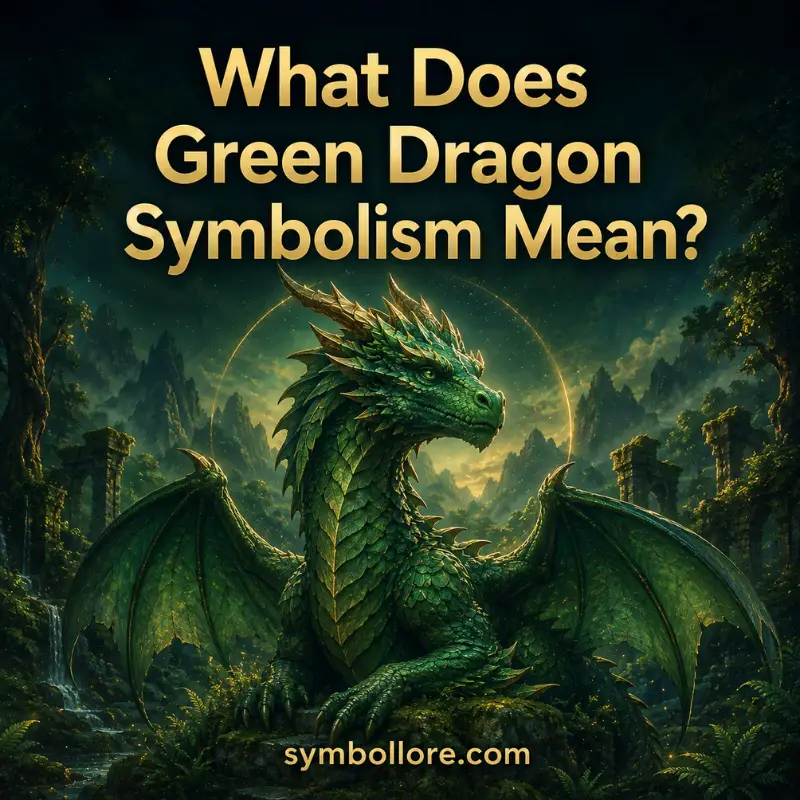
The core green dragon meaning is life force with unusual scale. For example, green supplies familiar ideas such as vegetation, fertility, health, freshness, and new growth. Meanwhile, the dragon contributes authority, danger, guardianship, wisdom, or elemental power. Together, they often suggest nature that can create, protect, and overwhelm.
Still, no global tradition owns that definition. A forest guardian in a novel may symbolize ecological balance. In contrast, an aggressive emerald creature may signal poison, envy, or uncontrolled appetite. Therefore, start with the named culture, artwork, story, or personal purpose before treating the color as evidence.
How Green Changes the Dragon’s Meaning
Green can soften a dragon’s fiery image, yet it does not automatically make the creature gentle. Leaves and spring growth support positive ideas of nature and renewal. Rot, venom, illness, and jealousy can give the same hue a darker edge.
Our broader color symbolism chart
explains why setting and surrounding colors change any color reading.
For example, a green dragon curled around seedlings may protect fragile growth. The same dragon breathing toxic mist can represent corrupted nature or concealed danger. Thus, the creature’s action carries more weight than the paint alone. Shade matters too: bright green feels young and active, while deep moss green can feel old, secretive, or rooted.
The Azure Dragon in Chinese Cosmology
The strongest documented historical match is the Azure Dragon, or Qinglong (青龍). It belongs to the Four Symbols, a set of celestial guardians organized by direction and season. The dragon governs the eastern quarter; the wider correspondence joins the east and spring with the wood element, upward growth, and young yang energy.
This system is relational rather than a simple color dictionary. Meanwhile, the White Tiger marks the west, the Vermilion Bird the south, and the Dark Warrior the north. Cambridge scholar David Pankenier’s work on
early Chinese astronomy and cosmology
connects the eastern celestial field with the Azure, or Wood, spirit.
Readers can compare that visual logic with other Chinese symbols in art,
where companions, placement, and period also shape meaning.
Why Qing Means More Than Simply Green
Calling Qinglong a “green dragon” is useful but incomplete. The Chinese term qing does not map neatly onto one modern English swatch. Linguist Victor Mair explains that historical qing could cover
both blue and green, plus darker ranges.
Consequently, translators also use “azure,” “blue-green,” or “blue.”
This language point prevents a common error. Qinglong is not merely a dragon painted leaf green. It is a named cosmic figure whose color, direction, season, and celestial position work together. A blue-green dragon in that system can suggest spring’s return, ordered change, and rising vitality. Yet a random green creature in modern art does not become Qinglong by color alone.
Chinese Dragon Power Beyond Color
A Chinese dragon often carries meanings that exceed its hue. The Smithsonian’s National Museum of Asian Art notes that, by the Han dynasty, dragons were understood as divine water creatures. They could enter clouds, control weather, and bring life-giving rain. The museum also links them with
Therefore, an eastern green dragon may combine seasonal growth with rain, authority, or agricultural well-being. However, object type still matters. For example, a court robe, tomb image, temple ornament, and popular illustration serve different purposes. Likewise, a jade dragon may draw meaning from the material, date, owner, and use. Green stone does not automatically identify the celestial guardian.
Japanese Seiryu and East Asian Adaptations
In Japan, the related guardian is called Seiryu. It preserves the eastern and seasonal logic of the broader East Asian system, yet Japanese art and religion developed their own settings. Meanwhile, Korean Cheongryong and Vietnamese Thanh Long show how the figure traveled through related, not identical, traditions.
Japanese dragon art can stress water, clouds, seasonal movement, and natural abundance. For instance, the Smithsonian describes Sōtatsu’s early seventeenth-century
paired dragons and seasonal cycles:
one rises in spring, while the other descends in autumn. That example supports a growth reading without claiming that every Japanese green dragon has one fixed spiritual message.
Western Dragons and Modern Fantasy
Western dragon traditions often cast the creature as a threat, treasure guardian, or test for a hero. Yet color was not a stable medieval code. The British Library’s survey of
dragons in medieval manuscripts
shows varied forms and functions, including symbols, heraldic devices, and decoration. Therefore, “green always meant evil” is too rigid.
Modern fantasy uses color more systematically, but each fictional world sets its own rules. Green dragons may inhabit forests, breathe poison, practice deception, heal damaged land, or defend wildlife. Those meanings belong to the author, game, or franchise. Consequently, readers should check that fictional canon instead of projecting its rules backward onto medieval Europe or across Asian cultures.
Green Dragon Spiritual Meaning Today
The green dragon spiritual meaning usually centers on strong growth, healing, grounded power, and protection of living things. Some people use the figure during meditation or personal reflection. It can represent recovery that requires courage, or strength guided toward care rather than domination.
However, these uses are modern and personal unless a named tradition supports them. Repeatedly noticing green dragons does not prove a supernatural message. Instead, treat the image as a prompt: What is growing, what needs protection, and where has power become excessive? This approach honors personal meaning without presenting private intuition as ancient fact.
Green Dragon Dream Meaning by Context
A green dragon dream can reflect growth, ambition, fear, natural energy, or a need for protection. In addition, dreams do not provide a fixed omen, so the plot and emotion matter most. A calm guardian beside a garden creates a different reading from a predator chasing the dreamer through a ruined forest.
Use four clues:
- Action: guarding may suggest boundaries; pursuit may suggest pressure.
- Emotion: awe can signal respect, while terror points toward conflict.
- Setting: forests emphasize nature; caves suggest hidden concerns or value.
- Outcome: escape, friendship, injury, or victory changes the emotional lesson.
Finally, connect those details to recent life events. The most useful interpretation tests possibilities instead of predicting the future.
Green Dragon Tattoo Meaning and Design Choices
A green dragon tattoo meaning depends first on cultural style, then on color and pose. For example, a long dragon among clouds may evoke East Asian water, weather, dignity, or seasonal vitality. In contrast, a winged European creature may stress independence, danger, survival, or fierce protection. Our detailed
explains how posture and companion motifs change the result.
Before choosing ink, write one sentence that defines your intended message. Then make the design support it. New leaves can emphasize recovery, waves can suggest adaptive power, and a guarded seed can represent protected potential. Also, research sacred or culturally specific motifs before borrowing them. Personal meaning can add to cultural context, but it should not erase it.
Feng Shui Dragon Claims Need Context
A feng shui dragon usually refers to the Azure or Green Dragon side within a landscape model. In traditional form-based approaches, the dragon and White Tiger describe protective landforms around a site. That idea differs from the modern claim that any green figurine placed in the east will automatically produce wealth.
Therefore, treat décor formulas as modern practice rather than guaranteed outcomes. If you display a dragon, choose its position for respectful visual balance and your intended reminder. Avoid aiming an aggressive figure at a bed or workspace if it feels unsettling. More importantly, do not confuse symbolic placement with evidence that an object can control health, money, or fate.
How to Interpret a Green Dragon Responsibly
Use a context-first method instead of a universal symbol list:
- Identify the source. Name the culture, artist, story, game, dream, or personal use.
- Date the object. Historical and modern meanings often differ.
- Read the whole form. Note body type, pose, setting, companions, and material.
- Separate fact from inference. Label documented tradition, artistic convention, and personal reflection.
- Check language carefully. “Azure,” “blue,” and “green” may translate qing differently.
- Respect creator intent. A fictional or tattoo design can deliberately reverse older patterns.
As a result, this method explains contradiction without forcing one answer. It also keeps a flexible symbol useful while protecting cultural detail.
FAQs
A green dragon can be positive, negative, or mixed. Growth, rain, protection, and renewal support positive readings, while poison, envy, chaos, or uncontrolled nature support darker ones. The dragon’s tradition, behavior, companions, and purpose provide a stronger answer than color by itself.
Sometimes “Green Dragon” translates Qinglong, the Azure Dragon of the East. However, they are not interchangeable in every context. Qinglong is a specific East Asian celestial guardian, while “green dragon” can describe any green-colored creature in fantasy, dreams, tattoos, advertising, or personal art.
The Bible does not establish a separate green-dragon symbol. Biblical dragon or great-serpent imagery can represent chaos, evil, or opposition to God, especially in Revelation. Combining that creature with green is a later interpretation, so it should not be presented as a fixed biblical teaching.
A friendly green dragon may suggest protected growth, trust in personal strength, or a calmer relationship with change. Still, it is not an objective prediction. Consider what the dragon guarded, how you felt, and which current relationship, project, recovery, or responsibility resembles that scene.
A green dragon tattoo can symbolize renewal, resilience, nature, healing, protection, or formidable personal power. However, the design tradition matters more than hue alone. Body shape, clouds, fire, water, plants, direction, and the wearer’s stated intention determine whether the result reads as Chinese, Japanese, European, or purely personal.
There is no evidence-based placement that guarantees luck, health, or wealth. If you follow a Feng Shui school, use guidance specific to that method and your site rather than a generic internet rule. Otherwise, place the figure where its posture, direction, scale, and personal meaning feel balanced and respectful.
Conclusion
Green dragon symbolism most often joins growth, nature, healing, and renewal with the dragon’s exceptional power. Its clearest historical form is Qinglong, whose blue-green identity belongs to an East Asian system of direction, season, and celestial order. Yet Western art, modern fantasy, dreams, spirituality, and tattoos create different readings.
For the most accurate interpretation, identify the source first. Then examine color, action, setting, companions, and date. That context reveals whether the dragon represents ordered renewal, personal protection, dangerous nature, or a meaning created for one particular work.