
Blue crab symbolism most often centers on protection, resilience, adaptability, personal boundaries, and change. These meanings come from the animal’s hard shell, strong claws, agile movement, and vulnerable molting cycle. Yet the species carries another, more firmly documented meaning in the United States: it represents Chesapeake Bay life and Maryland pride.
That distinction matters. Spiritual meanings are modern interpretations rather than universal facts. By contrast, the blue crab’s place in regional foodways, fishing communities, art, and state identity has a clear historical record. Both layers can be meaningful when they are not confused.
Quick Answer
Blue crab symbolism represents protection, resilience, adaptable progress, transformation, and connection to home. Its shell and claws suggest defense, while molting can represent growth through vulnerability. In Maryland and the Chesapeake region, the blue crab also carries a documented public meaning: regional identity, working-waterfront heritage, shared meals, and care for the Bay.
Key Takeaways
- A hard shell makes the blue crab a natural symbol of protection.
- Molting connects the animal with growth, vulnerability, and renewal.
- Sideways movement can represent flexible rather than aimless progress.
- Blue crabs express Chesapeake heritage more clearly than universal spiritual doctrine.
- Personal context should guide interpretations of sightings, dreams, tattoos, and gifts.
Blue Crab Meanings at a Glance
| Feature or Context | Possible Meaning | Important Distinction |
| Hard shell | Protection and boundaries | Defense should not become total emotional withdrawal. |
| Powerful claws | Courage and self-defense | Claws can also warn against gripping too tightly. |
| Sideways movement | Adaptability and indirect progress | The crab can swim forward; the idea is metaphorical. |
| Molting | Transformation and renewal | Growth includes a temporary period of exposure. |
| Blue claws | Calm strength and coastal identity | Color meanings vary by person and setting. |
| Estuarine habitat | Balance and movement between conditions | This is an interpretation based on a changing habitat. |
| Maryland emblem | Pride, home, and heritage | This regional meaning has documented civic roots. |
| Crab feast | Community and shared work | The meal also reflects fishing labor and local foodways. |
What Does Blue Crab Symbolism Mean?
At its core, blue crab symbolism describes strength that stays responsive. The animal is armored but mobile, defensive but not motionless, and able to live across changing levels of salinity. That combination makes it a useful personal symbol for resilience without rigidity.
The species’ scientific name, Callinectes sapidus, is commonly translated as “beautiful savory swimmer.” The name highlights movement as well as appearance. Therefore, a blue crab can represent a person who protects what matters while still adapting to new conditions. This reading is an analogy drawn from the animal; it is not a scientific claim or a single meaning shared by every culture.
Why the Shell and Claws Suggest Protection
The blue crab’s shell makes protection its clearest symbolic association. A rigid outer covering shields softer tissue, while strong claws help the animal feed and defend itself. In human terms, those features can stand for healthy limits, self-respect, and the courage to guard one’s time, home, or emotional space.
However, the symbol also carries a useful warning. A boundary protects a living center; it should not cut that center off from every relationship. Likewise, claws can defend or hold. In art and reflective practice, the crab may ask whether someone needs firmer limits or needs to loosen a fearful grip. The surrounding context determines which reading fits.
Sideways Movement and Adaptable Progress
Sideways movement gives the crab its familiar link with adaptability. Its joint structure makes lateral walking efficient, and its paddle-shaped rear legs also make the blue crab a capable swimmer. Symbolically, this suggests that progress does not always follow a straight line.
A detour, pause, or change of approach can still move a person toward a goal. For example, changing careers through part-time study may look indirect but remain purposeful. Still, the crab should not be used to glorify avoidance. The strongest reading is flexible progress: notice obstacles, adjust position, and keep the goal in view.
Molting as a Symbol of Change
Molting links the blue crab with transformation because growth requires it to shed an old exoskeleton. Immediately afterward, the crab is soft and more exposed until its new shell hardens. That real process creates a more nuanced symbol than the simple idea of “starting over.”
Growth may require leaving a structure that once offered safety. During a move, recovery, new relationship, or major life transition, a person can feel both freer and less protected. The molting crab suggests that vulnerability may be a stage of change rather than proof of failure. It also reminds us that renewal takes time; a new defense does not form instantly.
What the Blue Color Adds to the Meaning
The blue color adds ideas of calm strength, truth, water, and clear communication for many modern readers. Male blue crabs are especially known for vivid blue on their claws, while mature females often show red-tipped claws. Their shells are usually olive or blue-green rather than uniformly bright blue.
This detail keeps the symbolism honest. A living blue crab does not look like a flat blue icon, and heat turns its pigments orange-red during cooking. Therefore, blue-claw imagery works well for a message about composed strength, but orange-red crab art may emphasize energy, food tradition, or celebration instead. Color meaning depends on the form being shown.
Chesapeake Bay and Maryland Meaning
In the United States, blue crab symbolism is closely tied to Chesapeake Bay and Maryland identity. Maryland designated the species as the official state crustacean in 1989.
The Maryland State Archives’ blue crab profile
also records its place in local cooking, from steamed hard shells to crab cakes and soup.
That public status gives the crab meanings such as home, regional pride, coastal livelihood, and continuity. It appears on clothing, signs, souvenirs, sports branding, and art because people recognize it as more than seafood. For Marylanders and many Bay communities, the shape itself can function like a badge of belonging.
Community, Food, and Shared Tradition
A crab feast turns the blue crab into a symbol of community. People gather around a covered table, open shells by hand, pass seasoning and tools, and spend time over food that cannot be rushed. The shared effort often matters as much as the meal.
This tradition also has deeper historical layers. Smithsonian research reports that blue crabs fed Indigenous people, European American colonists, and African Americans around the Chesapeake.
The Smithsonian summary of archaeological and historical evidence
shows a long food history, though today’s commercial crab culture developed later. As a result, crab imagery can honor hospitality and local memory, but it should also acknowledge watermen, seafood workers, and the Bay that sustains the practice.
Spiritual Meaning of Seeing a Blue Crab
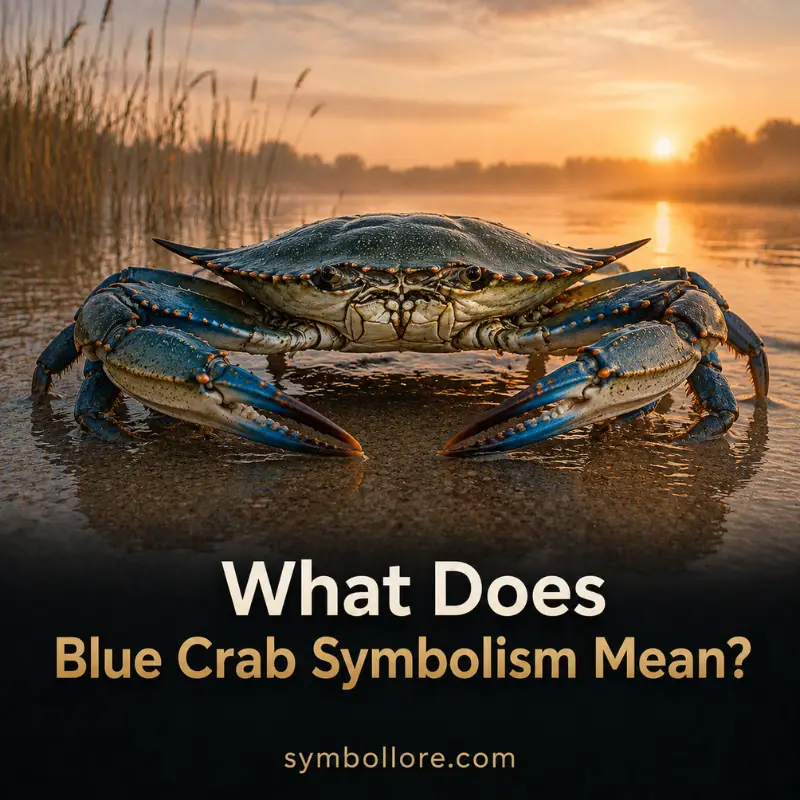
Seeing a blue crab has no fixed supernatural meaning. As a personal symbol, however, the encounter may prompt reflection on safety, flexible action, emotional limits, or attachment to home. The most useful interpretation begins with what actually happened rather than a universal omen list.
Consider three questions:
- Where was the crab? A shoreline encounter may emphasize place, water, or home.
- What was it doing? Hiding may suggest rest; molting may suggest transition; defending itself may suggest limits.
- How did you feel? Curiosity, fear, delight, and nostalgia point toward different personal meanings.
This approach respects intuition without claiming that nature sent one guaranteed message.
Blue Crab Dream Meaning
A blue crab dream may represent defensiveness, persistence, indirect progress, or a vulnerable change. Yet dreams do not have a reliable one-symbol dictionary. Their meaning depends on the dream’s action, emotional tone, and the dreamer’s memories.
A crab pinching your hand could reflect conflict or a limit that needs attention. A crab leaving an old shell might mirror a transition, while a table of crabs could evoke family, celebration, work, or homesickness. Someone raised near the Chesapeake may read the dream through regional memory. Another person may simply be processing a recent beach trip or meal. Start with personal associations before adopting a spiritual explanation.
Blue Crab Tattoos, Art, and Gifts
In tattoo design, blue crab symbolism often expresses toughness, coastal roots, and the ability to adapt. A detailed naturalistic crab can honor marine life, while a crab filled with Maryland flag colors usually signals state pride. A shed shell, tide line, or new growth can shift the design toward transformation.
The same choices guide art and gifts. Blue claws with open pincers can suggest confident protection. A crab beside marsh grass may emphasize Chesapeake home and ecology. Meanwhile, several crabs around a table or circular design can represent community. Before choosing the image, decide whether the message is personal strength, family tradition, regional identity, or conservation. One clear intention usually creates a stronger symbol than many unrelated details.
Conservation and the Symbol’s Living Context
The blue crab is a living part of an estuarine ecosystem, not merely a decorative emblem. It serves as both predator and prey, supports commercial and recreational fisheries, and uses habitats such as underwater grasses and oyster reefs.
The NOAA Fisheries blue crab overview
explains that populations naturally vary and that managers assess long-term trends when setting rules.
Consequently, the symbol can also represent stewardship and interdependence. The Chesapeake Bay Program identifies the species as ecologically, economically, and culturally important; its
explains its recognizable traits and Bay habitat. Wearing or displaying the crab can express affection for a place, but protecting habitat gives that affection practical meaning.
FAQs
A blue crab can serve as a personal sign of good luck, especially when someone connects it with persistence, abundance, or home. However, there is no universal tradition that makes every blue crab encounter lucky. Its positive meaning comes from personal belief, local culture, or the circumstances of the sighting.
Spiritually, a blue crab may represent self-protection, emotional awareness, flexible movement, and renewal after vulnerability. These are interpretive associations based on its shell, aquatic habitat, sideways walk, and molting. They should be treated as reflective possibilities rather than established messages shared by all spiritual traditions.
In Maryland, the blue crab symbolizes state pride, Chesapeake heritage, seafood culture, and working-waterfront life. Its status as the Maryland state crustacean reinforces that connection. The emblem also recalls summer gatherings, local businesses, family food traditions, and public concern for the health of the Bay.
The crab represents Cancer in Western astrology, but the zodiac symbol is not specifically the Atlantic blue crab. Modern artists may use a blue crab to personalize Cancer imagery, especially for someone with Chesapeake ties. That design blends two traditions rather than documenting an ancient blue-crab association.
A blue crab tattoo commonly means protection, resilience, adaptability, or pride in a coastal home. Maryland flag patterns often make the regional message explicit. Details change the emphasis: an open claw suggests defense, a molting shell suggests change, and marsh plants connect the design with Chesapeake ecology.
General crab imagery appears in old mythology, astrology, and art, but today’s specific set of blue-crab meanings is not one continuous ancient doctrine. Much of it is modern interpretation. The species’ strong Chesapeake and Maryland significance rests on documented regional history, foodways, fisheries, and civic identity.
Conclusion
Blue crab symbolism combines protection, adaptable progress, transformation, and attachment to home. Its shell, claws, movement, color, and molting cycle give modern readers useful metaphors, while its strongest documented cultural meaning comes from Maryland and Chesapeake Bay life.
No sighting, dream, tattoo, or gift carries one automatic message. The most grounded reading considers the animal’s real traits, the regional setting, and the person’s own experience. In that balance, the blue crab bec