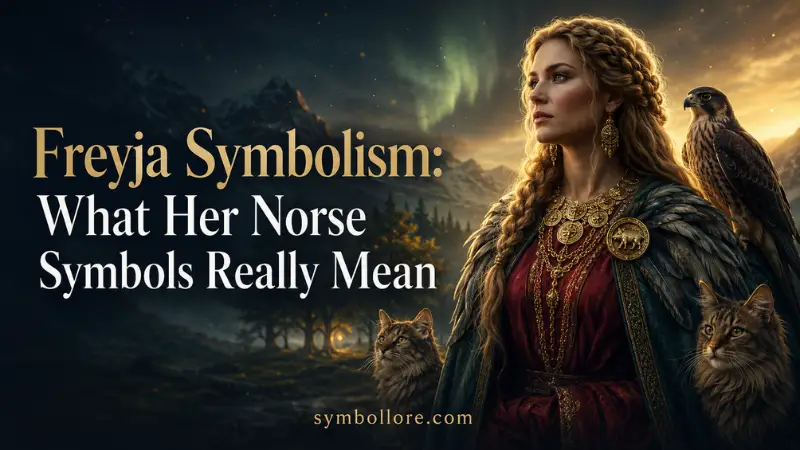
Freyja symbolism brings together love, desire, fertility, wealth, magic, grief, warfare, and death. These meanings can seem contradictory, yet the surviving Norse stories present Freyja as a goddess whose influence crosses several parts of human life.
Often called the Norse goddess of love and war, Freyja is more complex than a Scandinavian version of Venus. Her strongest symbols include a famous necklace, cats, a falcon garment, a boar, gold, and a field that receives slain warriors. However, some meanings popular online are modern interpretations rather than documented Viking beliefs.
Quick Answer
Freyja symbolizes love, fertility, beauty, valuable possessions, magical knowledge, grief, personal agency, warfare, and death. Her best-supported attributes are Brísingamen, a cat-drawn chariot, a falcon-feather cloak, the boar Hildisvíni, seiðr magic, and Fólkvangr. Modern meanings such as independence and feminine strength are reasonable interpretations, but they are not direct ancient definitions.
TL;DR
- Freyja represents love, magic, wealth, grief, fertility, war, and death.
- Her necklace signifies value, beauty, desire, and contested ownership.
- Cats and the boar are her strongest animal associations.
- Her falcon garment supports themes of movement and transformation.
- Modern interpretations should remain separate from medieval evidence.
Freyja’s Symbols at a Glance
| Symbol or Association | Historical Basis | Grounded Meaning | Modern Interpretation |
|---|---|---|---|
| Brísingamen | Named in medieval Norse literature | Preciousness, beauty, status, desire | Self-worth and personal value |
| Cats and chariot | Described in the Prose Edda | Distinctive divine status and movement | Independence, sensuality, domestic power |
| Falcon garment | Used in Eddic narratives | Flight, mobility, and altered form | Freedom and transformation |
| Hildisvíni | Appears in Hyndluljóð | Fertility, protection, strength, battle | Courage and loyal companionship |
| Seiðr and staff | Literary and archaeological connections | Magical knowledge and influence | Intuition and spiritual authority |
| Fólkvangr and Sessrúmnir | Named in Eddic sources | Death, selection of the slain, hospitality | Honoring courage and mortality |
| Golden tears | Connected with Freyja’s search for Óðr | Grief transformed into value | Resilience after loss |
| Vanir identity | Freyja belongs to the Vanir | Fertility, prosperity, nature, exchange | Balance between creation and conflict |
What Freyja Symbolism Means
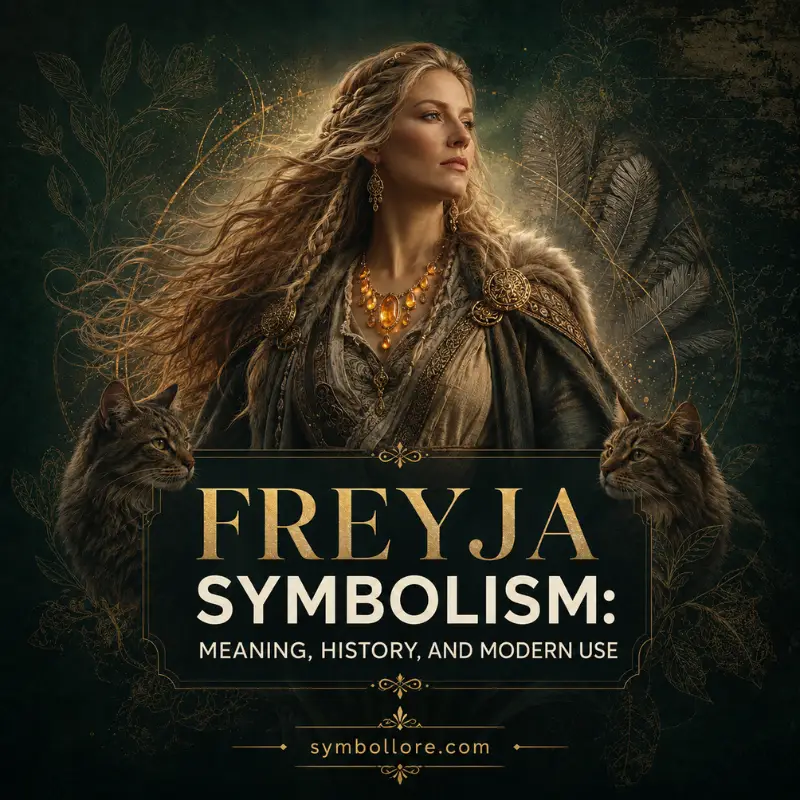
Freyja’s symbols express the value and danger of desire. Love can produce intimacy and fertility, yet desire can also create bargains, rivalry, loss, and conflict. Gold represents beauty and wealth, but it can also become an object others try to possess.
Her battlefield role adds another layer. Freyja does not stand only for romance or physical beauty. She also has authority over magic and some of the dead. Therefore, her symbolism works best as a network of connected meanings: attraction, agency, value, transformation, courage, sorrow, and mortality.
This complexity does not prove that Viking Scandinavians assigned one fixed psychological lesson to Freyja. Instead, it shows that the stories gave her several roles that modern readers can interpret together.
How Strong Is the Historical Evidence?
Freyja’s associations fall into three useful evidence levels. The first includes attributes directly named in medieval literature, such as her necklace, cats, falcon garment, boar, magic, and battlefield realm. The second includes scholarly interpretations of texts and archaeological objects. The third includes later folklore, modern religious practice, art, jewelry, and popular psychology.
The Swedish History Museum’s account of Freyja
identifies her with fertility, love, beauty, magic, war, a staff, and two chariot-pulling cats. The museum also acknowledges the limits of physical evidence. This distinction matters because an old female figurine, necklace, staff, or cat image cannot automatically be identified as Freyja.
Most detailed narratives survive in manuscripts written after Scandinavia’s conversion to Christianity. They preserve older material, but authors, scribes, and changing cultural values shaped the form available today.
Brísingamen: Beauty, Wealth, and Desire
Brísingamen is Freyja’s most recognizable possession. Medieval sources identify it as her celebrated necklace or neck ornament. As a visible precious object, it can reasonably represent beauty, wealth, status, desire, and the power attached to owning something rare.
However, the famous story in which Freyja obtains the necklace from four dwarfs comes from a later narrative, Sörla þáttr. It should not automatically be treated as an unchanged Viking-era belief. The episode reflects desire, bargaining, sexuality, judgment, and contested ownership, but its Christian-era setting may also shape how Freyja is portrayed.
Modern jewelry often uses the necklace as a sign of self-worth or feminine authority. That interpretation fits the object’s value, although no surviving Norse text defines Brísingamen with those exact psychological terms.
Cats and the Cat-Drawn Chariot
The cats are firmly connected with Freyja because medieval prose describes them pulling her chariot. They distinguish her visually from gods who travel on horses, ships, or other animals. They may suggest status, unusual power, movement, and a connection with domestic life.
Independence, sensuality, mystery, and feminine confidence are common modern cat meanings. These qualities can make thoughtful interpretations, but the medieval passages do not provide a symbolic definition of the animals.
Freyja’s cats are not named in the principal medieval sources. Names such as Bygul and Trjegul circulate in modern books and websites, while claims that they were Norwegian Forest Cats or lynxes are also later attempts to fill a gap. An accurate design can simply show two powerful, unnamed cats.
The Falcon-Feather Cloak and Seiðr
Freyja’s falcon garment permits rapid flight or movement in bird form. Other gods borrow it when they need to travel, which makes the garment a practical mythic possession. Freedom, altered identity, perspective, and crossing boundaries are later interpretations built from that function.
Her magical importance extends beyond the cloak. Freyja is associated with seiðr, a form of Norse magic concerned with knowledge, influence, fate, and altered states. The Swedish History Museum also connects her with a staff, while reminding readers that archaeological interpretations remain uncertain.
Together, the garment and magic make transformation a strong interpretive theme. Still, it is safer to say that the stories support movement and magical ability than to claim every falcon, feather, staff, or rune was uniquely sacred to Freyja.
Hildisvíni and the Boar
Hildisvíni, whose name is commonly translated as “battle swine,” appears with Freyja in Hyndluljóð. In the poem, she travels to seek genealogical knowledge that will help her favored follower Óttar. The relationship between the named boar and Óttar becomes deliberately complicated within the story.
Boars carried broad associations with fertility, prosperity, protection, and martial strength in the world of the Vanir. Consequently, Hildisvíni joins Freyja’s life-giving and combative roles without reducing her to either one.
Modern readers often treat the boar as a sign of courage, perseverance, or fierce protection. Those readings suit the animal and its mythic context, but they remain interpretations rather than a preserved list of ancient meanings.
Fólkvangr, Sessrúmnir, War, and Death
Fólkvangr is the field ruled by Freyja, while Sessrúmnir is described as her hall. In Grímnismál, Freyja receives half of those who fall in battle, and Odin receives the other half. The poem establishes her authority over the slain, although it does not explain their later duties in detail.
The accessible Project Gutenberg edition of the Eddic material
shows how Freyja’s residence and divine roles entered English-language study. Translations differ in wording, so broad conclusions should rest on several editions. The central point remains clear: Freyja possesses an afterlife domain connected with battlefield death.
Calling Freyja the confirmed “queen” or “leader” of the Valkyries goes beyond the surviving text. Scholars have explored connections, but the title should not appear as an undisputed fact.
Golden Tears and Óðr: Grief Made Precious
Freyja’s husband Óðr is frequently absent, and she searches for him under different names. Medieval prose says she weeps red gold during this separation. The image connects love, absence, grief, movement, and precious material.
The golden tears offer one of the most emotionally direct readings of Freyja. Sorrow does not disappear, yet poetry transforms it into something enduring and valuable. Modern readers therefore associate the tears with resilience, remembrance, and the worth revealed by loss.
Popular retellings often say tears falling into the sea became amber. That detail is widespread in later explanations, but it should not receive the same evidentiary weight as the Eddic reference to gold.
Freyja and Frigg: Common Misconceptions
Freyja and Frigg are separate figures in the surviving Norse sources. Freyja belongs to the Vanir and marries Óðr, while Frigg is Odin’s wife and holds a different position among the gods. Their names, functions, and relationships nevertheless overlap enough to inspire scholarly debate about an earlier connection.
A common-origin theory remains a theory rather than a settled fact. The Freya spelling is simply a widely used English form of Freyja and does not turn her into Frigg.
Other claims also need caution:
- No principal medieval source supplies standard names for Freyja’s cats.
- Runes belong to the wider Norse world, not exclusively to Freyja.
- The Valknut is more commonly discussed in relation to Odin.
- Roses and modern crystals are later correspondences.
- Archaeologists cannot securely identify every richly dressed female figure as Freyja.
How Modern Freyja Symbolism Is Used Today
Modern Freyja symbolism appears in tattoos, jewelry, fiction, games, visual art, and contemporary Heathen or Pagan practice. American readers often use her imagery to express personal agency, sexuality without shame, courage, magical knowledge, grief, or the balance between tenderness and strength.
A necklace can emphasize value and desire. Cats may express independence, while a falcon garment suggests freedom. A boar can signify fierce protection, and golden tears can memorialize love or loss. Combining every symbol, however, may produce a generic fantasy design rather than a clear reference.
Living religious interpretations also deserve respect.
The Troth’s contemporary Freyja resource
presents her through the perspective of modern Heathen worshipers. That perspective is valuable, but it should be identified as living practice rather than projected backward as one universal Viking tradition.
FAQs
Freyja is associated with love, desire, beauty, fertility, wealth, gold, magic, warfare, and death. She belongs to the Vanir but lives among the Æsir in surviving mythology. Her many domains explain why a single “love goddess” label feels incomplete.
Brísingamen is probably Freyja’s most recognizable object, while her cats are her clearest animal association. The necklace identifies her through value and beauty, whereas the chariot distinguishes her movement and divine presence. Neither symbol has only one historically fixed meaning.
Cats and the boar Hildisvíni have the strongest textual connection with Freyja. Falcons are associated with her garment rather than necessarily serving as personal companion animals. Modern artists may use all three, but cats and the boar have the clearest narrative roles.
The surviving sources do not simply identify Freyja as a Valkyrie. She receives half of the battlefield dead, and scholars have examined possible connections between her and the choosers of the slain. Calling her their confirmed leader presents a debated interpretation as fact.
Runes are not a unique or defining emblem of Freyja. They belong to Norse writing, magic, memorial culture, and mythology more broadly. A rune may accompany modern Freyja artwork, but the artist should explain the rune’s individual meaning instead of calling all runes hers.
A Freyja tattoo can represent love, independence, desire, magical knowledge, courage, grief, or protection. Its precise meaning depends on the selected attribute. Brísingamen emphasizes value, cats suggest autonomy, the boar implies strength, and golden tears connect love with loss.
Conclusion
Freyja symbolism is best understood as a meeting point between desire, value, magical power, grief, fertility, conflict, and death. Her necklace, cats, falcon garment, boar, golden tears, and battlefield realm reveal different parts of that larger identity.
The medieval sources establish the attributes, but they rarely supply the neat symbolic definitions found online. Separating textual evidence from scholarly inference and modern interpretation preserves Freyja’s historical complexity while leaving room for meaningful contemporary art, jewelry, tattoos, and spiritual practice.