
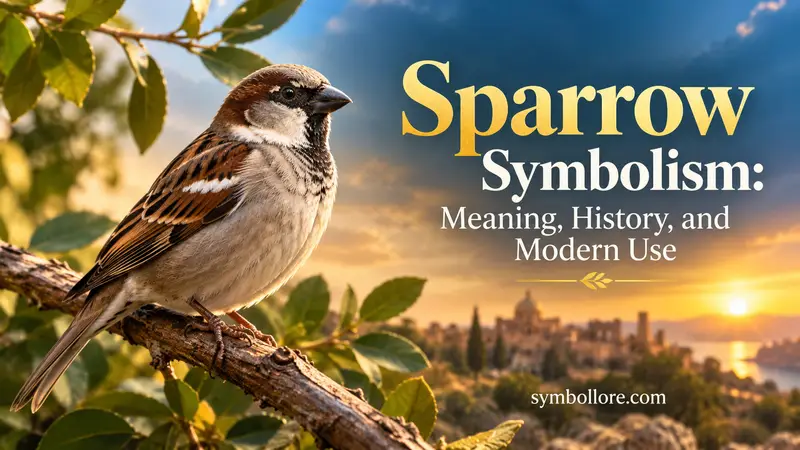
Sparrow symbolism often centers on humility, resilience, community, ordinary life, affection, and the value of small things. These meanings make sense because sparrows are small, social birds that have lived close to people for centuries.
Yet the sparrow does not carry one fixed meaning across every culture. Christian scripture uses it to show divine care for seemingly insignificant life. Greco-Roman traditions connect it with love and intimacy. Japanese folklore can turn it into a figure of gratitude and moral reward. Modern symbolism often adds resilience, teamwork, simplicity, and adaptability.
The strongest interpretation therefore depends on the setting, tradition, and species involved.
Quick Answer
Sparrow symbolism commonly represents humility, resilience, community, simplicity, affection, and the worth of ordinary life. These meanings come partly from the bird’s small size, social behavior, and close relationship with human settlements. Religious, literary, and cultural traditions add more specific meanings, including divine care in Christianity, love in classical antiquity, and gratitude in Japanese folklore.
TL;DR
- Sparrows often symbolize humility and ordinary life because they are small and familiar rather than grand or rare.
- Their social behavior supports modern meanings of community, cooperation, and companionship.
- Christian scripture uses sparrows to express divine care and the value of seemingly insignificant lives.
- Greco-Roman tradition connects sparrows with Aphrodite, love, affection, desire, and grief.
- Japanese folklore uses the sparrow in stories about kindness, gratitude, cruelty, and greed.
- Spiritual “messages” attached to sparrow encounters are modern or personal interpretations, not universal predictions.
Sparrow Meanings at a Glance
| Context | Possible Meaning | Why the Association Exists | Important Limit |
|---|---|---|---|
| Small size | Humility, modesty | Sparrows are physically small and visually unassuming | This is mainly a symbolic interpretation |
| Flock behavior | Community, cooperation | Many sparrows feed and move socially | Not every sparrow species behaves identically |
| Human settlements | Home, familiarity, everyday life | House Sparrows live closely around buildings and people | Modern symbolism often focuses on House Sparrows |
| Christian scripture | Divine care, worth, humility | Sparrows are used as examples of low-cost creatures still noticed by God | This is a specifically biblical meaning |
| Aphrodite tradition | Love, sexuality, affection | Sparrows were associated with Aphrodite in classical antiquity | It should not be generalized to all ancient cultures |
| Catullus | Intimacy, desire, grief | Lesbia’s sparrow appears in poems about affection and loss | Literary meaning depends on the poem |
| Japanese folklore | Kindness, gratitude, greed | The Tongue-Cut Sparrow rewards kindness and punishes greed | It is one tale, not a universal Japanese sparrow meaning |
Why Sparrows Became Symbols of Humility
Humility is one of the easiest modern sparrow meanings to understand.
Sparrows are small and visually modest compared with birds such as eagles, peacocks, cranes, or swans. Their brown, gray, and muted plumage can make them seem ordinary.
That ordinary appearance is exactly what gives the symbolism its force.
The sparrow can represent:
- modest value;
- quiet strength;
- ordinary people;
- simple living;
- worth without status;
- beauty that is easy to overlook.
This interpretation does not come from one ancient doctrine. It is a modern symbolic reading built from the bird’s familiar appearance and long association with everyday human spaces.
The sparrow’s smallness makes it a useful image for the idea that importance does not require grandeur.
Why Sparrows Symbolize Community and Cooperation
Community symbolism has a stronger behavioral basis.
House Sparrows are social birds. Cornell Lab of Ornithology describes them feeding together in crowded flocks, communicating through displays, and living in close company around buildings and human settlements.
That behavior naturally supports modern symbolic themes such as:
- teamwork;
- friendship;
- family;
- belonging;
- cooperation;
- communication;
- mutual support.
The symbolism works because a sparrow often appears as part of a group rather than as a distant solitary bird.
Still, “community” should be treated as an interpretation of observable behavior, not as a spiritual law.
A flock of sparrows can remind someone of cooperation. It does not prove that the birds were sent to deliver that message.
Sparrows as Symbols of Resilience and Adaptability
Sparrows also make strong symbols of adaptability because some species thrive in environments heavily shaped by people.
The House Sparrow is especially closely associated with streets, barns, buildings, farms, parking areas, and other human spaces. Cornell notes that the species has become deeply tied to human settlements.
In North America, the House Sparrow is not native. It was introduced in Brooklyn in 1851 and spread rapidly across the continent.
That history makes it a striking modern example of adaptability.
Symbolically, this can suggest:
- surviving change;
- making use of limited resources;
- persistence;
- adjusting to unfamiliar surroundings;
- continuing despite difficult conditions.
However, ecological success is not automatically positive. House Sparrows can compete with native cavity-nesting birds.
So “resilience” is a human interpretation of the species’ ability to persist, not a moral judgment about its ecological role.
Sparrow Symbolism in Christianity
Christian scripture gives the sparrow one of its clearest documented symbolic roles.
In Matthew 10:29, Jesus refers to two sparrows being sold for a very small amount of money while still remaining within God’s care. Luke 12:6 makes a similar point by describing five sparrows sold cheaply and yet not forgotten by God.
The contrast is central.
Economically, the birds are presented as inexpensive and ordinary.
Spiritually, they are not ignored.
This has encouraged Christian interpretations involving:
- divine care;
- human worth;
- humility;
- protection;
- trust;
- attention to the overlooked;
- the value of seemingly insignificant life.
The sparrow’s meaning here does not come from its beauty or strength. It comes from its low social and economic importance within the teaching.
That gives the symbol a distinctive message: small value in the marketplace does not equal small value before God.
What “His Eye Is on the Sparrow” Adds to the Symbol
The Christian sparrow image continued well beyond the biblical text.
The gospel hymn “His Eye Is on the Sparrow,” written in the early 20th century by Civilla D. Martin and Charles H. Gabriel, draws on the same biblical idea of divine care.
The bird became a religious image of reassurance.
In this context, the sparrow can suggest that a person who feels forgotten, powerless, poor, or unimportant remains worthy of care.
That meaning is different from generic “sparrow spirituality.”
It comes from a recognizable Christian scriptural tradition.
This distinction matters because modern symbolism pages sometimes describe divine protection as if every culture associated sparrows with the same idea.
The evidence supports a strong Christian tradition, not a universal one.
Sparrows, Aphrodite, and Love in Ancient Greece
In ancient Greek culture, sparrows had a documented association with Aphrodite, goddess of love and sexuality.
The Acropolis Museum notes that sparrows, like pigeons, were related to Aphrodite.
This gives the bird a meaning very different from Christian humility.
In an Aphrodite-related setting, the sparrow could evoke:
- love;
- desire;
- sexuality;
- attraction;
- intimacy;
- fertility.
The association also appears in classical poetry, where small domestic birds could become emotionally charged objects.
This is a good example of why symbolism changes with culture.
A sparrow beside Aphrodite should not automatically be interpreted as humility or teamwork. Its classical context points much more strongly toward love and desire.
Catullus and the Sparrow as a Symbol of Intimacy and Grief
The Roman poet Catullus gives us one of the most famous literary sparrows in Western literature.
In poems traditionally numbered 2 and 3, Catullus writes about Lesbia’s sparrow. The bird appears first as an intimate pet connected with affection and play. After the sparrow dies, it becomes the focus of grief.
The poems give the sparrow several overlapping meanings:
- affection;
- intimacy;
- desire;
- domestic companionship;
- emotional attachment;
- mortality;
- grief.
Scholars have long debated how literally or erotically the sparrow should be interpreted.
That uncertainty is worth preserving.
What is clear is that Catullus turns an ordinary small bird into a highly personal emotional object.
The sparrow becomes meaningful precisely because it belongs to private daily life rather than heroic mythology.
Sparrow Symbolism in Japanese Folklore
Japanese folklore gives the sparrow a strong moral role through Shita-kiri Suzume, usually translated as The Tongue-Cut Sparrow.
In the tale, a kind old man cares for a sparrow. His cruel and greedy wife injures the bird and drives it away. Later, the sparrow receives the kind man hospitably and rewards him, while greed brings misfortune.
The story supports themes such as:
- kindness;
- compassion;
- gratitude;
- hospitality;
- greed;
- cruelty;
- moral consequences.
This does not mean “sparrows symbolize wealth in Japanese culture.”
The lesson is more specific.
The sparrow functions as a moral character through whom kindness is rewarded and greed exposed.
That is more accurate than reducing the entire tale to “good luck.”
Do Sparrows Symbolize Simplicity?
Sparrows can symbolize simplicity, especially in modern reflective writing.
The bird’s ordinary appearance, familiar song, small size, and close presence around homes make it easy to associate with everyday life.
This can support meanings such as:
- contentment;
- modest living;
- appreciating small pleasures;
- staying grounded;
- noticing what others overlook.
However, simplicity is better understood as a modern symbolic reading than a universal historical tradition.
Ancient Greek, Roman, Christian, and Japanese sources did not all use the sparrow to express the same idea.
The modern symbolism works because sparrows are familiar.
They rarely appear exotic or distant.
That makes them natural symbols for the value of ordinary experience.
Sparrow Symbolism and the Idea of Freedom
Like many birds, sparrows can symbolize freedom because they fly.
This meaning is less distinctive than the sparrow’s links with humility, community, or biblical care.
An eagle, swallow, dove, or migrating bird can also symbolize freedom.
What makes the sparrow slightly different is its closeness to home.
A sparrow can fly freely while remaining strongly associated with nests, neighborhoods, buildings, gardens, and social groups.
That creates an interesting symbolic balance between:
- independence and belonging;
- movement and home;
- freedom and community.
A modern sparrow tattoo may therefore represent freedom without isolation.
That interpretation is personal rather than historically fixed.
The Sparrow and Ordinary Human Life
One of the sparrow’s most persistent qualities is familiarity.
House Sparrows have lived around human settlements for generations, often nesting in buildings and feeding where people leave food.
That long proximity gives the bird a symbolic quality that an eagle or albatross cannot easily carry.
The sparrow belongs to:
- streets;
- farms;
- courtyards;
- roofs;
- marketplaces;
- gardens;
- stations;
- neighborhoods.
It is a bird of everyday human space.
That can make it a symbol of ordinary people rather than kings, warriors, saints, or elites.
In literature and modern symbolism, this everyday quality can express dignity without prestige.
The sparrow is small, common, and easily ignored.
That is exactly why it works so well as a symbol of unnoticed value.
Sparrow Symbolism in Modern American Culture
Modern American readers often encounter sparrows as ordinary city or backyard birds.
But an important distinction is easy to miss.
The familiar House Sparrow is an Old World species introduced into Brooklyn in 1851. It spread rapidly across North America and became deeply associated with urban and suburban life. All About Birds
That means modern American sparrow imagery can mix several layers:
- imported European bird symbolism;
- biblical tradition;
- literary symbolism;
- observations of House Sparrow behavior;
- native North American sparrow species;
- modern spiritual interpretation.
These layers should not automatically be treated as one ancient American tradition.
For modern U.S. readers, the strongest everyday themes are usually resilience, familiarity, community, resourcefulness, and ordinary life.
What Does Seeing a Sparrow Mean Spiritually?
Seeing a sparrow has no scientifically proven spiritual meaning.
Modern spiritual writers often interpret a sparrow encounter as a reminder of humility, community, gratitude, resilience, or divine care.
Those interpretations can be meaningful if they are treated as reflection.
For example, someone might think:
“This small bird reminds me that ordinary things still matter.”
That is a personal symbolic response.
It is different from saying:
“The sparrow appeared to guarantee that good news is coming.”
The first is interpretation.
The second is a prediction unsupported by the bird’s presence.
A grounded approach allows symbolism without pretending that every wildlife encounter contains a supernatural message.
What Does a Sparrow Mean in Dreams?
A sparrow dream does not have one established universal meaning.
The bird’s role in the dream matters more than a fixed dictionary definition.
A sparrow flying away might personally suggest independence or loss.
A flock could evoke community, social pressure, or companionship.
An injured sparrow might represent vulnerability.
A sparrow inside a house could relate to home, intrusion, familiarity, or protection depending on the dreamer’s reaction.
Cultural background also matters.
A Christian dreamer may think of divine care. Someone familiar with Catullus may associate a sparrow with love or grief.
Dream interpretation is therefore most useful as reflection, not prophecy.
Sparrow Tattoo Meaning
Sparrow tattoos can carry several meanings because modern tattoo symbolism draws from religion, literature, bird behavior, and personal experience.
Common interpretations include:
- freedom;
- loyalty;
- resilience;
- home;
- humility;
- companionship;
- survival;
- remembrance;
- love.
A pair of sparrows may suggest partnership or affection.
A sparrow near a nest may emphasize home or family.
A sparrow with biblical text may express faith and divine care.
A sparrow in flight may represent movement or personal freedom.
The wearer’s own meaning matters most.
Historical traditions can influence a design, but they do not give every sparrow tattoo one fixed definition.
Why Sparrow Symbolism Can Seem Contradictory
Sparrow symbolism becomes confusing when separate traditions are blended together.
In Christianity, the bird can represent the value of small lives.
In Aphrodite’s world, it can belong to love and desire.
In Catullus, it becomes intimate and mournful.
In Japanese folklore, it can serve a moral story about kindness and greed.
Modern symbolism adds teamwork, resilience, home, and simplicity.
These meanings are not contradictions that need to be solved.
They come from different settings.
The sparrow remained symbolically useful because people repeatedly encountered a small, familiar bird and gave it meaning according to their own religion, literature, social life, and environment.
How to Interpret Sparrow Symbolism Correctly
A context-first approach gives the most reliable interpretation.
Ask these questions:
- Which tradition is involved? Christian, Greco-Roman, Japanese, literary, or modern spiritual?
- Which sparrow is being discussed? House Sparrow, native sparrow species, or an unspecified literary bird?
- What is the bird doing? Feeding in a flock, nesting, flying, dying, singing, or appearing alone?
- What surrounds it? A Bible verse, Aphrodite image, tattoo, dream, poem, or everyday wildlife encounter?
- Is the meaning documented or modern? Historical evidence and personal symbolism should not be treated as the same thing.
This method prevents broad claims such as “sparrows always mean hope” or “a sparrow always brings a message.”
The meaning becomes clearer when the source, culture, and context are known.
FAQs
What is the main symbolic meaning of a sparrow?
The sparrow most commonly represents humility, ordinary life, resilience, and community in modern symbolism. Its small size and social behavior help explain these meanings. Historical traditions add more specific themes such as divine care, love, desire, gratitude, and grief.
What does a sparrow symbolize in Christianity?
In Christianity, the sparrow is strongly associated with divine care and the value of seemingly insignificant life. Matthew 10:29 and Luke 12:6 describe sparrows as inexpensive birds that are nevertheless known and remembered by God.
Is a sparrow a symbol of love?
Yes, in some historical contexts. Sparrows were associated with Aphrodite in ancient Greece, and Catullus’s poems about Lesbia’s sparrow connect the bird with intimacy, affection, desire, and grief. That love symbolism belongs to specific classical traditions rather than every culture.
Does seeing a sparrow mean good luck?
There is no universal rule that seeing a sparrow predicts good luck. Some folklore and modern spiritual traditions give the bird positive meanings, but an ordinary sighting is first a wildlife encounter. Any symbolic meaning is cultural or personal.
What does a flock of sparrows symbolize?
A flock can symbolize community, cooperation, friendship, or shared protection in modern interpretation. This association has a behavioral basis because House Sparrows commonly feed and gather socially. All About Birds
What does a dead sparrow symbolize?
A dead sparrow may suggest mortality, vulnerability, grief, or the loss of something familiar in personal or literary interpretation. There is no universal historical rule that a dead sparrow predicts death or misfortune.
What does a sparrow tattoo mean?
A sparrow tattoo can represent freedom, resilience, home, companionship, humility, faith, or remembrance. The surrounding design and the wearer’s intention usually matter more than any fixed symbolic definition.
Conclusion
Sparrow symbolism draws much of its power from the bird’s small size and ordinary presence. Modern readers often connect sparrows with humility, resilience, community, and simple living, while older traditions add more specific meanings. Christian scripture uses the bird to express divine care. Classical culture links it with Aphrodite and love, Catullus turns it into a symbol of intimacy and grief, and Japanese folklore uses it to explore kindness and greed.
No single meaning applies everywhere. The most accurate interpretation begins with the culture, text, behavior, and setting in which the sparrow appears.