
Beetle symbolism most often centers on renewal, transformation, resilience, protection, and persistent effort. Its strongest documented historical expression comes from ancient Egypt, where the scarab became closely connected with the rising sun, creation, and funerary beliefs.
Modern interpretations have expanded those ideas. Today, people may use beetles to represent endurance, personal change, or a new beginning. However, there is no single meaning shared by every culture or beetle species. Understanding the symbol requires looking at the insect, the cultural setting, and the way the image is being used.
Quick Answer
Beetle symbolism commonly represents transformation, renewal, resilience, and protection. The strongest historical basis comes from the Egyptian scarab, which was associated with Khepri and the rising sun. Modern spiritual, dream, and tattoo meanings often build on those older associations and the beetle’s natural traits, but they should be understood as interpretations rather than universal truths.
Key Takeaways
- Beetles commonly represent persistence, change, renewal, and protection.
- Egyptian scarabs have the clearest documented historical symbolism.
- Real beetle behavior helped inspire several symbolic associations.
- Different species and contexts can suggest different meanings.
- Dreams and encounters do not have one fixed prophetic meaning.
- Modern symbolism often combines history with personal interpretation.
Beetle Symbolism Meanings at a Glance
| Context | Common Meaning | Why the Association Exists |
|---|---|---|
| General modern use | Resilience, persistence | Beetles survive in remarkably varied environments |
| Life cycle | Transformation | Beetles develop through complete metamorphosis |
| Egyptian scarab | Renewal, creation, rising sun | Linked historically with Khepri |
| Amulets | Protection | Scarabs served religious and funerary purposes |
| Dung beetles | Renewal, cycles | Their ball-rolling behavior inspired Egyptian solar imagery |
| Dreams | Change, pressure, persistence | Usually a personal or modern interpretive association |
| Tattoos | Rebirth, strength, protection | Often draws on Egyptian and contemporary meanings |
| Jewelry | Renewal, protection, heritage | Scarab forms have a long history as ornaments and amulets |
What Beetle Symbolism Usually Means
The most defensible general interpretation combines resilience, transformation, persistence, and renewal. These meanings make intuitive sense because beetles survive in an enormous range of habitats and undergo dramatic changes during their development.
Still, these associations are not universal rules. A beetle depicted on an Egyptian object has a different cultural history from a beetle appearing in a modern tattoo or personal dream. Even within contemporary symbolism, someone may emphasize endurance while another person sees protection or new beginnings.
Therefore, context matters more than a fixed dictionary-style definition. Beetle symbolism works best as a group of related meanings shaped by biology, history, art, and personal interpretation.
Why Beetles Became Symbols: Biology Behind the Meaning
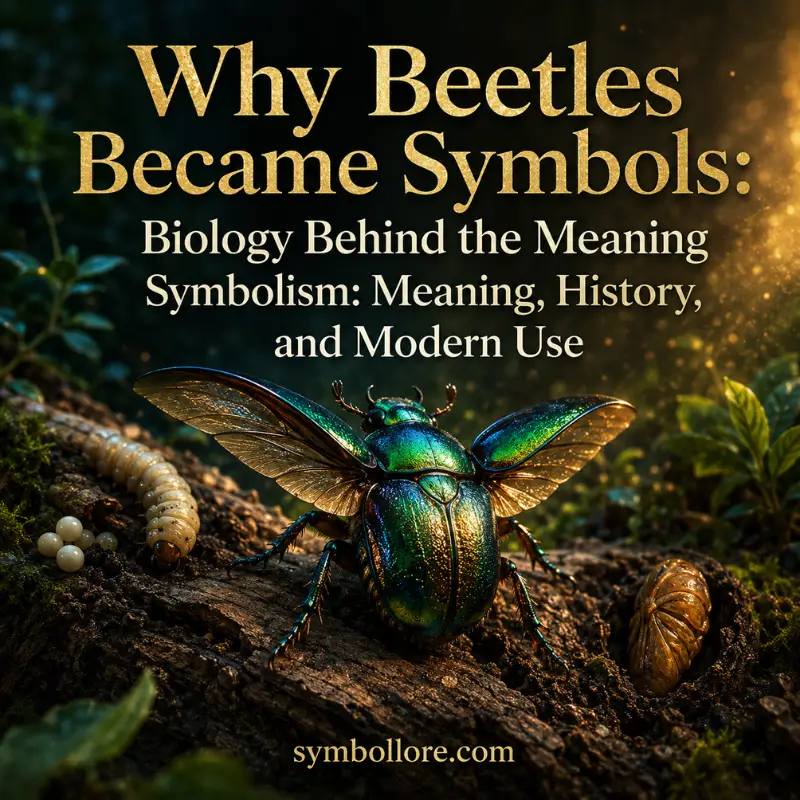
Real beetle traits help explain why these insects lend themselves to ideas such as toughness and change. Beetles belong to the insect order Coleoptera. Their front wings form hardened protective covers called elytra, which shield the more delicate flight wings beneath.
The Smithsonian’s overview of beetles
also highlights their important ecological roles. Many act as decomposers, while others prey on insects that can damage plants. These facts make modern metaphors about persistence and adaptation understandable, even though biology itself does not assign symbolic meaning.
Their life cycle adds another useful metaphor. Like butterflies, beetles undergo complete metamorphosis: egg, larva, pupa, and adult. Modern writers therefore frequently connect them with personal development and transformation.
Scarab Beetle Symbolism in Ancient Egypt and Khepri
The scarab beetle provides the strongest historical foundation for beetle symbolism. In ancient Egypt, scarabs were closely associated with Khepri, the deity connected with the rising morning sun and coming into existence.
The relationship drew partly on the behavior of the dung beetle. Some scarabs roll balls of dung across the ground. Ancient Egyptians connected that visible movement with the solar cycle and the image of the sun moving across the sky.
Physical evidence makes this association especially important.
A New Kingdom scarab in The Metropolitan Museum of Art,
dated roughly 1300–1080 BCE, depicts a winged beetle rolling a sun disk. The museum identifies the figure with Khepri.
Scarabs also appeared as seals, jewelry, and religious objects. A beetle amulet could therefore carry associations involving existence, regeneration, divine power, and protection. Heart scarabs had a particularly important role in funerary practice. This historical tradition helps explain why rebirth remains one of the scarab’s strongest modern meanings.
Beetle Meanings Beyond Ancient Egypt
Ancient Egyptian symbolism is famous, but humans have interacted with beetles in far more varied ways. They can function as food, decorative inspiration, useful ecological organisms, feared pests, valued insects, or subjects of stories.
A peer-reviewed study on the
cultural significance of beetles in sub-Saharan Africa
documents this variety particularly well. Researchers gathered information involving respondents from 27 countries and found roles connected with food, medicine, beliefs, children’s activities, and other areas of cultural life.
That evidence also shows why statements such as “African beetle symbolism means X” are too broad. Africa contains thousands of communities and distinct traditions. The same caution applies to claims about “Native American,” “Celtic,” or “Asian” symbolism without identifying a specific community, period, or source.
Reliable symbolism writing should preserve those differences instead of inventing one global tradition.
Beetle Spiritual Meaning Today
In contemporary spirituality, beetle spiritual meaning often focuses on perseverance, grounding, self-protection, gradual progress, and the ability to change. These interpretations may borrow from the Egyptian scarab, beetle biology, or personal experiences with the insect.
For example, a hard outer covering can become a metaphor for boundaries. Metamorphosis may suggest growth, while a persistent beetle can inspire an association with continuing despite difficulty.
However, these are reflective meanings, not scientifically established messages. Seeing a beetle does not prove that a particular event will occur. A useful spiritual interpretation asks what the insect represents to the observer instead of treating it as a guaranteed prediction.
That distinction allows people to appreciate symbolic meaning without turning subjective ideas into historical or scientific facts.
Color, Species, and Dung Beetle Meanings
Different beetles can create different symbolic impressions. A scarab carries strong Egyptian associations, while a rhinoceros or stag beetle may suggest physical strength because of its striking form. A lady beetle can bring different cultural associations again.
Color also shapes modern interpretation:
- Black beetles may suggest endurance, mystery, boundaries, or grounded strength.
- Green beetles can suggest growth, nature, vitality, or restoration.
- Golden beetles may evoke sunlight, value, achievement, or sacred imagery.
- Red beetles can suggest energy, urgency, passion, or vitality.
These color meanings are mainly modern symbolic associations rather than universal traditions. Likewise, not every beetle should inherit scarab symbolism simply because it belongs to the same insect order.
For historically grounded interpretation, identify the species or artistic form first. Then consider its specific cultural setting.
What Seeing a Beetle Can Mean
Seeing a beetle can become a personal reminder of persistence or adaptation, but the encounter has no scientifically established supernatural meaning. In everyday life, a beetle may simply be searching for food, shelter, moisture, light, or a suitable habitat.
Symbolically, however, the encounter can still provide a useful prompt. Someone dealing with a difficult long-term project might associate a beetle with steady work. A person entering a new phase may instead focus on metamorphosis and renewal.
The key difference is between reflection and prediction. “This beetle reminds me to keep going” is a personal interpretation. “This beetle guarantees good luck tomorrow” is a much stronger supernatural claim for which the encounter itself provides no evidence.
Beetle Dream Meaning
Beetle dream meaning depends more on the dream’s context and the dreamer’s associations than on a universal symbolic code. A calm beetle may evoke persistence or protection, while an overwhelming number of beetles could reflect irritation, pressure, fear, or something that feels difficult to control.
Three details help with interpretation:
- Notice what the beetle was doing.
- Identify your strongest emotion during the dream.
- Connect those details with current concerns or experiences.
A transforming or emerging insect might suggest change to one dreamer. Someone who dislikes insects may experience exactly the same image as anxiety.
Dream interpretation can therefore be useful for reflection, but it should not be treated as a reliable prediction of future events.
Beetle Tattoo Meaning, Jewelry, and Art
Beetle tattoo meaning often combines rebirth, strength, protection, persistence, and personal change. A scarab tattoo can refer more specifically to Egyptian imagery, including the solar cycle and Khepri.
Design details matter. Adding a sun disk strengthens the Egyptian solar connection. Wings can create an image of movement or emergence, while geometric or botanical elements may turn the design into a more personal statement.
Jewelry has an especially strong historical precedent. Scarab-shaped objects existed in ancient Egyptian religious, decorative, and administrative settings.
The McClung Museum’s discussion of the sacred scarab describes its connections with the sun, transformation, and funerary belief.
Modern wearers do not need to reproduce an ancient belief system. However, understanding the original context makes a scarab design more meaningful and prevents inaccurate historical claims.
How to Interpret Beetle Symbolism Responsibly
A good interpretation begins with context rather than assuming every beetle sends the same message. Four questions provide a practical framework.
First, identify the beetle or representation. A real stag beetle, Egyptian scarab, cartoon lady beetle, and abstract tattoo do not begin with identical meanings.
Second, identify the source. Ancient artifact, documented folklore, contemporary spirituality, dream interpretation, and personal association are different categories of evidence.
Third, look at behavior and visual details. Color, posture, wings, a sun disk, surrounding objects, or ball-rolling imagery can narrow the intended meaning.
Finally, separate documented history from personal symbolism. You can choose a beetle as a symbol of resilience without claiming that every historical culture used it that way.
This approach preserves the richness of the symbol while avoiding unsupported cultural generalizations.
FAQs
A beetle can represent good fortune in some modern interpretations and historical contexts, but it is not universally a lucky symbol. Egyptian scarab amulets had protective and religious functions that contributed to later positive associations. Meaning still depends on culture, period, species, and use.
The Egyptian scarab is strongly associated with coming into existence, the rising sun, regeneration, and protection. Its connection with Khepri gave the scarab a major religious role. Scarab-shaped objects also served as amulets, seals, jewelry, and funerary objects, so their precise function varied.
It can have a personal spiritual meaning if you choose to interpret the encounter symbolically. Common modern readings include persistence, boundaries, change, and renewal. However, there is no objective evidence that the appearance of a beetle delivers a fixed supernatural message or predicts a specific event.
A black beetle is commonly interpreted today as a symbol of resilience, protection, grounded strength, or change. Those associations are not universal cultural rules. The species, situation, and observer’s own associations provide more reliable context than color alone.
Scarabs were connected with Khepri, the rising sun, creation, and regeneration. Egyptians produced scarab-shaped amulets, seals, jewelry, and funerary objects for different purposes. Heart scarabs became particularly significant in funerary traditions, linking the form with beliefs surrounding death and continued existence.
A beetle tattoo commonly represents strength, endurance, personal transformation, or renewal. A specifically Egyptian scarab design can carry deeper historical associations with Khepri and solar regeneration. Symbols surrounding the beetle should also be considered because they can substantially change a tattoo’s intended meaning.
No. Rebirth is particularly strong in modern interpretations influenced by scarab traditions and insect metamorphosis. Beetles are an enormous and varied group, so applying one ancient Egyptian association to every species and culture erases important differences. Persistence, strength, ecological cycles, or no symbolic meaning at all may fit other contexts better.
Conclusion
Beetle symbolism has no single universal definition, but renewal, transformation, resilience, and protection form its most familiar modern themes. The richest historical foundation comes from ancient Egyptian scarabs and their association with Khepri, the rising sun, religious practice, and funerary culture.
Modern dreams, tattoos, jewelry, and spiritual readings can extend those ideas in personal ways. The most accurate approach is to consider the particular beetle, cultural source, historical period, and context before assigning meaning.