
Rhinoceros beetle symbolism commonly suggests strength, resilience, protection, determination, and endurance. Those meanings are easy to understand when you look at the insect itself: males have striking horns, they use those horns in competition, and some species can move remarkable loads relative to their size.
Yet the symbol has a more specific cultural history than many online lists suggest. In Japan, the rhinoceros beetle, or kabutomushi, became deeply popular as a seasonal insect, children’s pet, cultural image, and subject of art. Historical Japanese artwork even depicted the beetle during the Edo period.
The important distinction is that these documented associations do not create one universal meaning. A rhinoceros beetle in Japanese popular culture, a modern tattoo, and a personal spiritual interpretation can carry very different messages.
Quick Answer
Rhinoceros beetle symbolism most often represents strength, resilience, protection, determination, and transformation. Its horn and physical power support strength-related interpretations, while its complete life cycle can suggest change. In Japan, the kabutomushi also has a strong cultural connection with summer, insect collecting, childhood, art, and popular culture.
TL;DR
- The horn makes the beetle a natural modern symbol of strength and defense.
- Its impressive physical power supports ideas of resilience and determination.
- Complete metamorphosis can inspire modern interpretations of transformation.
- Japanese culture gives the kabutomushi a particularly rich documented context.
- The famous Egyptian scarab tradition should not automatically be transferred to rhinoceros beetles.
- Modern spiritual and tattoo meanings are personal interpretations, not universal rules.
Rhinoceros Beetle Meanings at a Glance
| Context or Feature | Possible Meaning | Why the Association Exists | Important Limit |
|---|---|---|---|
| Male horn | Strength and defense | The horn is used in male competition | Primarily a modern symbolic reading |
| Physical power | Resilience and determination | Some species can lift very large loads relative to body size | Strength varies by species |
| Hard body | Protection and boundaries | Beetles have protective external structures | A metaphor, not an ancient universal code |
| Complete life cycle | Transformation | Beetles pass through egg, larva, pupa, and adult stages | Modern symbolic interpretation |
| Japanese kabutomushi | Strength, seasonal nature, cultural identity | Strong popularity in Japanese insect culture | Not every Japanese use has the same meaning |
| Beetle artwork | Nature, curiosity, vitality | Beetles appear in Japanese art and modern design | Artistic intention determines meaning |
| Modern tattoo | Personal strength or change | People choose animal imagery to express personal ideas | No fixed tattoo dictionary exists |
Why Rhinoceros Beetles Became Symbols of Strength
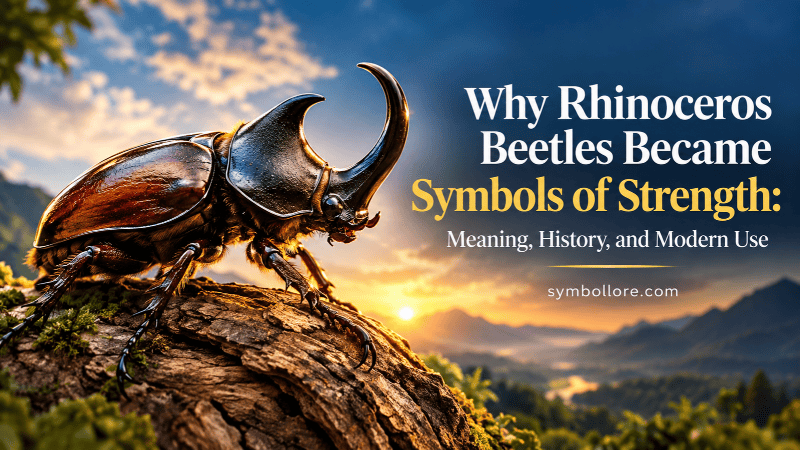
Strength is the easiest meaning to connect with the rhinoceros beetle because the animal’s physical abilities are genuinely unusual.
The National Wildlife Federation explains that some rhinoceros beetles can lift about 30 times their own weight without sacrificing speed. Some can lift considerably more, although their movement becomes difficult at the highest loads. Male horns are used mainly in competition with other males.
That creates a clear symbolic contrast: small body, remarkable force.
As a modern metaphor, the beetle can therefore represent strength that is easy to underestimate. It may suit someone who wants an image of quiet capability rather than obvious size or dominance.
However, the scientific fact and the symbolic meaning should remain separate. The beetle does not “prove” that humans should be strong. People simply use its observable traits as a metaphor for human qualities.
The Horn Represents More Than Aggression
The rhinoceros beetle’s horn is one of its most recognizable features. In males, it plays an important role in competition. The National Wildlife Federation notes that males use their horns to drive rivals away from females.
That behavior can inspire several related symbolic ideas:
- standing your ground;
- defending what matters;
- confidence under pressure;
- determination;
- controlled force;
- competition and persistence.
Protection is therefore a reasonable modern interpretation, but it should not be confused with a documented ancient doctrine.
The horn can also represent assertiveness without constant aggression. A person choosing the beetle as a personal symbol might focus on the ability to resist pressure rather than the desire to defeat others.
Transformation Comes From the Beetle’s Life Cycle
Rhinoceros beetles undergo complete metamorphosis. Their development moves through egg, larva, pupa, and adult stages. The larval period can occupy a large part of the insect’s life, depending on species.
This biological process provides a strong basis for modern symbolism.
The beetle can represent:
- personal change;
- development that happens privately;
- patience before visible results;
- leaving one stage behind;
- emergence into a new role.
This meaning is best described as metaphorical. Biology explains the transformation, while people create the symbolic connection.
That distinction matters because many symbolism websites describe metamorphosis as if nature intentionally sends a spiritual lesson. There is no scientific basis for that claim. The symbolism becomes meaningful because humans recognize a useful parallel between an insect’s life cycle and their own experiences.
Rhinoceros Beetle Symbolism in Japan
Japan provides the strongest documented cultural context for the rhinoceros beetle.
The Japanese rhinoceros beetle is commonly known as kabutomushi. Japanese interest in insects has deep historical roots, and the Japanese government’s Web Japan explains that rhinoceros and stag beetles became especially popular with children during the 1960s. Their large horns, jaws, and hard outer wings made them visually exciting.
The same source describes the rhinoceros beetle as one of the most popular insects among Japanese children. Children keep them as pets, schools sometimes maintain them as class pets, and summer insect exhibitions allow people in cities to encounter them.
This creates a richer meaning than simply calling the beetle a “samurai symbol.” The kabutomushi can represent summer, childhood, curiosity, competition, nature, and fascination with insects within modern Japanese life.
Academic research also identifies the rhinoceros beetle as an important part of modern Japanese cultural entomology. Hoshina and Takada’s peer-reviewed 2012 article specifically examines the rhinoceros beetle in Japanese popular culture.
The Samurai Helmet Connection Needs Context
The Japanese name kabutomushi is commonly explained through kabuto, the Japanese helmet, and mushi, meaning insect. The beetle’s horn resembles the shape of a helmet ornament, which helps explain the association with martial imagery.
But it is too simple to say that Japanese people historically treated rhinoceros beetles as literal representations of samurai warriors.
The museum record for Kitagawa Utamaro’s 1788 Picture Book of Crawling Creatures provides stronger evidence for the beetle’s place in Japanese visual culture. The Metropolitan Museum of Art identifies a page featuring the horned scarab beetle, or kabutomushi, in an Edo-period illustrated book.
A related Metropolitan Museum publication preserves a poem in which the speaker imagines being reborn as a helmet beetle after death and connects the beetle with endurance. That is a fascinating literary example, but it should be treated as one historical work rather than proof of a universal Japanese belief.
The Beetle’s Japanese Meaning Also Includes Competition
Rhinoceros beetles are not only admired for appearance. Their behavior has also shaped their cultural appeal.
Male rhinoceros beetles compete with one another using their horns. In Japan, beetle fighting became part of the wider culture surrounding insect keeping. A British Museum object record describes a Japanese netsuke showing a rhinoceros beetle fighting a stag beetle and notes the popularity of insect fighting among children.
The symbolism that emerges is therefore more specific than generic “power.”
The beetle can suggest competitive courage, persistence, physical confidence, and the excitement of testing one’s strength.
At the same time, this does not mean every Japanese person assigns these symbolic meanings to the insect. Cultural popularity and symbolic interpretation are related, but they are not identical.
Why the Egyptian Scarab Should Not Be Confused With the Rhinoceros Beetle
One of the biggest problems in online rhinoceros beetle symbolism is the transfer of Egyptian scarab symbolism to rhinoceros beetles.
Ancient Egyptian scarab symbolism is real and extensively documented. The scarab became associated with Khepri, the rising sun, regeneration, and religious and funerary practices. But that history primarily concerns scarab and dung beetles, not rhinoceros beetles simply because both belong to the larger scarab-beetle family.
The distinction matters.
The rhinoceros beetle can be called a scarab beetle in the broad taxonomic sense because rhinoceros beetles belong to Scarabaeidae. That does not make a rhinoceros beetle the same symbol as the Egyptian sacred scarab.
For broader background, North Carolina State University’s entomology resource explains how ancient Egyptians connected the dung beetle’s behavior with the sun and incorporated scarab imagery into religious and funerary objects.
So if a modern rhinoceros beetle tattoo includes a solar disk or explicitly references Khepri, the Egyptian association may be intentional. Without that context, automatically calling every rhinoceros beetle a symbol of Egyptian rebirth is historically misleading.
Rhinoceros Beetle Symbolism and the Idea of Protection
Protection is another common modern interpretation.
The beetle’s body is visually armored, while beetles generally possess hardened forewings called elytra that protect the softer wings underneath. The Smithsonian explains that elytra are an important beetle adaptation that contributes to survival.
That physical structure provides a reasonable metaphor for boundaries.
A rhinoceros beetle image may therefore suggest:
- protecting personal space;
- keeping vulnerable parts guarded;
- surviving difficult conditions;
- remaining strong without revealing everything;
- defending something valuable.
This interpretation is especially useful in modern art and design because it connects a visible biological feature with an understandable human idea.
Still, it remains an interpretation. The beetle’s shell does not scientifically contain a message about emotional boundaries.
What Rhinoceros Beetle Symbolism Means in Modern American Use
There is no reliable evidence that Americans share one fixed traditional meaning for rhinoceros beetles.
In the United States, the insect is more naturally encountered through wildlife education, entomology, gardening, photography, museums, nature collections, and modern creative work. Rhinoceros beetles are also present in the southern United States.
Modern personal symbolism can add another layer. Someone might choose a rhinoceros beetle image because it represents:
- surviving a difficult period;
- discovering hidden strength;
- protecting personal boundaries;
- persistence through slow progress;
- fascination with insects and nature;
- personal transformation.
These meanings are best understood as individual or contemporary symbolic choices, not as an established American folk tradition.
Is Rhinoceros Beetle Symbolism Always Positive?
No. Symbolic meaning can change when the surrounding context changes.
Strength can become stubbornness. Protection can become excessive defensiveness. Competition can suggest courage in one setting and unnecessary conflict in another.
This creates a more balanced interpretation:
| Positive Reading | Cautionary Reading |
|---|---|
| Strength | Stubbornness |
| Protection | Over-defensiveness |
| Persistence | Refusal to change |
| Confidence | Excessive pride |
| Competition | Conflict |
| Transformation | Fear of uncertainty |
There is no need to force every animal symbol into a positive category. Good symbolism writing should explain how the same physical trait can produce different readings.
Rhinoceros Beetle Meaning in Tattoos and Art
A rhinoceros beetle tattoo can represent strength, resilience, transformation, protection, or personal determination.
The design itself can make the intended meaning clearer.
A large horn can emphasize power. A beetle emerging from soil can suggest transformation. A Japanese-inspired kabutomushi can point toward Japanese insect culture, while a realistic scientific illustration may simply express admiration for nature.
Surrounding imagery also matters.
A beetle paired with plants may emphasize nature and growth. A geometric design may focus on structure and strength. A sun motif can introduce a separate solar or renewal association, but it should not automatically be described as ancient Egyptian symbolism.
The best interpretation starts with the actual design rather than assuming that every beetle tattoo means the same thing.
What Does Seeing a Rhinoceros Beetle Mean?
Seeing a rhinoceros beetle does not have a scientifically established supernatural meaning.
A beetle may appear because it is searching for food, shelter, moisture, a mate, or suitable habitat. Its presence alone cannot predict an event or prove that a spiritual message has arrived.
A personal symbolic interpretation can still be meaningful.
For example, someone working through a difficult project might see the beetle’s strength as a reminder to continue. Another person might focus on its metamorphosis and connect the encounter with a period of change.
The useful distinction is between reflection and prediction.
“This beetle reminds me to stay persistent” is a personal interpretation. “This beetle guarantees that something fortunate will happen” is a supernatural claim that the encounter cannot establish.
Rhinoceros Beetle Dreams: A Careful Interpretation
Dreams involving rhinoceros beetles do not have one scientifically established meaning.
A dream may reflect personal memories, fears, interests, or current concerns. The beetle’s appearance can provide a useful image for reflection, but it cannot reliably predict the future.
Consider three details:
- What was the beetle doing? A fighting beetle may bring competition to mind.
- How did you feel? Admiration and fear can lead to very different interpretations.
- What is changing in your life? The beetle’s life cycle may become a useful metaphor for transition.
This approach is more useful than a fixed dream dictionary. It respects personal symbolism without presenting speculation as scientific evidence.
What Rhinoceros Beetle Symbolism Does Not Prove
Several popular claims should be treated carefully.
It does not prove that the beetle predicts luck. Cultural or spiritual beliefs may attach good fortune to an encounter, but the insect itself does not provide evidence of future events.
It does not prove one universal spiritual meaning. Symbolic interpretation changes across cultures, periods, species, and personal settings.
It does not make every beetle an Egyptian symbol. The historical Egyptian scarab tradition has its own specific religious context.
It does not establish one “Native American” meaning. Indigenous nations have distinct traditions, and broad labels can erase those differences.
It does not mean every rhinoceros beetle represents a warrior. The Japanese kabutomushi has a documented connection with Japanese insect culture that is much broader than a simple warrior metaphor.
These distinctions make the symbolism more accurate without making it less interesting.
How to Interpret Rhinoceros Beetle Symbolism Responsibly
A useful interpretation can follow four steps.
First, identify the actual beetle. Rhinoceros beetles are a group, and different species can look and behave differently.
Second, identify the context. Ask whether the image appears in Japanese art, modern jewelry, a tattoo, a dream, scientific illustration, or another setting.
Third, identify the physical feature being emphasized. A horn points toward one set of interpretations. Metamorphosis, armor, competition, or nocturnal activity can create different associations.
Finally, separate history from personal meaning. A documented Japanese cultural practice is different from a modern spiritual interpretation. A personal tattoo meaning is different again.
This method avoids the biggest problem in online symbolism: turning several unrelated ideas into one supposedly ancient universal definition.
FAQs
A rhinoceros beetle commonly symbolizes strength, resilience, protection, determination, and transformation in modern symbolic interpretation. The horn and physical strength support power-related meanings, while its life cycle provides a metaphor for change. These meanings are interpretive rather than one universal historical code.
In Japan, the kabutomushi has a strong cultural presence connected with insect collecting, childhood, summer, pets, art, and popular culture. It became especially popular with children from the 1960s onward, partly because of its striking horns and armored appearance.
No. Rhinoceros beetles belong to the scarab beetle family, but the famous ancient Egyptian scarab tradition centers on specific scarab and dung beetles. Egyptian symbolism should not automatically be transferred to every member of the broader scarab family.
Strength is one of the clearest modern interpretations because rhinoceros beetles have exceptional physical abilities. Some species can lift many times their own weight, and males use their horns during competition.
A rhinoceros beetle tattoo can represent strength, resilience, protection, persistence, transformation, or admiration for nature. A Japanese kabutomushi design can also reference Japanese insect culture. The surrounding symbols and the wearer’s intention determine the specific meaning.
There is no scientific evidence that seeing a rhinoceros beetle predicts good luck or bad luck. Some personal or spiritual interpretations may treat the encounter as meaningful, but those interpretations belong to belief and reflection rather than established fact.
The horn can symbolize strength, defense, confidence, and determination in modern interpretations. Biologically, male rhinoceros beetles use their horns mainly during competition with other males.
Sources and Further Reading
- National Wildlife Federation — Rhinoceros Beetles
- Web Japan — Catching and Raising Insects: A Popular Hobby for Kids in Japan
- University of Fukui — Cultural coleopterology in modern Japan
- The Metropolitan Museum of Art — Horned Scarab Beetle (Kabutomushi), 1788
- Smithsonian National Museum of Natural History — The Beetle’s Special Adaptation for Survival: Elytra
Conclusion
Rhinoceros beetle symbolism centers on strength, resilience, protection, determination, and transformation, but its meaning becomes clearer when the evidence is separated from modern spiritual claims. The insect’s horn and physical power explain why strength is such a natural metaphor, while its life cycle supports interpretations of change.
Japan provides the richest documented cultural context, where the kabutomushi became closely connected with insect collecting, childhood, summer, art, and popular culture.
Most importantly, the rhinoceros beetle should not simply inherit every meaning associated with the Egyptian scarab. Its symbolism is strongest when species, culture, history, and personal context are considered together.