
Resilience symbolism most often represents recovery, adaptation, endurance, and the ability to continue after hardship. But resilience is not exactly the same as strength. A mountain may symbolize stability, while bamboo can symbolize the ability to bend and survive pressure. A repaired bowl can represent recovery that keeps visible evidence of damage.
That distinction matters because different cultures have developed different images for surviving difficulty. Chinese art, Buddhist traditions, Japanese craft, Christian imagery, and modern American culture do not use one universal symbol of resilience. Instead, each gives certain objects, plants, stories, or forms meanings shaped by history and context.
Quick Answer
Resilience symbolism represents the ability to adapt, recover, endure, or continue after difficulty. Bamboo emphasizes flexibility, plum blossoms perseverance through winter, lotus imagery can express spiritual purity arising from difficult conditions, and kintsugi emphasizes visible repair. The phoenix is closely related but more precisely symbolizes rebirth and renewal. These meanings belong to particular traditions rather than a universal symbolic code.
TL;DR
- Bamboo represents flexibility because its traditional imagery emphasizes bending without breaking.
- Plum blossoms can represent perseverance because they bloom in late winter and became important symbols in Chinese art.
- Kintsugi represents repair and continued value rather than pretending damage never happened.
- The lotus is strongly connected with purity and spiritual awakening in Buddhist art, especially through its growth from muddy water.
- The phoenix is better understood as rebirth or renewal, although modern audiences often use it as a resilience image.
- Modern personal symbolism can combine these older meanings with an individual’s own experience of recovery.
Resilience Meanings at a Glance
| Symbol or context | Possible meaning | Why the association developed | Important limit |
|---|---|---|---|
| Bamboo in Chinese art | Flexibility, endurance, moral character | Bamboo bends without breaking and became a major literati motif | Its meaning depends on the artwork and tradition |
| Plum blossom in Chinese art | Perseverance, courage, hope | It blooms during late winter and became associated with adversity and renewal | Not every plum image carries the same moral message |
| Lotus in Buddhist art | Purity, enlightenment, spiritual growth | The flower emerges from muddy water while remaining visually pure | Buddhist symbolism is broader than “overcoming hardship” |
| Kintsugi in Japan | Repair, continuity, acceptance of damage | Broken ceramics are repaired while the cracks remain visible | Modern wellness versions can simplify its historical context |
| Phoenix in Christian art | Resurrection and eternal life | Christian artists used the mythical bird as an analogy for resurrection | It represents rebirth more directly than continuous survival |
| Modern personal symbolism | Recovery, endurance, new beginnings | People adapt older symbols to individual experiences | Personal meaning is not evidence of a universal tradition |
What Does Resilience Symbolism Really Mean?
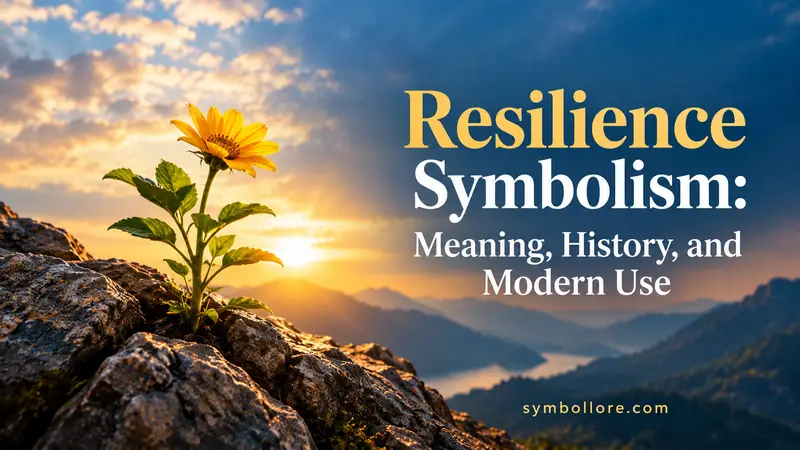
At its core, resilience symbolism is about continuing after change or difficulty, not about remaining untouched.
That distinction matches the modern psychological understanding of resilience. The American Psychological Association describes resilience as successful adaptation to difficult experiences, involving flexibility and adjustment rather than simple toughness. Research and educational material from the APA also stresses that resilience does not mean never feeling distress or hardship.
Symbolic traditions often express this idea visually. A bent plant, a flower appearing after winter, a repaired object, or a mythical being returning to life gives an abstract quality a concrete form.
This is why resilience symbolism can include several different ideas:
- Adaptation: changing without losing one’s basic identity.
- Endurance: continuing through prolonged difficulty.
- Recovery: returning to useful or healthy functioning.
- Repair: becoming functional again after damage.
- Renewal: beginning another phase after loss or change.
- Transformation: emerging in a different form.
These are related, but they are not identical.
Why Bamboo Became a Powerful Image of Resilience
Bamboo provides one of the clearest examples of resilience symbolism because its physical behavior became part of its cultural meaning.
In Chinese art, bamboo became a favored subject of literati painters. The Metropolitan Museum of Art describes bamboo as a traditional symbol that bends without breaking, linking its physical flexibility with moral symbolism.
The association is especially useful because bamboo does not symbolize invulnerability. Its symbolic lesson is almost the opposite. It survives pressure through flexibility.
Chinese and East Asian artistic traditions also placed bamboo within larger groups of meaningful plants. The “Three Friends of Winter,” for example, combine pine, bamboo, and plum. A British Museum object record explains that bamboo represented the ideal gentleman-scholar who should bend rather than break under adversity.
So when bamboo appears as a resilience symbol, the strongest interpretation is not simply strength. It is strength through adaptability.
Plum Blossoms Represent Perseverance Through Winter
Plum blossoms offer a different model of resilience.
In Chinese art, Prunus mume became significant partly because it flowers during the cold season, before many other plants show signs of spring. The Smithsonian’s National Museum of Asian Art describes plum blossom imagery as connected with perseverance, strength, and courage because the tree blooms after the long winter.
The symbolism became particularly powerful in literati painting. The flowering plum was one of the traditional “Four Gentlemen,” a group of plants associated with cultivated character in Chinese art. It also appears with pine and bamboo in the “Three Friends of Winter.”
This gives plum blossom symbolism a specific form of resilience:
Blooming before conditions are fully favorable.
That is different from bamboo. Bamboo teaches flexibility under pressure, while the winter-blooming plum suggests perseverance and the arrival of renewal despite difficult conditions.
For a deeper look at this tradition, see
Plum Blossom Symbolism: Meaning, History, and Cultural Context.
What Kintsugi Says About Surviving Damage
Kintsugi offers perhaps the clearest visual metaphor for resilience after something has actually broken.
Kintsugi is a Japanese ceramic-repair practice in which cracks can be repaired with lacquer and highlighted with gold. The Metropolitan Museum of Art describes the tradition as one that emphasizes repairs rather than disguising them.
The Smithsonian has also documented kintsugi on Japanese tea ware, explaining how the technique can connect visible repair with Japanese ideas about impermanence and the fragility of objects.
That makes kintsugi different from a symbol of simple toughness. The bowl did break. The repair does not erase that fact.
Modern writers often turn this into the phrase “more beautiful because it was broken.” That can be a useful personal metaphor, but it simplifies the tradition. A more careful interpretation is that the object’s history remains visible while the object continues to have value and function.
That is a stronger model of resilience because it allows recovery to involve change.
Why the Lotus Is Connected With Purity and Spiritual Growth
The lotus is another common resilience image, but its historical meaning should not be reduced to a generic “overcoming adversity” message.
In Buddhist art, the lotus often represents purity because it grows from muddy water while producing an apparently clean blossom. The Metropolitan Museum of Art describes the lotus as a Buddhist symbol of purity and perfection, while a Smithsonian National Museum of Asian Art object identifies the lotus as a symbol of purity in Buddhist imagery.
This explains why modern audiences sometimes use the lotus as a symbol of resilience. The visual metaphor is clear: difficult surroundings do not prevent the flower from developing.
Yet the historical meaning is more specific than “life is hard, but keep going.” In Buddhist contexts, the lotus can relate to purity, wisdom, awakening, and spiritual development.
So a lotus tattoo or artwork may express resilience for a modern American viewer, but that personal interpretation should not be presented as the one original meaning of the lotus.
Is the Phoenix Really a Symbol of Resilience?
The phoenix is one of the most recognizable modern symbols associated with resilience, but rebirth is the more precise historical idea.
The phoenix is a mythical bird that dies and returns to life. Because the story centers on destruction followed by a new life, it naturally became an image of renewal.
Christian artists later used the phoenix as a symbol of resurrection. The Metropolitan Museum of Art, for example, identifies a phoenix rising from ashes on a Christian vestment as an allusion to Christ’s resurrection. A Met portrait from the late fifteenth century similarly identifies the phoenix as referring to resurrection.
The distinction is useful:
- Phoenix: destruction → rebirth.
- Bamboo: pressure → flexibility.
- Kintsugi: breakage → repair.
- Plum blossom: winter → perseverance and renewal.
- Lotus: difficult surroundings → purity or awakening.
All can support a modern idea of resilience, but they tell different stories.
For more historical detail on the phoenix in Christian imagery, see
Phoenix Symbolism in Christianity: Resurrection, Hope, and Eternal Life.
Resilience Symbolism Across Cultures Is Not One Universal System
A major mistake in symbolism writing is assuming that similar meanings prove identical cultural origins.
For example, Chinese bamboo symbolism and Japanese kintsugi both work well as modern images of resilience, but they come from very different cultural practices.
Likewise, the lotus has specific Buddhist and Hindu traditions, while the phoenix entered Christian art through a different historical pathway. Similar modern interpretations do not erase those differences.
Research on resilience itself also shows why cultural context matters. A multinational study of trauma survivors found that resilience should be considered within social, political, interpersonal, and cultural settings rather than treated as a purely individual quality.
The same caution helps with symbolism. A symbol can travel between cultures, but its meaning may change during that process.
How Resilience Symbolism Is Used in the United States Today
There is no single American symbol of resilience that everyone recognizes in the same way.
Instead, contemporary U.S. use often appears in personal and creative settings:
- tattoos marking survival or recovery;
- memorial artwork;
- jewelry and personal objects;
- paintings and illustrations;
- motivational or educational design;
- literary and film imagery;
- gifts connected with difficult life transitions;
- artwork representing healing or a new beginning.
The meaning often comes from the user’s story as much as from historical tradition.
For example, someone might choose bamboo because they want to emphasize flexibility. Another person might choose kintsugi because they want visible evidence of having survived a difficult experience. A third person might choose a phoenix because they identify more strongly with starting over.
None of these choices needs to be treated as a universal symbolic rule.
A related example appears in
Pony Symbolism: Quiet Strength, Freedom, and Resilience,
where resilience comes from a different source: the idea of underestimated capability, endurance, and steady partnership.
How to Choose the Right Resilience Symbol for Its Context
If you are interpreting a symbol in artwork, literature, jewelry, or a tattoo, begin with the type of resilience being expressed.
If the focus is flexibility
Bamboo is especially appropriate. Its traditional imagery emphasizes bending rather than breaking.
If the focus is perseverance through a difficult season
Plum blossom offers a more specific metaphor. Its winter flowering connects endurance with the arrival of spring.
If the focus is surviving visible damage
Kintsugi is particularly direct. The repair remains part of the object.
If the focus is spiritual growth
Lotus imagery may be more appropriate, especially when the surrounding work is Buddhist or otherwise connected with South Asian religious traditions.
If the focus is starting again after destruction
The phoenix communicates rebirth and renewal more clearly than continuous resilience.
This approach is more useful than asking which symbol is “the” symbol of resilience. The better question is what kind of resilience does the symbol need to express?
Common Misconceptions About Resilience Symbolism
“Resilience always means being strong.”
Not necessarily. Resilience can involve flexibility, adaptation, recovery, repair, or seeking support. The APA specifically describes resilience as successful adaptation rather than simply remaining unaffected by adversity.
“The phoenix is the original universal symbol of resilience.”
No. The phoenix has specific mythological and religious histories, and its strongest symbolic idea is rebirth or resurrection. Modern people may use it for resilience, but that is not the same as claiming one universal ancient meaning.
“Kintsugi means that suffering is beautiful.”
That wording is too broad. Kintsugi visibly incorporates repair into a ceramic object’s continued life, but modern wellness culture can simplify the practice into a message that damage itself is desirable. The historical craft is more specific than that.
“The lotus universally means overcoming hardship.”
The lotus has important Buddhist symbolism involving purity and spiritual awakening, among other traditions. Its modern resilience interpretation grows naturally from its visual form, but it should not replace its religious and cultural context.
“Every culture has the same resilience symbols.”
Similar ideas appear in many cultures, but the stories and meanings differ. Chinese plum and bamboo traditions, Japanese ceramic repair, Buddhist lotus imagery, and Christian phoenix imagery developed through distinct histories.
FAQs
There is no single universal symbol of resilience. Bamboo, plum blossoms, kintsugi, lotus imagery, and the phoenix are common examples, but each emphasizes a different form of surviving difficulty: flexibility, perseverance, repair, spiritual growth, or rebirth.
Plum blossoms are a strong historical example because they bloom in late winter and became associated with perseverance in Chinese art. The lotus is another important example, especially in Buddhist traditions, where its emergence from muddy water supports symbolism of purity and spiritual awakening.
Yes, particularly in Chinese artistic symbolism. Bamboo became associated with bending without breaking, making it a useful metaphor for flexibility and endurance under pressure. The Metropolitan Museum of Art explicitly describes bamboo’s symbolic value in these terms.
Kintsugi can serve as a modern symbol of resilience because it shows an object being repaired while its cracks remain visible. Historically, however, kintsugi is a Japanese ceramic-repair tradition, so modern interpretations should not be treated as its only meaning.
The phoenix most strongly symbolizes rebirth, renewal, and resurrection. In Christian art, the phoenix became an established image associated with resurrection, while modern audiences often extend the metaphor to personal recovery and transformation.
It can have a spiritual meaning within particular traditions, but there is no single universal spiritual interpretation. Buddhist lotus imagery, for example, connects purity and awakening with the flower’s emergence from muddy water. Personal spiritual interpretations should be identified as beliefs rather than scientific facts.
Sources and Further Reading
- American Psychological Association — Resilience
- Metropolitan Museum of Art — Bamboo
- National Museum of Asian Art — A Breath of Spring
- Smithsonian Magazine — Kintsugi and the 16th-Century Tea Bowl
- Metropolitan Museum of Art — Chasuble with Phoenix Imagery
Conclusion
Resilience symbolism is less about being untouched by hardship than about what happens after pressure, loss, change, or damage. Bamboo represents flexible endurance, plum blossoms suggest perseverance through winter, kintsugi makes repair visible, and the lotus connects difficult surroundings with purity and awakening. The phoenix belongs in the conversation too, although its strongest historical meaning is rebirth rather than continuous survival.
These differences make symbolism more useful, not less. When interpreting a resilience image, consider its culture, period, setting, and physical or narrative qualities. The most grounded reading is the one that explains not only what the symbol means, but also why that meaning developed.