
Salmon symbolism in Native American cultures is closely tied to nourishment, renewal, reciprocity, community, and the continuing relationship between people and waterways. These meanings are especially well documented among Indigenous nations of the Pacific Northwest and Alaska, where salmon shaped food systems, trade, ceremonies, art, and community life.
Yet there is no single Native American salmon meaning. A Columbia River First Salmon ceremony, a Tlingit salmon crest, and a contemporary Coast Salish artwork may communicate different ideas. The most accurate interpretation therefore begins with the nation, place, tradition, and purpose behind the salmon image.
Quick Answer
Salmon symbolism in Native American cultures commonly connects with life, nourishment, abundance, renewal, perseverance, reciprocity, and continuity. These meanings developed from salmon’s importance as food and from its seasonal return to rivers. However, traditions differ among Indigenous nations, so salmon should not be assigned one universal “Native American” meaning.
TL;DR
- Salmon represents nourishment and life because it has sustained communities for generations.
- Its return to rivers supports meanings of renewal, continuity, and homecoming.
- In Columbia River traditions, salmon is honored as a First Food and as part of a reciprocal relationship with people.
- Alaska Native traditions connect salmon with subsistence, sharing, family, and cultural continuity.
- Northwest Coast art may use salmon as a crest or culturally specific visual form.
- Modern interpretations should not turn these living traditions into a generic “spirit animal” system.
Salmon Meanings at a Glance
| Cultural context | Possible meaning | Why the association exists | Important limit |
|---|---|---|---|
| Columbia River tribal traditions | Nourishment and reciprocity | Salmon is honored as a First Food and giver of sustenance | Specific teachings belong to particular tribal communities |
| First Salmon ceremonies | Renewal and continuity | The annual return begins another cycle of food, ceremony, and community life | Ceremony forms vary by nation and location |
| Alaska Native traditions | Sharing and cultural continuity | Salmon supports subsistence, cooperation, preservation, and seasonal life | Alaska Native nations have distinct traditions |
| Coast Salish and Northwest Coast art | Life, abundance, renewal, identity | Salmon is deeply connected with waterways, food, art, and community | A salmon crest or artwork may have a specific family or artist meaning |
| Salmon migration | Perseverance and return | Fish overcome currents and return toward natal waters | This is a symbolic interpretation of biological behavior |
| Contemporary environmental use | Restoration and responsibility | Salmon depend on connected rivers, habitats, and healthy ecosystems | Conservation symbolism is a modern layer, not the whole tradition |
Why Salmon Became Such a Powerful Symbol
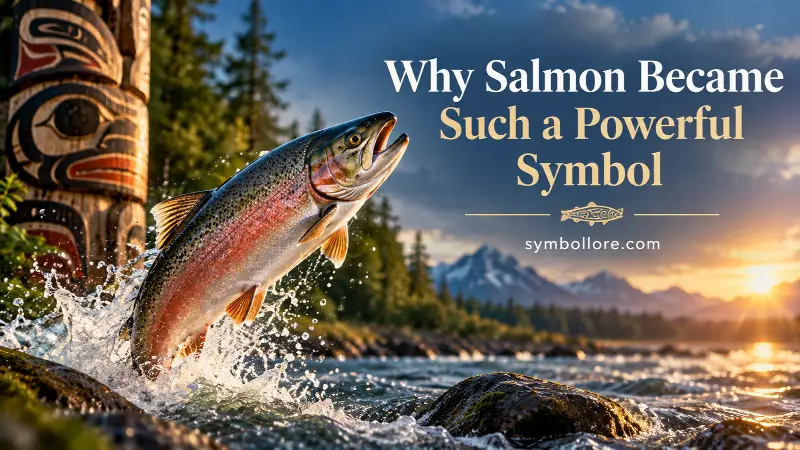
The salmon’s symbolic importance begins with its practical importance.
Across the Pacific Northwest and Alaska, salmon provided a dependable seasonal source of food. Communities developed ways to catch, preserve, share, and manage the fish. These practices became part of social life rather than remaining separate from culture.
The U.S. Fish and Wildlife Service describes salmon as a species that once sustained Native American populations across much of the Pacific Coast. It also notes that First Fish ceremonies celebrating returning salmon continue today.
That relationship helps explain why salmon can symbolize more than wealth or success. Abundance means having food, sharing resources, sustaining families, and maintaining the conditions that allow the next generation to live.
This is why a salmon image can carry ideas of provision and responsibility at the same time.
Salmon as a First Food and Gift
Among several Columbia River tribal communities, salmon is understood through the concept of First Foods.
The Columbia River Inter-Tribal Fish Commission explains that salmon is one of the traditional First Foods honored in tribal ceremonies. These foods include water, salmon, game, roots, and berries.
The Confederated Tribes of the Umatilla Indian Reservation provides an especially clear explanation of this relationship. Its First Foods tradition places salmon at the center of a reciprocal relationship: the foods nourish people, while people have responsibilities to protect the foods and their habitats.
This creates a deeper symbolic pattern:
Salmon gives → people receive → people honor → people protect → salmon returns.
The meaning is therefore not simply “abundance.” It includes reciprocity.
That distinction matters because modern readers sometimes interpret Indigenous symbolism as a list of abstract traits. In this tradition, salmon is connected to an ongoing relationship involving food, water, ceremony, responsibility, and survival.
What the First Salmon Ceremony Represents
First Salmon ceremonies are among the clearest examples of salmon symbolism in Native American cultures.
The exact practices differ between communities. The Columbia River Inter-Tribal Fish Commission explains that First Salmon Feasts occur before open fishing in some Columbia River tribal traditions. The ceremonial harvest honors salmon and its role in sustaining people.
The Northwest Power and Conservation Council also documents historic First Salmon ceremonies at places such as Kettle Falls and Celilo Falls. The details varied by tribe, but respect for the returning fish remained a central theme.
Symbolically, the ceremony can represent:
- Renewal: another salmon run has returned.
- Gratitude: the fish provides nourishment.
- Continuity: the ceremony connects generations.
- Reciprocity: people have responsibilities toward the fish.
- Community: the salmon is prepared and shared.
- Respect for place: salmon depend on rivers and watersheds.
The ceremony should not be treated as one identical ritual practiced by every Native nation. Its meaning belongs to the communities that maintain each tradition.
Salmon Symbolism in Columbia River Cultures
The Columbia River Basin provides some of the strongest documented examples of salmon’s cultural importance.
The Smithsonian’s National Museum of the American Indian describes Native nations of the Pacific Northwest as Salmon People, emphasizing salmon as an important gift of food and the role of ceremonies honoring the fish’s sacrifice. The museum also distinguishes major geographic regions and recognizes the cultural diversity within the Pacific Northwest.
The Columbia River Inter-Tribal Fish Commission similarly describes salmon as central to the cultures, diets, societies, and religions of the tribes connected with the Columbia River.
This context gives salmon several connected meanings:
Food → community → ceremony → identity → responsibility.
The symbol is powerful because these ideas are not separate. Salmon links them through a living resource that returns to the same watershed year after year.
That makes “renewal” a more useful interpretation than a vague claim that salmon simply represents spirituality.
Salmon in Coast Salish and Northwest Coast Traditions
Salmon also holds major importance in Northwest Coast Indigenous art and cultural expression.
Coast Salish artists have used salmon imagery in contemporary works, while salmon figures appear in broader Northwest Coast artistic traditions. A University of British Columbia account of Coast Salish artist Brent Sparrow’s work describes salmon as part of an artwork connected with protection, enlightenment, and balance.
A separate UBC cultural resource describes salmon as deeply woven into Coast Salish culture and communities and connects the fish with resilience and the broader web of life.
However, salmon imagery should not be treated like a universal icon with one dictionary definition.
Northwest Coast Indigenous art often contains crests, inherited designs, family histories, and culturally specific visual conventions. The Douglas Reynolds Gallery notes that crest meanings can vary according to nation, clan, family, and context.
Therefore, a salmon in a specific artwork may communicate much more than “perseverance.”
Salmon Among Alaska Native Peoples
Salmon symbolism is also deeply connected with Alaska Native cultures.
The Alaska Department of Fish and Game reports that salmon have been tied to Alaska Native cultures for at least 11,800 years. Seasonal harvesting, sharing, cooperation, traditional knowledge, and cultural values remain part of human-salmon relationships in Alaska.
For Tlingit and Haida communities, salmon was a major food resource and an important part of traditional life. Smithsonian Folklife documentation describes salmon as a foundational food resource in precontact Tlingit and Haida society.
Salmon also appears in Tlingit cultural education. Sealaska Heritage Institute materials teach students about salmon as food, salmon crests and clans, and appropriate respectful treatment of salmon.
These examples show why sharing, survival, family, identity, and responsibility can be better descriptions than a generic “spiritual meaning.”
The traditions are living cultural systems, not ancient symbols disconnected from modern communities.
Salmon, Perseverance, and the Journey Home
The salmon’s physical journey also explains why perseverance became a common symbolic interpretation.
Many Pacific salmon migrate from the ocean toward freshwater spawning areas. They face strong currents and other obstacles along the way. Their return has naturally inspired metaphors about persistence and determination.
This does not mean salmon are “rebels” because they swim upstream. Their behavior is biological. The symbolic meaning comes from the human tendency to compare that difficult journey with human challenges.
The same migration also supports the idea of returning home.
A salmon leaves its freshwater environment, spends part of its life at sea, and later returns toward the waters connected with its early life. That pattern can become a metaphor for:
- returning to one’s homeland;
- reconnecting with family;
- remembering one’s roots;
- preserving cultural identity;
- returning after a difficult journey;
- maintaining continuity across distance.
This meaning is especially powerful when considered alongside Indigenous relationships with ancestral places and waterways.
Renewal Is More Than “Rebirth”
Salmon is often described online as a symbol of rebirth. That wording needs some care.
In many Pacific salmon species, adults reproduce and then die. Their bodies contribute nutrients to aquatic and surrounding ecosystems. This means the cycle involves one generation supporting another, rather than the same individual literally being reborn.
That distinction produces a richer interpretation.
Salmon can symbolize:
life → sacrifice → nourishment → continuation.
The meaning is therefore closer to renewal through continuity than simple personal rebirth.
This idea fits documented First Foods traditions particularly well because salmon’s value continues beyond the individual fish. The fish nourishes people, and communities maintain responsibilities toward the waters and habitats that support future salmon runs.
Salmon, Abundance, and Community
Abundance is another major salmon association.
The reason is practical. Large salmon runs historically provided enough food for families and communities to preserve supplies for later seasons. Salmon also supported exchange, trade, and social gatherings.
The National Academies Press notes that salmon became connected with community and regional identity as well as American Indian tribal heritage in the Pacific Northwest.
But abundance should not be reduced to modern ideas of wealth.
In an Indigenous context, salmon abundance can be more closely connected with:
- enough food for the community;
- successful seasonal harvests;
- sharing;
- family support;
- healthy waterways;
- continuation of cultural practices;
- responsibility toward future generations.
This is a different concept from simply treating salmon as a symbol of financial prosperity.
Salmon as a Symbol of Reciprocity and Responsibility
One of the most important ideas competitors often understate is reciprocity.
The relationship is not simply:
People take salmon → people receive benefits.
Instead, many documented Indigenous teachings emphasize relationships in which people have obligations toward the fish, water, land, and future generations.
The Confederated Tribes of the Umatilla Indian Reservation describes First Foods through a reciprocal relationship in which the foods nourish people while people must protect the foods and their supporting habitats.
That principle changes how the symbol should be understood.
Salmon can represent receiving a gift while accepting responsibility for the source of that gift.
This makes salmon especially meaningful in discussions of stewardship, community, conservation, and cultural continuity.
Salmon in Contemporary Native Art and Identity
Salmon symbolism has not remained in the past.
Native artists continue to represent salmon through carving, painting, printmaking, public art, jewelry, and other media. Contemporary artworks may combine salmon with environmental concerns, family identity, cultural history, or modern community life.
For example, the Smithsonian’s National Museum of the American Indian documents a Tsimshian artist’s salmon-centered totem pole and identifies the artist’s community connection to the “People of the Salmon.”
Modern salmon imagery can therefore communicate both heritage and present-day identity.
A salmon in contemporary Native art does not automatically mean that the artist is reproducing an ancient symbol unchanged. The artist may be preserving a traditional form, expressing a personal experience, addressing environmental issues, or creating something entirely new.
The artist’s statement and community context should guide interpretation.
Salmon and Environmental Responsibility Today
Salmon has also become a powerful symbol of environmental health.
The fish depends on connected waterways and suitable habitat throughout its life cycle. When rivers are blocked, polluted, or damaged, salmon populations can suffer.
NOAA describes salmon as one of the First Foods for tribes along the West Coast and notes the importance of salmon to tribal culture, ceremonies, songs, artwork, and legends. It also connects salmon recovery with protecting the ecosystems and communities that depend on them.
This creates a modern symbolic layer:
Healthy salmon → healthy rivers → healthy communities.
For Indigenous communities, environmental protection can therefore overlap with cultural protection. Restoring salmon habitat may also help preserve fishing practices, ceremonies, foods, knowledge, and relationships with ancestral waters.
What Salmon Symbolism Does Not Mean
Several popular claims need qualification.
First, there is no single salmon meaning shared by every Native American nation. The phrase “Native American” covers hundreds of distinct peoples and traditions.
Second, salmon is not simply a generic “spirit animal.” Some Indigenous traditions have specific relationships with salmon, but modern spirit-animal language can flatten those traditions into a personal personality system.
Third, not every salmon image represents “rebirth.” Renewal, continuity, nourishment, return, and generational responsibility are often more precise.
Finally, a salmon design in Northwest Coast art should not automatically be treated as decorative. It may connect with an artist, family, clan, community, story, or cultural design tradition.
The safest approach is to ask who created the symbol, where it comes from, and how that community explains it.
How to Interpret a Salmon Symbol Respectfully
If you encounter a salmon in an Indigenous artwork, ceremony, story, or design, use context rather than a generic symbol dictionary.
Start with these questions:
- Which nation or community is involved?
- Where was the object or artwork created?
- Who made it?
- Is salmon being shown as food, a crest, a story figure, or an environmental symbol?
- Is the meaning documented by the artist or community?
- Is the object public, ceremonial, family-specific, or restricted?
This method prevents cultural meanings from being mixed together.
It also respects an important principle: not every Indigenous teaching is intended for unrestricted public interpretation. When reliable community information is unavailable, saying “the evidence is limited” is better than filling the gap with a made-up meaning.
For broader context on why Indigenous symbols should be interpreted within their own communities,
see Native American symbolism and its cultural limits.
FAQs
Salmon commonly symbolizes nourishment, abundance, renewal, continuity, reciprocity, and community among several Indigenous nations of the Pacific Northwest and Alaska. The exact meaning depends on the nation and tradition. Columbia River communities, for example, connect salmon with First Foods and reciprocal responsibilities toward food and water.
Salmon is deeply respected because it has provided food and supported community life for generations. In some Columbia River traditions, salmon is honored as a First Food and as a gift that carries responsibilities for people. This relationship is expressed through ceremonies, feasts, fishing practices, and stewardship.
There is no single spiritual meaning for salmon across Native American cultures. In documented Pacific Northwest traditions, salmon may be connected with life, food, ceremony, reciprocity, ancestry, and the relationship between people and water. These meanings should be attributed to specific communities rather than presented as universal.
Yes, perseverance is a common modern interpretation of salmon imagery. The association comes from the difficult migration of salmon against currents toward spawning waters. However, perseverance is a symbolic human interpretation of animal behavior, not a universal traditional teaching shared by every Indigenous nation.
The meaning depends on the artist and artwork. Salmon is deeply connected with Coast Salish life, waterways, food, identity, and artistic traditions. Contemporary Coast Salish artists may use salmon to communicate ideas such as resilience, renewal, balance, or connection with the natural world.
No. Salmon traditions differ among Indigenous nations. Columbia River tribes, Alaska Native peoples, Coast Salish communities, and other nations have different languages, histories, ceremonies, and artistic traditions. A responsible interpretation identifies the community instead of assigning one universal definition.
A salmon in a dream may personally suggest perseverance, return, change, nourishment, or connection with home. However, dream interpretation is not a scientifically fixed system. A dream image should be understood through the dreamer’s personal experiences rather than treated as a guaranteed spiritual prediction.
Sources and Further Reading
- Columbia River Inter-Tribal Fish Commission: Tribal Salmon Culture
- Columbia River Inter-Tribal Fish Commission: First Salmon Feast
- Smithsonian National Museum of the American Indian: Columbia River/Plateau Region
- U.S. Fish & Wildlife Service: Salmon—A Pacific Northwest Icon
- Alaska Department of Fish and Game: Alaska’s Wild Salmon
Conclusion
Salmon symbolism in Native American cultures is rooted in relationships rather than a single symbolic definition. Among Indigenous nations of the Pacific Northwest and Alaska, salmon has been connected with nourishment, abundance, ceremony, renewal, community, identity, and responsibility for waterways. Its return can also inspire modern ideas of perseverance and homecoming.
The most respectful interpretation keeps these meanings tied to their communities and places. Salmon is not simply a generic symbol of spirituality or rebirth. Its deeper significance comes from a living relationship in which people receive nourishment, honor the fish, protect its habitat, and carry cultural knowledge forward.