
Chinese bird symbolism connects birds with joy, longevity, love, virtue, social rank, seasonal change, and sometimes sorrow. However, no single meaning applies to every bird or picture. The species, its pose, nearby objects, and the artwork’s historical setting all shape the message.
A crane beside a pine may express long life, while a crane on an official badge can indicate civil rank. Likewise, paired mandarin ducks suggest romantic harmony, but one duck on court clothing may represent an official position. Context therefore matters as much as the bird itself.
Quick Answer
Chinese bird symbolism uses real and mythical birds to express wishes, virtues, relationships, emotions, and social identity. Fenghuang imagery commonly suggests virtue and harmony, cranes represent longevity, magpies announce joy, and mandarin ducks evoke devoted love. Yet meanings can change according to the bird’s companion symbols, number, setting, and historical period.
Key Takeaways
- The fenghuang represents virtue, harmony, prosperity, and imperial authority.
- Cranes commonly convey longevity, wisdom, immortality, and distinguished rank.
- Magpies signal joy, good news, reunion, and romantic happiness.
- Paired mandarin ducks traditionally express affection and marital harmony.
- Cuckoos can represent grief, longing, homesickness, or separation.
- Complete compositions matter more than isolated bird images.
Chinese Bird Meanings at a Glance
| Bird | Common Meaning | Typical Context or Visual Clue |
|---|---|---|
| Fenghuang | Virtue, harmony, prosperity, imperial authority | Paired with a dragon or shown in court art |
| Crane | Longevity, wisdom, immortality, high rank | Beside pine, peach, clouds, sun, or lingzhi |
| Magpie | Joy, good news, reunion, good fortune | On a plum branch or shown as a pair |
| Mandarin duck | Love, affection, marital harmony | Two ducks beside lotus flowers |
| Wild goose | Loyalty, travel, messages, separation | Flying in formation or appearing alone |
| Swallow | Spring, return, family happiness, renewal | Near homes, blossoms, or seasonal scenes |
| Oriole | Joy, friendship, music, spring | Singing among flowering branches |
| Peacock | Beauty, dignity, splendor, official success | Displayed tail or court clothing |
| Cuckoo | Sorrow, grief, longing, homesickness | Poetry, lonely landscapes, or lamentation |
| Owl | Warning, darkness, death, or protective power | Ancient objects, night scenes, or later folklore |
What Does Chinese Bird Symbolism Represent?
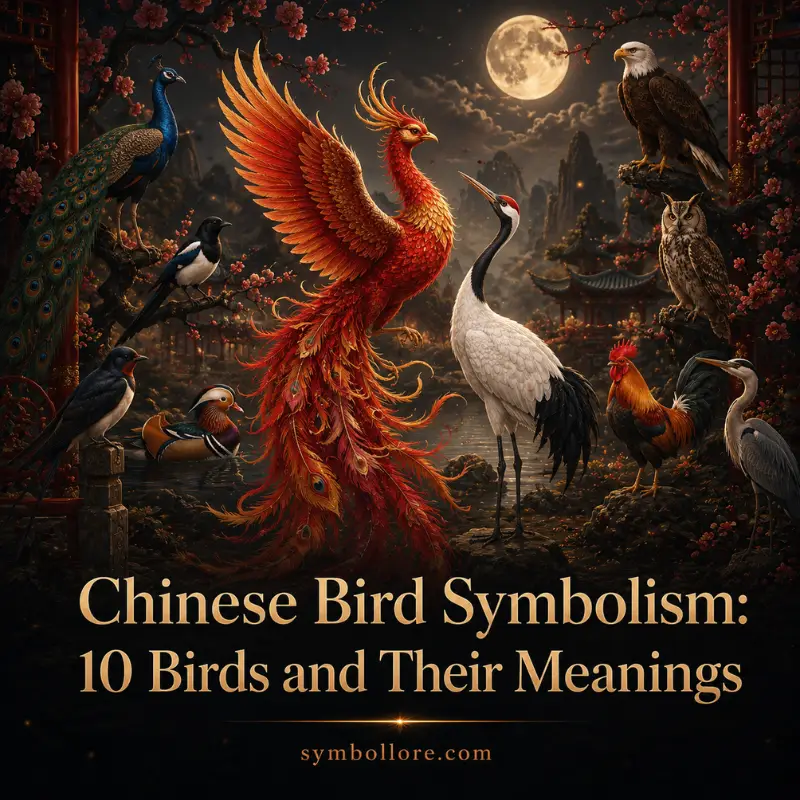
Chinese bird symbolism represents a visual language rather than one universal belief. Artists and viewers associated different species with human experiences such as marriage, family duty, advancement, grief, good fortune, and long life. Some birds gained meaning from their behavior, while others became meaningful through literature, mythology, sound, or court rules.
A picture can also function as a wish. For example, a household object decorated with magpies may offer joy rather than describe an actual event. Meanwhile, cranes on a birthday gift can communicate hopes for health and longevity. Therefore, symbolic images often express blessings, social values, or personal aspirations.
Not every meaning applies throughout all of China. Traditions changed across dynasties, regions, ethnic communities, religions, and artistic settings. Modern interpretations may also simplify older ideas.
Why Birds Became Important in Chinese Culture
Birds gained importance because they appeared across Chinese ritual objects, poetry, painting, textiles, ceramics, legends, and court clothing. Their flight encouraged associations with heaven and transcendence. In addition, their songs, migrations, pair bonds, seasonal return, and distinctive colors gave artists a rich vocabulary for human emotions.
Birds also became vehicles for social ideas. A scholarly study of
bird imagery on Qing-dynasty textiles
explains that bird pairs could reflect spouses, nests could evoke homes, and different species could communicate social relationships. This evidence matters because it shows that the motifs were not merely decorative; they could carry organized cultural and moral messages.
Language added another layer. Artists used similar-sounding words to create visual rebuses, which are pictures that suggest an auspicious phrase. As a result, identifying the species alone may not reveal the complete message.
Fenghuang: Virtue, Harmony, and Imperial Authority
The fenghuang is a mythical Chinese bird associated with virtue, harmonious rule, peace, prosperity, and imperial dignity. English texts often call it the “Chinese phoenix,” but it does not simply reproduce the Western phoenix that burns and rises from ashes. Rebirth through fire is not its central traditional meaning.
Chinese descriptions combine features from several beautiful birds. Its composite body suggests an ideal creature rather than a natural species. According to the
USC Pacific Asia Museum’s guide to imperial symbols,
the fenghuang served as an emblem of the empress and was believed to appear during peaceful and prosperous times. The museum also connects its colorful feathers with moral virtues, showing why it represented ethical order as well as beauty.
When the fenghuang appears with a dragon, the composition often conveys balanced authority or marital harmony. However, reducing the pair to “male dragon and female phoenix” in every setting can erase historical nuance. The object’s period and purpose should guide the interpretation.
Cranes: Longevity, Wisdom, and High Rank
Cranes most often represent long life, wisdom, immortality, dignity, and spiritual elevation. Their graceful posture, pale feathers, and association with Daoist immortals helped make them important subjects in paintings, robes, ceramics, and birthday imagery.
Companion objects sharpen the message. A crane with a pine, peach, tortoise, lingzhi fungus, or heavenly clouds usually strengthens a wish for longevity. Two cranes may suggest a long marriage. By contrast, cranes flying toward the sun can communicate ambition or advancement.
The crane also held a precise political meaning.
The Penn Museum’s research on Chinese rank badges
identifies the white crane with the highest civil rank in established imperial systems. Therefore, a crane on a formal badge can express office, wisdom, and status alongside the broader idea of long life.
This overlap shows why context matters. A birthday painting and an official robe may display the same bird but communicate different primary messages.
Magpies: Joy, Good News, and Romantic Reunion
Magpies represent happiness, welcome news, good fortune, and reunion. Their Chinese name, xǐquè, contains a character associated with happiness. This language connection helped turn the bird into a recognizable bearer of joyful messages.
A well-known legend further connects magpies with love. In the story celebrated during the Qixi Festival, magpies form a bridge across the Milky Way so the separated lovers Niulang and Zhinü can reunite. Consequently, a pair of magpies may suggest romantic happiness, reunion, or double joy.
Magpies also appear in visual rebuses.
The Spencer Museum of Art’s interpretation of magpies and plum blossoms
explains that the combination forms an auspicious phrase meaning joy reaching the eyebrows. This example matters because the message depends on both the pictured objects and Chinese wordplay.
A Western viewer may simply see a bird on a flowering branch. A culturally informed reading recognizes a carefully constructed wish for happiness.
Mandarin Ducks and Other Birds of Love
Paired mandarin ducks are among the clearest symbols of affection, partnership, and marital harmony in Chinese decorative art. They commonly appear on wedding gifts, textiles, porcelain, and paintings. Lotus flowers, paired blossoms, or a peaceful pond can reinforce the romantic message.
The symbolism developed from the belief that the birds form devoted pairs. However, the image works mainly as a cultural ideal of loving partnership. It should not be treated as a scientific claim that every mandarin duck maintains one lifelong mate.
A single duck may convey something different.
The Denver Art Museum’s mandarin duck rank badge
explains that this bird identified a seventh-rank civil official during the Qing dynasty. The museum’s object demonstrates why number and setting matter: paired ducks in a wedding scene suggest love, while one bird on an official badge indicates status.
Swallows can also represent domestic happiness, spring, fidelity, and return. Wild geese may convey loyalty, but their migration can introduce distance, longing, or messages between separated people.
Birds of Sorrow, Warning, and Separation
Not every Chinese bird motif promises luck. Cuckoos frequently express sorrow, grief, longing, or homesickness in classical literature. Their repeated call became a natural sound for poets describing exile, loss, and emotional pain.
The cuckoo’s melancholy reputation also draws on the legend of Du Yu. In later tradition, the displaced ruler became a cuckoo whose mournful cry embodied regret. Thus, the bird may communicate political loss as well as private sadness.
Owls have a more complicated history. Some ancient owl forms held power and importance, while later folklore often treated the bird’s nighttime call as an omen of misfortune or death. A modern reader should not compress these changing traditions into a single timeless meaning.
Wild geese also carry emotional tension. A formation can represent order, loyalty, or companionship. In contrast, a solitary goose may evoke absence, travel, separation, or a message from far away.
How Companion Symbols Change the Meaning
Companion symbols act like words in a visual sentence. They narrow, strengthen, or transform the bird’s general association. Therefore, readers should examine the entire composition before assigning a meaning.
Common combinations include:
- Crane and pine: a strong wish for longevity and endurance.
- Crane and peach: long life reinforced by an immortality symbol.
- Magpie and plum: approaching joy expressed through visual wordplay.
- Mandarin ducks and lotus: harmonious love and a peaceful partnership.
- Fenghuang and dragon: balanced power, prosperity, or marital harmony.
- Swallow and blossoms: spring, renewal, return, and household happiness.
- Bird flying toward the sun: aspiration, advancement, or recognition.
- Solitary goose in an open sky: distance, travel, or emotional separation.
Position also matters. A pair suggests relationship, while a flock may convey abundance or community. Upward movement can imply ambition. A bird perched quietly beside an old tree may instead emphasize stability, reflection, or long life.
Imperial Rank, Art, and Social Identity
Birds became official signs of civil position during the Ming and Qing dynasties. Embroidered rank badges, often called buzi or mandarin squares, appeared on court garments. Civil officials wore birds, while military officers generally wore animals.
The species indicated rank. Under the better-known Qing arrangement, the crane represented the first civil rank. It was followed by birds including the golden pheasant, peacock, wild goose, silver pheasant, egret, mandarin duck, quail, and paradise flycatcher.
The Metropolitan Museum of Art’s mandarin duck badge
identifies that species with the seventh civil rank. It also notes that badge birds followed artistic conventions and did not always match nature perfectly. This detail helps modern viewers avoid judging a historical bird solely through realistic anatomy.
Rank badges gave birds a public function. They displayed education, authority, hierarchy, and official identity. Consequently, a peacock or duck on court clothing cannot be interpreted only through its popular meanings of beauty or love.
How to Interpret Chinese Bird Symbolism Correctly
A reliable interpretation begins with the species, continues with the composition, and ends with historical context. This three-part method prevents a single memorized meaning from being applied to every object.
- Identify the bird carefully. Note its bill, legs, crest, tail, color, and whether it is real or mythical.
- Count the birds. One bird, a pair, and a flock can communicate different relationships.
- Inspect companion objects. Look for pine, peach, lotus, plum, sun, clouds, rocks, water, or a dragon.
- Study the action. Flying, calling, nesting, facing the sun, and standing alone create different tones.
- Identify the medium. A wedding textile, poem, rank badge, ceramic vase, and temple object follow different conventions.
- Check the period and region. Meanings changed across dynasties and communities.
- Separate evidence from personal belief. Traditional motifs can inspire reflection without predicting future events.
This method also helps with museum objects. Read the curator’s description when possible because stylized species may be hard to recognize.
Modern Tattoos, Gifts, and Home Décor
Modern use should preserve the symbol’s essential context while allowing personal meaning. A crane tattoo may honor longevity, wisdom, or an older relative. Paired mandarin ducks can celebrate a relationship, while a magpie design may express joy after a difficult period.
Before choosing an image, decide which meaning matters most. Then include a companion symbol that supports it. For example, a crane and pine create a clearer longevity message than an unidentified white bird. Likewise, two magpies on plum branches communicate joy more precisely than a generic flock.
Avoid treating all Chinese birds as interchangeable “good-luck symbols.” In addition, do not label the fenghuang as merely a fire phoenix. Check Chinese characters, artist references, and historical claims before making a permanent tattoo or purchasing culturally themed décor.
For gifts, consider the recipient and occasion. Mandarin ducks suit a wedding, while cranes and peaches can suit a birthday honoring an older adult. A cuckoo or solitary goose may create an unintended mood of sadness or separation.
FAQs
The fenghuang is one of the most important mythical birds because it represents virtue, harmony, prosperity, and imperial authority. The crane is also highly prominent, especially in images of longevity, immortality, wisdom, and civil rank. Importance changes according to the artistic and historical setting.
The magpie is strongly associated with good luck, happiness, and welcome news. Its name and its role in legends support this joyful meaning. Cranes, swallows, and the fenghuang can also appear in auspicious compositions, although each carries a more specific message.
A pair of mandarin ducks traditionally symbolizes affection, marital harmony, and devoted partnership. Magpies may also represent romantic reunion through the Qixi story. Swallows can communicate family happiness and fidelity, particularly in seasonal or domestic scenes.
No. Longevity is its best-known meaning, especially when the crane appears with pine, peach, lingzhi, or clouds. However, a crane can also represent wisdom, immortality, high civil rank, ambition, dignity, or a long marriage.
The fenghuang does not primarily symbolize fiery death and rebirth. That interpretation comes largely from Western phoenix traditions. In Chinese culture, the fenghuang more often represents virtue, peace, harmony, prosperity, ethical rule, and imperial dignity.
They can carry religious, philosophical, literary, political, or personal meaning, but they do not automatically predict events. A bird in art may express a blessing or cultural value. Seeing the same species outdoors does not provide objective proof of a supernatural message.
Conclusion
Chinese bird symbolism forms a rich visual language of love, joy, longevity, sorrow, virtue, ambition, and social identity. Yet the bird alone rarely tells the full story. Its number, pose, companion objects, artistic medium, and historical setting determine the most appropriate reading.
Begin by identifying the species, then examine the complete composition. This approach reveals why cranes, magpies, mandarin ducks, cuckoos, and the fenghuang can communicate distinct messages without reducing Chinese culture to a list of fixed spiritual signs.